Private equity reporting requirements in 2026 come from three places. In the US, there is no SEC rule telling a private fund adviser what to put in a quarterly investor report or when: the 2023 private fund adviser rules, including the quarterly statement rule, were vacated in full by the Fifth Circuit on June 5, 2024. What remains is the fund's own limited partnership agreement and side letters, the anti-fraud rule for pooled vehicles, the custody rule's annual audit and, for advisers with at least $150 million in private fund assets, Form PF filings to the SEC. In the EU, AIFMD requires an annual report within six months and periodic disclosures to investors, which AIFMD II extended from April 16, 2026. Every one of those reports leans on the same raw material: each portfolio company's figures, checked and approved. That is the layer Botminds' Private Equity Portfolio Monitoring produces, with every figure cited to the company's own page.
This guide covers the duties as they stand on October 28, 2026, flags the proposals that are not law, and dates each. Where it uses an example, it is from the solution's sample data on a fictional sponsor, Quillfield Capital.
"Because the promulgation of the Final Rule was unauthorized, no part of it can stand."
U.S. Court of Appeals for the Fifth Circuit, National Association of Private Fund Managers v. SEC, June 5, 2024
What are the reporting requirements for private equity funds?
For a US-registered private equity adviser, the binding reporting duties are: report to investors what the fund documents promise, truthfully; deliver audited financial statements to investors within 120 days of fiscal year-end if the fund relies on the custody rule's audit route; and file Form PF with the SEC, annually for most, with event reports for certain private equity events. For an EU manager, add the AIFMD annual report within six months of year-end and periodic investor disclosures, now including fees.
The truthfulness duty is the one with the widest reach. Rule 206(4)-8 makes it fraud for an adviser to a pooled investment vehicle to make a materially untrue or misleading statement to an investor or prospective investor, or otherwise to deceive them (17 CFR 275.206(4)-8). It sets no format and no deadline. It applies to every figure in an investor report, including each portfolio company's revenue and EBITDA, whether or not any other rule asks for them.
The audit duty is mechanical and dated. A private fund that satisfies the custody rule through an annual audit must send GAAP audited financial statements to every limited partner within 120 days of its fiscal year end (17 CFR 275.206(4)-2(b)(4)). An October 2026 SEC proposal would give funds of funds longer; it is a proposal, with comments due by December 7, 2026.
Who files what with the SEC about private equity
27,682
private equity funds reported on Form PF, end of 2025
2,047
advisers to private equity funds filing Form PF
586
large private equity advisers filing section 4, covering 11,983 funds
$9.3T
gross assets of private equity funds on Form PF
Was the SEC private fund adviser rule vacated?
Yes, entirely. On June 5, 2024, the Fifth Circuit held that the SEC "exceeded its statutory authority" in adopting the August 2023 private fund adviser rules and vacated them (5th Cir. No. 23-60471). The vacated package included the quarterly statement rule, the private fund audit rule, the adviser-led secondaries rule, the restricted activities rule and the preferential treatment rule.
The SEC then removed the text. In a November 19, 2024 release it stated that the vacatur "was effective as of June 5, 2024" and had the effect of vacating the new rules and the related amendments to the books-and-records and compliance rules "such that those vacated amendments are no longer in effect" (89 FR 91252). Any guide or vendor page that still describes a 45-day quarterly statement deadline as a current SEC requirement is describing a rule no adviser ever had to comply with: it took effect on November 13, 2023, but compliance was not due until March 2025, 18 months after publication, and the court struck it down in June 2024.
What was the quarterly statement rule, and what still binds a US adviser?
The quarterly statement rule would have required a standard statement to each private fund's investors, "within 45 days after the end of each of the first three fiscal quarters of each fiscal year and 90 days after the end of each fiscal year", or 75 and 120 days for a fund of funds (88 FR 63206, Sept. 14, 2023). For illiquid funds such as private equity, it would have required gross and net internal rate of return and multiple of invested capital since inception, a statement of contributions and distributions, and a table of "all portfolio investment compensation" paid by portfolio companies to the adviser.
Its vacatur did not remove the investors' interest in those figures. It moved the obligation back to contract. What a US private equity adviser now owes its limited partners in each quarter is what the limited partnership agreement and side letters say, delivered on their timetable, and true under Rule 206(4)-8. Where an agreement or side letter asks for a quarterly report within a set number of days, that number is a negotiated term, not a regulatory one, and it varies by fund.
The SEC's examiners still look at the substance. The Division of Examinations' fiscal 2027 priorities say that reviews of private fund advisers will assess whether controls address both fund-level and investment-level risks, including the accuracy of fee and expense calculations at both levels and the use of fund-level lines of credit (SEC Division of Examinations, Oct. 23, 2026). The document states that it is not a rule; it is a reliable guide to what an exam request will ask for.
When is Form PF due for private equity advisers?
Most private equity advisers file Form PF once a year, within 120 days of their fiscal year-end; a large private equity adviser, one with at least $2 billion in private equity fund assets under management, completes the more detailed section 4 in that same annual filing. Separately, section 6 requires a private equity adviser to report certain events, such as an adviser-led secondary, the removal of the general partner, or the end of the investment period or of the fund itself, within sixty calendar days after the end of the quarter in which one occurs (91 FR 22232).
Two dates are moving. The amendments to Form PF adopted on February 8, 2024 now have a compliance date of July 1, 2027, after the SEC and CFTC extended it "from October 1, 2026, to July 1, 2027" (91 FR 56593, Sept. 3, 2026). And an April 24, 2026 proposal would raise the Form PF filing threshold "from $150 million to $1 billion" in private fund assets under management and would eliminate section 6 entirely. Comments closed on June 23, 2026. Until it is adopted, section 6 stays in force.
Days after period end: the deadlines in force, and the one that was vacated
What the SEC decided not to collect: portfolio company data
The SEC considered asking large private equity advisers on Form PF about their portfolio companies' financing, restructurings and floating-rate borrowings, and in 2023 decided not to. "Several commenters emphasized the additional difficulty that these questions pose due to the complexity and administrative expense inherent in collecting the necessary information at the portfolio-company-level", the adopting release notes, and the SEC acknowledged that "many private equity funds also have ten or more portfolio company investments and some may have hundreds or more" (88 FR 38146, June 12, 2023).
The decision tells a GP something about its own reporting. The regulator judged company-level data too costly to collect across the industry, and kept its reporting at the fund level. The sponsor does not have that option: its valuation, its covenant oversight and its investor report all run on company-level figures. The difficulty the commenters described is the daily work of a portfolio monitoring team, and the reason a portfolio company reporting template needs a map behind every cell.
The status of every moving private equity reporting rule, on October 28, 2026
| Rule | What it does | Status | Date |
|---|---|---|---|
| SEC private fund adviser rules (quarterly statements, audits, restricted activities, preferential treatment) | Would have set the format and timing of investor statements | Vacated; text removed from the CFR | Vacated June 5, 2024; removed Nov. 19, 2024 |
| Form PF amendments of Feb. 8, 2024 | More detailed reporting for all filers and large hedge fund advisers | Adopted; compliance date extended | Compliance July 1, 2027 |
| Form PF proposal of Apr. 24, 2026 | Threshold to $1 billion; drop section 6 private equity event reports | Proposal, not law | Comments closed June 23, 2026 |
| Custody rule proposal of Oct. 6, 2026 | Longer audit delivery for funds of funds | Proposal, not law | Comments due Dec. 7, 2026 |
| AIFMD II, Directive (EU) 2024/927 | Annual fee and SPV disclosures to investors; new rules on loan origination | Applies, as transposed by each member state | From Apr. 16, 2026; reporting changes Apr. 16, 2027 |
| UK AIFM regime, FCA CP26/28 | Three tiers of manager by size; parallel fund reporting consultation (CP26/26) | Consultation | Closed Oct. 22, 2026; implementation envisaged 2028 |
What changed under AIFMD II?
AIFMD II made two changes that reach a private equity fund's investor reporting. It added to the list of periodic disclosures a manager must make to investors: "on an annual basis, all fees, charges and expenses that were directly or indirectly borne by investors" and, also annually, "any parent undertaking, subsidiary or special purpose vehicle utilised in relation to the AIF's investments" (Directive (EU) 2024/927). Member states had to apply these measures from April 16, 2026. The rewritten reporting to supervisors under Article 24 applies from April 16, 2027.
The fee line has a portfolio company dimension. The directive's recital says managers should identify costs "that are subsequently directly or indirectly allocated to the AIF or to any of its investments", and each portfolio company is one of those investments. Monitoring, transaction and director fees paid by portfolio companies are a question each manager should settle with its counsel; either way, a manager that cannot list, company by company, what each paid and to whom will struggle to show its annual disclosure is complete. The same figures sat behind the SEC's vacated "portfolio investment compensation" table, which shows that regulators on both sides of the Atlantic had reached the same question.
The rest of AIFMD's investor reporting is unchanged. Article 22 still requires an annual report "no later than 6 months following the end of the financial year", containing at least a balance sheet, an income and expenditure account, a report on the activities of the year, material changes to the disclosed information and remuneration figures, with the accounting information audited (Directive 2011/61/EU). Article 23(4) still requires periodic disclosure of the share of illiquid assets under special arrangements, any new liquidity arrangements and the fund's current risk profile.
What must an EU private equity fund report about the companies it controls?
When an EU fund acquires more than 50% of the voting rights of a non-listed company that is not a small or medium-sized enterprise, AIFMD adds three duties. Article 27 requires notice of the acquisition of control, and of crossing 10%, 20%, 30%, 50% and 75% of voting rights, "as soon as possible, but no later than 10 working days" after the event. Article 28 requires disclosures about the manager's policies and intentions. Article 29 requires the annual report of the fund, or of the company, to include "at least a fair review of the development of the company's business" at the period end, with "any important events that have occurred since the end of the financial year" and "the company's likely future development" (AIFMD, Articles 26–29).
Article 29 is in effect a portfolio-monitoring requirement written into the investor report. A sponsor that tracks each controlled company's results against budget, with the drivers in the company's own words, has the fair review already. A sponsor that assembles it once a year from scattered management accounts writes it from memory.
Private equity reporting requirements side by side: US, EU and UK
United States: No SEC format or deadline since the vacatur; set by the LPA and side letters; must be truthful under Rule 206(4)-8.
EU (UK where noted): No EU-wide quarterly format; periodic disclosures under AIFMD Article 23(4); timing in fund documents.
United States: Audited GAAP financial statements to investors within 120 days, where the custody rule's audit route is used.
EU (UK where noted): AIFMD annual report within six months, audited. UK: FUND rules carried over from AIFMD.
United States: Disclosed as the fund documents require; examiners test the accuracy of fee calculations.
EU (UK where noted): Annual disclosure of all fees, charges and expenses borne directly or indirectly, from April 16, 2026.
United States: No company-level investor disclosure rule; Form PF section 4 at fund level.
EU (UK where noted): Notice of control within 10 working days; a fair review of each controlled company in the annual report.
United States: Form PF yearly within 120 days; section 6 events within 60 days of quarter end; 2024 amendments from July 1, 2027.
EU (UK where noted): Article 24 reporting to the national supervisor, rewritten from April 16, 2027. UK reform under consultation.
What the FCA expects of UK private equity managers now, and what it proposes
UK managers still work under rules carried over from AIFMD, and the FCA has said what it expects in investor reporting on valuations. Its March 2025 review reminded full-scope UK managers that they "must ensure they inform investors in the fund of the valuations and their calculations (FUND 3.9.6R)", and singled out good practice: "reporting quantitative and qualitative information on performance at both the fund and asset-level" (FCA, Private market valuation practices).
The regime itself is under review. Consultation paper CP26/28, published July 14, 2026, proposes "a new 3-tier structure – small, medium and large" for UK managers, and states that "the implementation date currently envisaged for the new regime is 2028" (FCA CP26/28). A companion consultation, CP26/26, proposes changes to fund reporting to the FCA. Responses to CP26/28 closed on October 22, 2026. Nothing in either has changed a UK manager's duties yet.
Do private equity funds have to report fees to investors?
In the EU, yes, every year: AIFMD II requires annual disclosure of all fees, charges and expenses borne directly or indirectly by investors, from April 16, 2026. In the US, no federal rule now sets a fee report for private funds, but the fund documents almost always require fee disclosure, and a misstatement is a Rule 206(4)-8 problem. The SEC's examiners have also made fee and expense accuracy "at both the fund and investment levels" an announced priority for fiscal 2027.
The investment-level half is where monitoring comes in. Portfolio company fees, such as monitoring fees, director fees and transaction fees, are paid by the companies, often offset against the management fee under the LPA, and visible first in the companies' own accounts. A monitoring team that maps each company's payments to the sponsor and its affiliates every quarter gives fund accounting the input it needs; one that does not leaves the offset to be reconstructed from invoices. The fee calculation itself belongs to fund accounting, and the LPA checks to Botminds' LPA Compliance.
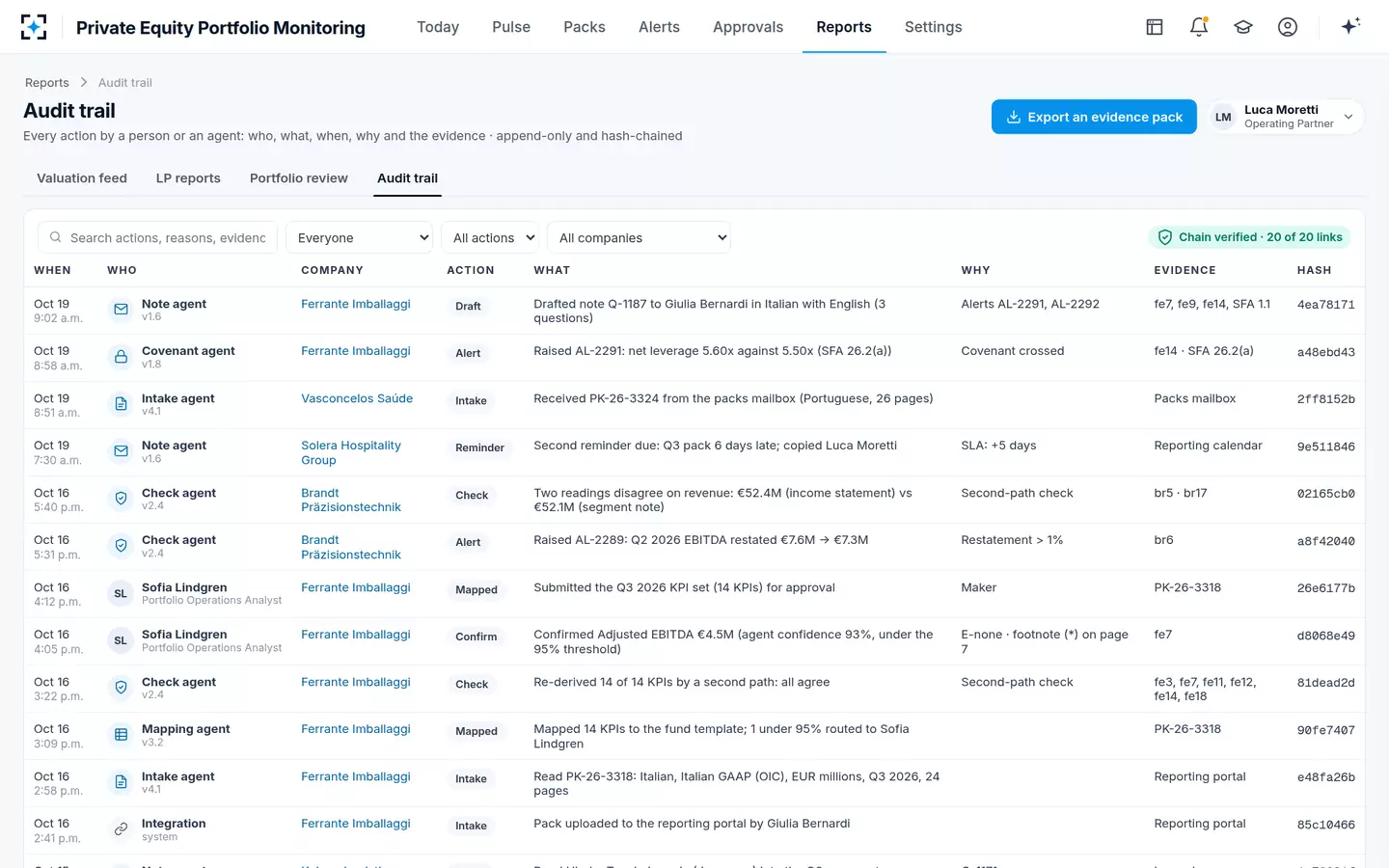
Every action behind a reported figure, kept by Private Equity Portfolio Monitoring for an examination request
What to keep, whatever the reporting rule
Working papers are the part of private equity reporting that no vacatur touched. Rule 204-2 requires an adviser to keep the working papers behind any performance figure it presents, the ones that prove the number, for five years from the end of the fiscal year in which it last disseminated that performance (17 CFR 275.204-2(a)(16), (e)(3)). Company KPIs feed valuations and valuations feed performance, so the chain from a portfolio company's page to a reported return is within reach of that rule.
A private equity reporting checklist for 2026–27
- List every investor reporting promise in each LPA and side letter
Content, deadline and recipient. Since June 2024 these are the US quarterly requirements.
- Diary the dated duties
Audited statements within 120 days; Form PF within 120 days; section 6 events within 60 days of quarter end; EU annual report within six months.
- Track the moving rules
Form PF amendments from July 1, 2027; the April 2026 Form PF proposal; the October 2026 custody proposal; UK CP26/28. Re-check each before relying on it.
- Map portfolio company fees every quarter
Monitoring, director and transaction fees by company and recipient: the input to US offsets and to the EU annual fee disclosure.
- Keep the trail from page to report
For each company figure in an investor report: the page, the reading, the check and the approver.
- For controlled EU companies, build the Article 29 review quarterly
Drivers, events and outlook in the company's words, so the annual report is assembled, not written from memory.
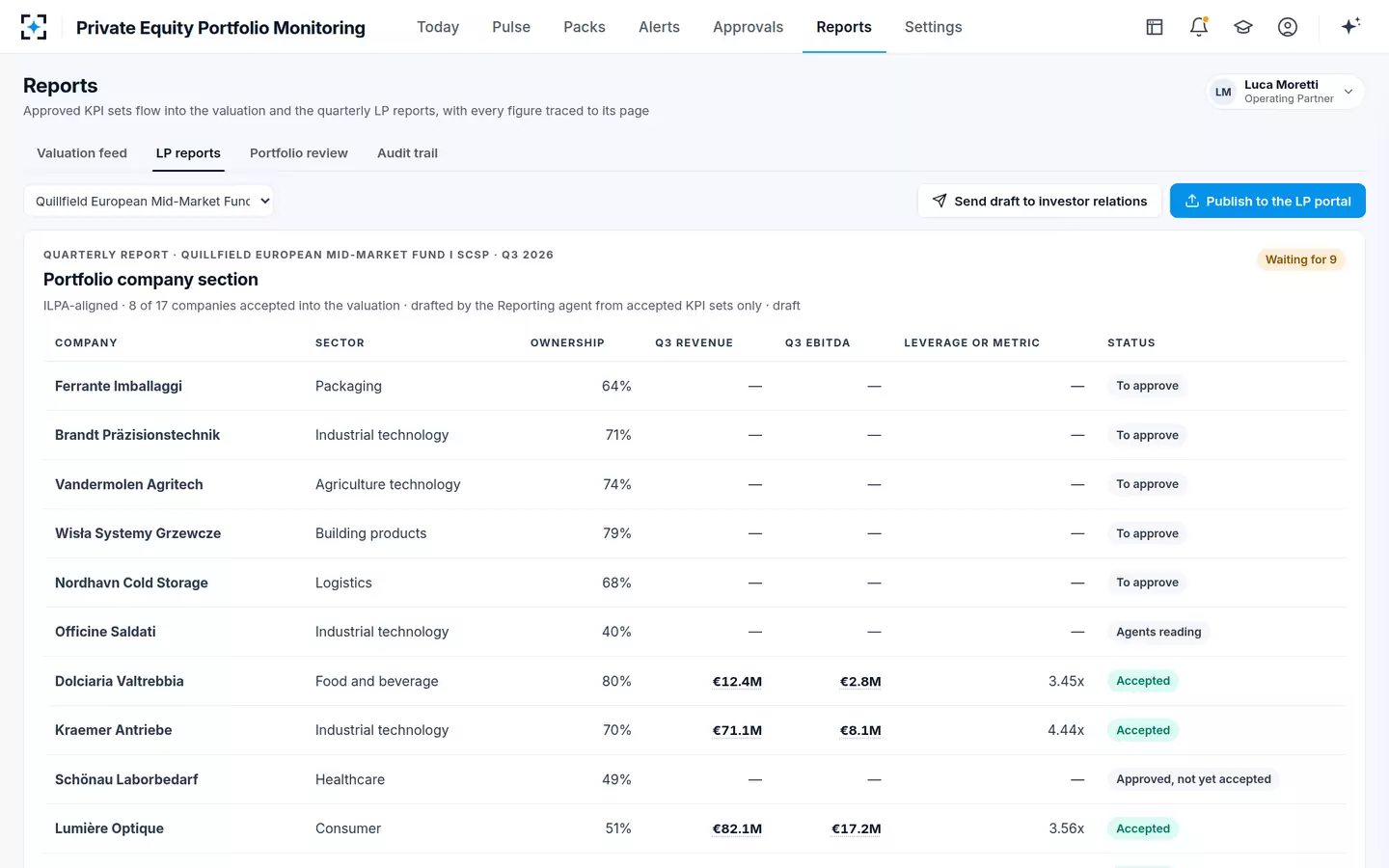
Private Equity Portfolio Monitoring does not file Form PF, calculate fees or publish investor reports. It produces the approved, cited company figures those reports start from, and keeps the trail an examiner or auditor will ask to see. How those figures reach the investor report without being changed on the way is the subject of the guide to LP reporting software.
Private Equity Portfolio Monitoring drafts the company section only from figures accepted into the valuation
Questions people ask
Is the SEC quarterly statement rule coming back?
No. The rule was vacated with the rest of the 2023 package and removed from the Code of Federal Regulations in November 2024, and the SEC's 2026 proposals on Form PF and custody do not revive it. A future rule would need a new rulemaking with notice and comment.
What is the Form PF compliance date?
The amendments adopted on February 8, 2024 have a compliance date of July 1, 2027, after an extension published on September 3, 2026; the previous date was October 1, 2026. Until then, advisers file the existing form. The April 2026 proposal would change the form again if adopted.
Do private equity funds report to the SEC every quarter?
Generally no. Private equity advisers file Form PF annually, within 120 days of fiscal year-end, and file section 6 only for a quarter in which a reportable private equity event occurs. Quarterly Form PF filing applies to large hedge fund advisers and large liquidity fund advisers, not to private equity.
When did AIFMD II start to apply?
Member states had to apply most of Directive (EU) 2024/927 from April 16, 2026, with the changes to reporting to supervisors under Article 24 from April 16, 2027. What applies to a given manager depends on its home state's transposition, so check the national rules as well as the directive.
Does the vacatur mean US advisers can stop sending quarterly reports?
No. Most limited partnership agreements and side letters require quarterly reports, and those contractual duties were never affected by the court's decision. What the vacatur removed was a uniform federal format and deadline; the adviser's promise to its investors, and the anti-fraud duty, remain.
Do UK private equity managers have new reporting rules?
Not yet. The FCA's CP26/28 consultation on a three-tier UK AIFM regime closed on October 22, 2026, and the FCA envisages implementation in 2028. Until then, UK managers report under the existing FUND rules carried over from AIFMD.