An equity cure is a right, written into a leveraged company's facility agreement, that lets its owners put in new equity after a financial covenant fails so that the test is treated as met. Depending on the clause, the cash either counts as extra EBITDA for the test period or is deemed to reduce net debt; the agreement also limits how often the right can be used, how large a cure may be and how soon the cash must arrive. For a private equity sponsor, the cure is one of four answers to a covenant problem, alongside a certified add-back, a waiver and doing nothing, and it is worth most when the decision is framed early. Botminds' Private Equity Portfolio Monitoring tests each portfolio company's covenants on the agreement's own definitions the day its report arrives, and sets out the cure arithmetic for the deal team, which decides.
The worked example is from the solution's sample data: Ferrante Imballaggi, a fictional Bologna packaging company owned 64% by a fund of the fictional sponsor Quillfield Capital, at its third-quarter 2026 covenant test. Lender-side covenant monitoring, the bank's view of the same test, is covered by Botminds' Covenant Monitoring.
Covenant-lite is rarely covenant-free: the revolver's covenant springs early
45%
of deals with covenant-lite term loans and covenanted revolvers had springing covenants on the revolver
17.5%
median revolver use at which those covenants spring; 40% spring at any use at all
70%+
average revolver use among borrowers that draw at all, enough to set most covenants live
What is an equity cure?
An equity cure is the borrower's contractual right to fix a financial covenant breach with new equity from its shareholders, instead of a waiver from its lenders. It exists only if the facility agreement grants it; there is no general law of equity cures, and no regulator sets their terms. A typical clause names the covenants it can cure (usually the financial maintenance covenants, not every default), the form the cash must take, how the cash is counted in the test and the limits on its use.
The equity cure clause is the sponsor's clause. Lenders accept it because new equity sits beneath them and reduces risk; sponsors want it because a waiver costs a fee, a margin step-up or tighter terms, and hands the lender a negotiation. What it does not do is change the business. A cure fixes one test; the trend that produced the breach is still there next quarter.
How does an equity cure work? Two mechanisms, one company
An equity cure works by adding the injected cash to one side of the covenant ratio: either to EBITDA, as if the company had earned it, or to the deduction from debt, as if the company had used it to repay. The two give very different cure sizes for the same breach, because EBITDA is multiplied by the leverage limit and debt is not.
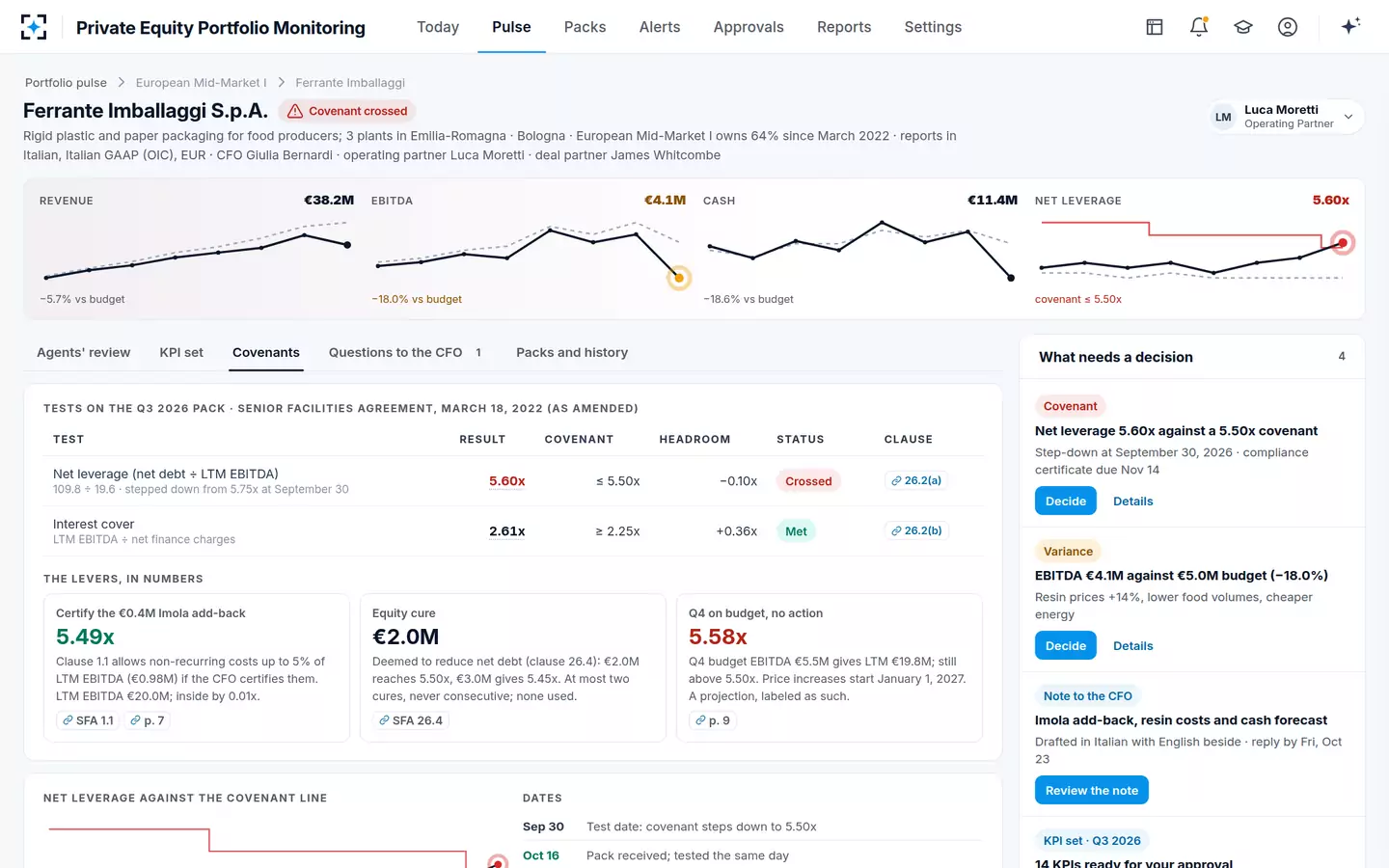
Ferrante's numbers show the gap. At the September 30, 2026 test its net debt was €109.8M and trailing twelve-month EBITDA €19.6M, so net leverage was 5.60x against a covenant that had stepped down that quarter from 5.75x to 5.50x. Its agreement, as set up in the sample, treats a cure as reducing net debt. To reach 5.50x, net debt must fall to 5.50 × €19.6M = €107.8M, a cure of €2.0M; with a buffer to 5.45x, €3.0M.
Had the agreement counted the cure as EBITDA instead, the arithmetic is different. Leverage reaches 5.50x when EBITDA is €109.8M ÷ 5.50 = €19.96M, so about €0.37M of cure would do; to 5.45x, about €0.55M. Per euro injected, an EBITDA cure here is about five and a half times as powerful as a debt cure, which is why the form of the cure is one of the most negotiated words in the clause.
Curing one leverage breach: the cash needed under each kind of clause
| Way to reach the covenant | Calculation | Leverage after | Cash needed |
|---|---|---|---|
| Do nothing | €109.8M ÷ €19.6M | 5.60x, fails 5.50x | — |
| Certified add-back (clause 1.1) | €0.4M one-off added to EBITDA, inside the 5% cap of €0.98M: €109.8M ÷ €20.0M | 5.49x, passes by 0.01x | None, if the CFO certifies |
| Equity cure counted against net debt (clause 26.4) | €109.8M − €2.0M = €107.8M; ÷ €19.6M | 5.50x | €2.0M (€3.0M for 5.45x) |
| Equity cure counted as EBITDA (another agreement's form) | €109.8M ÷ (€19.6M + €0.37M) | 5.50x | about €0.37M (€0.55M for 5.45x) |
| Fourth quarter on budget, no action | EBITDA of €5.5M; net debt €110.5M; ÷ €19.8M | about 5.58x, still fails | — |
Does an equity cure count as EBITDA?
It depends entirely on the clause. Some agreements count the cure amount as EBITDA for the test period, and unless the clause says otherwise it then stays in the trailing twelve months for later tests; others deem it to reduce net debt; some allow either at the borrower's choice. Read the definition of the cure amount and the paragraph that says how it is applied.
Because an EBITDA cure is so much cheaper per point of leverage, it invites guard-rails, and the guard-rails are what to read. Is the cure amount disregarded for every other purpose, such as pricing grids, baskets and incurrence tests? Must the cash actually repay debt, or may it sit on the balance sheet? Is the cure limited to the amount needed to fix the breach, or can the sponsor over-cure to build headroom? None of these has a market standard published by a regulator or an independent study; each is a drafting choice, and the answer sits in the agreement.
Two forms of equity cure, compared on the same breach
Cure counted as EBITDA: About €0.37M: each euro is multiplied by the 5.50x limit.
Cure deemed to reduce net debt: €2.0M: each euro reduces debt one for one.
Cure counted as EBITDA: Stays in trailing EBITDA for up to four tests unless the clause removes it.
Cure deemed to reduce net debt: Counts while the debt reduction stands; real repayment helps permanently.
Cure counted as EBITDA: Headroom that is not earned by the business; over-cures.
Cure deemed to reduce net debt: Cash that is counted but not applied to repayment.
Cure counted as EBITDA: Whether the cure is disregarded for pricing, baskets and other tests.
Cure deemed to reduce net debt: Whether the cash must prepay the loan, and in what order.
How many equity cures are allowed?
As many as the facility agreement permits; the total number and how close together cures may fall are both negotiated, and both are written in the clause. Ferrante's agreement, in the sample, allows at most two cures, never in consecutive quarters, and none has been used. The limit matters more than the amount: a sponsor who cures in the third quarter cannot cure in the fourth, so it must be confident that the fourth will pass on its own.
That is where Ferrante's projection bites. On the company's own fourth-quarter budget, EBITDA of €5.5M and net debt of €110.5M give leverage of about 5.58x, still above 5.50x. Its price increases start only on January 1, 2027. A cure in the third quarter, with no consecutive cure allowed, would leave the fourth quarter to a certified add-back, a better-than-budget quarter or a waiver.
The sponsor's covenant clock, from quarter end to cure
The sponsor's clock starts when the company's figures arrive, not when the compliance certificate is due. The lender learns the result from the certificate; the sponsor can know it the day the company sends its quarterly report, and every day between those two dates is time to choose a path.
Two clocks on one covenant test: the sponsor's starts four weeks earlier
- Company closes its booksdays 0–16
- Testeddays 16–23
- Deal team and committee decide the pathdays 23–45
- Waiting for the certificatedays 0–45
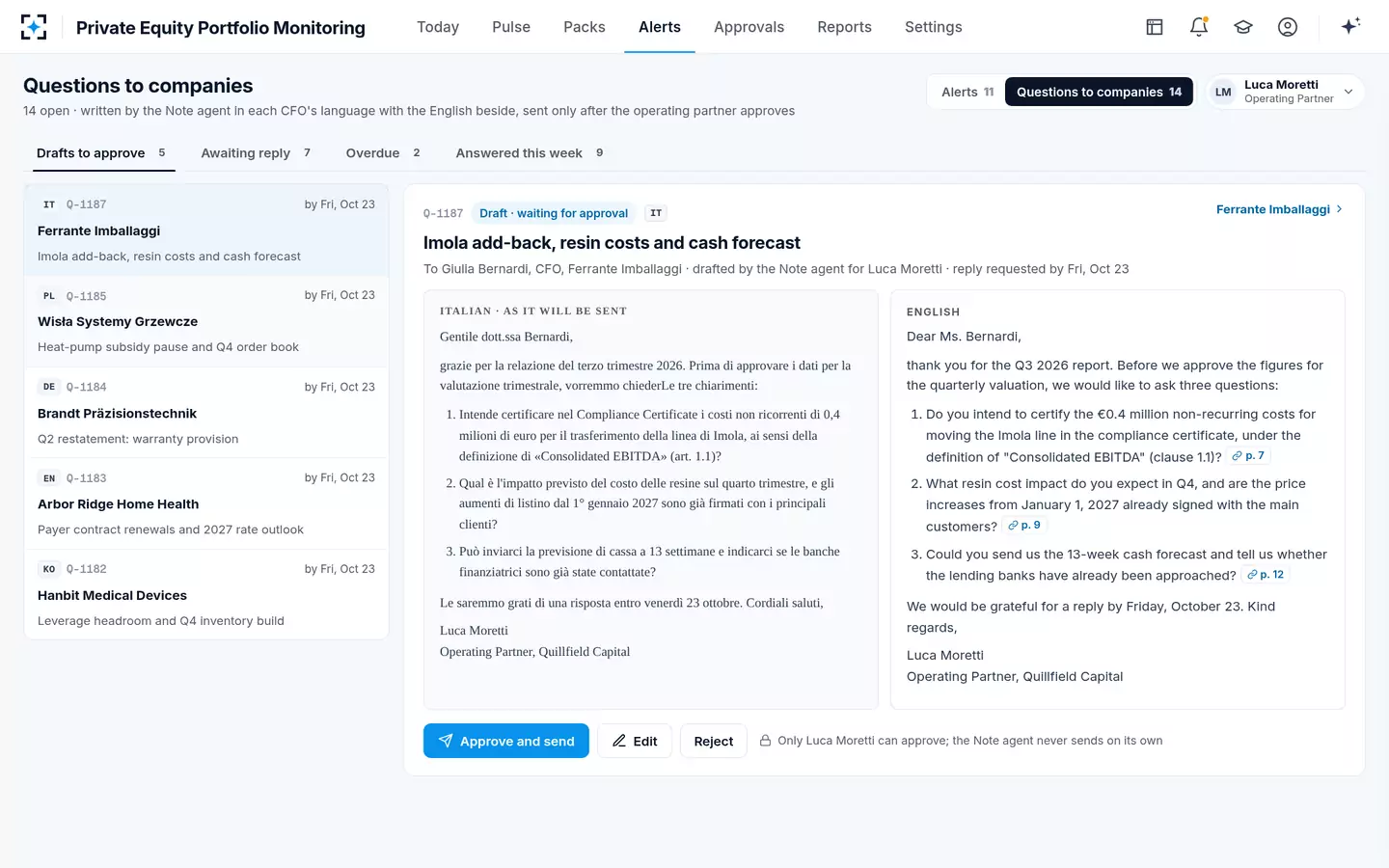
In the sample, the four weeks were used like this. The Covenant agent tested the September 30 figures the day they arrived, and the crossing headed the operating partner's list on Monday morning. On Monday, October 19, the operating partner confirmed the alert and escalated it to the deal partner who owns the lender relationship. The same morning, the Note agent's draft to the company's CFO went out, once the operating partner approved it, in Italian with the English beside, asking three questions: would she certify the €0.4M one-off under clause 1.1, what resin costs would do to the fourth quarter, and for the 13-week cash forecast, including whether the lending banks had already been approached.
The covenant test in Private Equity Portfolio Monitoring, with the levers in numbers and the dates
What happens if a portfolio company breaches a covenant?
Under a typical facility agreement, a breach of a financial maintenance covenant becomes an event of default once it is confirmed and any cure period has passed, which lets the lenders accelerate the loan. In practice they rarely do; they negotiate, and the breach transfers bargaining power to them. Chava and Roberts, studying US borrowers, found that "capital investment declines sharply following a financial covenant violation, when creditors use the threat of accelerating the loan to intervene in management" (Journal of Finance, 2008).
Breaches are also not rare, and not always a sign of distress. Lenders set covenants tight by design, and Dichev and Skinner's study of private loan agreements found technical violations to be relatively common and not necessarily linked to financial distress (Journal of Accounting Research, 2002). For a sponsor, that means a breach is a negotiation to prepare for, not a crisis to react to, and the preparation is worth more the earlier it starts.
The current credit climate makes the preparation more valuable. The Federal Reserve's May 2026 Financial Stability Report noted elevated use of payment-in-kind provisions in private credit, explaining that adding interest to principal instead of paying it keeps cash in the borrower but can be a sign that credit quality is slipping (Federal Reserve, May 2026). A lender that already sees stress across its book will price a waiver accordingly.
What is a springing leverage covenant?
A springing leverage covenant is a maintenance covenant that is tested only when the borrower's use of its revolving credit facility exceeds a set threshold. It is common where the term loan is covenant-lite: the term lenders have no maintenance covenant, but the revolving lenders keep one that springs when the revolver is drawn. In the Philadelphia Fed study by Berlin, Nini and Yu, "45% of the deals with split control rights have springing financial covenants" (Philadelphia Fed Working Paper 19-41).
The thresholds are low. In that sample, "40% have a threshold of zero, meaning that the covenants become standard maintenance covenants if the revolver is used at all", and "the median threshold is 17.5%". Among borrowers that drew on their revolvers, "the mean level of utilization is over 70%", which led the authors to conclude that "springing covenants offer only limited ability for borrowers to evade the scrutiny of financial covenants". Revolver use also rises as firms weaken, so a springing covenant tends to come alive exactly when it matters.
For monitoring, a springing covenant adds a second test: revolver utilisation against the threshold, every test date. A company comfortably covenant-lite at 10% drawn can be in a live leverage test at 20%. The cure question then belongs to the revolving lenders alone; as Berlin, Nini and Yu note, under split control rights "these lenders have the unilateral right to negotiate with the borrower about how to cure the default".
Who decides to cure a covenant breach?
The sponsor's deal team and investment committee decide whether to cure, because a cure is a new investment of fund capital and the fund's documents govern it; the company's board approves the share issue, and the CFO certifies the covenant calculation to the lenders. Monitoring informs the decision; it does not make it.
In Private Equity Portfolio Monitoring that boundary is fixed. The Covenant agent never contacts lenders and never decides a cure, a waiver or a certification; it reads the agreement, runs the test on the agreement's definitions and sets out each lever in numbers. The Note agent never sends a question to a CFO without the operating partner's approval. In the sample, the agent's answer to "How big an equity cure?" ends: "Whether to cure is the deal team's and the investment committee's decision."
The question to the CFO, drafted in her language by Private Equity Portfolio Monitoring, sent only after approval
Cure, add-back, waiver or wait: the decision in numbers
The four paths have different costs and different futures, and the right one depends on the next quarter, not this one. A certified add-back costs nothing but needs the CFO's signature and room under the agreement's cap; at Ferrante it passes by 0.01x, which leaves no margin for a weak fourth quarter. A cure costs fund capital, uses one of two rights, and rules out a cure next quarter. A waiver costs a fee and terms, and puts the lender in the room. Waiting is a choice only if the agreement gives time and the business is about to turn.
What to read in an equity cure clause before the breach, not after
- Which covenants it can cure
Often the financial maintenance covenants only; check whether a springing covenant is included.
- How the cure is counted
As EBITDA, as a reduction of net debt, or either; and for how many later test periods it stays in.
- How often, and how close together
The total number of cures and the ban on consecutive quarters. In the sample: two, never consecutive.
- How much
Whether the cure is capped at the amount needed, and whether an over-cure counts.
- When the cash must arrive
The number of days after the certificate, or after the test date; diary it from the agreement.
- What else the cure is disregarded for
Pricing grids, baskets, incurrence tests and distributions. Expect lenders to object to a cure that also improves pricing.
- Whether the cash must prepay debt
And in what order across tranches, if the lenders have split control rights.
The arithmetic for every path is mechanical once the agreement's definitions are mapped, which is what makes it suited to an agent and what makes the decision not suited to one. The portfolio monitoring team's job is to put all four paths, with numbers, in front of the deal team weeks before the certificate. How the same test is prepared every quarter for every company is in the portfolio monitoring process guide, and how adjusted EBITDA enters the template in the first place is in the reporting template guide.
Questions people ask
What is the equity cure mechanism in simple terms?
The shareholders put new money into the company within a deadline set by the facility agreement, and the agreement lets that money count in the covenant calculation for the failed period, either as earnings or as a reduction of debt. If the recalculated ratio passes, the breach is treated as never having occurred for that test.
Is an equity cure the same as a waiver?
No. A cure is the borrower's own right under the agreement, used without the lenders' consent within its limits. A waiver is the lenders' agreement not to enforce a breach, usually for a fee or tighter terms. A sponsor uses a cure to avoid needing a waiver.
Can a sponsor cure a covenant breach with a shareholder loan?
Only if the clause allows it. The agreement's definition of a permitted cure amount says what counts, such as new common equity, debt subordinated to the lenders, or both; senior lenders want the new money beneath them. That definition settles it.
Does curing a breach affect the fund's valuation of the company?
The cure adds capital to the investment, so the fund's cost basis rises by the amount injected; whether the fair value rises with it is the valuation team's judgment. A breach and its cure are also events the valuation committee will want to see, with the covenant test that prompted them.
What is an equity cure clause?
It is the paragraph of a facility agreement that grants the cure right and sets its conditions: which covenants it can fix, how the cash is counted, how many times it can be used, how much and by when. In the sample company's agreement, it is clause 26.4, which treats new equity as reducing net debt and allows two cures, never in consecutive quarters.