Investor portal software for private equity is a secure website where a fund manager publishes each limited partner's documents, such as capital call and distribution notices, capital account statements, quarterly reports, tax documents, the partnership agreement and side letters, and often a dashboard of the LP's position. It solves distribution: every LP gets the right document, once, with a record that it was posted. What it does not do is answer the question an LP sends after reading one: how much of this distribution was return of capital, why our balance fell, when the K-1 will be corrected. Those questions still arrive by email and through the portal's message box, and someone still has to look up the LP's own records and the governing clause to answer. In the US, with the SEC's quarterly statement rule vacated in 2024, what LPs receive is set by their agreements, so the answer is often the only place a document's meaning is explained to that investor. Botminds' Investor Relations AI is that answering layer: it sits beside the portal, reads the same documents, and drafts cited replies in the LP's language for a person to approve, sending on its own only approved wording.
The examples come from the solution's fictional sample data: Quillfield Capital and its private funds' LPs.
Investor portal software and an answering system do different jobs
Investor portal: Publish each LP's documents securely, once
Answering system: Answer each LP's question about its own documents and account
Investor portal: A document posted to many LPs
Answering system: A question from one LP, often about one line of one document
Investor portal: User accounts and permissions set at onboarding
Answering system: An entitlement check on every question, against the CRM, the register and the signatory list
Investor portal: The document, and perhaps a dashboard
Answering system: A reply in its language, every figure cited to a page of its own documents
Investor portal: Documents posted that no one reads, or reads wrongly
Answering system: A fluent reply with the wrong LP's figure, unless entitlement and recomputation are enforced
Investor portal: Documents approved before posting
Answering system: Wording approved once as a template; everything else approved reply by reply
What is investor portal software for private equity?
A secure document shelf and, increasingly, a self-service window on each LP's position. Private equity investor portals hold the notices, statements, reports, tax documents and fund documents an LP is entitled to, organised by fund and period, with access controlled per user. Many add dashboards of commitments, contributions, distributions and net asset value, drawn from the administrator's data.
Two rules shape it. The portal provider is a service provider under the amended Regulation S-P if it receives, maintains or may access customer information for a covered institution, such as a registered adviser, so the adviser's programme must oversee it, including 72-hour breach notice (17 CFR 248.30). And delivery rules may change: the SEC's July 2026 e-delivery proposal would let covered entities deliver information required under the federal securities laws electronically without asking recipients to opt in first, while letting them opt out to paper; it is a proposal, and its comment period closed on 21 September 2026 (91 FR 45884). Most of what a private fund's portal holds is delivered under the fund's agreement rather than federal law.
Do LPs still email if there is a portal?
Yes. The portal moves the document; the question follows it. No regulator or independent study publishes how many questions a fund receives after posting a statement, so the evidence that counts is your own: count the LP emails and portal messages in the two weeks after each posting, and sort each by the document and line it was about. The pattern to look for is a spike that follows the document calendar.
On the sample Monday, the questions followed the documents
642
investor questions since midnight, by email, the portal and calls, in 11 languages
+38%
on a normal Monday, after Q3 distribution notices and capital account statements went out
31%
of them about distributions and tax dates
418
answered automatically from approved wording; the rest to people
What does a portal show vs what an LP asks?
The portal shows a document; the LP asks what it means for them. Every document type sets off its own predictable questions, and each question is answered from one of the LP's own records plus a clause. That map is the specification for an answering system, and it is also a useful test of any portal: if the portal cannot show the record that answers the question, someone will be emailing.
Each document an LP receives, the questions it sets off, and what answers them
Capital call notice
Questions"Has our wire arrived?" · "Why is this call larger than the last?" · "Which investment is it for?"
Answered fromCash receipt matched to the notice; the call's purpose in the notice
Distribution notice
Questions"How much of this is return of capital?" · "When will it reach our account?"
Answered fromThe notice and the capital account's split; payment record
Capital account statement
Questions"Why did our balance fall?" · "What is our unfunded commitment?" · "Why is our fee different?"
Answered fromThe roll-forward lines; commitment summary; side-letter fee terms
Quarterly report
Questions"When is the next report?" · "What does this valuation change mean for us?"
Answered fromThe agreement's reporting clause; the LP's own capital account
K-1 or tax statement
Questions"When will it arrive?" · "Why was it amended?"
Answered fromThe agreement's tax clause; the amendment notice and the LP's own K-1
LPA and side letter
Questions"What does our side letter give us?" · "Can our consultant see this?"
Answered fromThe clause and its page; authorized-contact list
The questions on the right are the reason a portal and an answering system belong together. Twelve common LP questions and where each answer lives sets out the map in full, including the messages that are not questions at all, such as a request to change bank details, which no system should answer on its own.
Can a portal answer a question?
Not in the sense an LP means. A portal can answer "where is my statement?" by showing it, and a dashboard can answer "what is my unfunded commitment?" if the figure is there and current. It cannot answer "why did our balance fall this quarter?", "does our side letter change the fee?" or "why was our K-1 amended?", because each needs the LP's own records read together with a clause and explained. A chatbot bolted onto a portal can produce fluent text, but without an entitlement check before it reads and a citation and recomputation on every figure, it can just as fluently quote the wrong LP's figure.
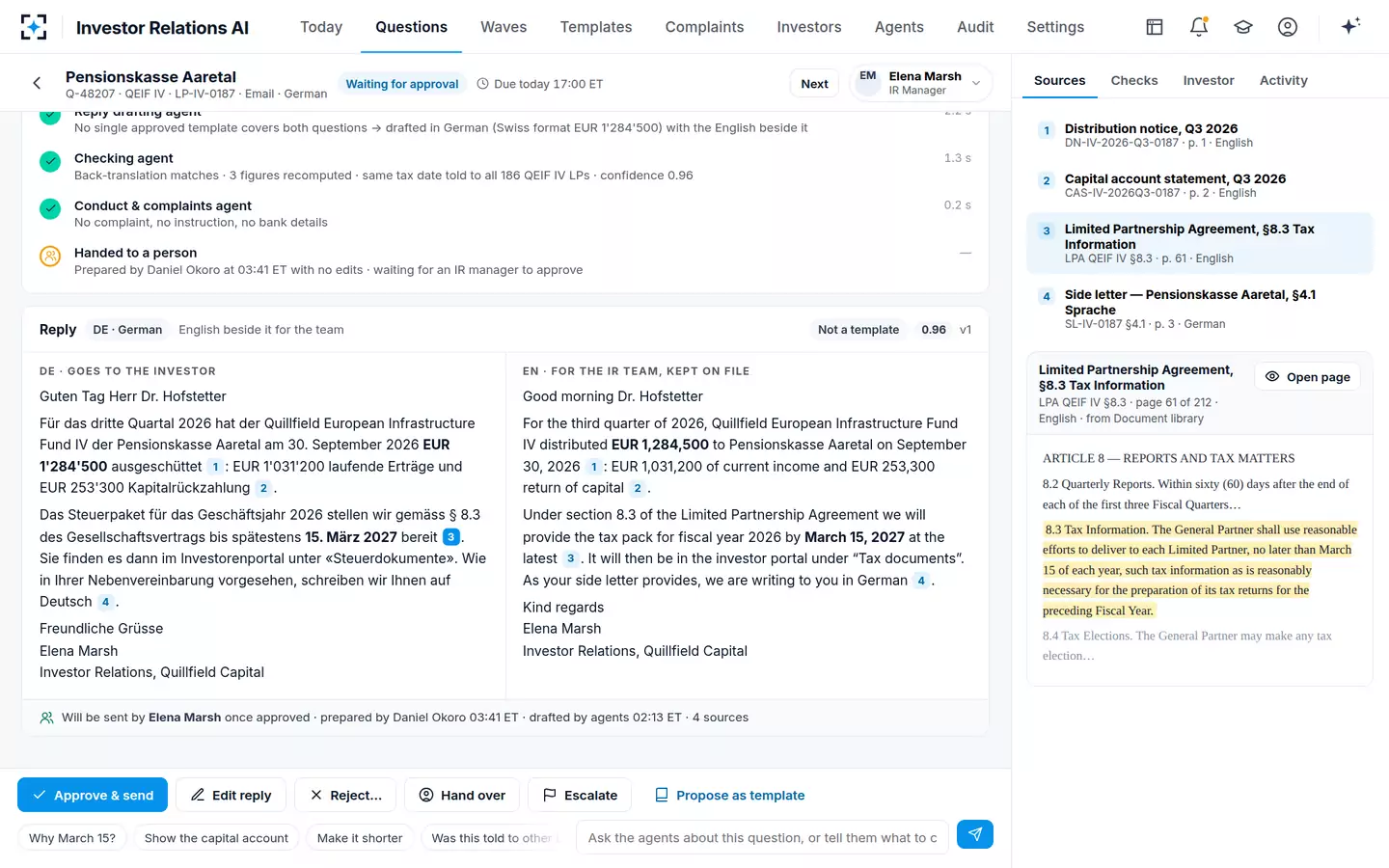
The answer can still arrive through the portal. In the sample, the reply to a Swiss pension fund's question told it that its tax documents would be in the investor portal under "Tax documents" by the date in the agreement, and cited section 8.3 of the agreement for that date. The portal is where the document lives; the reply is what makes it understood.
The reply cites the clause, and points to where the document will be
Do private funds have to send quarterly statements?
Not under an SEC rule. The Fifth Circuit vacated the SEC's 2023 private fund adviser rules, including the quarterly statement rule, on 5 June 2024 (5th Cir. No. 23-60471), so a US private fund's quarterly reporting is whatever its partnership agreement and side letters require. A fund relying on the custody rule's audit route must still deliver audited financial statements to its LPs within 120 days of its fiscal year-end (17 CFR 275.206(4)-2(b)(4)). Private equity reporting requirements after the vacatur sets out what remains, including the EU rules for AIFMs.
That shifts weight onto the answers. With no standard US format, two funds' statements can present the same economics differently, and an LP with twenty managers reconciles them by asking. The sample fund's agreement promises quarterly reports within 60 days of each of the first three quarter-ends and tax information by 15 March; an LP who asks when either will come should get that date, cited, and the same date every other LP got.
Should we buy a portal or an answering system?
Most private equity managers need both, in that order: a portal to distribute documents and an answering layer for the questions they set off. A firm already running a portal does not need to replace it to answer questions; an answering system reads from the portal's documents and the administrator's records and replies by email or through the portal. Which to fund first depends on where the hours go: if the IR team spends its days attaching documents, fix distribution; if it spends them looking up figures and writing replies, fix answering. Botminds' LP reporting software guide makes the same case for the reporting layer: integrate, do not replace.
Questions to ask any portal or answering vendor
- Who may see which account, and how is it decided?
Per user at onboarding, or per question against the CRM, the register and the signatory list?
- Can every figure shown or sent be traced to a document and page?
A dashboard number without a source invites the next question.
- What happens with a message that is not a question?
Complaints, bank-detail changes and forecast requests must go to a named person.
- Does it reply in the LP's language and number format?
And is the translation checked, not just produced?
- Does it check what other LPs were told?
Different dates or figures for the same fund are a contractual and anti-fraud risk.
- Will you notify us within 72 hours of a breach?
Regulation S-P expects the firm's policies to secure this from service providers.
- Is every answer logged with who approved it and what it used?
The log is what an LP, an auditor or an examiner will ask for.
- Does it replace our systems, or read from them?
Administrator, transfer agency system, CRM and document library should stay the systems of record.
What should private equity investor portals include?
Everything an LP is entitled to, organised so that the record answering the common questions is one click from the document that prompts them: notices next to the capital account lines they hit, statements with their valuation dates, the agreement and side letter searchable by clause, tax documents with their amendment history. A portal built that way reduces questions; it does not end them, because the questions are about meaning, not location.
Firms are adding the answering layer cautiously. In the Bank of England and FCA's 2026 survey of UK financial firms, most reported using agents to recommend rather than act, and the share running agents with broad autonomy was 2% (Bank of England and FCA, 2026). An answering system that sends only approved wording, and puts every other reply in front of a person, fits that caution. When hundreds of LPs ask the same thing after a document goes out, the approved answer can go to all of them, each with its own figure.
After a document goes out, one approved answer reaches every LP who asked, with their own figure
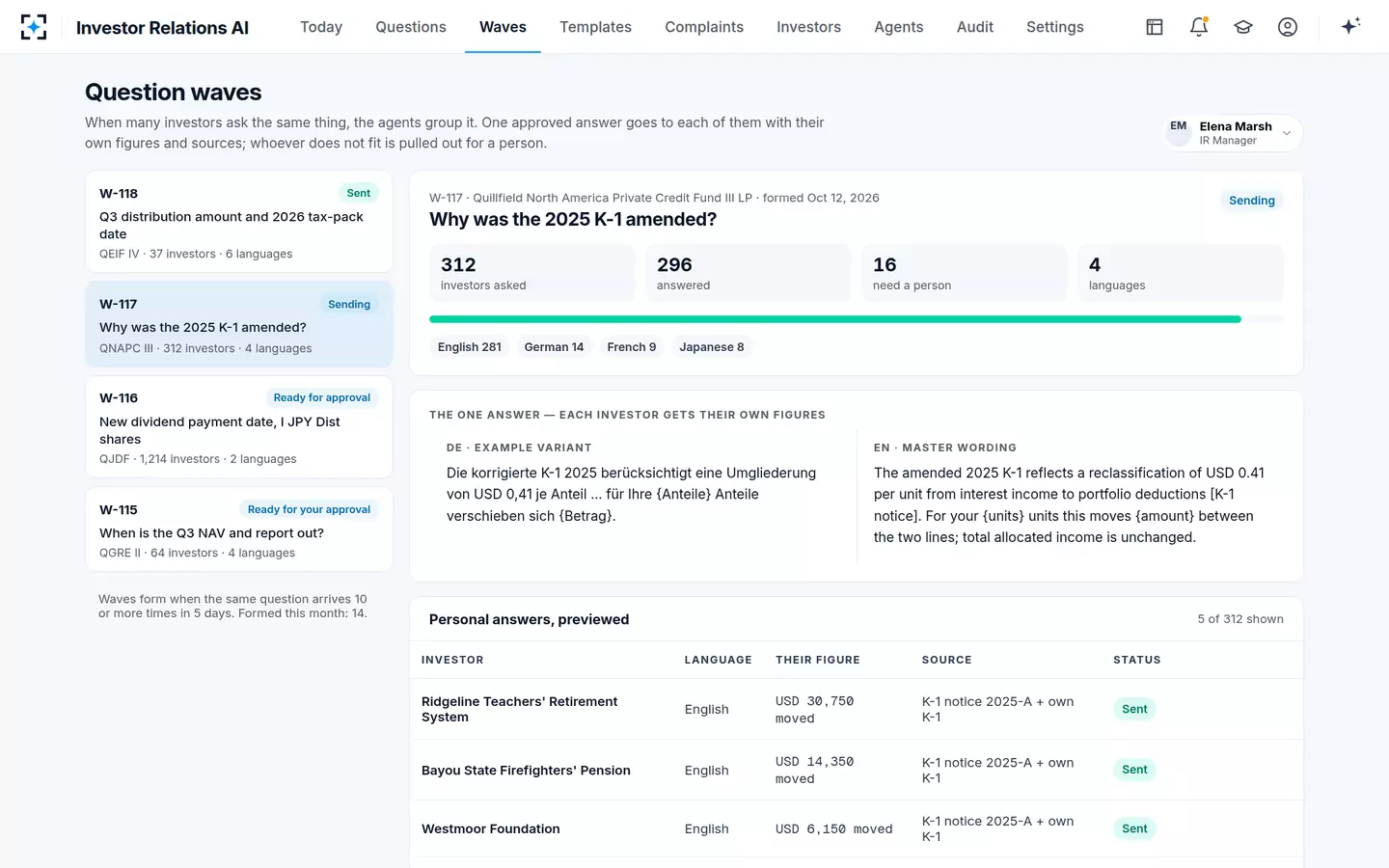
A portal tells an LP that a document exists; an answer tells it what the document means for its money. One capital account figure traced from the notice to the reply shows what that takes. To see LP questions answered beside your portal, start from Investor Relations AI.
Questions people ask
What is an LP portal?
Another name for an investor portal: a secure site where a fund publishes each limited partner's documents and, often, a summary of its position. Access is usually per user, set when the LP and its staff are onboarded.
Can an AI chatbot on our portal answer LP questions safely?
Only with controls a generic chatbot lacks: an entitlement check before any record is read, figures cited to their pages and recomputed, approved wording for anything sent automatically, and complaints and payment instructions routed to people. Without them it can quote one LP's figures to another.
Do private equity firms have to use an investor portal?
No US rule requires one. Funds deliver what their agreements require, by the means the agreements allow; the SEC's 2026 e-delivery proposal addresses delivery of information required under the federal securities laws and is still a proposal.
Who owns the data in an investor portal?
Whatever the hosting arrangement, the fund manager stays responsible for its investors' information; the provider holds it as a service provider. Under the amended Regulation S-P, a covered institution must oversee such providers and make sure they report a breach within 72 hours.
Will an answering system reduce LP emails?
It will not stop them arriving; it changes who does the work. In the sample data, 418 of 642 overnight questions went out from approved wording and the rest were drafted and cited for a person, so the IR team's time went to approval rather than lookups.