A capital account statement is the report a private fund, usually through its administrator, sends each limited partner to show that partner's capital account: the balance at the start of the period, the capital it contributed, the distributions it received, its share of the fund's income, expenses, fees and gains, any carried interest allocated to the general partner, and the balance at the end. Most statements also show the commitment and how much of it is still unfunded. It is the document behind most of the questions an LP sends its fund, and every figure on it has a source upstream: a capital call or distribution notice, a cash receipt, a valuation, a fee calculation. The hard part comes when an LP asks about a figure, because the person answering has to find that same number, at the same date, in the same LP's statement, and say where it came from. Botminds' Investor Relations AI answers those questions from the LP's own statement and notices, every figure cited to its page and recomputed before a person approves the reply.
The figure followed on this page comes from the solution's fictional sample data: a Swiss pension fund, Pensionskasse Aaretal, with a EUR 40,000,000 commitment to Quillfield European Infrastructure Fund IV. The roll-forward below is illustrative arithmetic, labelled as such.
The life of one figure: EUR 1,284,500, from the notice to the LP's answer
- Notice 23 Sep7 days
- Paid 30 Sep; booked to the capital account15 days
- Statement 15 Oct4 days
- Answeredhours
What is a capital account statement?
It is the partner-level view of a partnership's books. A fund's financial statements show the fund; the capital account statement shows one partner's slice of it, built from the same accounting. In the US no regulation sets its format or frequency for private funds since the Fifth Circuit vacated the SEC's 2023 private fund adviser rules, including the quarterly statement rule, in June 2024 (5th Cir. No. 23-60471); what an LP receives, and when, is whatever the partnership agreement and side letters require. Private equity reporting requirements after the vacatur sets out what remains, including the annual audited financial statements a fund relying on the custody rule's audit route must deliver within 120 days of its fiscal year-end (17 CFR 275.206(4)-2(b)(4)).
Two kinds of capital account sit side by side and are easy to confuse. The statement LPs receive each quarter is usually on the fund's financial-reporting basis, with investments at fair value. The capital account on Schedule K-1 is on a tax basis, with its own rules; partnership tax basis capital account reporting explains that one. When an LP's tax adviser and its investment team quote different balances, they are often reading different capital accounts, and a reply has to say which one it means.
What does a capital account statement show?
A roll-forward: the beginning balance, every movement in the period, and the ending balance, so that each line can be checked against its source. The example below is illustrative arithmetic, not sample data, laid out the way most statements present a quarter.
A capital account roll-forward, line by line: every movement has a source document
Beginning capital account, 1 July
30,000,000
+ Contributions paid in the quarter
2,000,000
− Distributions paid in the quarter
(1,500,000)
+ Net investment income allocated
450,000
− Management fee allocated
(200,000)
+ Net unrealised gain allocated
900,000
− Change in carried interest accrual
(130,000)
Ending capital account, 30 September
31,520,000
Contributions come from capital call notices and the administrator's cash receipts. Distributions come from distribution notices and payment records, split into income, gains and return of capital. Income, fees and expenses come from the fund's accounts, allocated by the agreement's terms and any side-letter fee terms. Unrealised gains come from the quarter's valuations. Carried interest is a hypothetical accrual: what the general partner would receive if the fund were liquidated at reported values.
Statements usually add a commitment summary: total commitment, contributions to date, unfunded commitment, distributions since inception, and often the multiples an LP watches. In the sample, Pensionskasse Aaretal's third-quarter statement shows EUR 27,600,000 contributed, 69% of its commitment, so EUR 12,400,000 remains unfunded; distributions since inception of EUR 4,912,300; and a net asset value of EUR 31,846,900 at 30 June 2026.
One LP's quarter in two splits: the commitment, and the distribution
Commitment EUR 40.0m
- Contributed EUR 27.6m · 69%
- Unfunded EUR 12.4m · 31%
Q3 distribution EUR 1,284,500
- Current income EUR 1,031,200 · 80%
- Return of capital EUR 253,300 · 20%
Where do the figures on a capital account statement come from?
From the fund administrator's books, which take each figure from an earlier document. A contribution on the statement should match a capital call notice and a cash receipt; a distribution should match a distribution notice and a payment; income and fees follow the fund's accounts and the agreement's allocation terms; the closing value depends on the quarter's valuations. The statement is the last document in that chain, not the first, which is why the best citation for an LP's question is often the notice behind the statement as well as the statement itself.
In the sample, the answer to "how much was our third-quarter distribution?" cited both: the distribution notice, page 1, showing EUR 1,284,500.00 paid on 30 September 2026, and the third-quarter capital account statement, page 2, splitting it into EUR 1,031,200 of current income and EUR 253,300 of return of capital. Two documents, one number, the same at both ends. If they had differed, that difference would have been the answer. When an LP sells, the same lines are split between seller and buyer at an effective date, as the LP transfer process shows.
Why can two statements for the same quarter differ?
Because a statement is a snapshot of an estimate. The commonest reasons an LP sees two numbers for the same quarter are worth knowing before the question arrives:
- Valuation date. Many funds value a quarter in arrears, so a third-quarter statement may carry a June net asset value, as the sample statement does. A balance quoted without its valuation date is not wrong, but it invites the wrong comparison.
- Estimate and final. A flash or estimated statement precedes the final one; a late valuation or a fee true-up moves the number.
- Restatement. An error found after the statement went out is corrected in the next one, or by a reissued statement.
- Basis. Book basis and tax basis capital accounts differ by design.
- Partner-specific terms. A side letter with a different fee rate, or an LP that joined at a later close and paid an equalisation amount, will not match a fund-level average.
Each reason has a source that settles it: the valuation date on the statement, the reissue notice, the side letter, the close at which the LP entered. A reply that names the reason and cites the source ends the thread; a reply that repeats the number starts another.
How do you prove a figure in a reply?
Cite the page it came from and recompute it in front of the reader. Every figure in a reply from the solution carries a numbered citation that opens its source at the page, in its original language, and the same number appears in every language version of the reply. Behind the citation, the Checking agent recomputes each figure from its parts: in the sample, 1,031,200 + 253,300 = 1,284,500, payment date 30 September 2026, tax date 15 March 2027.
Asked in plain words: show the capital account behind the reply
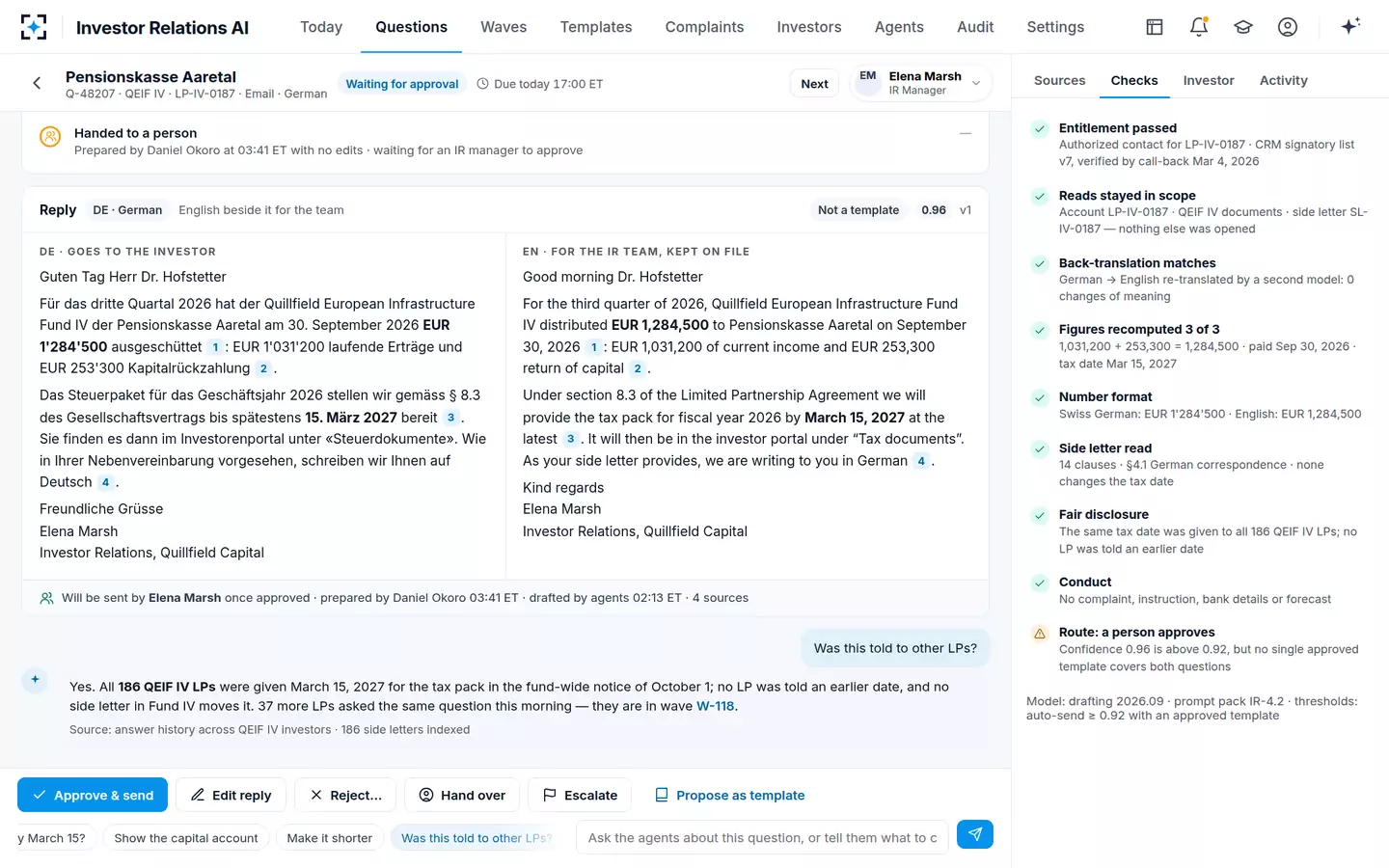
A cited figure also protects the firm. For an investment adviser to a pooled vehicle, the SEC's anti-fraud rule makes it fraudulent to make an untrue statement of a material fact, or to leave out one needed to keep a statement from misleading, to any investor in the fund (17 CFR 275.206(4)-8). A wrong balance quoted to one LP is a small error until it is the basis of that LP's decision; a citation turns "the IR team said" into "the statement on page 2 says", which is the claim the firm actually stands behind.
Who checks a figure before it is sent?
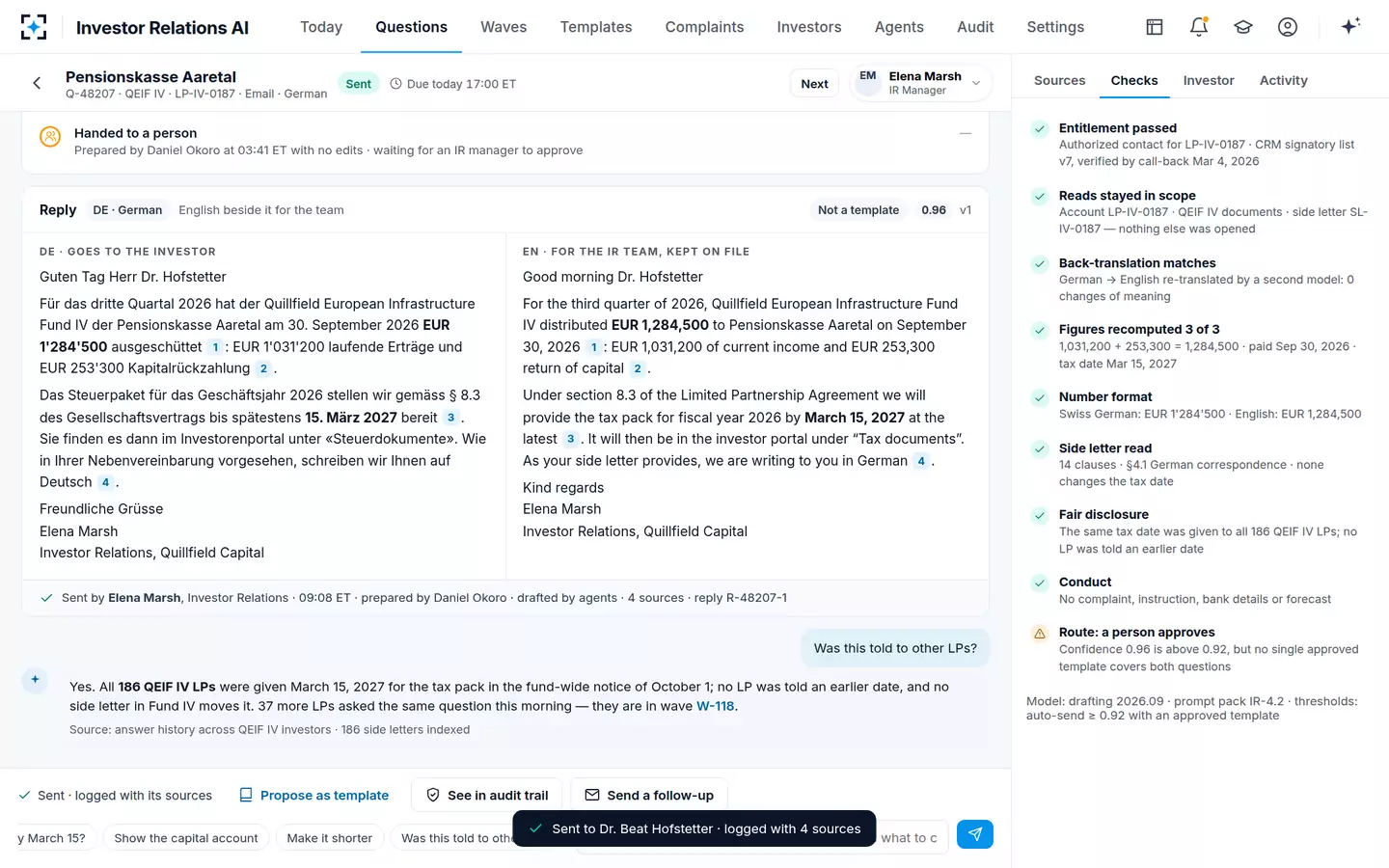
A second person, after an agent has checked it against its source. In the solution the Checking agent recomputes, back-translates and compares what other LPs were told, but it cannot approve; it only routes. The reply is prepared by one person and approved by another, and the sent-by line names both. In the sample, an investor services associate in London prepared the reply overnight without edits, and the Head of Investor Relations approved it with a checker note: "Figures match the notice and LPA §8.3; side letter respected."
Sent with the approver's name and its sources, logged
Before a capital account figure goes into a reply
- Is it this LP's statement, for the period asked about?
Account number, fund, quarter and version: estimate, final or reissued.
- Is the valuation date stated?
Especially when the statement period and the valuation date differ.
- Does the figure match the document behind the statement?
Notice, cash receipt or payment record, at the same amount and date.
- Do the parts add up?
Income plus return of capital equals the distribution; contributions plus unfunded equals the commitment.
- Book basis or tax basis?
Say which capital account the answer is about.
- Does a side letter change it?
Fee terms, reporting terms and language can all differ for one LP.
- Was another LP told something different?
Same fund, same quarter, same basis.
- Is it right in the LP's number format?
EUR 1'284'500 in Swiss German is EUR 1,284,500 in English.
How to read a private equity capital account statement
Read it in the order the money moved. Start with the commitment summary: how much was promised, how much has been called, how much is left, because that tells you what the fund can still ask for. Then the cash: contributions and distributions in the period, each of which should match a notice you received. Then the allocations: income, fees, expenses and gains, which you cannot check against a notice and should check against the agreement and your side letter. Last, the ending balance and its valuation date.
The questions LPs send follow the same order. "Has our wire arrived?" is about the cash line; "how much of our distribution was return of capital?" is about the split; "why is our fee higher than the fund average?" is about the allocation and the side letter. Twelve common LP questions and where each answer lives maps them all. When the same question arrives from many LPs at once, as it does after every statement, the solution groups it into a wave: one approved answer, each LP's own figures, each cited to its own documents. To see a figure traced from the notice to the reply, start from Investor Relations AI.
Questions people ask
What is the difference between a capital account statement and a K-1?
The capital account statement reports the LP's share of the fund on the fund's financial-reporting basis, usually quarterly. Schedule K-1 reports the LP's share of the partnership's income, deductions and credits for US tax, once a year, with a tax-basis capital account. The two balances differ by design.
How often are capital account statements sent?
As often as the partnership agreement says, most often quarterly. No SEC rule has set the frequency for private funds since the quarterly statement rule was vacated in June 2024; in the sample fund, the agreement requires quarterly reports within 60 days after each of the first three fiscal quarters.
Why is my distribution split into income and return of capital?
Because the two are treated differently: a return of capital gives back money the LP paid in, while income or gains are what the investment earned, and the agreement's distribution terms and the LP's tax treatment may depend on the difference. In the sample, a EUR 1,284,500 distribution was EUR 1,031,200 of income and EUR 253,300 of return of capital.
What does unfunded commitment mean?
The part of an LP's commitment the fund has not yet called. It is the commitment less contributions to date, adjusted for any distributions the agreement allows the fund to recall. In the sample, EUR 40,000,000 committed less EUR 27,600,000 contributed leaves EUR 12,400,000 unfunded.
Who prepares the capital account statement?
Usually the fund administrator, from the fund's books, reviewed by the manager's finance team. The IR team rarely prepares it but answers most of the questions about it, which is why it needs the same figures, at the same date, that the administrator used.