The LP transfer process is the chain of documents and decisions that moves a limited partner's interest in a private fund to a buyer: the request and transfer agreement, the buyer's questionnaire, KYC and tax forms, the fund's tests against its LPA and its limits, the capital account split, GP consent and admission, and the register update. It takes weeks when it is run by email, not because any one step is long but because each step waits on a document from someone else. The seller's counsel waits for the GP's comments, onboarding waits for the buyer's owner list, accounting waits for the quarter's statement, and the CFO waits for all of them. Botminds' LP Interest Transfer Processing takes each transfer from request to GP consent: agents read, test and draft between the hand-offs, and people approve, consent and post.
The transfer followed below is from the solution's sample data, with fictional people and firms: the Ellery Foundation selling $20 million of its $30 million commitment in Quillfield Buyout Fund III to Marlowe Secondaries Fund II, requested on October 13, 2026.
One LP interest transfer in LP Interest Transfer Processing, hand-off by hand-off
A person decides
Seller's counselSends the request: transfer agreement, transferee questionnaire, joinder and papers; in the sample, 5 documents and 112 pages on October 13
Agent
Intake agentMatches the seller to the register, opens the transfer, drafts a request for anything missing
Never: Opens a transfer it cannot match, or writes to a party without approval
A person decides
Fund administration managerApproves the request for the buyer's owner list; the package is complete on October 15
Agent
Transfer-terms, Limits and Buyer onboarding agentsRead the agreement against the LPA, replay the fund's limits across the queue, map and screen the buyer's owners, check the tax forms
Never: Approve or waive a term, waive a limit, clear a sanctions hit
A person decides
Investor onboarding specialistClears the buyer's KYC on October 16
Agent
Capital account and Checker agentsSplit the account as of the effective date from the finalised statement; a second agent re-derives every figure
Never: Post to the books
A person decides
GP counselApproves Amendment No. 1 with a reason code; both parties e-sign it
A person decides
Fund CFOGrants GP consent on one page with every check in front of her, on October 19
Agent
Consent drafterSends the signed letters, issues the administrator's instruction, drafts the register update
Never: Sends anything before counsel approves and the CFO consents
A person decides
Senior fund accountantChecks the before and after rows against the split and the letter, and posts
What is the LP transfer process?
It is the fund's side of a secondary sale: everything between "we have agreed a price" and "the buyer is on the register". The seller and buyer negotiate the price between themselves; the fund's work is to decide whether the transfer may happen, on what terms and as of what date, and then to make the books say so. In a Delaware fund that work is required because the buyer becomes a partner only as the LPA provides, which in practice means with the GP's consent (6 Del. C. §17-704(a)).
The process has three phases. Intake collects a complete package. Review tests it: the transfer agreement against the LPA, the fund's limits, the buyer, the tax forms. Close-out decides and records it: counsel's approval, consent and admission, the capital account split, the administrator's instruction and the register. The first and third phases are mostly waiting; the second is mostly reading.
How do you transfer a partnership interest? The documents, in the order they are needed
A transfer of a partnership interest needs a document from each party, and the fund cannot test anything until the buyer's are in. The table below lists them in the order the fund needs them, with who prepares each.
The documents in an LP transfer: who prepares each, and who is waiting for it
| Document | Prepared by | Needed for |
|---|---|---|
| Transfer request and transfer agreement | Seller and buyer, usually through counsel | Opening the transfer; reading it against the LPA |
| Transferee questionnaire | Buyer | Investor status, ERISA status, the partner and owner counts |
| Joinder to the LPA | Buyer | Admission: the buyer agrees to be bound |
| Owner list, entity papers, IDs | Buyer | KYC and sanctions screening of owners and control persons |
| W-9 or W-8 forms; any 1446(f) certification | Seller, buyer, sometimes the fund | Withholding on the sale and on the buyer's future income |
| Capital account statement as of the effective date | Fund administrator | The split of commitment, contributions, distributions and capital |
| Amendment to the agreement, if needed | Fund counsel drafts; both parties sign | Curing a conflict with the LPA |
| GP consent and admission letter | The general partner | The transfer itself |
| Administrator instruction and register update | Fund operations; a second person checks | Moving the books, the portal and the notices |
Two documents pace everything. The transferee questionnaire, because without it the fund cannot count the buyer against its limits; and the administrator's statement as of the effective date, because without it there is nothing to split. In the sample, the Intake agent saw on day one that Marlowe's owner list was missing and drafted the request, which the fund administration manager approved; the package was complete two days later. The Q3 statement was finalised on October 16, and the split ran on it the following Monday.
Who prepares the transfer documents?
The parties prepare the deal documents and the fund prepares the fund's. Seller's and buyer's counsel draft the transfer agreement. The buyer completes the questionnaire and joinder and supplies its KYC papers and tax form. The fund's counsel reviews the agreement and drafts any amendment the LPA requires; the general partner issues the consent; fund operations writes the administrator's instruction and the register update; the administrator supplies the statement and books the entries.
The split between preparing and checking matters as much as who drafts. The SEC's examiners, reviewing transfer agents that also acted as paying agents, found that some let one person move issuer money with nobody else confirming it, and that some agents' written policies were silent on periodic redemption requests from limited partnerships (SEC OCIE Risk Alert, February 13, 2019). A fund's own transfer process is not a transfer agent's, but the lesson carries: the person who prepares a register change should not be the person who posts it.
Who waits on whom: the dependency chain
The critical path of an LP transfer runs through the slowest outside dependency, not through the fund's busiest person. Reading the agreement against the LPA can start the day the request arrives. Testing the limits needs the buyer's questionnaire. KYC needs the owner list. The split needs the statement. Counsel's approval needs the review and any amendment; consent needs counsel; the register needs consent and a checker.
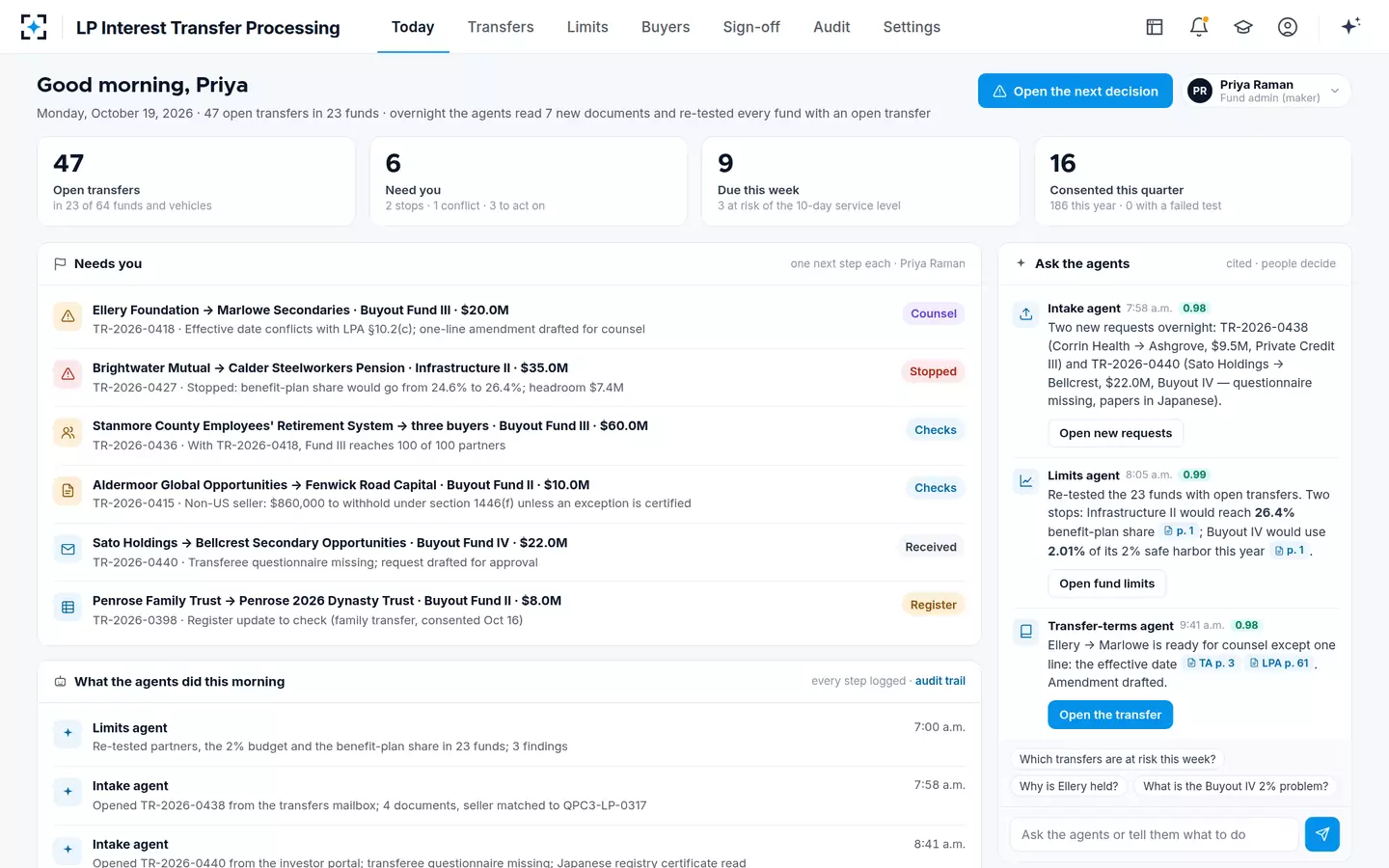
That shape has two consequences. Time saved inside the fund only shortens the transfer if it is time on the critical path; a faster LPA review does nothing while the owner list is missing. And the most valuable thing a transfer desk can do on day one is find every missing document at once and ask for all of them, because each one discovered late restarts a wait. In the sample, the morning screen lists one transfer with the transferee questionnaire missing and a request already drafted for approval.
The morning queue: what needs a person today, and what the agents did overnight
What does the administrator need?
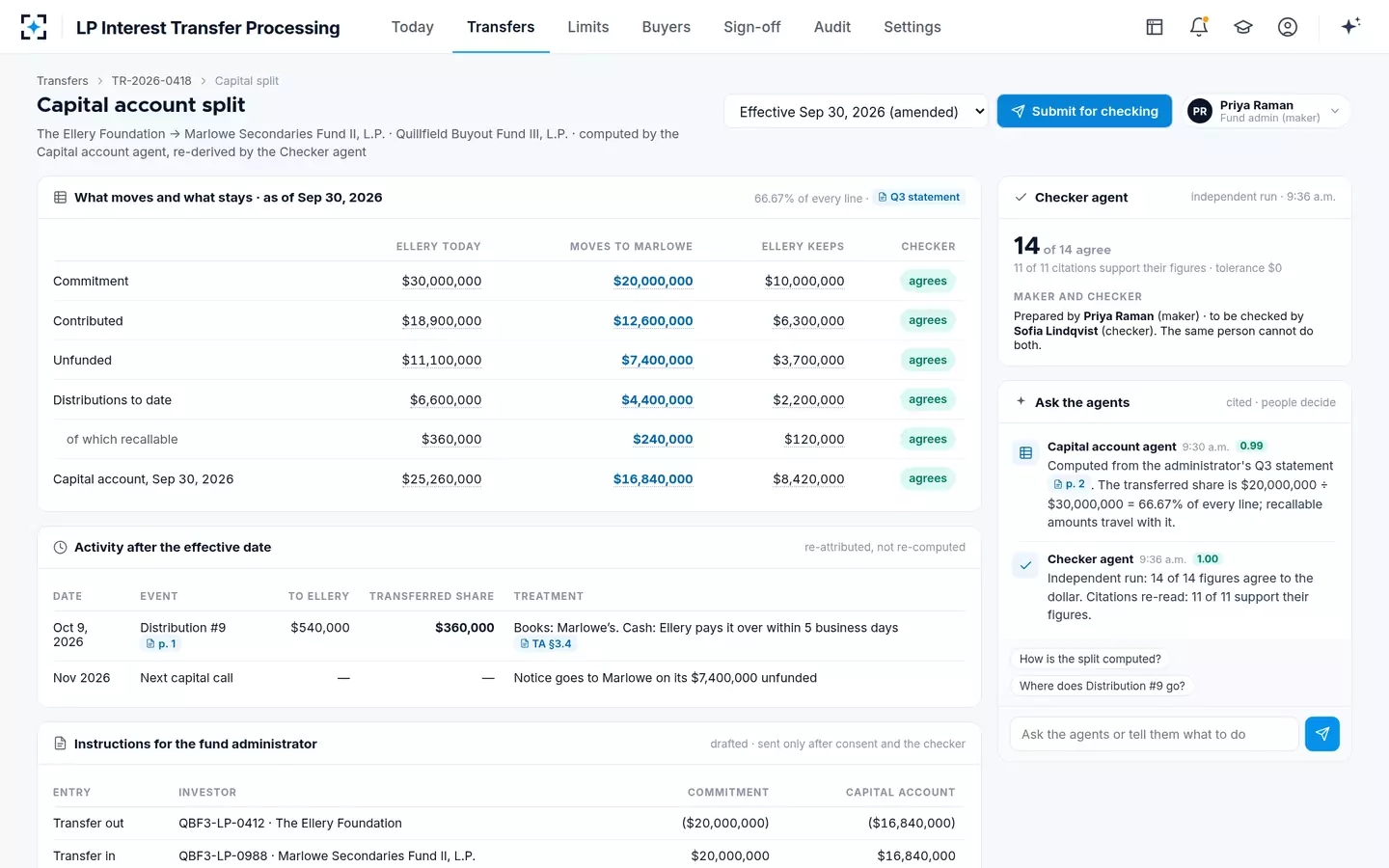
The administrator needs four things from the fund: the effective date, the share of the seller's interest that moves, the finalised capital account statement as of that date, and the treatment of anything that happened after it. The effective date comes from the LPA, often a quarter end; the sample LPA allows a transfer only "as of the last day of a Fiscal Quarter". A date between quarter ends would force an estimated balance and a later true-up on two accounts, which is why the sample agents recommended amending the agreement rather than waiving the clause.
Activity after the effective date is the part that goes wrong. In the sample, Distribution #9 was paid to the seller on October 9, after the September 30 effective date; $360,000 of it belonged to the transferred share. The Capital account agent re-attributed it to the buyer in the books and noted that the cash would be settled between the parties under the transfer agreement. Every line of the split moved at 66.67%, and the Checker agent re-derived all 14 figures to the dollar.
The capital account split as of the effective date, with activity after it re-attributed
The administrator also has the tax side to carry through to year end. When an interest changes hands mid-year, the fund's income for the year has to be divided between seller and buyer under section 706, by an interim closing of the books or by proration; interim closing method vs proration method works one transfer both ways.
Which IRS forms does a transfer of partnership interest need?
No single IRS form records the transfer of a partnership interest. Three sets of rules can each require something, and each has its own clock.
If the seller is foreign, the buyer may have to withhold 10% of the amount realized under section 1446(f), file Form 8288 within 20 days and certify to the fund within 10 days what it withheld (26 CFR 1.1446(f)-2). If the fund has a section 754 election in effect, the buyer has 30 days from the sale to tell the fund in writing, so the fund can compute its basis adjustment (26 CFR 1.743-1(k); the full tax sequence is in 1446(f) withholding, step by step). And if the sale involves the fund's section 751 assets, the seller must notify the fund within 30 days, or by January 15 of the next year if that is earlier, and the fund files Form 8308 with its return (26 CFR 1.6050K-1). At year end both partners receive K-1s for their parts of the year. The 1446(f) calculation, step by step, has the full clock.
How long does an LP transfer take?
No regulator or independent study publishes how long LP transfers take, and no federal turnaround rule applies to most of them. The SEC's transfer agent rules have exempted interests in limited partnerships from their turnaround and processing standards since 1977, for what the SEC's 2026 proposal calls "the low volume of transfers" (SEC, Transfer Agent Rules, 91 FR 56946). That proposal would end the exemption; it is a proposal, with comments due by November 3, 2026, and it reaches only registered transfer agents, which the release describes as required for securities registered under section 12 of the Exchange Act.
What a fund can measure is its own process, and it should measure two clocks: request to complete package, which is mostly the parties' time, and complete package to consent, which is the fund's. In the sample, consent came four business days after the request and two after the package was complete, against a service level of 10 business days from a complete package. A quarter-end cut-off five business days before the quarter end decides which requests can still make that quarter.
Where one transfer's hands-on days go, by hand and with the solution
- Logging and chasing documents3
- Agreement against LPA and side letters3
- Re-testing limits1
- Buyer KYC and tax forms4
- Capital split and check2
- Letters, signatures, register4
- Chasing, agreement review and limits1.1
- KYC, tax forms, split and check2
- Letters and register1
The estimate's last row is the one that does not shrink to zero, and should not. Letters, signatures and the register are where people decide, and the solution leaves every one of those decisions with them.
Who updates the register, and who checks it?
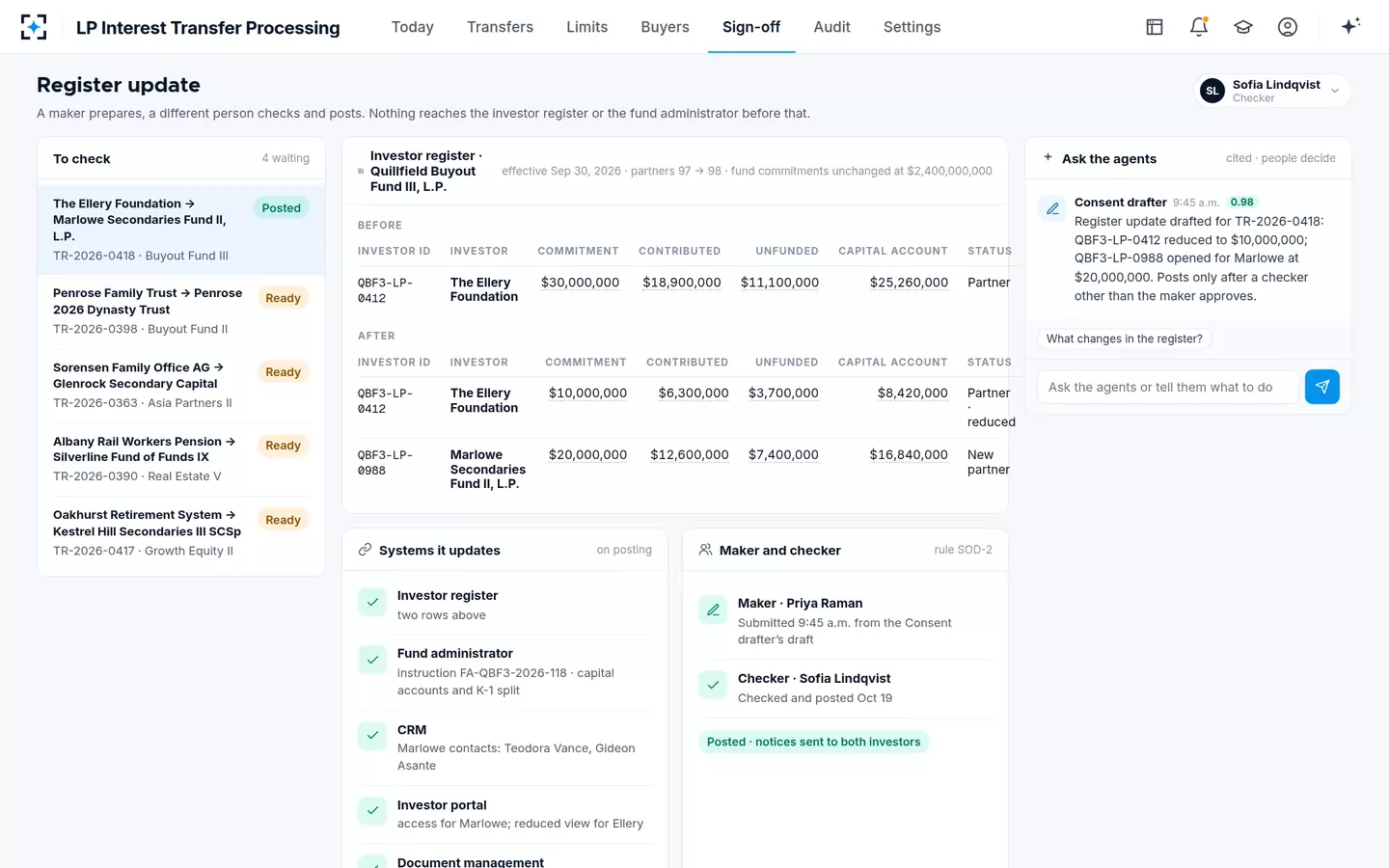
Fund operations prepares the register update and a different person checks and posts it. In the sample, the fund administration manager prepared it from the Consent drafter's draft, and the senior fund accountant compared the before and after rows with the split and the consent letter before posting. The seller's account dropped to a $10 million commitment, the buyer opened with $20 million, and posting sent the administrator its instruction, opened the buyer's portal access and sent notices to both investors.
The register update: rows before and after, and the maker and checker as different people
The people in one LP transfer, before and after the agents
Five people at the fund carry each transfer, and the solution changes what fills their week, not what they decide. The before lines below are the sample personas' own descriptions of their work by hand.
Five people, one LP transfer: what their week held, and what it holds now
Today
Tracks dozens of transfers in a spreadsheet and an inbox, chasing documents and asking counsel, onboarding and accounting where each one stands.
With agents
Starts the day with the transfers that need her, asks the agents in plain words and approves every message before it reaches an investor.
Still theirs: Every message to a party; preparing the split and the register update
Today
Reads each 20- to 40-page transfer agreement against the LPA's transfer article and the side letters by hand.
With agents
Sees the clause, the conflict and the drafted fix in one place, then approves, edits or rejects with a reason code.
Still theirs: Approval of every document and amendment
Today
Collects entity papers, owner lists and tax forms by email, often in another language, before a buyer can be admitted.
With agents
Gets owners and control persons already mapped and screened, foreign papers beside the English, and clears KYC himself.
Still theirs: KYC clearance; any sanctions hit goes to the AML officer
Today
Answers for every consent, and for any transfer that might break a plan limit or a safe harbor, from numbers gathered by others.
With agents
Grants consent on one page with all six checkpoints, the split and the letters, and decides any limit question with the options in front of her.
Still theirs: GP consent, and every decision on a limit
Today
Re-adds every capital split and register change before it posts, and makes sure she never checks her own work.
With agents
Reviews a split a second agent has already agreed to the dollar, then checks and posts the register update.
Still theirs: Checking and posting; never her own work
The seller's side of the same chain looks different, and a seller who supplies everything up front shortens it; what the GP's desk needs from a seller lists it. The GP's decision at the end is covered in GP consent to an LP transfer: the six checks. To see a whole queue of transfers, start from LP Interest Transfer Processing.
Questions people ask
What is a transferee questionnaire?
It is the buyer's form for the fund: who it is, its investor status, whether it is a benefit plan investor, its tax status and the information the fund needs to count it against its limits. The sample LPA makes receipt of the questionnaire and the buyer's tax forms a condition of any transfer.
What IRS form is used for a transfer of partnership interest?
There is no single form. A foreign seller's sale may need Forms 8288 and 8288-A from the buyer; a sale involving section 751 assets needs the seller's notice and the fund's Form 8308; a fund with a section 754 election needs the buyer's written notice within 30 days. Both partners get K-1s for their parts of the year.
When is a transfer of an LP interest effective?
When the LPA allows, and the consent letter should state the date and time. An LPA may tie effectiveness to a quarter end so the administrator can split a finalised capital account; the sample LPA allows only the last day of a fiscal quarter unless the GP agrees otherwise in writing.
Who pays the costs of an LP transfer?
Whoever the LPA and the transfer agreement say. The sample LPA puts the GP's costs on the seller in §10.4, and the agents checked that the transfer agreement said the same before counsel reviewed it.
What happens to a distribution paid after the effective date?
It belongs to the transferred share and is re-attributed to the buyer in the books; the cash is usually settled between the parties under the transfer agreement. In the sample, $360,000 of a $540,000 distribution paid to the seller after the effective date was re-attributed to the buyer.
Can an LP transfer be made effective mid-quarter?
If the LPA allows it or the GP agrees in writing. The cost is accounting: a mid-quarter date needs an estimated capital balance and a later true-up on both accounts, which is why funds that close books quarterly usually prefer a quarter-end date.