Secondaries technology, for a private fund, is the software its transfer desk uses to process LP-led secondary sales: reading requests and transfer agreements, testing them against the LPA and the fund's legal and tax limits, onboarding buyers and drafting the consent. Most of that work is reading. The part people do worst by spreadsheet is the arithmetic that has to span transfers: whether the fund stays under the 25% benefit-plan line in every class, at or under 100 partners, and within 2% of interests transferred for the year, if every open transfer closes in the order it will close. Botminds' LP Interest Transfer Processing gives that job to one agent, the Limits agent, which replays every open transfer in each fund in closing order before anyone consents, shows its working and hands any breach to the CFO.
The examples come from the solution's sample data: fictional funds managed by Quillfield Capital, with 47 transfers open across 23 of its 64 funds and vehicles on a Monday in October 2026.
The Limits agent's working for three funds on one Monday: start, each open transfer in closing order, and the result
Buyout Fund IIINot more than 100 partners (1.7704-1(h))
Start97 partners
Open transfers, in closing orderEllery → Marlowe, part sale: +1 → 98 · Stanmore → three buyers, full exit: −1 +3 → 100
Result100 of 100 · At ceiling: inside
Options shownA fourth new buyer would be stopped
Buyout Fund IVCounted transfers ≤ 2% in the tax year (1.7704-1(j))
Start1.62% counted in 2026
Open transfers, in closing orderHarwell University Endowment, $15.0M: +0.39 → 2.01%
Result2.01% · Over: stopped
Options shownMake it effective January 1, 2027, a quarter start the LPA allows
Infrastructure IIBenefit-plan share < 25% per class (2510.3-101(f))
Start24.6%
Open transfers, in closing orderCalder Steelworkers Pension Trust buys $35.0M: → 26.4%
Result26.4% · Over: stopped
Options shownScale back to $7.0M (headroom $7.4M), hold for the next reading, or decline
What is secondaries technology? For a fund, the tooling of the transfer desk
The phrase covers two markets. One is technology for trading fund stakes: marketplaces, pricing tools and deal rooms for buyers and sellers. The other is technology for the fund that has to process the result: intake of transfer requests, review of documents, re-testing of limits, buyer onboarding, the capital account split, consent and the register. A fund buying the second should judge it by what it decides correctly before consent, and by what it leaves to people.
The second market is quieter because the work is internal, but it carries the risk. A secondary sale's price is the parties' affair; its admission is the fund's. Each consent re-runs the tests that protect the fund's partnership tax status, its ERISA position and its Investment Company Act exclusion, and each of those tests is a count.
What is the secondary transfer process in private equity?
In private equity, a secondary transfer is the movement of an LP's interest to a buyer after the two have agreed a sale: the fund receives a request, collects the buyer's documents, tests the transfer, splits the seller's capital account as of the effective date, consents, admits the buyer and updates its register. The LP transfer process follows one through every hand-off. This page looks inside one step, the re-test of the fund's limits, because it is the step where technology changes the answer, not just the speed.
Why one agent for the limits: the check spreadsheets do worst
A spreadsheet tests each transfer against the fund as it stands. The rules test the fund as it will stand. Three features of the rules make that difference matter, and each one is easy to get wrong by hand.
The counts are cumulative and ordered. The 2% safe harbor adds up every percentage of capital or profits transferred in the tax year, month by month (26 CFR 1.7704-1(j) and (k); counted in the publicly traded partnership safe harbor), and the benefit-plan test re-runs straight after each acquisition of an equity interest (29 CFR 2510.3-101(f)). A transfer harmless alone breaks the line once an earlier one closes.
The counts are different from one another. The tax safe harbor counts partners, with its own anti-avoidance look-through; the Investment Company Act counts beneficial owners, with a look-through for 10% holders that are themselves funds (15 U.S.C. §80a-3(c)(1)(A)); the plan test measures value per class and leaves out the GP and its affiliates. One column labelled "holders" cannot answer all three.
And the exceptions are many. Ten kinds of private transfer are disregarded for 2%; block transfers are disregarded; estate and gift transfers are treated as the transferor's ownership for the Investment Company Act. A test that does not classify each transfer before counting it gets the count wrong in both directions.
How does an agent re-test the 25%, 100-partner and 2% limits?
The Limits agent starts from the investor register, the list of which investors are benefit plan investors, and the transfer rules read from each LPA, and adds every open transfer in the order it is expected to close. For each fund it tests the partner count against the 100-partner private placement safe harbor, applies the 2% lack-of-trading test with disregarded transfers left out, checks the benefit-plan share in each class against 25%, and checks the fund's Investment Company Act status. It runs overnight on every fund with an open transfer, and anyone working a transfer can re-run the checks on the spot.
It shows its arithmetic. In the figure above, the agent's answer for Buyout Fund III is not "inside" but 97, plus one for a part sale, minus one and plus three for a full exit to three buyers, equals 100 of 100. A CFO can check that in a sentence, and an examiner can follow it later. The settings put the warning lines in plain view: a warning at 23.5% and a stop at 25.0% on the benefit-plan share, and a warning at 1.75% on the 2% budget.
Where the Limits agent sits in LP Interest Transfer Processing, and who decides after it
Agent
Intake agentOpens each transfer and matches the seller to the register; the buyer's questionnaire supplies its status
Agent
Limits agentReplays every open transfer in each fund in closing order against the 100-partner, 2%, 25% and Investment Company Act limits
Never: Waives a limit or decides an order of closing
Agent
Checker agentRe-derives the figures without seeing the first agents' working, on a different model; a disagreement blocks the hand-off
Never: Does anything but pass or block, with its reason
A person decides
Fund administration managerAsks follow-up questions in plain words; sees which transfers are held
A person decides
Fund CFODecides any limit question from the options shown, with a reason code and an e-signature
Agent
Consent drafterDrafts letters only from the decided facts
Never: Sends before counsel approves and the CFO consents
What does it do with several open transfers at once?
It replays them in closing order and reports each fund twice: as it stands, and as it would stand if everything in the queue closed. It does not choose which transfer goes first. When two transfers compete for the last room under a limit, the order is a business decision with consequences for two sellers and two buyers, and the agent leaves it to the people who own it.
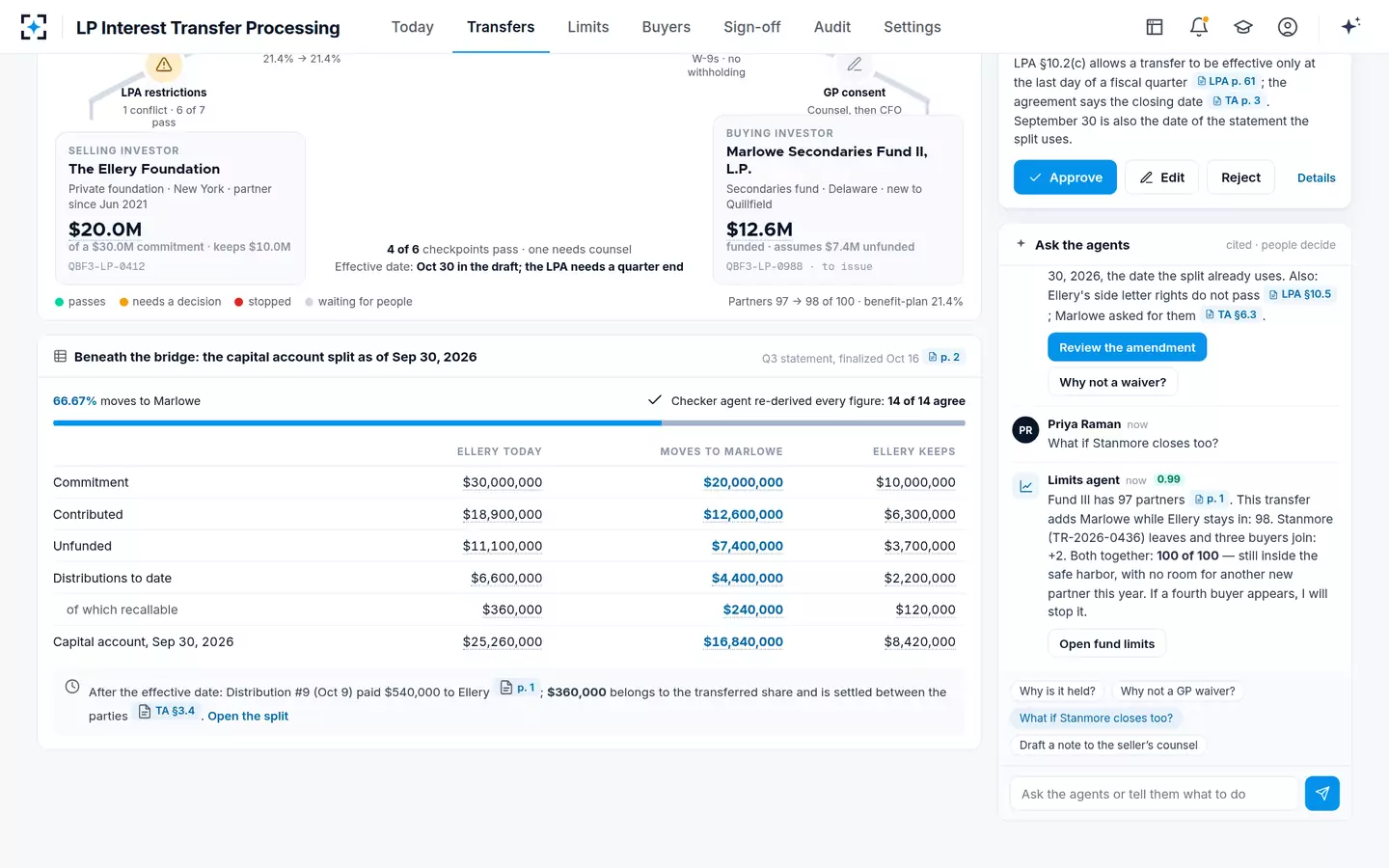
The sample's fund administration manager asked the question in those terms. Her thread with the agent shows the reply, cited to the register: Fund III has 97 partners; the Ellery sale adds the buyer while Ellery stays in, making 98; Stanmore leaves and three buyers join, adding two; together that is 100 of 100, still inside the safe harbor. Its last line is the useful one: if a fourth buyer appears, it will stop it.
A question in plain words, answered from the register with the arithmetic
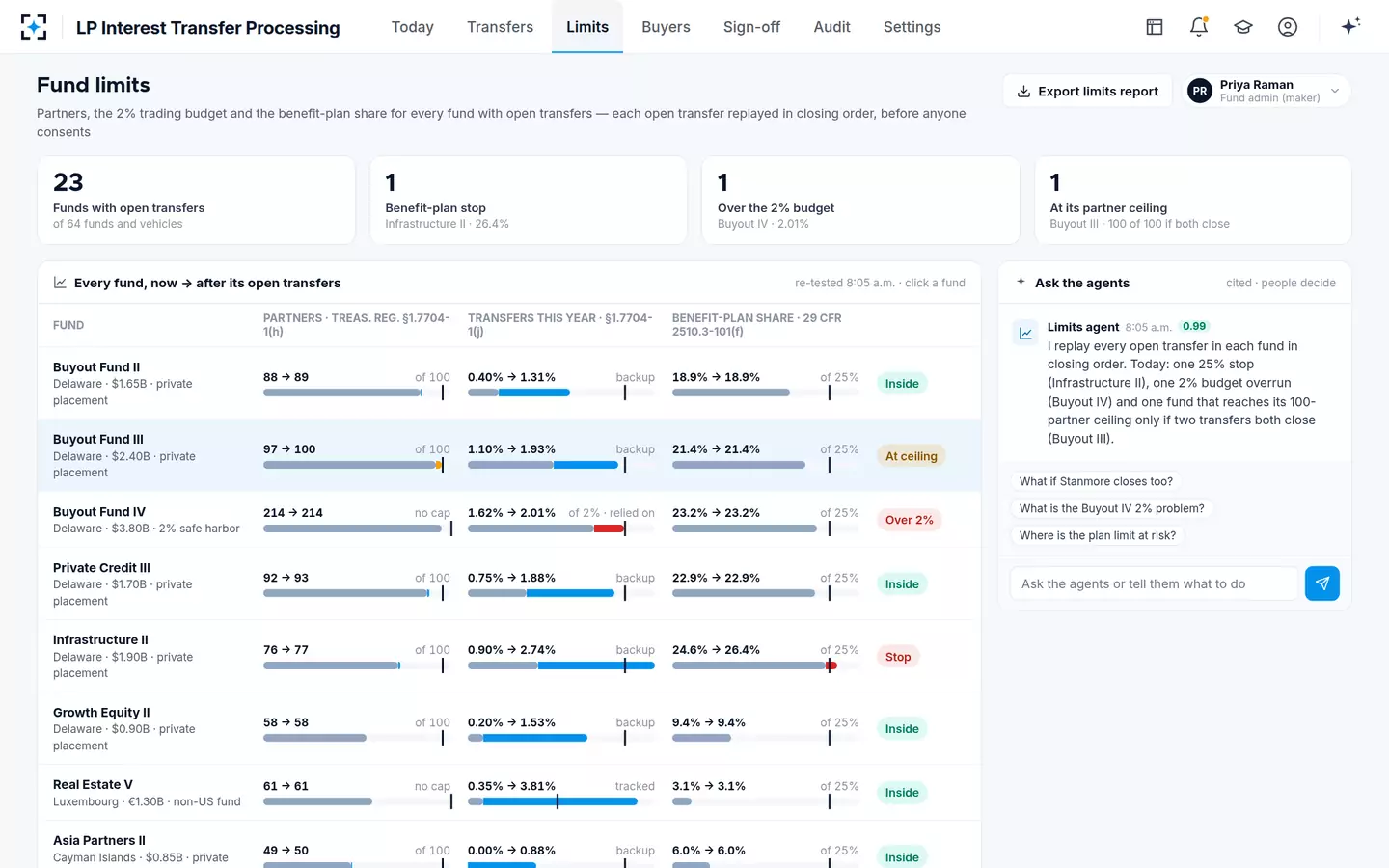
The fund-wide view is where the queue becomes visible. On the sample's Monday, the agent's overnight run across 23 funds produced three findings: a benefit-plan stop in Infrastructure II, a 2% overrun in Buyout IV and a ceiling in Buyout III that only bites if two transfers both close. Twenty funds had nothing to decide.
Every fund, now and after its open transfers, in LP Interest Transfer Processing
Can AI check an LPA's transfer clauses?
It can read them and cite them; it should not be the one to accept them. In LP Interest Transfer Processing a second agent, the Transfer-terms agent, reads each transfer agreement against the LPA's transfer article, the side letters and prior consents, clause by clause and in the agreement's own language, cites both sides of any conflict and drafts the smallest amendment that resolves it. It never approves or waives a term and never sends an amendment.
The limits depend on what it reads. At first-time setup the agents read every fund document, in the sample LPAs, side letters and prior consents read into 412 transfer rules, and ask the fund to confirm them. After that the confidence settings decide how much a person reads: in the sample, a citation is accepted at 0.90, and below 0.75 a person reads the page. The quarter-end rule that held the sample transfer, LPA §10.2(c), is one of those rules, and it is cited to page 61.
Who signs off the result?
People do, and the record says which person. The agents read, test and draft; they never approve, consent, waive or post. Counsel approves documents and amendments, the CFO grants consent and decides limit questions, the onboarding specialist clears KYC, only the AML officer clears a sanctions or PEP hit, and the person who prepares a register update cannot post it.
That division matches what regulators are asking of automation. The SEC's 2026 transfer agent proposal expects transfer agents using AI or automated technology to control it, describe its capabilities truthfully and oversee it (SEC, Transfer Agent Rules, proposed, 91 FR 56946; see the SEC transfer agent proposal). The SEC's Division of Examinations, in its fiscal 2027 priorities, describes registrants increasingly incorporating what it calls super intelligence (SI) into their businesses, and says it is working to understand how the technology affects outcomes and whether firms still meet their existing obligations (SEC, 2027 Examination Priorities). A limits test that shows its arithmetic and its source, with a named person deciding, is the kind an examiner can follow.
What does the transfer audit trail record?
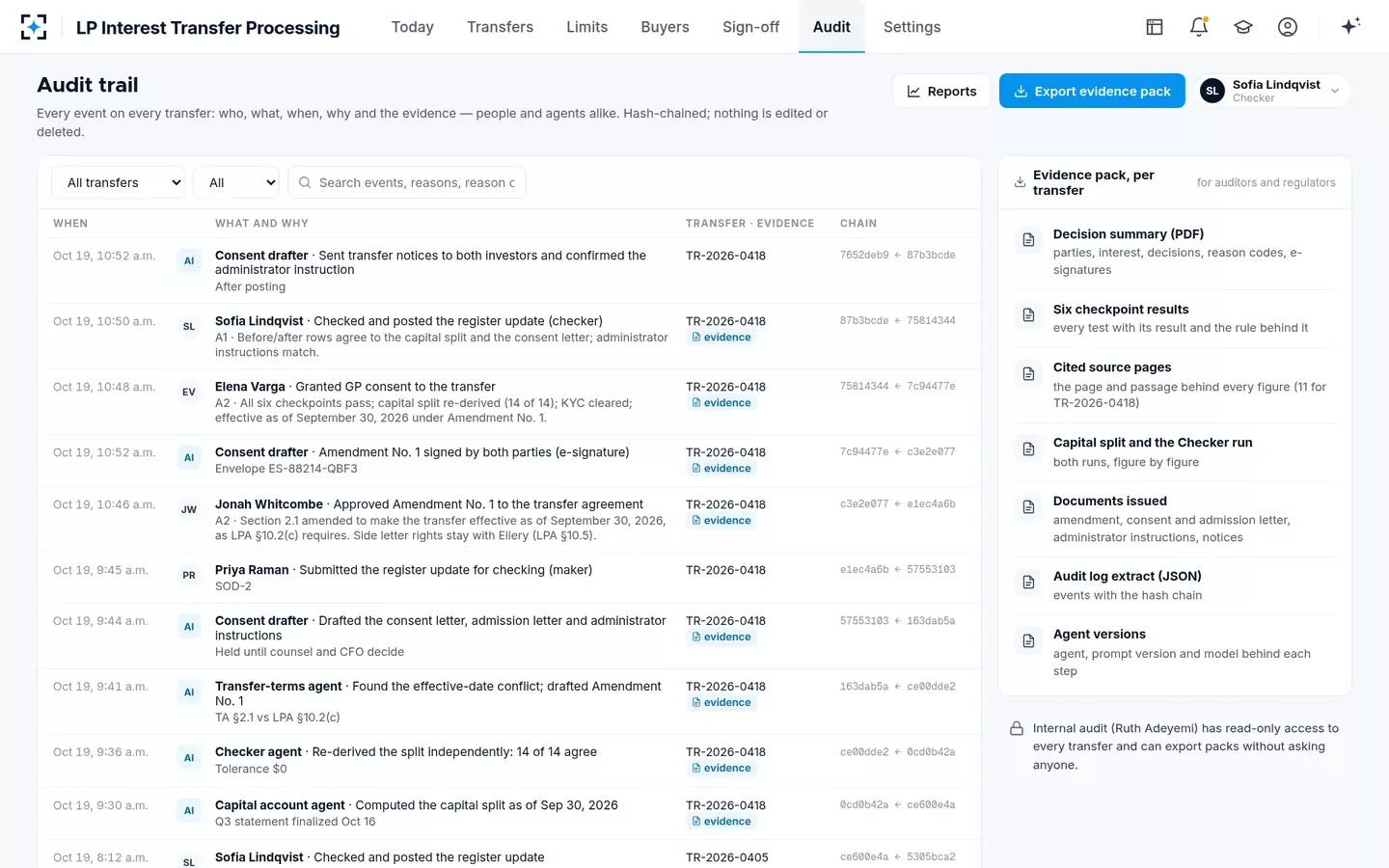
Every event on every transfer: who or what acted, what it did, when, why and on what evidence. In the sample, each entry is hash-chained to the one before it, nothing is edited or deleted, and each transfer can be exported with its decisions, checkpoint results, cited pages, the capital split with the Checker's run, the documents issued and the version of each agent and prompt behind each step.
The audit trail: people and agents on the same trail, each step chained to the last
What the Limits agent does, and what it never does
| It does | It never does | Who does instead |
|---|---|---|
| Counts partners, beneficial owners and the year's 2% after every open transfer | Decide which transfer closes first | The fund CFO, with the parties |
| Classifies transfers as counted or disregarded, citing the rule | Waive a limit | No one: a breach is cured by changing the transfer |
| Shows headroom and options, such as a smaller sale or a later effective date | Choose among the options | The fund CFO, with a reason code |
| Stops a transfer before consent | Release a stop on its own | The CFO decides; the agent re-tests the changed transfer |
| Answers questions in plain words, cited | Write to a seller or buyer | The fund administration manager approves every message |
The agent's tests are only as good as the rules it applies, which is why the right way to judge it is on the fund's own files with errors planted in them; ten errors to plant before you buy sets out the test, and the publicly traded partnership safe harbor explains the 2% rule it counts against. The whole desk is at LP Interest Transfer Processing.
Questions people ask
Can AI decide whether a fund consents to a transfer?
It should not, and in LP Interest Transfer Processing it cannot. The agents read, test and draft, and a stop on a limit holds the transfer, but consent is granted by the fund CFO after GP counsel has approved the documents, each with a reason code and an e-signature.
How often does the Limits agent re-test?
Overnight for every fund with an open transfer, and on demand: the transfer screen has a button to re-run the checks after a document or a term changes. In the sample's Monday run it re-tested 23 funds and reported three findings.
Does it handle funds that rely on different safe harbors?
Yes. A fund relying on the private placement safe harbor is tested against its partner count, with the 2% count tracked as a backup; a fund with more than 100 partners is tested against the 2% count. The fund's limits screen labels which harbor each fund relies on.
What happens when the agents disagree?
The Checker agent re-derives figures without seeing the first agents' working, on a different model, and can only pass or block with its reason. A disagreement blocks the hand-off to people and comes with an explanation.
Can the thresholds be changed?
Yes, as settings with an approval trail. In the sample, the benefit-plan share warns at 23.5% and stops at 25.0%, and the 2% budget warns at 1.75%; a change is proposed, approved by counsel, versioned and logged.