Section 1446(f) withholding is the tax a buyer must hold back when it acquires a partnership interest from a foreign person whose gain would be treated, under section 864(c)(8), as effectively connected with a US trade or business. The buyer withholds "a tax equal to 10 percent of the amount realized on the disposition" (26 U.S.C. §1446(f)(1)), files Form 8288 by the 20th day after the transfer, and is excused only if it can rely on one of six certifications. If it fails, the partnership itself must withhold from the buyer's distributions. That last rule is why a private fund cannot leave 1446(f) withholding to the parties. Botminds' LP Interest Transfer Processing checks the seller's and buyer's tax forms for every LP interest transfer, decides whether withholding applies and shows the amount before the GP consents.
The calculation below uses illustrative numbers, not anyone's sale. The product examples come from the solution's sample data on fictional funds and investors.
10% of the amount realized can be more than 10% of the cash
Amount realized: $13.5M
- Cash price $12.0M · 88.9%
- Liabilities relieved $1.5M · 11.1%
Cash at closing: $12.0M
- Seller receives $10.65M · 88.75%
- Withheld $1.35M · 11.25%
What is 1446(f) withholding?
It is a collection mechanism for a tax the seller owes. For sales on or after November 27, 2017, section 864(c)(8) treats a foreign partner's gain on selling a partnership interest as effectively connected income to the extent the partner's share of gain would have been effectively connected "if the partnership had sold all of its assets at their fair market value as of the date of the sale or exchange" (26 U.S.C. §864(c)(8)). Section 1446(f) makes the buyer collect it at source.
The IRS instructions boil the trigger down to two conditions on a transfer by a foreign person: the transferor realized a gain, and any portion of it would be effectively connected (IRS, Instructions for Form 8288, Rev. 01/2026). For a fund, that turns on whether the fund itself is engaged in a US trade or business, a question of what it holds and does that only the fund can answer. The buyer usually cannot tell, which is why the most useful certification for a private fund is one the fund itself provides.
The rules are recent. The final regulations for non-publicly traded interests apply to transfers on or after January 29, 2021 (26 CFR 1.1446(f)-2(f)), and the IRS applies the partnership's backstop withholding under section 1446(f)(4) to transfers on or after January 1, 2023.
What is the 1446(f) withholding rate? 10% of the amount realized, not of the gain
The rate is 10%, applied to the amount realized, which is usually larger than the cash price. The regulation says the amount realized includes the cash paid or to be paid, the value of other property, liabilities the buyer assumes, "and the reduction in the transferor's share of partnership liabilities" (§1.1446(f)-2(c)(2)(i)). A fund with a subscription line or other borrowing has liabilities, and each seller's share of them comes off its books on the sale.
The regulation gives the buyer three ways to adjust the number. It may rely on the seller's certification of its share of liabilities as shown on its most recent K-1, so long as that K-1's year ended no more than 22 months before the transfer, or on the fund's certification of the share on the determination date. A foreign seller may certify its maximum tax liability, the effectively connected gain times the applicable rate, if the fund gives it a statement of that gain. And where 10% would exceed the cash, or the buyer cannot find out the liabilities, the amount withheld is the amount realized without the liability relief (§1.1446(f)-2(c)(3)).
How to calculate 1446(f) withholding on an LP interest sale, step by step
The calculation is six steps, and the first two decide whether the other four are needed. Each step needs a document from someone outside the buyer's control: the seller, the fund or the IRS.
1446(f) withholding on one LP interest sale, step by step
| Step | What is decided | Document | Illustration |
|---|---|---|---|
| 1. Is the seller foreign? | A valid W-9 ends the analysis | Seller's W-9, or a W-8 | W-8BEN-E: foreign |
| 2. Does an exception apply? | One of six certifications, dated no earlier than 30 days before the transfer | Seller's or fund's certification | None provided |
| 3. Fix the determination date | The transfer date, any date up to 60 days before, or the start of the fund's year or last revaluation | Stated on every certification | Transfer date |
| 4. Amount realized | Cash + other property + liabilities assumed + reduction in share of fund liabilities | Agreement; K-1 or fund certification of liabilities | $12.0M + $1.5M = $13.5M |
| 5. Withholding | 10% of the amount realized, or a certified maximum tax liability | Form 8288, Part III | $1.35M |
| 6. Report and certify | Pay by day 20; tell the fund by day 10 what was withheld | Forms 8288 and 8288-A; certification to the fund | Both filed |
Step 3 is easy to skip and expensive to get wrong. "The same determination date must be used for all purposes with respect to a transfer," and every statement and certification must state it (§1.1446(f)-1(c)(4)). A fund that issues a liabilities certificate on one date and an effectively-connected-gain statement on another has given the buyer two documents it cannot use together.
What certificate avoids 1446(f) withholding? The six exceptions
A buyer need not withhold if it properly relies on one of six certifications, signed under penalties of perjury, and has no actual knowledge that it is wrong (§1.1446(f)-2(b)). For a US seller the answer is a Form W-9; for a foreign seller it is usually the fund's certification of little or no effectively connected gain.
Six certifications that excuse 1446(f) withholding, and who has to give each one
1
Non-foreign status
Given bySeller
What must be trueThe seller is not a foreign person: name, TIN and address, under penalties of perjury. A valid Form W-9 counts, including one the buyer already holds.
2
No realized gain
Given bySeller, with the fund's statement on section 751 income
What must be trueThe sale produces no realized gain, including no ordinary income from the fund's "hot" assets, as of the determination date.
3
Less than 10% effectively connected gain
Given byThe fund
What must be trueOn a deemed sale of all its assets, the fund's (or the seller's share of) effectively connected gain is under 10% of total net gain; or the fund was not engaged in a US trade or business at any time in its year up to the transfer.
4
Less than 10% effectively connected income
Given bySeller
What must be trueThree years as a partner; effectively connected income under $1 million and under 10% of its share of the fund's gross income each year; all of it reported and paid.
5
Nonrecognition
Given bySeller
What must be trueA nonrecognition rule means no gain or loss is recognised on the whole transfer; the law and facts are described.
6
Treaty
Given bySeller, on Form W-8BEN or W-8BEN-E
What must be trueA treaty exempts all the gain. The buyer must mail a copy to the IRS within 30 days of the transfer.
Three cautions apply to all six. A certification by an entity must be signed by an officer, director, general partner, managing member or someone else authorised to sign for it. It may arrive by email or as a PDF, but not if the recipient knows the sender was not authorised. And the person who relies on it must keep it "for as long as it may be relevant" to the withholding obligation (§1.1446(f)-1(c)(2)).
Which 1446(f) withholding exceptions depend on the fund itself?
Two of the six depend on the fund, and they are the two a foreign seller of a private fund interest most often needs. The less-than-10% effectively connected gain certification (exception 3) comes from the partnership, not the seller: it states that on a deemed sale of all its assets, the fund's net effectively connected gain, or the seller's share of it, would be under 10% of the total, or that the fund "was not engaged in a trade or business within the United States at any time during the taxable year of the partnership through the date of transfer" (§1.1446(f)-2(b)(4)). The no-realized-gain certification (exception 2) comes from the seller, but the seller may rely on the fund's statement that the sale would produce no ordinary income from section 751 assets, attached to its own.
A fund therefore needs a ready answer to "are we engaged in a US trade or business, and how much of a deemed-sale gain would be effectively connected?" before the first foreign seller asks. The answer has to be as of a determination date the buyer can use, so it is usually prepared per transfer, or at the start of the fund's year if nothing has happened since. Where the fund relies on its own books and records, including to give a certification, it must identify the information and the rule relied on within 30 days of the transfer and keep it for at least five calendar years (§1.1446(f)-1(c)(3)).
What if the buyer doesn't withhold? Section 1446(f)(4) and the fund's backstop
If the buyer fails to withhold what it should, the fund must. The statute says the partnership "shall be required to deduct and withhold from distributions to the transferee a tax in an amount equal to the amount the transferee failed to withhold (plus interest under this title on such amount)" (§1446(f)(4)). The regulation makes it blunt: the partnership withholds "the full amount of each distribution made with respect to the transferred interest" until it has collected the 10% and the interest (§1.1446(f)-3(c)(2)).
The trigger is the buyer's certification to the fund. Within 10 days of the transfer the buyer must tell the partnership what it withheld, with a copy of Form 8288-A or the amount realized and the amount withheld, and attach any certification it relied on (§1.1446(f)-2(d)(2)). A fund that receives none, or one it cannot rely on, withholds everything it distributes on the interest until it receives one it can. Withholding starts on the later of 30 days after the transfer or 15 days after the fund learns of it, and is reported on Forms 8288 and 8288-C.
Two exits are built in. A fund that already holds a valid W-9 from the seller may rely on it and owes nothing, unless the buyer's certification contradicts it. And a fund that makes a distribution as the transferee, for example on a redemption, is not also subject to the backstop. The rule turns a missing email from the buyer into a frozen distribution, which is why a fund should collect the buyer's 10-day certification as part of the transfer, not after it.
The 1446(f) clock around one LP interest transfer
- Day −30 or later: certifications dated
A seller's or fund's certification obtained more than 30 days before the transfer, or after it, cannot be relied on.
- Up to 60 days before: determination date
One date for every figure, stated on every statement; or the start of the fund's year or last revaluation event.
- Day 10: buyer certifies to the fund
What was withheld, or which exception was relied on, with the certification attached.
- Day 20: buyer files and pays
Form 8288 with Copies A and B of Form 8288-A, and the tax, to the IRS in Ogden.
- Day 30: treaty copies mailed
If the seller claimed a treaty on a W-8BEN or W-8BEN-E, the buyer mails a copy to the IRS with a cover letter.
- Day 30: fund's books-and-records note
If the fund relies on its own records for an exception, it identifies them by day 30 and keeps them five years or longer.
- Day 30 or later: backstop begins
If no reliable certification arrived, the fund withholds whole distributions on the interest, reported on Form 8288-C.
The cost of missing the clock falls on the buyer first. The IRS instructions warn that a transferee required to withhold who does not "the tax, including interest, may be collected from you", with a penalty of up to $10,000 for willful failure and personal liability for responsible persons under section 6672 (IRS i8288). A buyer that understands this is a buyer that asks the fund for its certificate early.
What is a section 754 election, and what does the buyer's 743(b) adjustment need?
A section 754 election lets a partnership adjust the tax basis of its assets for a buyer of an interest, so the buyer is taxed on gains that arise after it bought rather than on gains it paid for. Without the election, no adjustment is made on a sale "unless the partnership has a substantial built-in loss immediately after such transfer" (26 U.S.C. §743(a)), defined as more than $250,000 of built-in loss in the partnership's assets or in the buyer's share (§743(d)). An electing investment partnership under section 743(e) is not treated as having a substantial built-in loss.
The adjustment needs the buyer's help, and on a deadline that matches the 1446(f) clock. A buyer of an interest in a partnership with a 754 election in effect "must notify the partnership, in writing, within 30 days of the sale or exchange," with names, TINs, the price, liabilities assumed and anything else the partnership needs to compute the buyer's basis (26 CFR 1.743-1(k)). Separately, a seller whose sale involves the fund's section 751 assets must notify the fund within 30 days, or by January 15 of the next year if earlier, and the fund reports the exchange on Form 8308 (26 CFR 1.6050K-1). How the seller's tax capital carries over to the buyer on the K-1 is set out in partnership tax basis capital account reporting.
How LP Interest Transfer Processing handles the withholding decision
In the solution, tax forms are one of the six checkpoints every transfer passes before consent. The Buyer onboarding agent validates the W-9, W-8BEN-E or W-8IMY on file and decides whether section 1446(f) withholding applies; for a non-US seller with no exception certified, the transfer shows the amount to withhold. In the sample queue, Aldermoor Global Opportunities, a non-US seller, is selling a $10 million commitment in Buyout Fund II to Fenwick Road Capital, and the screen shows $860,000 to withhold, 10% of an $8.6 million amount realized, unless an exception is certified.
The non-US seller's withholding, on the fund administration manager's morning screen
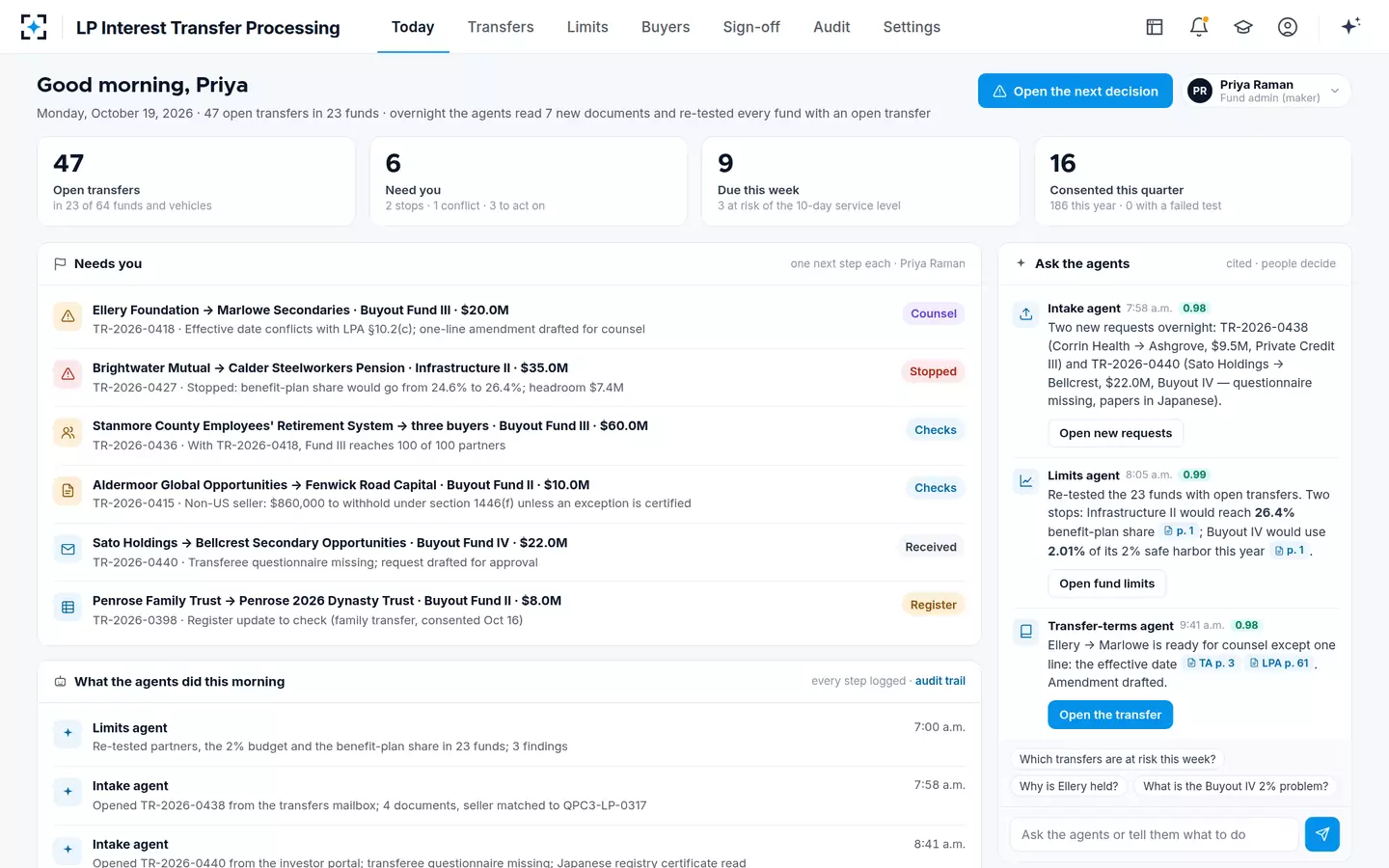
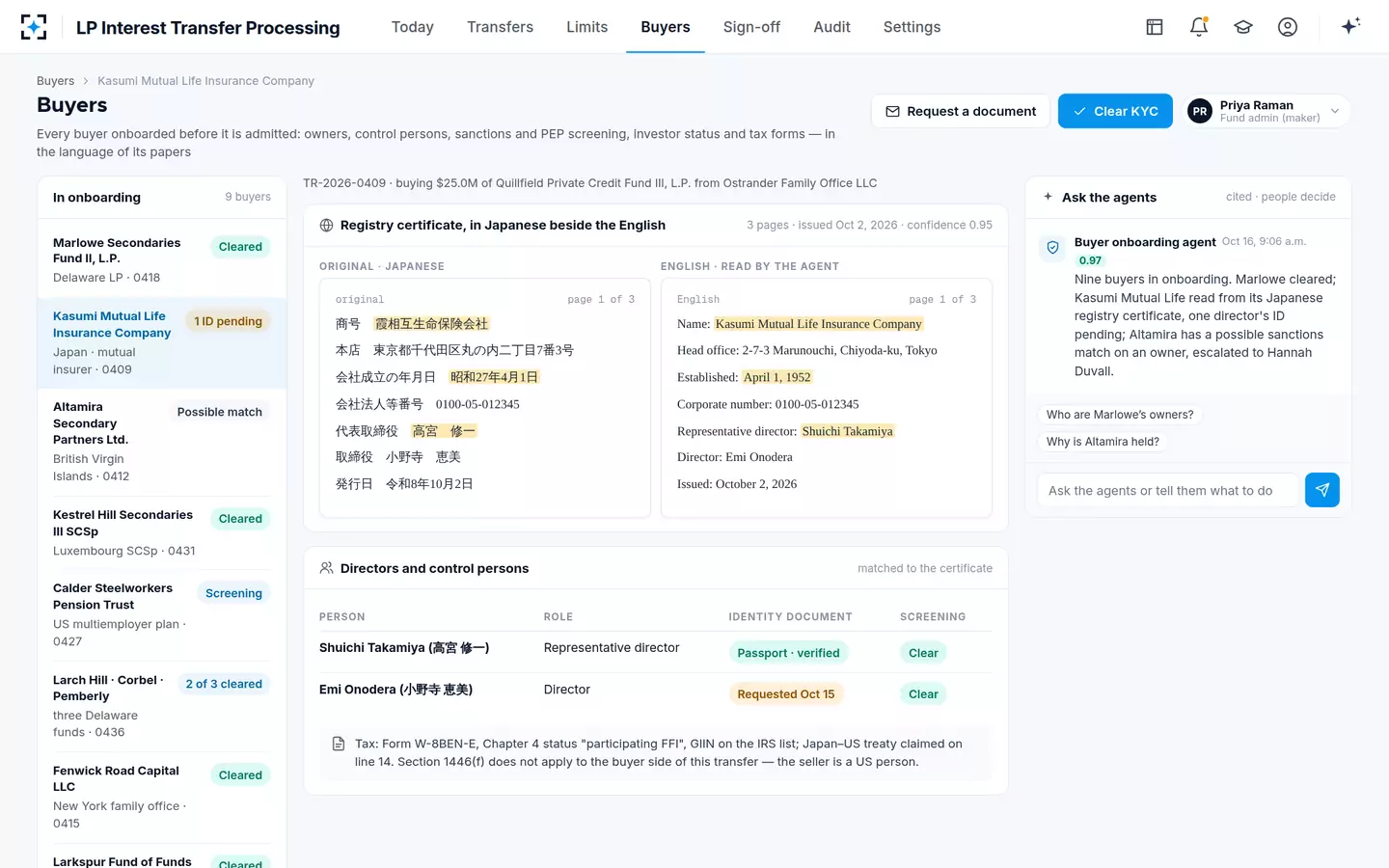
The sample's main transfer shows the other side. The Ellery Foundation is a US person, both W-9s are on file, and the tax-forms checkpoint reads "W-9s · no withholding". The buyer screen shows why a buyer's own forms still matter: Kasumi Mutual Life's W-8BEN-E, read from Japanese papers, matters for the fund's own withholding on the buyer's future share of income, though it does not change whether 1446(f) applies to a US seller's sale.
A buyer's tax form checked beside its registry papers
The agents prepare and the people decide. Counsel approves the transfer documents, the CFO grants consent, and a stop on a withholding question holds the transfer until someone with authority settles it. The LP transfer process, from request to consent shows where the tax forms sit in the chain, and the seller's view of the same transfer explains why the fund asks for them early. The whole desk is at LP Interest Transfer Processing.
Questions people ask
Is 1446(f) withholding required if the seller is a US person?
No, if the buyer has the seller's certification of non-foreign status. A valid Form W-9 counts, including one the buyer already holds. The fund may also rely on a valid W-9 it holds for the seller to conclude it has no backstop withholding to do.
How long is a 1446(f) certification valid?
Not long. Apart from the buyer's own 10-day certification to the fund, a certification cannot be relied on if it was obtained earlier than 30 days before the transfer or at any time after it, and every certification must state the determination date used for the transfer.
Does 1446(f) apply to a distribution from the fund?
It can. The regulations treat a distribution as a transfer and the distributing partnership as the transferee, so a distribution that produces gain for a foreign partner may need withholding. A distributing partnership may rely on its own books and records for several exceptions, and is not also subject to the backstop rule.
What is Form 8288-C?
It is the statement a partnership files, with Form 8288, to report tax it withheld under section 1446(f)(4) from distributions to a buyer that failed to withhold. Form 8288-A is the buyer's statement for its own withholding under section 1446(f)(1).
Who is liable if 1446(f) withholding is missed?
The buyer, first: the tax and interest may be collected from it, with penalties for late filing and payment, up to $10,000 for willful failure, and possible personal liability for responsible officers. The fund then has its own duty to withhold from the buyer's distributions until the amount is made good.
Does a 754 election change the 1446(f) amount?
No. The withholding is computed on the seller's amount realized. A 754 election affects the buyer's share of the fund's asset basis after the purchase, and the buyer must notify the fund in writing within 30 days of the sale so the adjustment can be computed.