An LP transfer system is the way a private fund receives, tests, approves and records transfers of limited partnership interests between investors. There are three common set-ups: the fund administrator runs the transfer under its service agreement, the fund's own operations team runs it with email, PDFs and a spreadsheet of partner counts, or agents read and test every transfer while people approve and consent. The right comparison is not speed alone but what each set-up lets the CFO prove when she signs: that the transfer fits the LPA, that every fund limit holds after every open transfer, that the buyer is known and screened, and that a second person checked the books. Botminds' LP Interest Transfer Processing is the third set-up, and this page compares all three on the same sale.
The sale is the solution's sample transfer, with fictional people and firms: the Ellery Foundation selling $20 million of a $30 million commitment in Quillfield Buyout Fund III to Marlowe Secondaries Fund II, with another sale open in the same fund.
What an administrator-led or an in-house spreadsheet set-up can show the CFO at consent
Administrator-led: The administrator's transfer team works a checklist; legal terms go to the GP's counsel.
In-house spreadsheet: Fund operations and GP counsel read it by hand against the LPA and side letters.
Administrator-led: Counted from the administrator's register, transfer by transfer.
In-house spreadsheet: Counted in a sheet that someone keeps up to date by hand.
Administrator-led: Depends on the administrator seeing every open request, including those sent to the GP first.
In-house spreadsheet: Depends on every open transfer being in the same sheet, in the right order.
Administrator-led: The administrator's sign-off and working papers, held at the administrator.
In-house spreadsheet: The sheet, the PDFs and the email thread, held wherever they were saved.
Administrator-led: The GP: delegating the work does not delegate the decision.
In-house spreadsheet: The GP.
What is an LP transfer system?
It is whatever a fund uses to turn a transfer request into a consented, posted change on its register, with a record of why. For one transfer a year that can be counsel and a folder. For a manager with many funds and a steady flow of secondary sales it becomes a system whether or not anyone calls it one: a queue, a set of tests, a set of approvals and a set of books that must agree.
The sample manager shows the scale at which the choice matters. On a Monday in October it had 47 transfers open across 23 of its 64 funds and vehicles, had consented to 186 that year and 16 that quarter, with nine due that week. At that volume the hard part is no longer any one transfer; it is keeping every fund's limits right while many transfers move at once.
Should the administrator handle transfers?
It can do much of the work, and it cannot take the decision. Fund administrators, as the Treasury describes them, are third parties that compute fees, keep the books and handle subscriptions and redemptions, and many also carry out due diligence on investors (Treasury, 2024 Investment Adviser Risk Assessment). A transfer touches all of those. But the consent is the general partner's under the LPA, and so are the consequences if a transfer breaks a limit.
Regulators take the same line on delegation elsewhere. When FinCEN finalised its investment adviser AML rule it let advisers delegate some or all of their programmes to a third party, a fund administrator among them, while keeping the adviser fully responsible and legally liable for the result and answerable to examiners for it (FinCEN, 89 FR 72156, 2024); that rule's effective date has since been delayed to January 1, 2028. A fund that hands transfers to its administrator should therefore still see the evidence for each check before it consents, not only the administrator's conclusion.
Can we keep using spreadsheets?
A spreadsheet can count; what it does badly is keep every count right across a moving queue. The 2% safe harbor sums the year's counted transfers month by month under a convention the fund must keep consistent (26 CFR 1.7704-1(j)–(k)); the benefit-plan test runs per class after each acquisition; the partner and owner counts differ from one another; and ten kinds of transfer are disregarded for 2%. A sheet that handles all of that for one transfer still has to be re-run for every other open transfer in the same fund whenever one changes.
The other weakness is control. A sheet maintained by one person, updated by the same person who prepares the register change, is the arrangement SEC examiners criticised at transfer agents where a single person could move issuer money without a second person confirming it (SEC OCIE Risk Alert, 2019). Spreadsheets can work for a fund with a handful of transfers a year and wide margins under every limit. They are a risk for a fund near any line.
Three set-ups on one sale, compared
Run the same sale through all three. The sample transfer has one conflict in the agreement, a buyer whose owners must be mapped, a US seller, a part sale that adds a partner, and a second sale open in the same fund that would take it to 100 partners.
The same LP transfer under three set-ups: what each finds, and when
| Step | Administrator-led | In-house spreadsheet | Agents, people deciding |
|---|---|---|---|
| Missing documents | Found as each reviewer reaches its part | Found as each reviewer reaches its part | All found on day one; one request drafted for approval |
| Effective date conflict (closing date vs quarter end) | Found if the checklist covers it | Found when counsel reads the agreement | Found and cited on both pages, amendment drafted for counsel |
| Partner count with the other open sale | Depends on the queue the administrator sees | Depends on the sheet holding both | Replayed in closing order: 97 → 98 → 100 of 100 |
| Buyer owners and screening | Administrator's KYC process | Email requests and a screening tool | Owners mapped from the papers and screened; specialist clears |
| Withholding question | Administrator's tax review | Operations and tax, by email | Forms validated; W-9 on file, no withholding shown |
| Capital account split | Administrator computes; fund reviews | Computed and re-added by hand | Computed, re-derived by a second agent, 14 of 14 to $0 |
| Consent and register | Letters drafted by counsel; administrator books | Letters by counsel; sheet and register updated | Drafted from decided facts; CFO consents; a second person posts |
The third set-up in practice: one queue, every decision with its owner
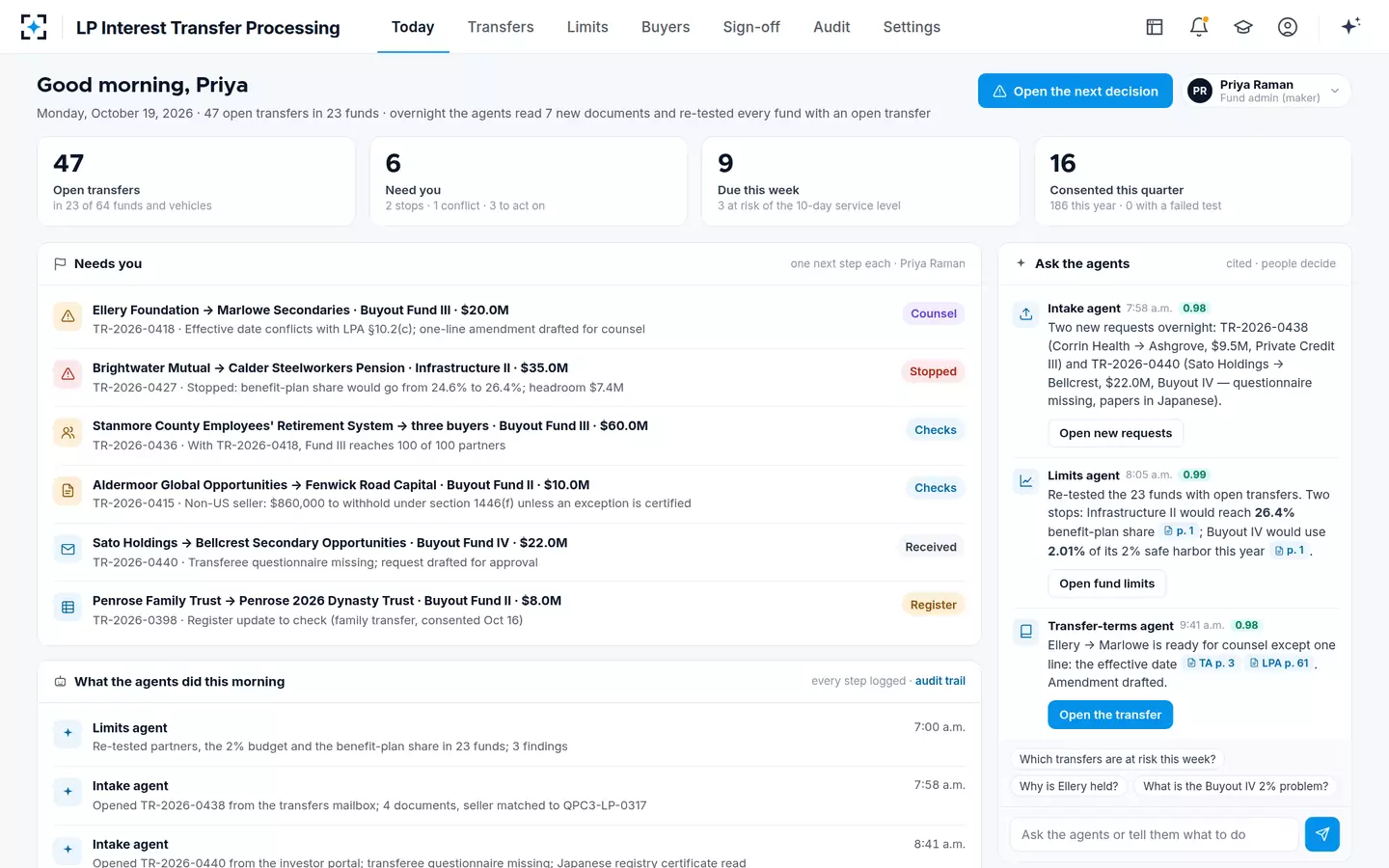
What changes if our transfer agent is SEC-registered?
Possibly a great deal, if the SEC adopts what it has proposed. Since 1977 the SEC's turnaround, processing and recordkeeping rules for registered transfer agents have exempted the processing of interests in limited partnerships, and the SEC's September 2026 proposal would rescind that exemption, concluding that the old carve-out from the minimum performance and recordkeeping standards is no longer justified (SEC, Transfer Agent Rules, 91 FR 56946; read in full in the SEC transfer agent proposal). It estimates up to 194 registered transfer agents that process limited partnership interests, dividend reinvestment plans and fund shares, and certain small agents, would newly have to comply. In its Form TA-2 analysis, 33 transfer agents serviced limited partnership securities, four of them exclusively.
Two cautions apply. It is a proposal: comments are due by November 3, 2026, and nothing changes unless and until the SEC adopts a final rule. And registration attaches to "qualifying securities", which the release describes as securities registered under section 12 of the Exchange Act; a fund whose interests are serviced by a registered transfer agent should ask it now how it would meet a turnaround standard, while a private fund whose administrator is not a registered transfer agent is outside these rules either way.
How do we switch mid-year?
Carry the year's counts across, and prefer to go live at a boundary the counts respect. The 100-partner safe harbor looks at "any time during the taxable year", and the 2% count sums the whole tax year under one month convention, so a new system that starts in October needs the year's counted transfers, the convention, the partner history and every open transfer loaded before it tests anything.
An illustrative mid-year switch for a calendar-year fund: load the year, shadow, then go live
- Transfers run as before; the year's 2% count accumulates9 months
- Not started
- Load1 mo
- Shadow run2 mo
- Live, counts carried3 mo
The shadow run is the useful part. Run the new system on the year's completed transfers, where the right answers are known, and on the open queue in parallel with the old process; any difference is either an error in the old process or in the new one, and both are worth finding before a consent depends on it. Ten errors to plant before you buy turns the shadow run into a scored test.
What must stay with counsel and the CFO?
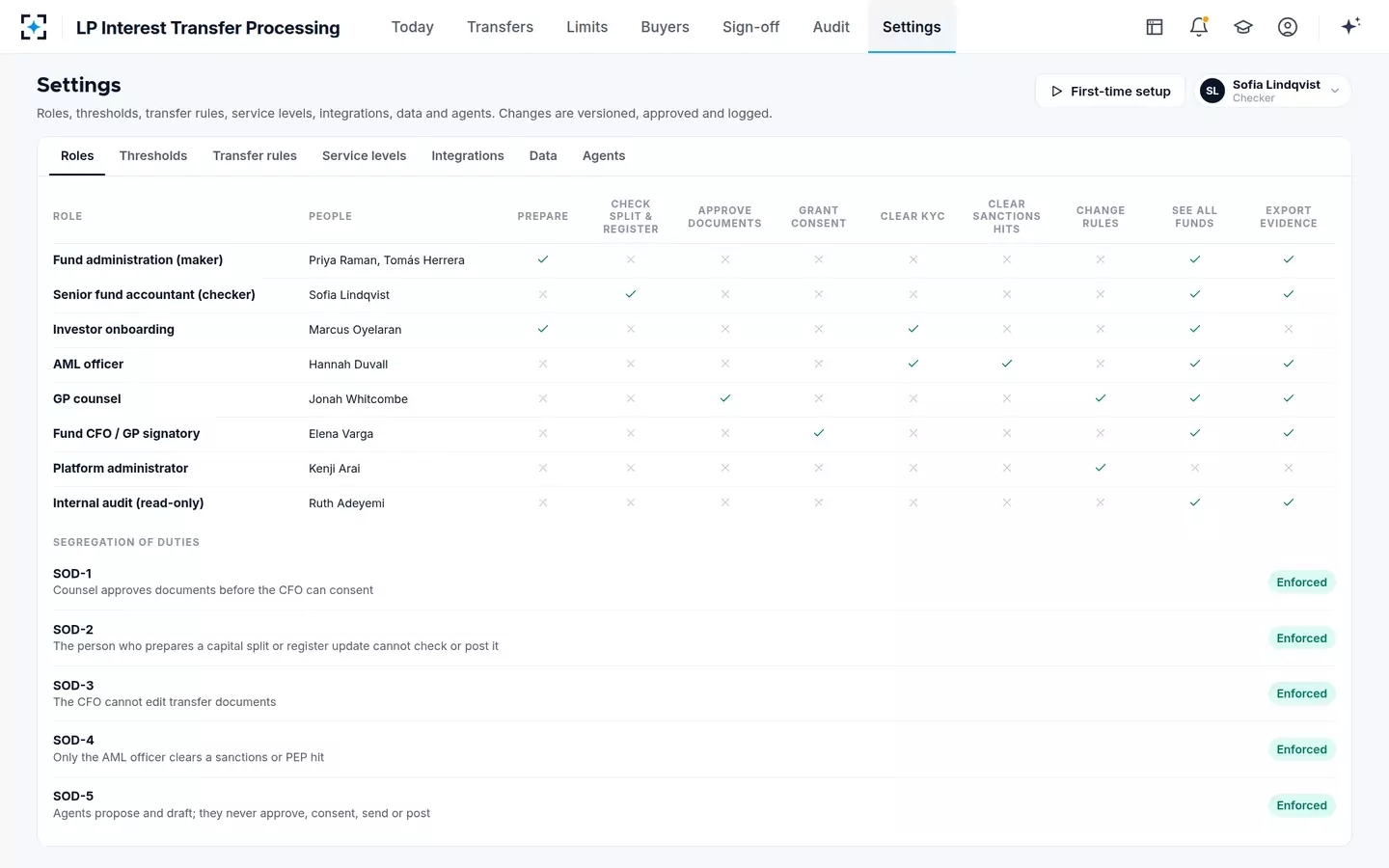
Every decision that binds the fund. Whatever the set-up, counsel should approve transfer documents and amendments and the CFO, or another authorised GP signatory, should grant consent and decide any limit question; the AML officer should be the only person who clears a sanctions hit, and the person who prepares a register change should not post it. In LP Interest Transfer Processing those are enforced rules, not habits.
Who keeps which decision when agents do the reading and testing
Today
Grants consent from a summary prepared by others, and carries every limit question in her head or her inbox.
With agents
Sees every check, the split and the drafted letters on one page, and decides limit questions from options with the arithmetic shown.
Still theirs: GP consent and every limit decision
Today
Reads each agreement against the LPA and side letters, and is asked for the same answers on every transfer.
With agents
Reviews conflicts already cited on both sides with a drafted fix, and approves, edits or rejects with a reason code.
Still theirs: Approval of documents and amendments, and of any change to the transfer rules
Today
Receives the outcome by email and books it, or runs part of the review under its service agreement.
With agents
Receives an instruction drafted from the decided facts, with the split already re-derived to the dollar.
Still theirs: Its own books, statements and the entries it posts
Today
Hears about a possible sanctions match when someone remembers to forward it.
With agents
Receives every possible match with its score and the lists it was screened against.
Still theirs: Clearing any sanctions or PEP hit; no one else can
Today
Reconstructs a transfer from email threads and spreadsheet versions after the fact.
With agents
Reads every event on a hash-chained trail and exports any transfer without asking anyone.
Still theirs: Independent read-only access
Roles and segregation of duties, as settings the solution enforces
What an LP transfer system costs, and how to judge one on your own files
Vendors and administrators do not publish prices for transfer processing, and no regulator or independent study publishes what a transfer costs a fund, so the comparison has to be built from the fund's own numbers. Count last year's transfers, the hands-on days each took and who spent them, how many crossed a quarter end, and how many came within a few transfers of a limit. Botminds' own estimate, for a manager handling about 200 LP-led transfers a year, is about 17 hands-on business days per transfer by hand and about 4 with the solution, waiting on other parties excluded; it is an estimate, and the fund's own count is the one to trust.
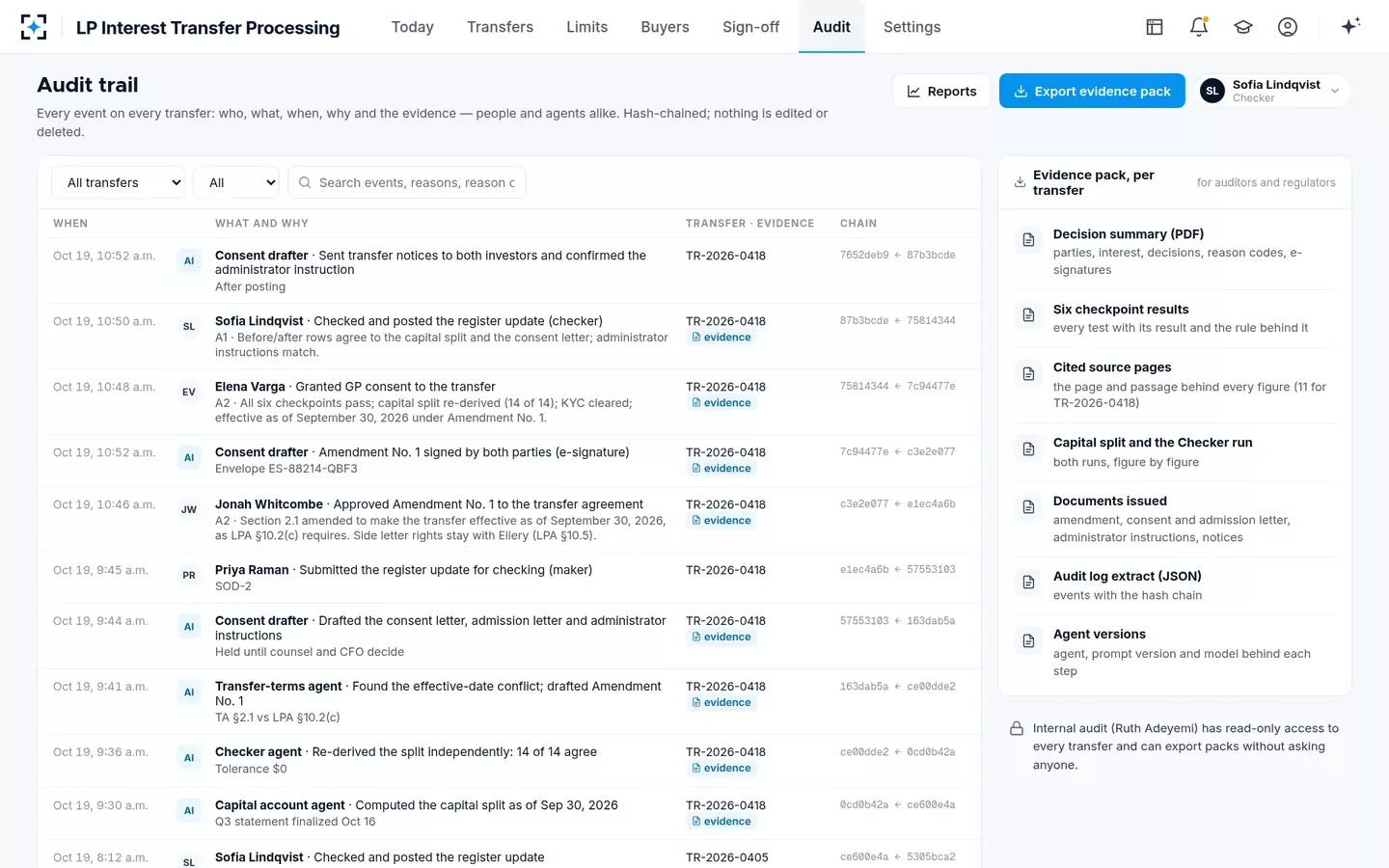
Then judge the system by its record, not its demonstration. Every event in LP Interest Transfer Processing, by people and agents, is written to a hash-chained trail, and each transfer exports with its decisions, checkpoint results, cited pages and the version of each agent behind each step.
The record each set-up should be able to produce: every event, by person or agent, with its reason
Where the solution fits, and where it does not, is worth stating plainly. It is built for the fund's side of LP-led transfers: intake, terms, limits, buyer onboarding, the split, consent drafting and the register. It does not price secondaries, match buyers with sellers or run continuation-fund elections, and it does not replace the administrator's books; it sends the administrator instructions and reads its statements. We run LP Interest Transfer Processing on a fund's own LPAs and a sample of its past transfer packages, so the comparison above can be made on the fund's files. The agent that re-tests every fund limit shows the part of it that differs most from a spreadsheet. The solution is at LP Interest Transfer Processing.
Questions people ask
Is LP transfer software the same as investor portal software?
No. A portal is how investors see documents and statements and sometimes submit requests. A transfer system tests and records the transfer itself: the LPA, the limits, the buyer, the split, the consent and the register. The two connect when a transfer completes and the buyer gets portal access.
Do private funds need a registered transfer agent?
Registration attaches to transfer agents for securities registered under section 12 of the Exchange Act, as the SEC's 2026 proposal describes. Whether a fund's interests are registered, and so whether whoever records them must be a registered transfer agent, is a question for the fund's counsel.
Would the SEC proposal set a turnaround time for LP transfers?
For registered transfer agents, if adopted. The September 2026 proposal would rescind the exemption that has kept limited partnership interests out of the turnaround and processing rules since 1977, and would require policies to turn around routine items within the shorter of one business day or the securities settlement cycle. Comments are due by November 3, 2026.
How many transfers a year justify a transfer system?
No regulator or study sets a threshold. The better test is how close the funds run to their limits and how many transfers are open at once: the sample manager had 186 consents in the year and 47 open transfers across 23 funds on one Monday, with three funds at or over a limit.
What should we keep when we switch systems?
Everything that affects this year's counts and future questions: the year's counted and disregarded transfers, the month convention, the partner and owner history, the benefit-plan holdings by class, every open transfer, and each past transfer's file. The tax year sets the boundary for the 2% and 100-partner tests.