LP-led and GP-led secondaries are the two ways an investor in a private equity fund gets out before the fund ends. In an LP-led secondary one limited partner sells its stake to a buyer, and the general partner's part is mostly to approve the transfer and process it. In a GP-led secondary the manager itself sells assets from the old fund to a new vehicle it also runs, usually a continuation fund, and every investor chooses between cash and rolling over. The difference decides who prices the deal, who carries the conflict and how much paperwork lands on the fund's own desk. Botminds' LP Interest Transfer Processing is built for the LP-led side: it takes each transfer of an LP interest from the request to GP consent, and re-tests the fund's limits before anyone signs.
The examples on this page come from the solution's sample data: Quillfield Capital, a fictional manager with 64 funds and vehicles and 47 transfers open on a Monday in October 2026. The research comes from two NBER studies and the court and regulatory texts linked where they appear.
The GP-led side grew fast, and most investors take the cash
130
continuation funds launched in 2024, up from five in 2018
$80B
and more in the 2024 continuation-fund vintage alone
5.7%
of legacy investors chose to roll into the new vehicle
~3months
average window an investor had to decide
What is the difference between LP-led and GP-led secondaries?
The difference is who sells and what is sold. In an LP-led sale the seller is one investor and the thing sold is its fund interest, a claim on every company in the portfolio. In a GP-led sale the seller is the fund itself, acting through its manager, and the thing sold is a chosen set of companies. The authors of the 2025 NBER study of continuation funds put the distinction in one line: "A CF transaction is distinctive in being both LP-specific and asset-specific" (NBER w34471). Some investors leave and others stay, but only for the assets the manager picked.
Two kinds of sale, side by side: who acts, who pays and what the fund must re-test
Who starts it
LP-ledOne limited partner that wants cash, often through an adviser it hires
GP-ledThe general partner, which chooses the assets and proposes the deal
What changes hands
LP-ledThe seller's interest, in whole or in part: a slice of every portfolio company, plus the unfunded commitment
GP-ledSelected assets of the legacy fund, bought by a new vehicle the same manager runs
Who pays
LP-ledA buyer the seller finds, often a fund that specialises in secondaries
GP-ledMostly new investors in the continuation fund, again usually secondaries specialists
Who sets the price
LP-ledSeller and buyer, between themselves; the fund is not a party
GP-ledThe GP, which acts for the selling fund and the buying vehicle at once
What the other LPs decide
LP-ledNothing, unless the LPA gives them rights over transfers
GP-ledEach chooses to take cash or roll into the new vehicle, inside an election window
What the fund re-tests
LP-ledPartner count, the 2% trading count, the benefit-plan share, the buyer and its tax forms, for each transfer
GP-ledThe legacy fund's sale, and the new vehicle's own closing, which is a fund raise in its own right
Read the table by its last row. An LP-led sale looks small, one investor and one buyer, but it reaches into the fund's tax status, its ERISA position and its investor register, and the fund has to re-test all three before it lets the buyer in. A GP-led sale is large and visible, but its back-office work is closer to a fund raise: a new vehicle with new investors, documents and a closing.
What is an LP-led secondary? One stake, one buyer, and the GP's approval
An LP-led secondary is the sale of one limited partner's interest to a new investor, negotiated between the two of them. The NBER authors describe the general partner's role in it plainly: "The GP is typically minimally involved, although they must usually approve the proposed transaction" (NBER w34471). The price is not the fund's business. The admission of the buyer is.
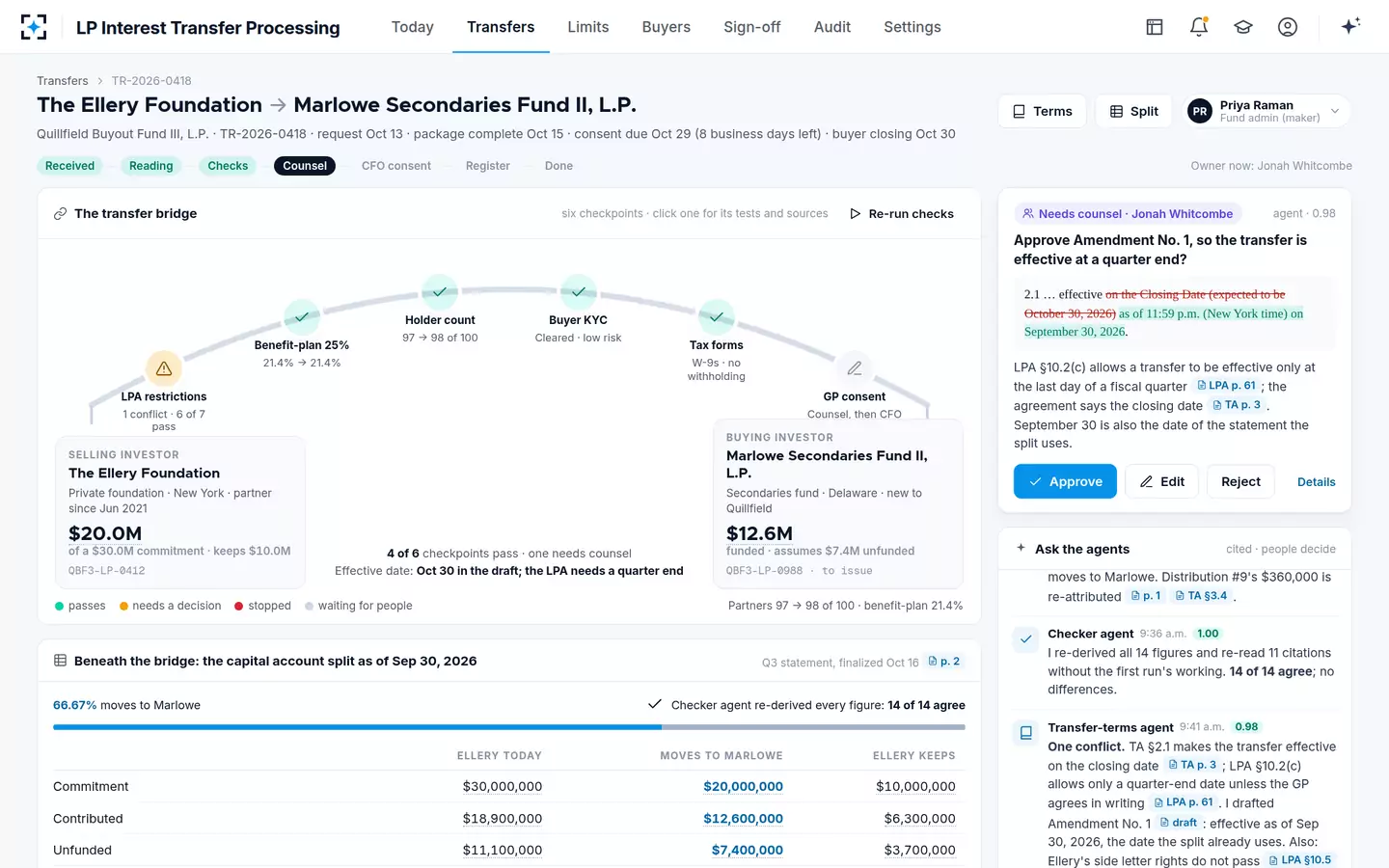
That approval is where the fund's work starts. The buyer arrives with a transfer agreement, a transferee questionnaire, a joinder to the LPA, its ownership papers and its tax forms, and the fund checks each against its own documents. In the sample, the Ellery Foundation's sale of $20 million of a $30 million commitment in Quillfield Buyout Fund III to Marlowe Secondaries Fund II arrived from the seller's counsel as five documents and 112 pages. The fund ran seven tests on the LPA's transfer article before counsel saw it, and one of them failed: the agreement's effective date did not fall at a quarter end.
A part sale is the common case, and it changes the arithmetic. Ellery kept $10 million and stayed in the fund, so the buyer's admission took Fund III from 97 partners to 98. A sale of the whole interest would have left the count where it was. Because the fund's safe harbors and its Investment Company Act exclusion both count heads, each part sale has to be counted before consent, not after.
What is a continuation fund? The GP-led sale, from the inside
A continuation fund is a new vehicle, sponsored by the same manager, that buys selected assets from one of its older funds at a negotiated price. The old fund's investors can sell their share of those assets for cash or roll it into the new vehicle, and the cash for those who sell usually comes from specialised secondary investors. The NBER study counts five such funds launched in 2018 and 130 in 2024, and puts the 2024 vintage alone at more than $80 billion (NBER w34471).
Most investors take the cash. Across the study's sample only 5.7% of legacy investors rolled, and new investors made up 73% of the continuation funds' investor base. The share rolling fell from roughly 14–15% in 2018–19 to below 5% by 2025, and among public investors from roughly 30% in 2018 to about 2% by 2024. Investors were more likely to roll when they were given longer to decide.
Fewer legacy investors roll into continuation funds each year
The window is short. The average election period in the sample was about three months, which the authors note leaves investors little time to decide. That is the GP-led side's operational squeeze: dozens of investors making the same decision at once, on information the manager controls. It is not the same squeeze as an LP-led transfer, where one decision, the GP's, waits on documents from people outside the fund.
Does the GP have to consent to an LP-led sale?
Almost always in practice, because the LPA says so; Delaware's default would let the sale happen but leave the buyer outside the partnership. Under 6 Del. C. §17-702, unless the partnership agreement provides otherwise, an interest is assignable in whole or in part, but the assignment alone does not make the buyer a partner or give it a partner's rights or powers (6 Del. C. §17-702(a)(2)). The buyer would receive the seller's share of profits, losses and distributions, and nothing more.
To become a limited partner, the buyer has to be admitted. Section 17-704 says an assignee becomes a limited partner as the partnership agreement provides, or, if the agreement is silent, "upon the vote or consent of all partners" (6 Del. C. §17-704(a)). A unanimous vote for every sale is unworkable, so LPAs commonly hand the decision to the general partner. In the sample LPA it is §10.1(a): prior written consent of the general partner, in its sole discretion.
The consent matters for tax as well as law. The Treasury regulation on publicly traded partnerships treats a fund's interests as tradable only if the partnership takes part in the market or recognises the transfers made on it, including by "Admitting the transferee as a partner" (26 CFR 1.7704-1(d)(2)(ii)). Every consent is therefore a transfer the fund has chosen to recognise, and it counts. The six checks before a GP says yes sets out what has to be true first.
Why do LP stakes sell at a discount?
LP stakes usually change hands below the fund's reported net asset value because the buyer is pricing a bundle of private companies it cannot see well, in a thin market. The NBER continuation-fund authors call information frictions "a key barrier" to LP-led sales and cite the study that measured the result. That study, by Nadauld, Sensoy, Vorkink and Weisbach, used every transaction one large intermediary handled from 2006 to 2014 and found most sales below NAV, with buyers then out-earning sellers (NBER w22404; Journal of Financial Economics, 2019).
In the 2016 working-paper version, the average discount over the full sample was 13.8% of NAV, and about 9% for the most common sale, a fund four to nine years old. The authors tie both the discount and the buyers' advantage to asymmetric information and market depth: discounts were larger for smaller funds and smaller transactions. The secondary discount and the price of a transfer that waits works through what that means for the fund's own process.
How big has the continuation-fund market become, and what about LP-led volume?
For continuation funds there is an academic count: from five launched in 2018 to 130 in 2024, with the 2024 vintage above $80 billion, in the NBER authors' hand-collected data. For LP-led sales there is no equivalent. No regulator or independent study publishes the total volume of LP-led secondary sales, and figures that circulate come from the advisers who arrange the deals.
A fund does not need the market total to plan its own desk. It needs its own count: transfer requests received a year, how many were part sales, how many crossed a quarter end, how many buyers were new to the manager. In the sample, Quillfield had consented to 186 transfers by mid-October, 16 of them in the current quarter, with 47 still open across 23 funds. That is the number that sizes the work.
Who prices a GP-led deal, and who checks the price?
The general partner proposes the price, and since June 2024 no SEC rule requires an outside opinion on it. In 2023 the SEC adopted an adviser-led secondaries rule that, as the Fifth Circuit summarised it, "requires registered private fund advisers to obtain and distribute to investors an independent fairness or valuation opinion and disclose any relationship with the opinion provider" (National Association of Private Fund Managers v. SEC, No. 23-60471). On June 5, 2024 the court vacated the whole rule set, that rule included.
What remains is the fund's own paper: the LPA's conflict provisions, the advisory committee's consent and the manager's fiduciary duty. The NBER authors describe the tension directly: the GP represents, and charges fees to, both the selling fund and the buying vehicle. They also report that GP ownership is higher in continuation funds than in the legacy funds, 9.48% against 7.18% on average, which they attribute to managers rolling their carried interest into the new vehicle. What an advisory committee may approve, and what its consent needs, is the place to start on the committee's side.
What the back office does in each, and where LP Interest Transfer Processing fits
The two kinds of sale put different work on the same desk. An LP-led transfer is a chain of documents and tests ending in one consent. A GP-led deal is a sale of assets by the old fund and a closing of the new one, run as a project. LP Interest Transfer Processing is built for the first, and it is honest to say where it stops.
What lands on the fund's desk, by kind of sale, and what LP Interest Transfer Processing does with it
| Work | LP-led transfer | GP-led continuation fund | In the solution |
|---|---|---|---|
| Price | Agreed between seller and buyer | Proposed by the GP; advisory committee and investors respond | Not touched: the agents never price a deal |
| Transfer agreement against the LPA | Every sale, clause by clause, with side letters | Rare: investors sell into the deal on standard terms | Read clause by clause, both sides cited, smallest amendment drafted |
| Partner count, 2% count, benefit-plan share | Re-tested for every transfer, across the open queue | Tested on the new vehicle at its closing | Replayed for every open transfer in each fund before consent |
| Buyer onboarding and tax forms | One buyer at a time | Many new investors at the new fund's closing | One buyer at a time; the new fund's closing belongs to subscription work |
| Capital account | Split as of the effective date; later activity re-attributed | Assets leave the old fund at the deal price | Split, then re-derived by a second agent to the dollar |
| Consent and register | GP consent, admission letter, register update | Election results, closing and the new fund's register | Drafted from decided facts; counsel approves, the CFO consents, a second person posts |
The sample's screen shows the LP-led shape. The seller sits on the left, the buyer on the right, and six checkpoints join them: LPA restrictions, the benefit-plan 25% test, the holder count, buyer KYC, tax forms and GP consent. The capital account split sits underneath, as of the effective date.
One LP-led transfer in LP Interest Transfer Processing: seller, buyer and the six checkpoints between them
A GP-led deal also creates LP-led work later. Once a continuation fund closes, its own investors will sell stakes one at a time, and each of those is a transfer like Ellery's. The fund that runs its LP-led transfers well is also the one that knows, at any moment, how close each vehicle is to its limits.
Every fund's limits, now and after its open transfers
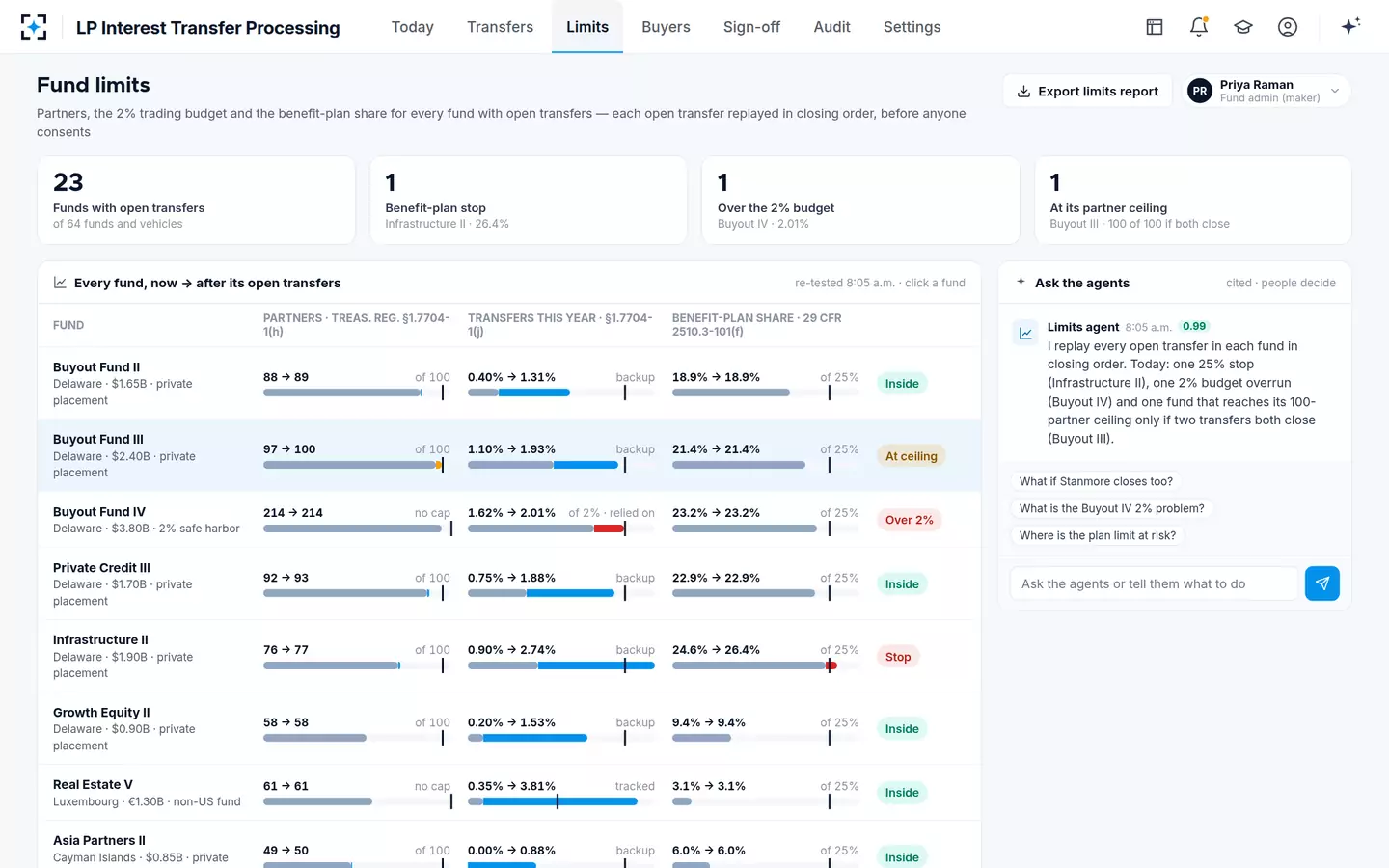
To see the transfer desk end to end, start from LP Interest Transfer Processing.
Questions people ask
What is a GP-led secondary?
A sale organised by the fund's manager rather than by an investor. The most common form today is the continuation fund: the manager sets up a new vehicle to buy chosen assets from an older fund, and each investor in the older fund decides whether to sell its share for cash or roll into the new vehicle.
Do investors have to sell in a continuation fund deal?
No. Each legacy investor chooses between cash at the deal price and rolling its exposure into the new vehicle. In the 2025 NBER sample of 472 continuation funds, only 5.7% of legacy investors rolled, and the share fell over time.
Who buys LP stakes in LP-led secondaries?
Mostly funds that specialise in buying secondary interests. The Nadauld, Sensoy, Vorkink and Weisbach study found buyers tended to be funds of funds and sellers more often endowments and pension plans, in transactions from 2006 to 2014.
Does an LP-led sale change the fund's tax position?
It can. Each transfer the fund recognises counts toward the 2% trading limit in the publicly traded partnership safe harbor unless it is a disregarded transfer, and a part sale adds a partner toward the 100-partner limit. If the seller is foreign, the buyer may also have to withhold 10% of the amount realized under section 1446(f).
Can the GP refuse an LP-led transfer?
Under most LPAs, yes. Delaware lets the partnership agreement decide how an assignee becomes a partner, and many LPAs give the GP consent in its sole discretion, as the sample LPA does, alongside conditions such as no breach of the fund's tax or ERISA limits. A buyer the GP does not admit keeps only the seller's economic rights.
How long do investors get to decide in a continuation fund?
In the NBER sample the average election period was about three months. The authors found investors were more likely to roll when they were given longer to decide, which they read as a sign of slow decision processes at many investors.