An LPAC in private equity, the limited partner advisory committee, is a small group of a fund's investors that the LPA empowers to review and consent to specific matters, most often conflicts of interest between the general partner and the fund. Its consent is valuable to a manager because it opens what the LPA otherwise forbids, and dangerous for the same reason: the SEC's examiners have found consents sought after the transaction, given on incomplete information, or not sought at all. Botminds' LPA Compliance treats every consent as a document with a fund, a scope, a period and a cap, and checks it inside every answer about what a fund may pay.
The examples follow a fictional sample manager, Quillfield Capital, whose data runs through the solution, and one request its CFO sends to an advisory committee.
What is an LPAC in private equity?
An LPAC is a committee of a few limited partners, set up by the LPA to advise the general partner and to approve the matters the LPA reserves for it. The SEC's staff use the term widely, covering "Limited Partner Advisory Committees, Advisory Boards or Advisory Committees (collectively “LPACs”)" (SEC risk alert, January 27, 2022). It is not a board of directors and it does not manage the fund. A seat is itself negotiated: the SEC notes that "private fund advisers often provide certain investors with preferential terms, such as representation in an LPAC."
The SEC described the committee's usual job in its 2023 private fund adviser release: "A fund's LPAC or board typically acts as the decision-making body with respect to conflicts that may arise between the interests of the third-party investors and the interests of the adviser," and advisers seek its consent "for conflicted transactions, such as transactions involving investments in portfolio companies of related funds or where the adviser seeks to cause the fund to engage a service provider that is affiliated with the adviser" (88 FR 63206, 2023). The rules in that release were vacated by the Fifth Circuit on June 5, 2024; its description of how funds work was not the part in dispute.
What does LPAC consent mean?
LPAC consent means the committee's recorded approval of a matter the LPA allows only with that approval: a conflicted transaction, a cost the manager would otherwise bear, a departure from an investment limit, sometimes an extension. LPAC approval and LPAC consent are used interchangeably. In both cases the meaning is narrow: the committee has approved this matter, for this fund, within these limits, on the information it was given.
In the sample, Quillfield's Fund III LPA puts entertainment and meals not incidental to travel on the manager "save to the extent approved in advance by the Advisory Committee in respect of the Fund." The phrase carries three conditions: approval, in advance, for this fund. A consent that misses any one of them does not open the clause.
The anatomy of an LPAC consent that holds: six parts, each with its evidence
1The clause
Which clause needs consent, and from whom?
The LPA names what the committee may approve. If it does not list the matter, the committee cannot open it, and consent from it proves nothing.
EvidenceClause and page cited in the request
2The disclosure
Could a member decide on what they were told?
The conflict itself, the parties, the amounts and the alternative, specific enough to decide on. A list of what “may” happen is not enough when it already has.
EvidenceThe request as sent, with its attachments
3The timing
Was it given before the act?
Consent dated after the transaction, the fee or the expense is not consent to it; examiners counted it as a failure.
EvidenceConsent date earlier than the first booking
4The vote
Did the right people approve it?
Quorum, majority and any recusal of a member with its own interest, as the LPA sets them.
EvidenceWho voted, how, and who stood aside
5The scope
What exactly was approved?
One fund, one matter, a period and a cap. A consent for one fund does not travel to another that shares its wording.
EvidenceFund, matter, period and cap in the minutes
6The use
Is every later line inside it?
Each expense or fee booked under the consent is tested against its scope, and the excess goes back to the manager.
EvidenceLines tested against the consent, quarter by quarter
Consent before the transaction, not after
Consent has to come first. The 2022 risk alert's first finding under "Conduct Inconsistent with Disclosures" was the failure to obtain informed consent from LPACs where fund disclosures required it. The staff saw advisers that "failed to bring conflicts to their LPACs for review and consent, in contravention of fund disclosures," and others that obtained consent "until after the transaction had occurred or obtained approval after providing the LPAC with incomplete information."
Late consent is common for a mechanical reason: the conflict is noticed in accounting, after the money has moved. A deal team engages an affiliate, an invoice arrives, the administrator books it, and someone asks the question at quarter end. The control that prevents it is a check at the point of booking: before a conflicted cost is charged to the fund, is there a consent dated earlier, covering this fund and this amount? If not, the cost sits with the manager until there is.
A consent is a document with a date, a fund, a scope and a cap. Missing any of the four, it is a precedent, not a permission.
What information must the LPAC receive?
Enough to decide, and specific to the conflict in front of it. The SEC's 2020 alert states the standard: an adviser "must eliminate or make full and fair disclosure of all conflicts of interest which might incline an investment adviser – consciously or unconsciously – to render advice which is not disinterested such that a client can provide informed consent to the conflict," and "In order for disclosure to be full and fair, it should be sufficiently specific so that a client is able to understand the material fact or conflict of interest and make an informed decision whether to provide consent" (SEC risk alert, June 23, 2020).
The Commission's 2019 interpretation adds a test for wording, quoted by the staff in June 2026: "disclosure that an adviser ‘may’ have a particular conflict, without more, is not adequate when the conflict actually exists" (SEC risk alert, June 9, 2026). A consent request that says the affiliate "may" provide services, when the engagement letter is already drafted, asks the committee to approve a possibility rather than the fact.
What an LPAC consent request should put in front of the committee
- The clause that needs consent
Quoted, with section and page, so members see what the LPA forbids without it.
- The conflict, stated as a fact
Who is on each side, what the manager or its affiliates gain, and since when; no “may” where it already exists.
- The amounts
The fee, cost or price, and how it was set; for a related-party price, how it compares with an outside one.
- The alternative
What happens if the committee says no: the manager bears the cost, the deal is restructured, or it does not proceed.
- Scope, period and cap
One fund, one matter, a date range and a ceiling, so the consent cannot be read wider later.
- Investors it cannot bind
Side letters that exclude the matter even with consent, and the investors who elected them.
- The date it is needed by
Before the transaction or the first booking, with time for questions.
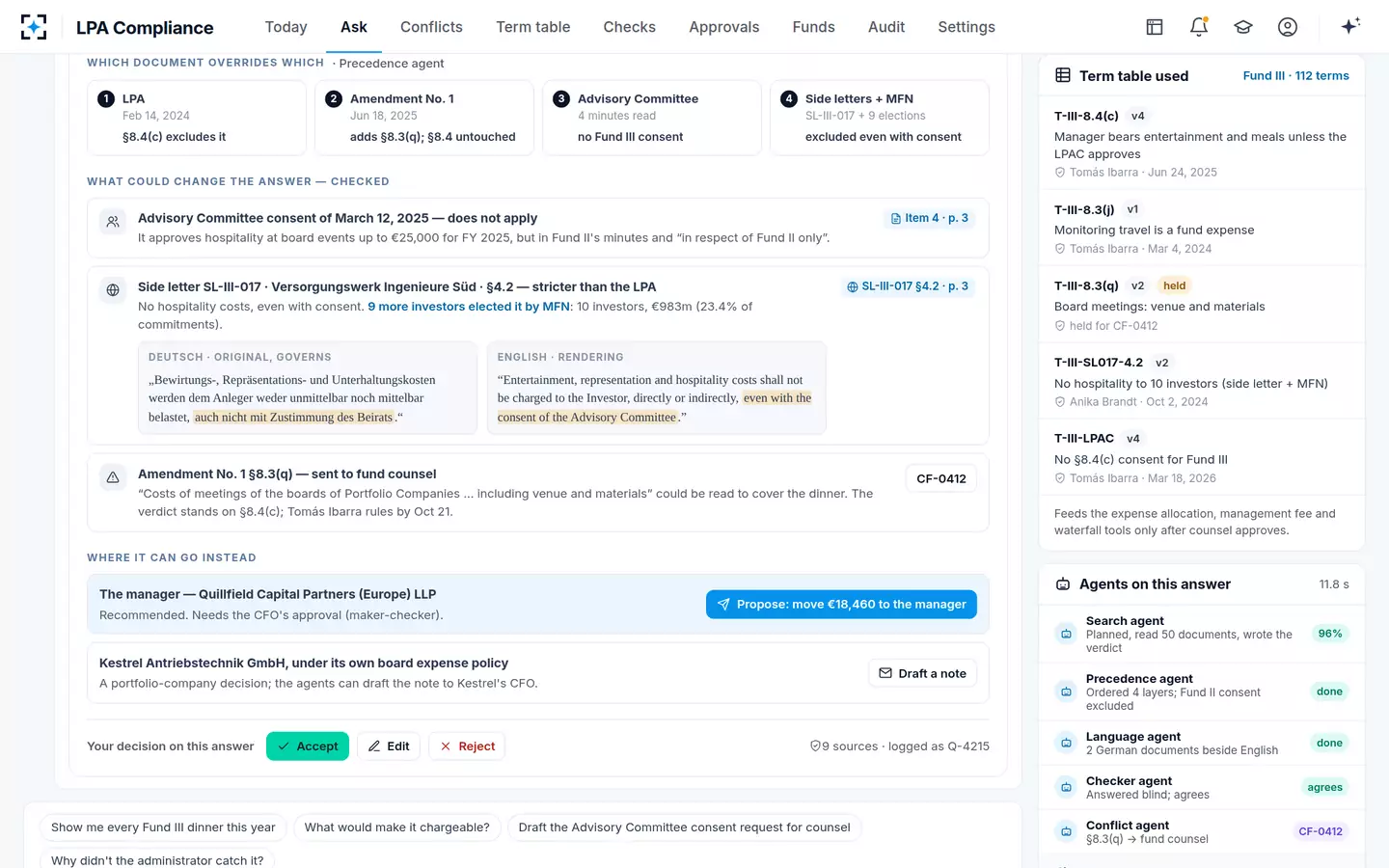
In the sample, the CFO's request for Fund III shows why the sixth item matters. A German side letter, elected by nine more investors under their most-favoured-nation rights, bars hospitality costs for those ten investors "even with the consent of the Advisory Committee," in the English rendering of the governing German text. Ten investors hold €983M, 23.4% of the fund's commitments. Any consent the committee gives for board-event hospitality reaches only the other investors, so the request has to say so.
Do LPAC members owe fiduciary duties?
Often not, and the LPA usually says so. Describing private fund governance in 2023, the SEC wrote that "certain fund agreements state that, subject to applicable law, LPAC members owe no duties to the private fund or to any of the other investors in the private fund and are not obligated to act in the interests of the private fund or the other investors as a whole" (SEC, 88 FR 63206). Delaware permits it: an agreement may restrict or eliminate duties, though not the implied covenant of good faith and fair dealing.
The Commission drew a sharp conclusion from that in its now-vacated rule. Because LPACs "do not generally have a fiduciary obligation to the private fund investors," the rule's consent-based exceptions would have required consent "sought and obtained specifically from fund investors" rather than from the committee. The Fifth Circuit vacated the whole rule on June 5, 2024 (Nat'l Ass'n of Private Fund Managers v. SEC), so committee consent still works wherever the LPA says it does. The doubt the Commission expressed about it is a reason to make each consent's record complete.
LPAC consent and investor consent are not the same approval
Advisory committee consent: A few investors the LPA or the general partner names to the committee.
Investor consent: Limited partners voting by the threshold the LPA sets.
Advisory committee consent: Often no duty to the fund or other investors, if the LPA says so.
Investor consent: Each votes its own interest; no duty is implied.
Advisory committee consent: Only the matters the LPA reserves for the committee.
Investor consent: Matters the LPA reserves for investors, such as amendments or some extensions.
Advisory committee consent: At a meeting or in writing, as the committee’s procedures provide.
Investor consent: Under Delaware’s default, in writing without a meeting by the votes a meeting would need, unless the LPA says otherwise.
Advisory committee consent: May lack “independence, authority, or accountability” to consent to some conflicts.
Investor consent: Preferred for the restricted activities in the 2023 rule, since vacated.
Why sitting on an LPAC does not make an investor a general partner
Delaware protects committee members from a risk limited partners have long had to manage: losing limited liability because a limited partner "participates in the control of the business" (§17-303(a)). Section 17-303 lists what a limited partner may do without that consequence, including "To serve on a committee of the limited partnership or the limited partners or partners," and to act by "proposing, approving, consenting or disapproving, by voting or otherwise," on "A transaction or other matter involving an actual or potential conflict of interest" (6 Del. C. §17-303(b)(7) and (8)(g)).
The safe harbour is broad by design, but it adds no rights. The same section says it "does not create rights or powers of limited partners. Such rights and powers may be created only by a certificate of limited partnership, a partnership agreement or any other agreement or in writing, or other sections of this chapter." What a committee can approve is whatever the LPA gives it, and nothing more.
Does one fund's consent cover another?
No, unless both funds' committees approve, or the LPA of the second fund says otherwise. Conflicts across funds are exactly where scope errors happen. The SEC's 2020 alert lists conflicts from "causing clients to invest at different levels of a capital structure, such as one client owning debt and another client owning equity in a single portfolio company," from cross-transactions priced between clients, and from coinvestment allocations that did not follow the disclosed process. Each fund that bears a conflict needs its own consent, from its own committee.
The sample shows the trap. Quillfield's Fund II committee approved board-event hospitality up to €25,000 on March 12, 2025, and the minutes say "in respect of Fund II only." When a fund accountant asked whether Fund III could pay for a €18,460 board dinner, the consent was the obvious precedent: same manager, same wording in the LPA. The Precedence agent marked it "does not apply," because a consent counts only for its own fund, period and cap, and the Fund III answer came back "Not chargeable."
LPA Compliance marks a consent from another fund as not applying
Who does what: the consent chain inside the manager
A consent passes through five or six hands, and the failures in the SEC's alerts sit at the handovers: a conflict that accounting saw but nobody raised, a request drafted without the amounts, minutes that never reached the people booking the costs. Naming who owns each step is the control.
Six roles around an LPAC consent, and what changes when agents carry the reading
Today
Learns of a conflict at quarter end, after costs are booked; asks counsel whether a consent exists.
With agents
Sees conflicted lines held before booking, with the clause and any consent found; sends the request.
Still theirs: Decides to ask, and approves every cost moved to the manager
Today
Drafts each request from scratch and re-reads the LPA, amendments and minutes every time.
With agents
Reviews a drafted request with the clause, amounts and excluded investors filled in.
Still theirs: Owns the wording and rules on any second reading
Today
Keeps a conflicts log by hand and rebuilds it for an exam.
With agents
Reads each consent’s scope, date and use from the trail.
Still theirs: Owns the conflicts policy and releases the exam file
Today
Receives a summary that says the affiliate “may” provide services.
With agents
Receives the conflict as a fact, with amounts, alternatives and the investors the consent cannot bind.
Still theirs: Votes, or abstains on its own conflict
Today
Books what the administrator sends and asks counsel by email.
With agents
Asks in plain words and gets a verdict citing the consent, or its absence.
Still theirs: Proposes moves; never approves them
Today
Books invoices as received.
With agents
Receives approved corrections with the clause behind them.
Still theirs: Keeps the books
One consent request, from the conflict to the tested lines
Agent
Conflict agentFinds a cost the LPA allows only with consent and no consent in this fund’s minutes.
Never: decides that a consent exists by analogy
Agent
Search agentDrafts the request: clause, conflict, amounts, scope, cap and excluded investors.
Never: sends anything to the committee without counsel
A person decides
Fund counselReviews and approves the wording.
A person decides
Fund CFO and the committeeThe CFO sends it; the committee votes, and its minutes record the scope.
Agent
Precedence agentReads the new minutes and applies the consent only to its own fund, period and cap.
Agent
Expense check agentTests every later line under the consent against its cap and proposes moves for the excess.
Never: moves money
Where LPA Compliance fits in the consent chain
LPA Compliance does not vote, negotiate or decide whether a conflict is acceptable. It reads every committee's minutes alongside the LPA, amendments and side letters; treats each consent as covering one fund, one matter, a period and a cap; and applies it inside every answer about what a fund may pay. When a consent is missing it says so, and when a fund needs one, it drafts the request for counsel.
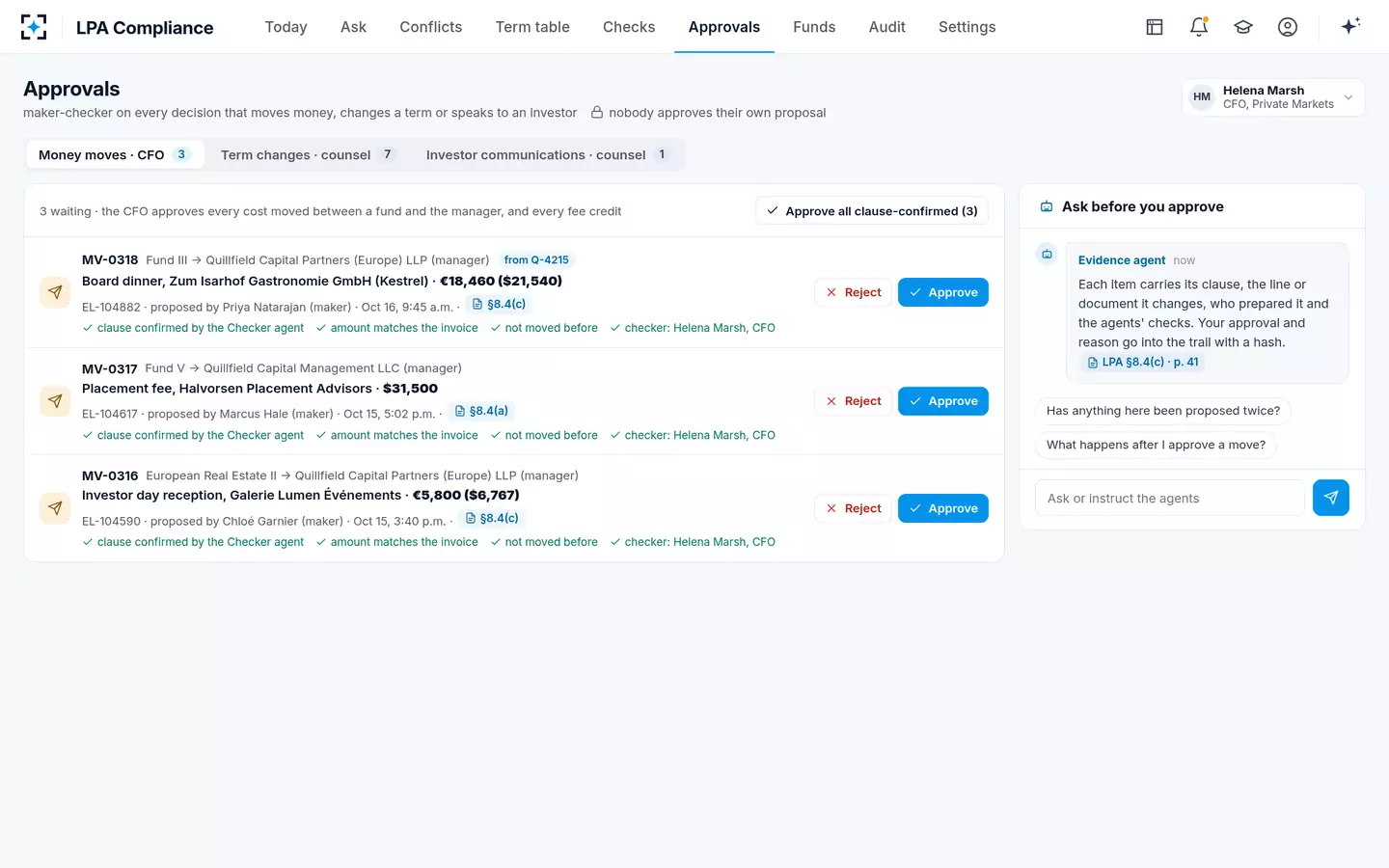
Two settings in the sample keep the people in charge. Counsel approves any investor-facing text before it is sent, and nobody approves their own proposal. Every consent relied on, rejected or requested appears in the audit trail with who acted, when and why, which is the evidence examiners ask for when they test the 2022 finding. Turning each examiner finding into a test with evidence builds that file; the LPA key terms, annotated shows where the committee clause sits among the others. To see a consent applied on the sample funds, start from LPA Compliance.
Approvals: no investor communication leaves without counsel
Questions people ask
Can LPAC consent cure any conflict of interest?
No. Consent opens what the LPA lets the committee open, and the adviser's fiduciary duty continues: as the Commission's 2019 interpretation puts it, quoted by the staff in 2026, disclosure and consent "do not themselves satisfy the adviser’s duty to act in the client’s best interest." Where a conflict cannot be disclosed well enough for informed consent, the interpretation says the adviser should eliminate or mitigate it.
How many members sit on an LPAC?
The LPA sets it, and no regulator or independent study publishes a typical size. What matters for compliance is that the minutes show who voted, whether a quorum was present, and whether any member with its own interest in the matter stood aside, as the LPA requires.
What conflicts usually go to an LPAC?
The SEC names investments in portfolio companies of related funds and engaging a service provider affiliated with the adviser as typical cases; its 2020 alert adds cross-transactions between clients, coinvestment allocations and investments at different levels of one company's capital structure. Many LPAs also reserve specific expenses, investment limit waivers and some extensions for the committee.
Can an LPAC approve something after it has happened?
A committee can ratify, if the LPA allows it, but the SEC's 2022 alert counted consent obtained "until after the transaction had occurred" as conduct inconsistent with fund disclosures. Where the LPA requires approval "in advance," as the sample fund's expense clause does, a later approval does not meet the clause.
Does an LPAC member lose limited liability by voting on conflicts?
Not under Delaware law: serving on a committee and approving or disapproving "A transaction or other matter involving an actual or potential conflict of interest" are listed in 6 Del. C. §17-303(b) as acts that are not participating in the control of the business.
Is LPAC consent the same as a vote of the investors?
No. The committee is a few investors acting under the LPA's committee clause; an investor vote is the limited partners acting by the threshold the LPA sets. The SEC's 2023 rule would have required investor consent rather than committee consent for some activities; it was vacated in June 2024.