A key person clause in a private equity LPA names the individuals whose involvement investors relied on when they committed, usually by requiring them to devote substantially all of their business time to the fund and its manager, and says what happens if they stop: a key person event, which suspends the fund's investment period automatically or lets investors vote to suspend or end it. The clause is short and the consequences are not, because a key person event starts a clock of notices, restricted capital calls, votes and, if the investment period ends, a lower management fee basis. Botminds' LPA Compliance holds the clause in each fund's term table, cited to its page, and tests the calls and fees that follow against it.
The SEC's examiners have found advisers that skipped the process altogether. Examples on this page come from a fictional sample manager whose data runs through the solution, and from an illustrative clause where no regulator or independent study publishes typical terms.
A key person event is a regulated moment, not only a contractual one
60days
after quarter end to report the end of a fund’s investment period on Form PF section 6, under the 2023 amendments
~176
section 6 reports a year the SEC has received since December 2023, across all four reportable events
$150M
of private fund assets, the level at which an SEC-registered adviser must file Form PF today
What is a key person clause?
A key person clause, also called a key man clause, is the LPA provision that ties a fund's ability to make new investments to named individuals: the founders, the senior investment professionals, sometimes a minimum number of a named group. It defines who counts, what involvement they owe (often "substantially all" or a set share of business time), what event triggers the clause, and what follows. It protects investors who chose a fund for its people from paying commitment-based fees to a team that has changed.
It is a governance term, not a fee term, but its consequences land on the fee. That is why it belongs in the quarterly test list next to the fee basis and the offset, and why the LPA key terms, annotated puts it among the ten clauses a CFO tests.
What is a key person event?
A key person event is whatever the clause says triggers it: commonly the death, disability, departure or reduced time commitment of a named individual, or of enough members of a named group that fewer than a set number remain. The trigger is something that happens to people, so the first control is knowing it happened. The SEC staff found advisers that "did not adhere to the LPA “key person” process after the departure of several adviser principals or did not provide accurate information to investors reflecting the status of key previously-employed portfolio managers" (SEC risk alert, January 27, 2022).
The second half of that finding matters as much as the first. A manager that keeps a departed portfolio manager on its fund documents and investor reports is describing a team that does not exist. The Form PF release of 2023 names "the replacement of key fund personnel" among the stress events behind an investor decision to end an investment period (88 FR 38146, June 12, 2023).
The clock after a key person event, day by day
Once the trigger occurs, the clause runs as a sequence with dates. The illustrative clause below is typical in shape, not in numbers: notice to investors within ten business days, then a suspension of the investment period, then a window in which investors may approve a replacement and reinstate it, failing which the investment period ends and the fee basis steps down. Two designs differ on one point, whether suspension is automatic or needs a vote.
The same key person event under two clause designs: the gap is the weeks new deals can still close
- Notice to investors14 d
- Suspended: no new investments; replacement proposed166 d
- Investors reinstate, or the period ends60 d
- Notice to investors14 d
- Vote window: new deals can still close45 d
- Suspended after the vote121 d
- Reinstate, or the period ends60 d
Each phase has an owner and a document. The notice needs a date and a list of recipients; the suspension needs every capital call during it to fit a permitted purpose; the vote needs the threshold and the basis the LPA sets; and the end of the investment period needs the fee recalculated from the right date. A manager that can produce each document, dated, has followed the process. One that cannot is the 2022 finding.
Does a key person event stop capital calls?
Not all of them. A suspension usually stops calls for new investments, while the LPA keeps calls open for management fees, fund expenses, follow-on investments in existing portfolio companies and deals already committed before the event; the exact list is in the clause. A capital call during a suspension is valid only if it fits one of those purposes, and the call notice should say which.
Delaware law supports investors who refuse a call outside the permitted purposes. Under 6 Del. C. §17-502(b)(2), "A conditional obligation of a partner to make a contribution or return money or other property to a limited partnership may not be enforced unless the conditions to the obligation have been satisfied or waived as to or by such partner," and "Conditional obligations include contributions payable upon a discretionary call of a limited partnership or a general partner prior to the time the call occurs" (6 Del. C. §17-502). A call that the clause does not permit during suspension rests on a condition that has not been met. Calls themselves, their notices and wires, are covered by Botminds' Capital Call Processing.
What happens to management fees after a key person event?
During a suspension, most clauses leave the fee where it is; the change comes if the investment period ends. Then the basis usually steps down from commitments to invested capital, and an adviser that misses the step-down overcharges every quarter after. The SEC said so directly when it made investor elections to end an investment period reportable: "an investor election to terminate a fund's investment period is often tied to a change in how management fees are calculated for the remainder of the fund's life," and "An adviser that fails to effectively administer such a change may overcharge management fees--a deficiency that the staff has observed in numerous instances" (88 FR 38146).
Some clauses go further and reduce the fee during a suspension, or offset part of it. Whatever the clause says, the test is the same: recompute the fee from the date the clause names and compare it with what the administrator charged. The SEC staff's June 2026 alert, about retail advisory accounts rather than funds, shows the pattern in another setting: fees charged "for wealth management and advisory services that the advisers did not provide because the personnel managing the accounts departed" (SEC risk alert, June 9, 2026). People leave; fee schedules do not notice unless someone tests them.
Automatic suspension or a vote: what each design asks of the manager
Suspension is automatic: Stop on the event date. Deals in signing need the clause’s carve-out for committed transactions.
Suspension needs an investor vote: Continue until the vote. The manager decides what to close in the window, and investors may later ask why.
Suspension is automatic: Tells investors the period is suspended and what calls are still allowed.
Suspension needs an investor vote: Tells investors they may vote, by when, and on what threshold.
Suspension is automatic: Each call tested against the permitted purposes from day one.
Suspension needs an investor vote: Ordinary until the vote; tested against permitted purposes after.
Suspension is automatic: Often by failure to reinstate within the window.
Suspension needs an investor vote: Often by a second vote, or by the first if the clause allows termination outright.
Suspension is automatic: Event date, notice, every call’s purpose, replacement approval or the end date.
Suspension needs an investor vote: All of that, plus the vote: who voted, on what basis, and the result.
Reporting the end of an investment period: Form PF section 6
Since December 2023, a private equity adviser that files Form PF has had to report the termination of a fund's investment period within 60 days of the end of the quarter in which it happens, alongside adviser-led secondary transactions, general partner removal and fund termination. Form PF is filed by SEC-registered advisers with at least $150 million of private fund assets. The SEC "has received approximately 176 section 6 filings per year since December 2023" (91 FR 22232, April 24, 2026).
That April 2026 release proposes to eliminate section 6, and to raise the filing threshold to $1 billion; comments closed on June 23, 2026 and, as of late October 2026, no final rule had been published. Until one is, a key person event that ends an investment period can carry a filing deadline as well as a fee change, and the compliance calendar should show both.
What a key person clause must define
Most disputes about a key person event are disputes about words the clause did not define. "Substantially all" business time, "involved in" the fund, a replacement "approved by" the committee or by investors: each needs a test someone can apply on a date. A clause drafted, or abstracted, with these answers is one the finance team can run without asking counsel every time.
Eight things a key person provision should answer, and the test each gives the finance team
- Who the key persons are
Named individuals, or a group and the minimum number that must remain; and whether a replacement becomes a key person.
- What involvement they owe
A share of business time, or duties to this fund and its successors, so a quarterly check has something to measure.
- What triggers the event
Death, disability, departure, reduced time, removal for cause; and from which date the event runs.
- Who must be told, and by when
Investors, the committee or both, within a stated number of days, with what content.
- Whether suspension is automatic
Or needs a vote; and if a vote, the threshold and the basis.
- Which calls survive the suspension
Fees, expenses, follow-ons, committed deals; anything else is a conditional call that has not been earned.
- How the period is reinstated or ends
Replacement approval, the window, and what happens on silence.
- What happens to the fee
Any reduction during suspension, and the step-down date if the period ends.
Where LPA Compliance fits after a key person event
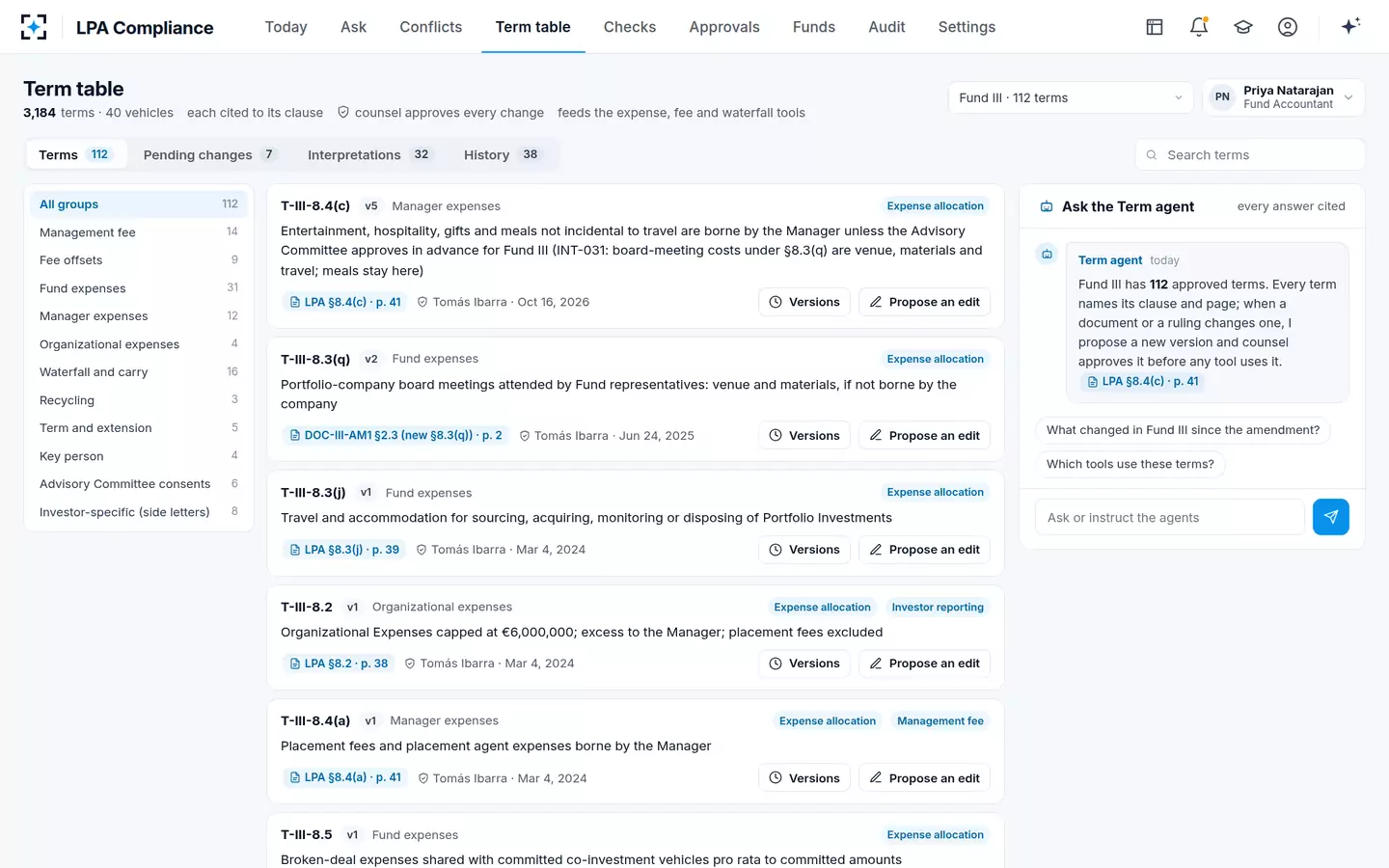
LPA Compliance does not track who works where; the departure itself is something the manager tells it. What it does is hold the clause and apply it. In the sample, Fund III's 112 terms sit in 11 groups, and key person is one of them, with four terms each cited to clause and page. When the event is entered, a fund accountant can ask whether a given call or expense is allowed during the suspension and get a verdict citing the clause, or a referral to counsel if the words can be read two ways.
A key person event in LPA Compliance: the agents read and test, people decide and send
A person decides
General partner and CCOConfirm the event and its date; the manager tells the agents.
Agent
Search agentReads the key person terms and lists what follows: notice, suspension, permitted calls, the vote, the fee.
Never: decides that the event has not occurred
Agent
Conflict agentSends undefined words, such as “substantially all” time, to counsel with both readings.
Never: resolves a reading itself
A person decides
Fund counselRules once, in writing; approves the investor notice before it is sent.
Agent
Expense check agentTests each call and fee during the suspension against the permitted purposes, and recomputes the fee if the period ends.
Never: moves money
A person decides
CFOApproves any correction to a call or fee; the CCO tracks any Form PF deadline.
LPA Compliance: key person terms sit in each fund's term table, cited and approved
The fee check is where the clause usually pays for itself. The Expense check agent recomputes management fees from the approved terms and compares them with the administrator's; in the sample quarter, 38 of 40 vehicles agreed, and the two differences went to counsel with the clause behind each. A step-down missed after an investment period ends would surface the same way, as a difference with a date and a clause. The extension fee in the sample, billed at the full rate where the LPA gives half, is the same kind of error, and the fund term extension guide follows it.
The fund accountant's morning in LPA Compliance: what the agents found overnight
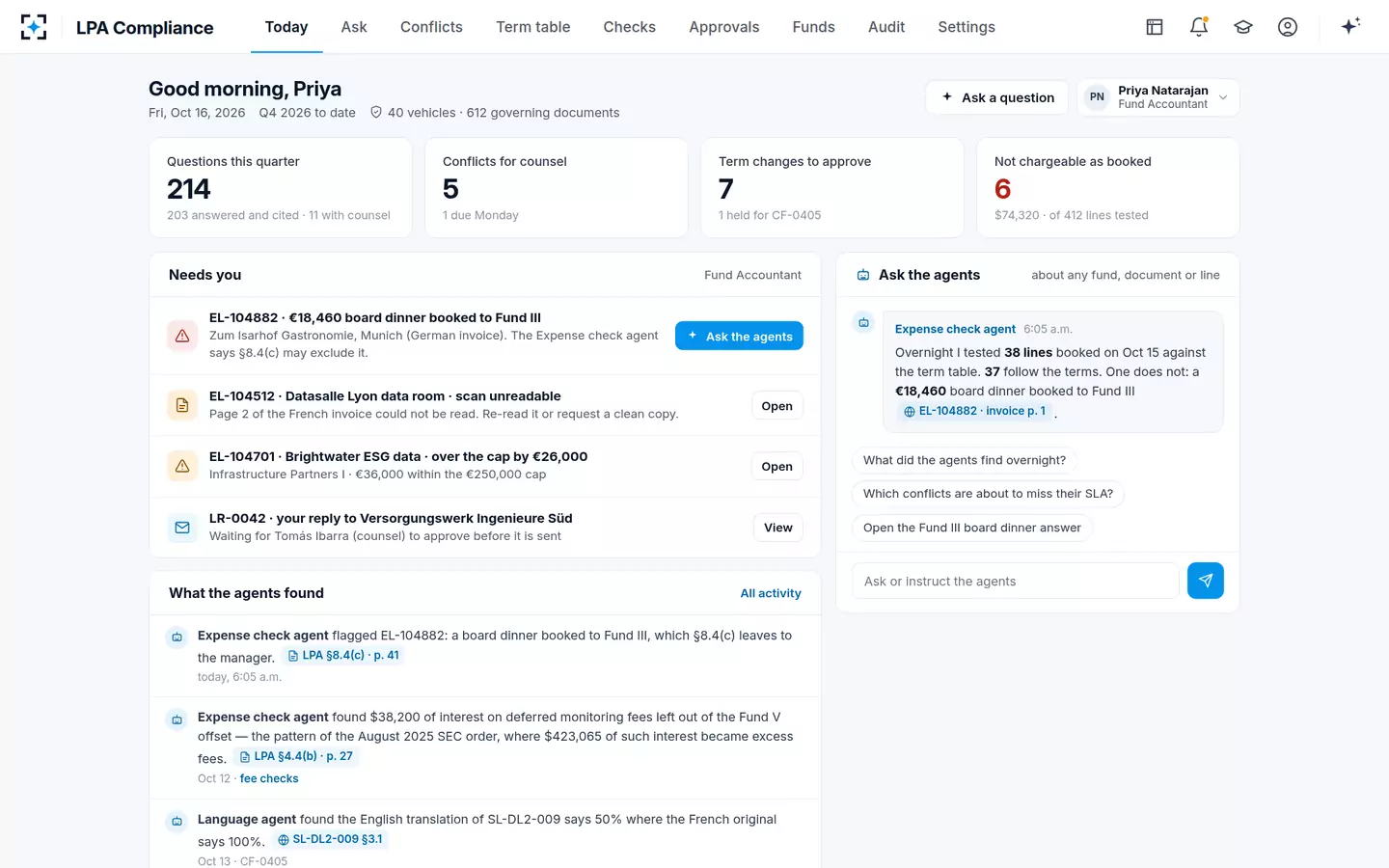
To see the term table and the fee checks on the sample funds, start from LPA Compliance; the examiner's view of the same finding sets out the evidence to keep.
Questions people ask
Is a key man clause the same as a key person clause?
Yes; "key man" is another name for the same clause, and the SEC's 2022 risk alert uses "key person." Both describe the LPA provision that ties new investments to named individuals and sets out what happens if they leave or reduce their involvement.
Can a key person be replaced?
Usually, if the clause provides a way: commonly a replacement approved by the advisory committee or by investors at the threshold the LPA sets, after which the suspension lifts. Delaware lets the LPA set that threshold on any basis, from a majority in interest to a vote by class (6 Del. C. §17-302(b)).
Do investors have to be told about a key person event?
The clause normally requires notice within a stated time, and the SEC's 2022 alert treats inaccurate information about "the status of key previously-employed portfolio managers" as a failure to follow fund disclosures. Telling investors late, or describing a departed manager as still in place, is the finding.
Does a key person event end the fund?
Normally not: it suspends or ends the investment period, while the fund keeps managing and selling what it owns until its term runs out. Delaware's list of dissolution causes includes the time and the events the partnership agreement specifies (6 Del. C. §17-801), so a key person event ends the fund itself only if the LPA makes it a dissolution event.
Does a key person event have to be reported to the SEC?
Not as such. If it leads to the end of a fund's investment period, a private equity adviser filing Form PF reports that in section 6 within 60 days after the quarter end, under the 2023 amendments; the SEC proposed on April 24, 2026 to eliminate section 6, and the proposal was not final as of October 2026.