An LPA compliance checklist lists the tests a private fund manager runs to show that what each fund pays, in fees and expenses, and what it does, in consents, limits and extensions, follows its limited partnership agreement as amended. A useful one has twelve or so tests, each tied to a clause type, and each can fail. The hard part is not writing the list; it is running it on every line and fee rather than a quarter-end sample, and measuring whether it works. The SEC prices the failures: its orders for missed fee step-downs, offsets and expense allocations run from about half a million dollars of excess fees to $17.4 million of misallocated costs. Botminds' LPA Compliance runs the tests continuously against a term table counsel approves, and reports the measures each quarter.
Programme figures below come from a fictional sample manager, Quillfield Capital, as it runs through the solution, and from a Botminds estimate where stated.
LPA compliance KPIs on one page: coverage, control and outcome
Nothing borne by investors that the fund documents do not allow, and proof of it
Coverage
Did we test everything?
Expense lines tested
all 2,318 in the quarter
Vehicles with fees recomputed
40 of 40
Governing documents read into the term table
612 across 40 vehicles
Control
Did people decide what mattered?
Answers a second, blind reading disagreed with
23 of 1,012, each decided by a person
Questions sent to counsel
51; 19 conflicts ruled
Moves to the manager approved by the CFO
44, each with clause and reason
Outcome
What did we find before investors bore it?
Moved to the manager before investors bore it
$612,400
Fee differences with the administrator
2, $810,700, with counsel
Flagged lines kept on the fund, with a reason
27
What is LPA compliance?
LPA compliance is the work of making a fund's money and decisions follow its limited partnership agreement, as changed by amendments, narrowed by side letters and opened by advisory committee consents. In practice it is two questions asked thousands of times a year: may this fund pay for this, and was this fee calculated as the agreement says? The answers live in a set of documents, not one, and the questions arrive at booking, at fee time and at quarter end.
It sits between functions. Fund accounting books the lines, the administrator calculates the fees, fund counsel reads the documents and the chief compliance officer answers to the examiner. A checklist is the contract between them: which test runs, on what, how often and who signs.
What are the LPA compliance requirements?
There is no single LPA compliance rule; the requirements come from three places. The fund's own documents set the terms. Rule 206(4)-8 makes it fraudulent for an adviser to a pooled vehicle to mislead its investors or prospective investors, by statement or omission, or to "engage in any act, practice, or course of business that is fraudulent, deceptive, or manipulative" toward them (17 CFR 275.206(4)-8). And the compliance rule requires a registered adviser to adopt and apply written policies and procedures designed to prevent breaches of the Advisers Act, and to review them at least once a year (17 CFR 275.206(4)-7).
The SEC's examiners tell advisers where to look. The 2020 and 2022 private fund risk alerts list fee, expense, consent, extension, recycling and key person failures, and the fiscal 2027 priorities single out fee and expense calculations, at the level of the fund and of each investment (SEC, October 23, 2026). Together they amount to the private equity compliance requirements a checklist has to cover.
The LPA compliance checklist: twelve tests
Each test below names the clause it reads and the failure it prevents. The first five are about money that leaves a fund; the next five about permissions and limits; the last two about whether the documents being tested are the right ones.
Twelve tests for an LPA compliance programme, each one able to fail
- Management fee basis
Recompute each period from commitments or invested capital, reduced for dispositions, write-downs and write-offs as defined. Failure found: 2022 alert; EDG, EIC and Insight orders.
- Fee offsets and their exclusions
Every portfolio company fee received, by the manager or affiliates, matched to the offset. Failure found: 2020 alert; Global Infrastructure and TZP orders.
- Expense chargeability
Every booked line against the fund and manager expense lists. Failure found: 2020 alert.
- Shared expense allocation
Each shared cost split across funds, co-investors and the manager by the disclosed method. Failure found: 2020 alert; KKR order.
- Expense caps
Running totals against each cap; the line that crosses it split. Failure found: 2020 alert.
- Advisory committee consent
Each conflicted transaction against a consent dated before it, for this fund, in scope and cap. Failure found: 2022 alert.
- Investment and leverage limits
Each investment and borrowing against the limits on its date. Failure found: 2022 alert.
- Term and extensions
Each extension against the approving body, the date and the cap; the extension fee rate. Failure found: 2022 alert.
- Recycling
Each distribution decided recallable or not when paid; the cap as a running total. Failure found: 2022 alert.
- Key person
Named persons against who is in place each quarter; the process run after an event. Failure found: 2022 alert.
- Side letters and elections
Each fund-wide charge checked against investors whose side letter, or election of one, excludes it.
- The document set itself
Every amendment, side letter and consent reflected in the terms before they are used, with counsel’s approval.
Tests 11 and 12 are the ones most programmes leave implicit. Side letters change who may be charged; side letter administration itself is covered by Botminds' Side Letter Management. And a test run against an abstract written at final close is a test of the abstract. The LPA key terms, annotated shows each clause the tests read.
What each test is worth: the SEC orders that price them
The value of a test is the error it would have caught, and the Commission's orders put numbers on six of them. Each case below is one LPA term applied wrongly for years; in each, the order repays investors and adds a penalty.
Six SEC orders, the LPA term each turned on, and what it cost
| Order | The LPA term | Excess fees or misallocation | Civil penalty |
|---|---|---|---|
| KKR, IA-4131 (June 29, 2015) | Broken-deal expenses shared with co-investors | $17.4M misallocated; $18,677,409 disgorgement and interest | $10,000,000 |
| EDG Management, IA-5617 (Oct. 22, 2020) | Fee basis reduced for write-downs | $901,760.91 overpaid | $175,000 |
| Global Infrastructure, IA-5930 (Dec. 20, 2021) | Portfolio company fees offset against the management fee | Remediated voluntarily before the order, in several amounts | $4,500,000 |
| EIC, IA-6104 (Sept. 2, 2022) | Fee basis reduced for dispositions, including write-downs | About $679,000 of excess fees | $175,000 |
| Insight, IA-6332 (June 20, 2023) | Fee basis reduced for “permanent impairment” | $773,754.41 of excess fees | $1,500,000 |
| TZP, IA-6908 (Aug. 15, 2025) | Fee offset of transaction fees, with listed exclusions | $502,041 of excess fees | $175,000 |
The penalties vary more than the errors. A missed write-down cost EDG a $175,000 penalty on $901,760.91 of overcharges; Insight paid $1,500,000 on $773,754.41, in a case that also found the criteria behind the fee basis were never disclosed. The disclosure and the policies around a term weigh as much as the arithmetic, which is why the checklist's evidence matters as much as its results.
How long an untested error runs
The orders share a second pattern: the errors ran for years. A term misread in the first quarter of a fund's post-commitment period stays misread until someone tests it, and a quarter-end sample can miss it every quarter. The time between the error ending and the order is the investigation; the time before is what a programme controls.
Six orders: years each LPA error ran, then the years to the SEC's order
- Error ran, Dec 2009 – Mar 20199.3 yrs
- Then to the order: 2.7 yrs
- Error ran, 2006 – 20116 yrs
- Then to the order: 3.5 yrs
- Error ran, Oct 2018 – Nov 20235.2 yrs
- Then to the order: 1.7 yrs
- Error ran, Aug 2017 – Apr 20213.8 yrs
- Then to the order: 2.1 yrs
- Error ran, Jan 2016 – Oct 20193.8 yrs
- Then to the order: 1.1 yrs
- Error ran, Jan 2020 – Mar 20222.2 yrs
- Then to the order: 0.4 yrs
A test that runs every fee period would have met each of these errors in its first quarter. That is the economic case for continuous testing in one sentence: the cost of an LPA error grows with every period it runs, and the cost of the test does not.
How do you measure LPA compliance?
With three kinds of measure: coverage, control and outcome. Coverage says whether the programme looked at everything it should: the share of expense lines and fee calculations tested, and the share of governing documents reflected in the terms. Control says whether people decided what mattered: how often a second reading disagreed, how many questions went to counsel and how fast they came back, how many moves were approved and by whom. Outcome says what the programme found and when: money moved before investors bore it, fee differences resolved, findings that repeat.
Two measures deserve particular attention. Disagreements between two independent readings show where the documents are hard, not where the readers are weak; a rising count in one fund points to a clause that needs a ruling. And repeat findings, the same error in the same fund a second quarter, show whether a correction reached the cause or only the line.
How often should LPA compliance be tested?
At the cadence of the money: each line when it is booked, each fee each period, each consent at booking, each distribution when it is paid, and the whole programme once a year in the annual review the compliance rule requires. Quarter-end sampling is a common substitute; it finds errors after investors have borne them and cannot show the untested lines were right.
The sample manager's experience shows what changes with coverage. Testing every line, the third quarter's 2,318 expense lines produced 44 moves to the manager, 27 lines flagged and kept on the fund by a person with a reason, and two fee differences sent to counsel.
One sample quarter, every line tested: $612,400 moved before investors bore it
Who owns LPA compliance at a private fund manager?
Ownership is split, and the checklist should say how. The CFO owns the money: approving every cost moved between a fund and the manager and signing the quarter. Fund counsel owns meaning: approving each change to a term and ruling on every clause that can be read two ways. The chief compliance officer owns the programme: its tests, thresholds and the exam file. Fund accountants run the questions and propose corrections; the administrator keeps the books.
What breaks a programme is a test nobody owns. In the sample, each person's role is written into the approvals: nobody approves their own proposal, a change counsel proposes to their own term goes to a second counsel, and moves above €250,000 need a second approver as well as the CFO.
What a programme costs to run, by hand and with agents
No regulator or independent study publishes what LPA compliance costs a manager, so the figure below is Botminds' estimate for one profile: about 1,000 "is this chargeable?" questions and 2,300 booked expense lines a quarter. Measure your own hours on the same six tasks before comparing.
Where a quarter's LPA compliance hours go: 640 by hand, about 116 with the solution
- Answering “is this chargeable?”330 h
- Evidence for an exam or audit120 h
- Quarter-end testing80 h
- Side letters, offsets, extension fees, report110 h
- Answering: 60 h
- Testing: 20 h
- Evidence: 10 h
- Side letters, offsets, extension fees, report: 26 h
Where LPA Compliance fits in the programme
LPA Compliance runs tests 1 to 12 against a term table counsel approves, at the cadence of the money: overnight on new lines, each fee period on the administrator's calculations, and on demand when someone asks. It reports the coverage, control and outcome measures each quarter from the same trail examiners can follow. It does not set the thresholds or own the programme; the CCO does, and changes to the agents and thresholds are versioned and approved before they take effect.
Expense checks in LPA Compliance: every booked line tested, not a sample
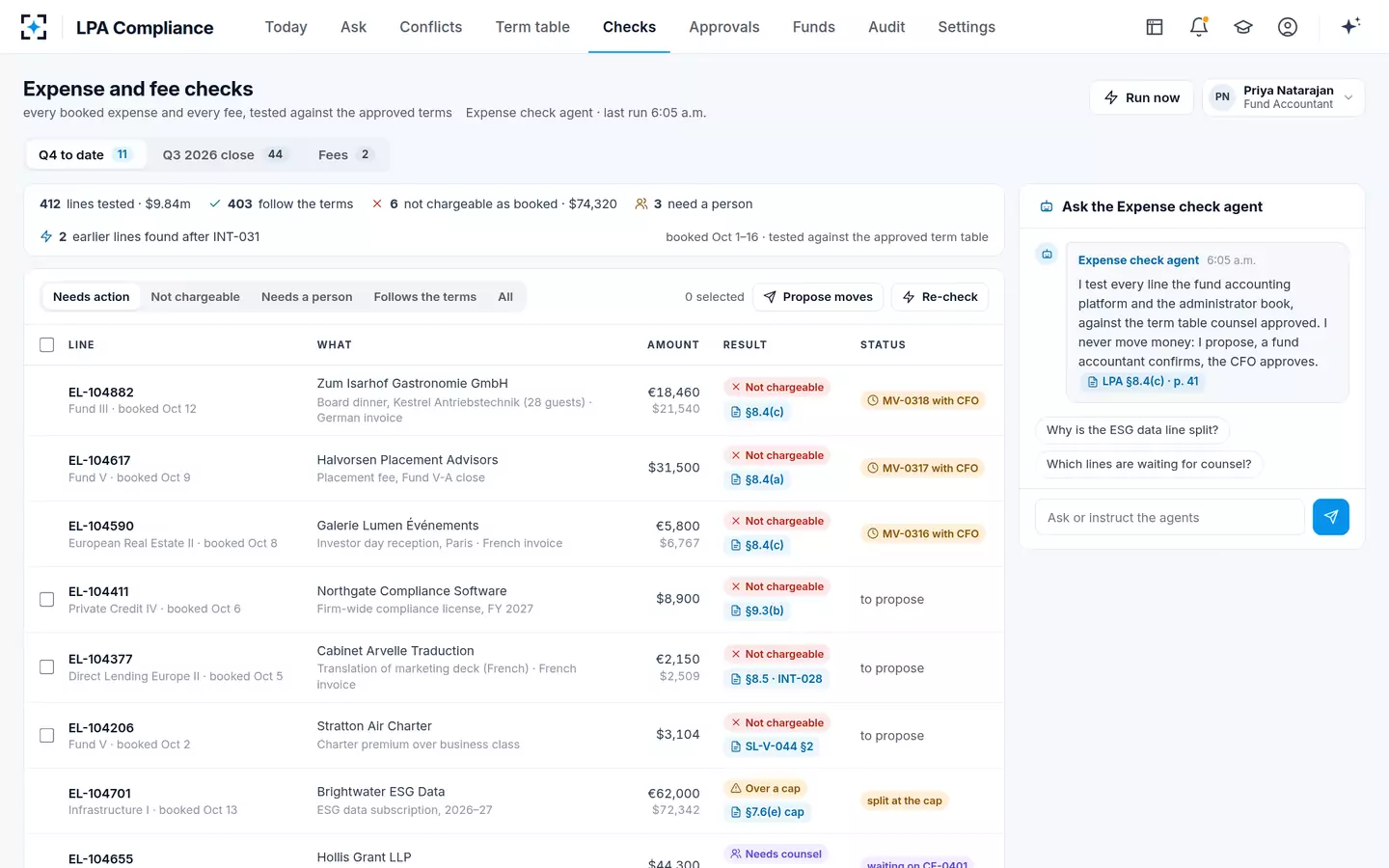
Two tests depend on information the solution does not hold: who works where for the key person test, and investment and borrowing data for limits where the fund accounting platform does not carry them. Both come from the manager's systems. The examiner's view of each test lists the evidence it should leave, and where LPA compliance fits beside private equity software maps the data each test reads. To see the sample quarter, start from LPA Compliance.
The quarterly LPA compliance report, with sign-off from the CCO to the CFO
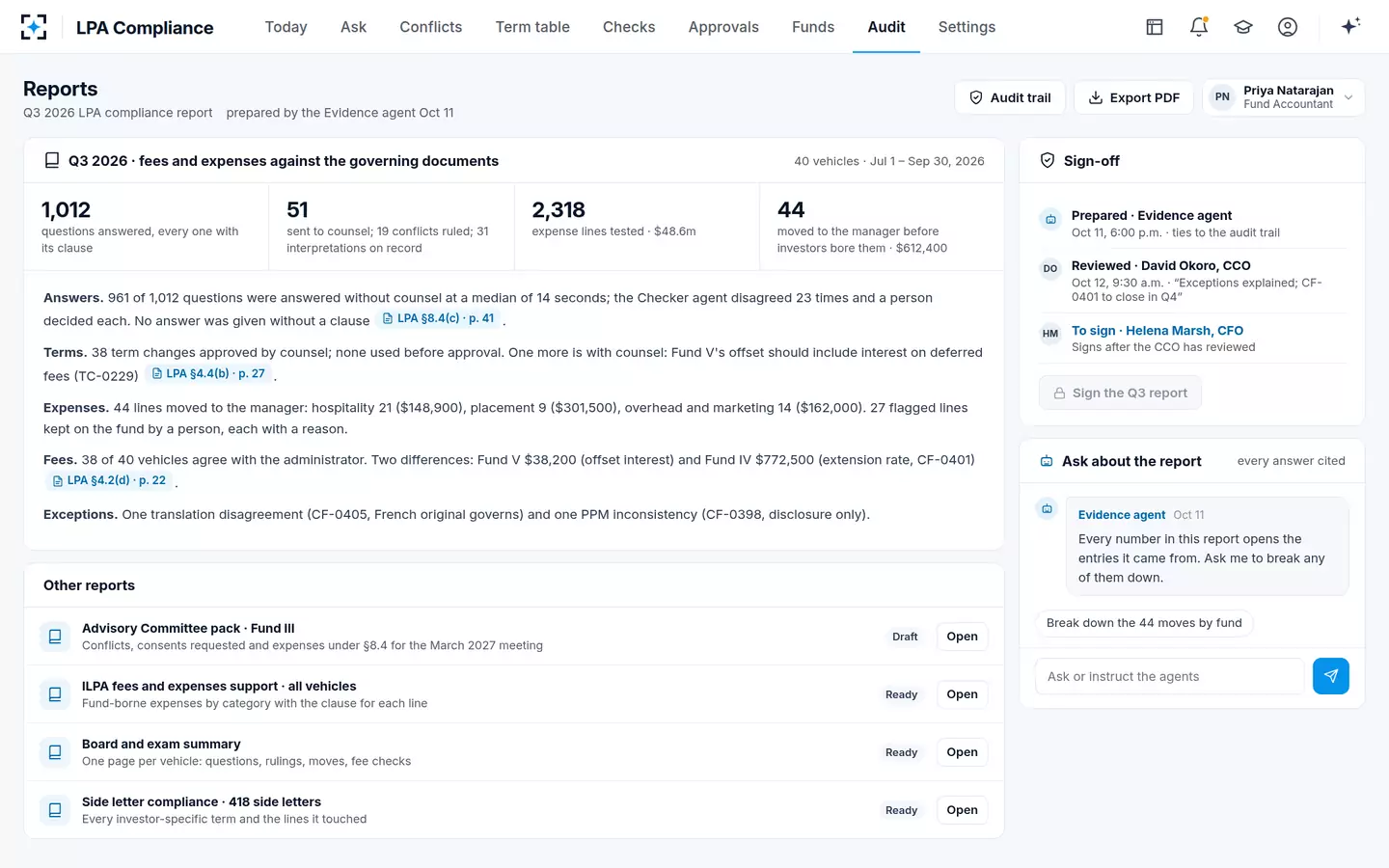
Questions people ask
What does an LPA compliance failure cost?
In the SEC orders on this page, the excess fees or misallocations ran from about $500,000 to $17.4 million, with civil penalties from $175,000 to $10 million, on top of repayment with interest. The cost of the investigation and of re-testing years of history is not in the orders, and no regulator publishes it.
Is a quarter-end sample enough?
It tells you whether errors exist in what you sampled. It cannot show the other lines were right, and it finds errors after investors have borne them; every error in the six orders above ran for more than two years.
Should the checklist cover side letters?
Yes, at least as a test of who may be charged: a fund-wide cost can be barred for investors whose side letter, or election of one, excludes it. In the sample, one German side letter and nine elections protect ten investors holding 23.4% of a fund's commitments from hospitality costs, even with committee consent.
Who should see the measures?
The CFO and the CCO each quarter, fund counsel for the rulings and term changes, and the annual review under Rule 206(4)-7. Many managers also report fees and expenses to investors and the advisory committee; the measures make that report checkable.
Can the checklist be automated?
The tests can; the decisions should not be. Agents can read the documents, test every line and fee and propose corrections, while counsel rules on meaning and the CFO approves money moves, which is how the sample firm divides the work.