The key terms of a private equity LPA, the limited partnership agreement between a fund's general partner and its investors, are the clauses that decide money and permission: the management fee and how its basis falls, the fee offset, the lists of fund and manager expenses and their caps, the advisory committee's consents, the investment limits, the fund's term and extensions, recycling and the key person provision. They are hard to keep because the LPA is never alone: amendments change it, side letters narrow it for some investors, consents open it for a single transaction, and an abstract written at final close goes stale with each. Botminds' LPA Compliance exists for that gap: it reads the whole document set, keeps each key term cited to its clause, and tests every booked fee and expense against the version in force.
Examples come from a fictional sample manager as it runs through the solution, Quillfield Capital, with 40 vehicles and 612 governing documents.
The LPA is the rulebook for a very large market
27,682
private equity funds reported to the SEC at the end of 2025, of 58,891 private funds
$8.5T
net assets of the private equity funds reported on Form PF, fourth quarter 2025
5+yrs
of SEC examinations behind the staff’s 2020 and 2022 lists of private fund failures
What is an LPA in private equity?
An LPA in private equity is the limited partnership agreement: the contract that creates the fund's partnership and sets every partner's rights and duties, from how capital is called to how the general partner is paid. Many are Delaware limited partnerships, as was the fund in the SEC's 2020 order against EDG Management, and Delaware's statute hands the agreement unusual power. "It is the policy of this chapter to give maximum effect to the principle of freedom of contract and to the enforceability of partnership agreements" (6 Del. C. §17-1101(c)).
That freedom reaches as far as fiduciary duty. Under §17-1101(d), duties "may be expanded or restricted or eliminated by provisions in the partnership agreement; provided that the partnership agreement may not eliminate the implied contractual covenant of good faith and fair dealing." So the question "may the fund pay for this?" is answered by reading the agreement, not by a general standard of fairness. And the agreement is wider than one signed PDF: Delaware defines a partnership agreement as "any agreement, written, oral or implied, of the partners as to the affairs of a limited partnership and the conduct of its business" (§17-101(14)).
The SEC reads private fund conduct against the same text. In its August 2025 order against TZP Management Associates, the Commission noted that the LPAs "contain the operative language for calculating, among other things, the management fees" the adviser could charge, and then found $502,041 of excess fees because the adviser's practice did not match that language (SEC order IA-6908). The LPA is not background. It is the test.
What is the difference between an LPA and a PPM?
The LPA is the contract; the private placement memorandum (PPM) is the offering document that describes the fund to prospective investors. When the two disagree about what the fund may pay, the agreement decides the partners' rights. The PPM still matters to the regulator: Rule 206(4)-8 makes it fraudulent for an adviser to a pooled vehicle to make "any untrue statement of a material fact" to an investor or prospective investor (17 CFR 275.206(4)-8), so a PPM that describes a practice the LPA does not allow is its own problem.
The SEC's examiners do not choose between the documents. Their 2022 list of failures measured advisers against "limited partnership agreements (“LPAs”), operating agreements, private placement memoranda, due-diligence questionnaires, side letters or other disclosures," which the staff calls "fund disclosures" (SEC risk alert, January 27, 2022). A compliance test that reads only the LPA misses the promises made elsewhere.
Five documents that together say what a fund may do
| Document | What it is | What it can change | What to test it for |
|---|---|---|---|
| LPA | The partnership contract, signed at first close and restated or amended later. | Everything, within Delaware law and its own amendment clause. | Each key term, against every booked fee and expense. |
| Amendments | Changes agreed under the LPA’s amendment clause. | The clauses they name; the rest stays as it was. | Which version of each clause was in force on the date of each line. |
| Side letters | Agreements between the fund and one investor. | How the LPA applies to that investor, and to others who elect the terms. | Whether a fund-wide charge reaches an investor whose letter excludes it. |
| LPAC minutes | The advisory committee’s consents and recommendations. | Only what the LPA lets the committee approve, for its own fund. | Date, scope, cap and fund of every consent relied on. |
| PPM | The offering memorandum. | Nothing in the contract; it describes it. | Statements that differ from the LPA or from practice. |
The private equity LPA key terms, annotated
Ten clauses decide almost every question a fund's finance team is asked about money or permission. Each one below shows what it decides, the test a CFO can run on it every quarter, and where SEC examiners or the Commission found a manager that had not followed it. The section names are generic; every LPA numbers them differently.
Ten LPA key terms: what each decides, the quarterly test, and where examiners found it broken
01Management feeFee rate, basis, step-down
What it decidesWhat the fee is charged on: commitments while the fund invests, then invested capital, reduced for what has been sold, written off or written down.
The quarterly testRecompute the fee from the basis the clause names, every period, and compare it with what was charged.
Where it was found brokenFees after the commitment period not reduced as the disclosures described (SEC, 2022).
02Fee offsetPortfolio company fees
What it decidesWhich fees the manager and its affiliates receive from portfolio companies, what share comes off the management fee, and what is excluded.
The quarterly testList every portfolio company fee received, including by affiliates, and match it to the offset; read the exclusions as a closed list.
Where it was found brokenOffsets not applied or miscalculated (SEC, 2020); interest on deferred fees left out (TZP order, 2025).
03Fund expensesWhat the fund bears
What it decidesThe costs the fund pays, usually as a list with a catch-all.
The quarterly testTest each booked expense line against the list, not a sample of them.
Where it was found brokenShared costs allocated inconsistently with disclosures (SEC, 2020).
04Manager expensesWhat the manager bears
What it decidesThe costs the fund may not pay: overhead, salaries, often entertainment unless approved.
The quarterly testLook for manager-only costs booked to the fund, and for approvals the exception needs.
Where it was found brokenAdviser salaries, compliance and office costs charged to funds (SEC, 2020).
05CapsOrganizational and other limits
What it decidesHow much of a category the fund may bear before the excess moves to the manager.
The quarterly testKeep a running total against each cap and split the line that crosses it.
Where it was found brokenContractual limits on legal and placement agent fees exceeded (SEC, 2020).
06Advisory committeeLPAC consents
What it decidesWhich conflicts need the committee’s consent, and how it is given.
The quarterly testMatch every conflicted transaction to a consent dated before it, given on full information.
Where it was found brokenConsent obtained after the fact, or on incomplete information (SEC, 2022).
07Investment limitsStrategy, concentration, leverage
What it decidesWhat the fund may buy and how much it may borrow.
The quarterly testTest each new investment and each borrowing against the limits at the date it was made.
Where it was found brokenStrategy diverged from disclosures; leverage limits exceeded (SEC, 2022).
08Term and extensionFund term, extensions, liquidation
What it decidesWhen the fund ends, who may extend it, and the fee during an extension.
The quarterly testCheck each extension’s approval against the clause, and the fee rate charged after it.
Where it was found brokenTerms extended without the required approvals (SEC, 2022).
09RecyclingReinvesting proceeds
What it decidesWhich proceeds may be added back to commitments, until when, and how much.
The quarterly testDecide each distribution when it is made, and keep unfunded commitments right.
Where it was found brokenRecycling practices described inaccurately; excess fees possible (SEC, 2022).
10Key personNamed individuals, suspension
What it decidesWho must stay involved, and what happens to new investments if they do not.
The quarterly testCompare the named people with who is actually there, each quarter, and run the process if the test fails.
Where it was found brokenKey person process not followed after principals left (SEC, 2022).
Read the last column as a map of risk. Six of the ten failures come from one SEC document, the 2022 risk alert, under a single heading: "Conduct Inconsistent with Disclosures." None required a new rule to find. Each was a manager whose practice drifted from words it had already signed.
An abstract of the LPA is right on the day it is written. A key term is right only in the version in force on the day the money moved.
Fees: the basis, the step-down and the offset exclusions
The management fee clause names a rate and a basis, and the basis is where the money moves. A typical structure, as the SEC staff describe it, charges a percentage of commitments while the fund deploys capital and then a percentage of invested capital, reduced for dispositions, write-downs and write-offs. In TZP's nine funds the LPAs set "between 1% and 2% of the LPs’ total committed capital during the commitment period and between 1% and 2% of invested capital for the remainder of the respective Fund’s term" (IA-6908).
The offset clause is shorter and easier to misread. TZP's LPAs credited all transaction, advisory and monitoring fees against the management fee, with a short list of named exclusions. The adviser treated interest it charged portfolio companies on deferred fees as outside the offset, and the Commission's answer turned on the list: the interest was not one of the named exclusions, so it belonged in the offset. Of $701,522 of such interest, $423,065 should have increased the offsets. Read an exclusion list as closed unless the LPA says otherwise, and test the offset against every fee the manager and its affiliates received, not just the ones the deal team remembers.
The arithmetic of offsets, step-downs and post-commitment bases is its own discipline; Botminds' Management Fee Calculation recomputes it. For LPA compliance the point is narrower: the fee clause and the offset clause must be read together, in their current versions, before anyone checks a number.
Expenses: two lists, a cap, and the line between them
Most LPAs have two expense lists: what the fund bears and what the manager bears, each with a catch-all. The hard lines sit between them. A board dinner for a portfolio company can be a cost of a board meeting, which many funds bear, or entertainment, which many leave to the manager unless the advisory committee approves. In the sample, Quillfield's Fund III LPA puts "entertainment, hospitality and gift expenses, including meals not incidental to travel" on the manager unless the advisory committee approves them in advance; a later amendment made board-meeting venue and materials a fund expense. Two clauses, one €18,460 dinner, a question for fund counsel.
The SEC's 2020 alert found the same seams at scale: shared costs such as broken-deal and annual meeting expenses split in ways the disclosures did not describe; the adviser's own staff, compliance and office costs charged to funds; contractual caps on legal and placement agent fees exceeded; and advisers that did not follow their own travel and entertainment policies (SEC risk alert, June 23, 2020). Caps need a running total: Fund III's organizational expenses are capped at €6,000,000 in the sample, and the line that crosses a cap is split, not passed. Allocation across funds and co-investors belongs to Botminds' Fund Expense Allocation; whether a cost is chargeable at all is an LPA question.
Governance terms: consents, key persons, the fund's term and recycling
Four clauses decide permission rather than price, and the 2022 alert found managers failing every one. The advisory committee clause lists the conflicts that need consent; consent given after the transaction, or on incomplete information, was a finding, and what LPAC consent requires is set out in a guide of its own. The key person clause names the people investors are paying for and what happens when they go; the staff found advisers that let the key person process lapse after principals left, and the clock after a key person event follows one through.
The term clause sets when the fund ends and who may extend it; examiners saw private equity funds extended "without obtaining the required approvals," with management fees charged as a result. The recycling clause lets a fund add realized proceeds back to commitments, and the staff found recycling described inaccurately to investors, with excess management fees as a possible result (SEC, 2022). Which distributions can come back works through the test for each distribution.
A CFO's quarterly test list for the LPA key terms
- Fee basis matches the clause in force
Commitments or invested capital, reduced for every disposition, write-down and write-off the clause names, from the date it names.
- Every portfolio company fee reaches the offset
Including fees paid to affiliates and interest on deferred fees, unless the exclusion list names them.
- Every expense line, not a sample
Each line tested against the fund and manager lists; manager-only costs moved before investors bear them.
- Caps carry a running total
The line that crosses a cap is split, and the excess goes to the manager.
- Consents predate what they approve
Each conflicted transaction has a consent of an earlier date, for this fund, within its scope and cap.
- Limits tested at the date of the act
Concentration, strategy and leverage limits checked when an investment or borrowing is made.
- Term, extension and fee rate agree
An extension has the approval the clause requires, and the fee charged after it uses the extension rate.
- Recycled amounts are designated and capped
Each recallable distribution was designated when made, and unfunded commitments were restored correctly.
- Key persons are where the clause needs them
Named individuals still devote the time the clause requires; if not, the notice and suspension steps have started.
- The version in force is the one tested
Every test uses the clause as amended, narrowed by side letters and opened by consents on that date.
Can an LPA be amended, and which document wins?
Yes. An LPA is amended under its own amendment clause, which usually sets the investor vote needed and lists changes that need every affected investor; Delaware lets an agreement even provide for an amendment "without the vote or approval of any limited partner" where it says so (6 Del. C. §17-302(a)). An amendment changes only what it names, which is why the version in force on the date of each line matters more than the version on the shelf.
Side letters are where order gets contested. Begenau and Siriwardane obtained 91 LPAs from the funds in their sample: in 75%, the agreement gave the general partner "the sole discretion to enter into a side letter with any LP," and "the LPAs explicitly stated that any such side letter supersedes the LPA and may confer rights and benefits to an LP that are not granted to others" (NBER working paper 29887, 2022; published in the Journal of Finance, 2024). In 54% there was no language requiring equal access to side letter terms. Most-favoured-nation elections and side letter management are a discipline of their own, covered by Botminds' Side Letter Management.
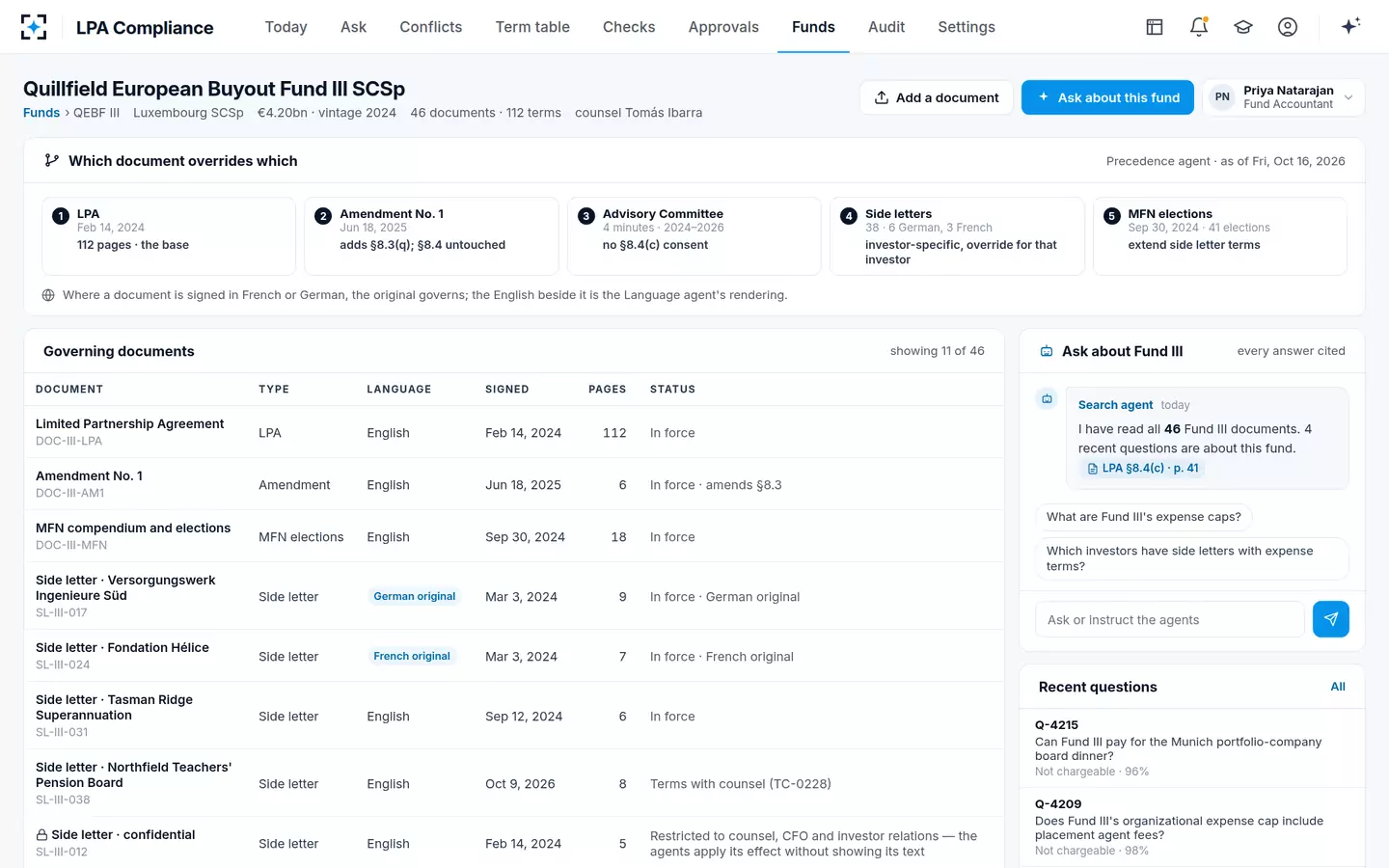
For LPA compliance, the order is a setting each manager decides with counsel and then applies every time. Quillfield's, in the sample, reads: a side letter for its own investor and those who elected it; an advisory committee consent for its own fund, period and cap; amendments in date order; the LPA; then the PPM and any summary, which describe but never govern. A French or German original governs over an English translation.
One fund's precedence chain in LPA Compliance: which document overrides which
Where examiners found LPAs not followed
The SEC's examination staff have published two lists of private fund failures, and almost every item is a key term read wrongly or not read at all. The 2020 alert covered conflicts and fees and expenses; the 2022 alert added six failures under "Conduct Inconsistent with Disclosures": LPAC consent, post-commitment management fees, liquidation and extension terms, investment limits, recycling, and the key person process. Both alerts are staff views, not rules, and both say so on their first page.
They describe a large population. In 2022 the staff counted "More than 5,000 SEC-registered investment advisers, approximately 35% of all SEC-registered advisers," managing "approximately $18 trillion in private fund assets" (Form ADV data as of November 30, 2021). The vacated 2023 private fund adviser rules removed none of these duties; they rest on the Advisers Act's anti-fraud provisions and on each fund's own documents. What examiners scored, and the evidence each test needs, turns the findings into an exam file.
Is there a sample limited partnership agreement for private equity?
Not one that the SEC, a court or Delaware publishes as a model. Fund agreements are private contracts negotiated for each fund, and the statute sets defaults rather than a form: much of chapter 17 applies "unless otherwise provided in a partnership agreement." Investor associations and law firms circulate model and sample agreements, but a sample tells you what a clause can look like, not what your fund agreed.
The useful sample is your own executed set: the signed LPA, every amendment and restatement, the side letters and MFN elections, and the advisory committee minutes. Begenau and Siriwardane needed confidentiality agreements to read 91 LPAs; most practitioners will only ever read their own funds' agreements closely. Reading them as a set, in force on a date, is the skill.
From abstract to term table: how LPA Compliance keeps the key terms
Most managers keep an LPA abstract: a summary of key terms written at final close. It is accurate on the day it is written and decays with each amendment, side letter and consent. LPA Compliance replaces it with a term table that changes only when counsel approves a new version, and tests every booked expense and fee against the version in force.
The LPA key terms table: every term cited to its clause, versioned and approved by counsel
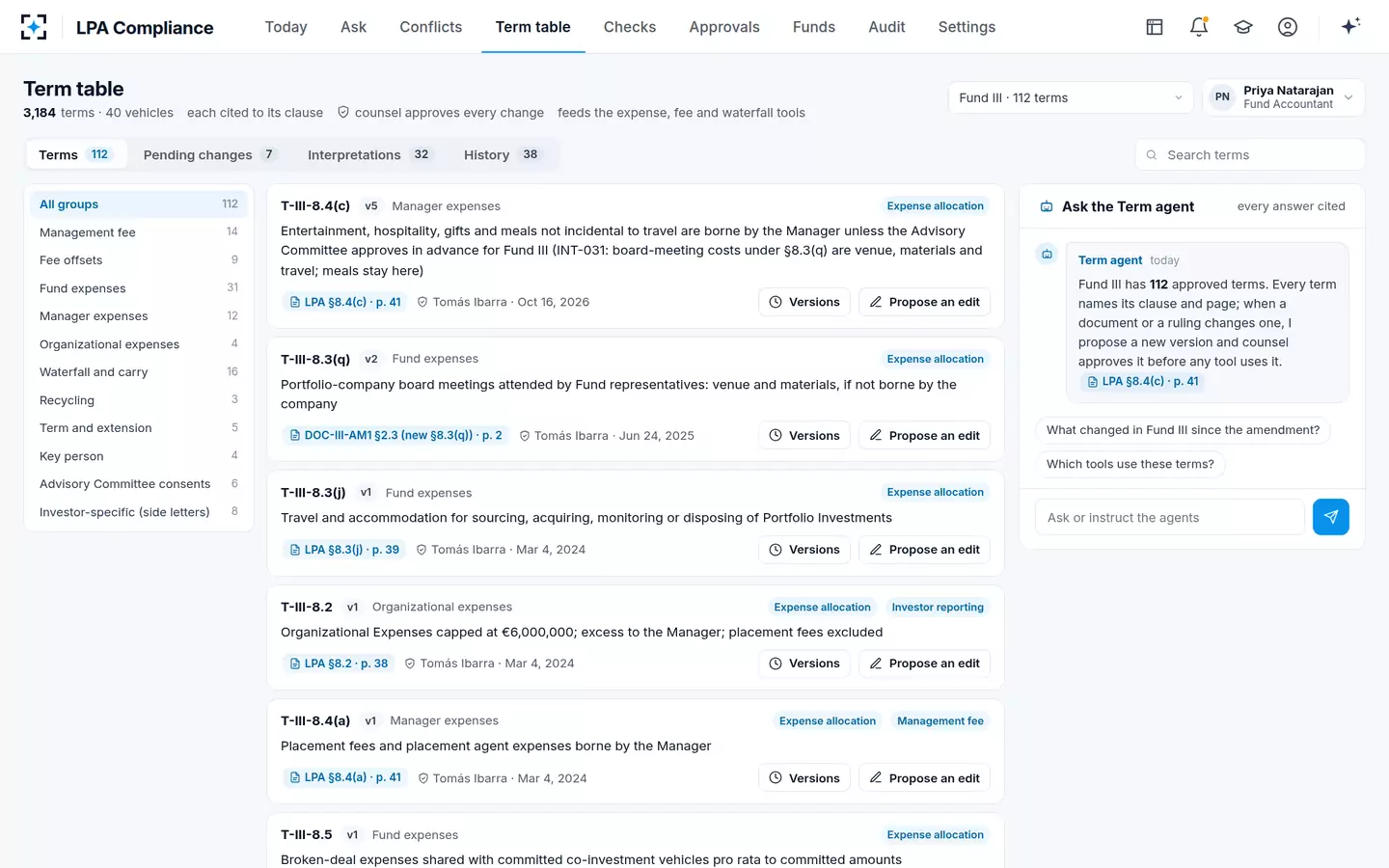
In the sample, Fund III's 112 terms sit in 11 groups, each term cited to clause and page, and 3,184 terms cover the 40 vehicles. The Term agent proposes a new version when a document or a ruling changes a term; fund counsel approves it, and nobody approves their own change. The Expense check agent then tests every booked line and every fee calculation against the approved table. Where two clauses can be read two ways, as the dinner's §8.4(c) and the amendment's §8.3(q) can, the Conflict agent sends both texts and the impact to counsel rather than choosing.
The table is only as good as the documents behind it, so the first job on any fund is the document set and counsel's confirmation of the first table. To see it on the sample funds, start from LPA Compliance.
Questions people ask
Do all investors sign the same LPA?
All limited partners are bound by the same agreement, and Delaware binds a partner "whether or not the partner or assignee executes the partnership agreement" (§17-101(14)). What differs is the side letters: in the 91 LPAs Begenau and Siriwardane read, 75% let the general partner enter into one with any investor at its sole discretion.
How long is a private equity LPA?
No regulator or study publishes a typical length. The fictional sample fund's agreement runs to 112 pages before its amendment, side letters and MFN elections, and its governing set is 46 documents; length is less of a problem than the number of documents that change it.
What is an LPA abstract, and why does it go stale?
An abstract is a summary of the key terms, usually written at final close for the finance and administration teams. It goes stale because amendments, side letters and consents arrive later and the abstract is rarely re-cut; a term table versioned with each document and approved by counsel avoids that.
Can the general partner change the LPA without investors?
Only where the agreement allows it. Delaware permits an agreement to provide for amendments "without the vote or approval of any limited partner," and Begenau and Siriwardane list the GP's ability to amend unilaterally among the terms negotiated in each LPA; the amendment clause is therefore a key term to read first.
Can an investor ask to see the LPA and its amendments?
Yes, subject to the agreement's reasonable standards: Delaware gives each limited partner the right, on reasonable demand and for a purpose reasonably related to its interest, to obtain "a copy of any written partnership agreement and certificate of limited partnership and all amendments thereto" (6 Del. C. §17-305(a)(4)). Side letters of other investors are a different matter and depend on the agreement's own terms.
Does the SEC approve LPAs?
No. The funds themselves are usually not registered; of the nine funds in the August 2025 TZP order the Commission notes that "None of the Funds were or are registered with the Commission in any capacity." Examiners read the LPA during an exam of the adviser, and the Commission's orders quote its words and find where practice did not match.