A recycling provision in a private equity LPA lets the fund put realized investment proceeds back to work instead of returning them for good: either by keeping them to reinvest, or by distributing them as recallable and calling them again later. The SEC's examiners define it in one line, "contractual provisions that allow a fund to add realized investment proceeds back to the capital commitments of investors," and have found advisers that described their recycling inaccurately, with excess management fees as a possible result. The work is a decision on each distribution, made when it is paid, that keeps investors' unfunded commitments and the fee basis right. Botminds' LPA Compliance holds each fund's recycling terms, cited to their clauses, beside the fee and waterfall terms they affect.
The worked cases below use an illustrative clause and fund rather than a market survey, because no regulator or independent study publishes typical recycling terms.
Can this distribution be recycled? Five questions, asked when it is paid
- What kind of proceeds is it?
Return of the cost of an investment, gain, income, or a refund of fees and expenses. A clause may recycle cost, and amounts equal to fees and expenses, but not gain.
- Is it inside the time window?
From an investment realized within a set period of its purchase, or before the end of the investment period; outside the window it is a final distribution.
- Is the cap still open?
Recycled amounts, or total contributions, against the clause’s ceiling, which is often a percentage of commitments.
- Was it designated when it was paid?
If the clause requires the notice to say the distribution is recallable, an undesignated distribution may not be recallable later.
- What does it do to the fee and the waterfall?
Restored unfunded commitment, a larger invested capital basis, and contributions that count again in the waterfall.
What is recycling in private equity?
Recycling in private equity is the reuse of capital a fund has already called and returned, so that more than investors' original commitments can be invested over the fund's life without anyone committing more. It takes two forms. Retained proceeds stay in the fund and are reinvested without being distributed. Recallable distributions go out to investors, are marked as recallable, and restore that much of each investor's unfunded commitment, so they can be called again.
The SEC staff's definition covers both: "“Recycling” refers to contractual provisions that allow a fund to add realized investment proceeds back to the capital commitments of investors" (SEC risk alert, January 27, 2022). The key word is contractual. Recycling exists only where the LPA provides for it, on the terms the LPA sets, and the general partner cannot recall a distribution the clause does not reach.
Does recycling increase my commitment?
No, it does not increase your commitment, but it can increase what you contribute in total. Your commitment stays the number you signed for. A recallable distribution restores part of your unfunded commitment, and when that amount is called again, your total contributions over the fund's life can exceed the commitment by the recycled amount, up to the cap the clause sets.
That is why investors track recallable amounts separately from final distributions: the cash received is not all theirs to keep. Delaware law treats a promise to contribute seriously. Except as the LPA provides, "a partner is obligated to the limited partnership to perform any promise to contribute cash or property or to perform services, even if that partner is unable to perform because of death, disability or any other reason" (6 Del. C. §17-502(a)(1)), and the LPA may attach penalties to a failure to fund, from "reducing or eliminating the defaulting partner’s proportionate interest" to "forfeiture of that partnership interest" (§17-502(c)). A recycled call is a call like any other once the clause allows it. The call itself, and each investor's running balance of unfunded commitment, are the work of Botminds' Capital Call Processing.
What distributions can be recycled?
Only the ones the clause describes. A recycling clause can limit recyclable amounts by type, by time and by total: for example, the cost basis of investments realized soon after purchase, amounts equal to management fees and fund expenses investors have paid, or proceeds received before the investment period ends, with a cap on the total, such as aggregate contributions limited to a stated percentage of commitments. Some clauses also require the general partner to designate the distribution as recallable when it is made.
The three cases below run the five questions on an illustrative clause: during the investment period, the fund may recall amounts up to the cost of investments realized within 18 months of their purchase, designated as recallable in the distribution notice, with total contributions capped at 120% of commitments.
Three distributions under one illustrative recycling clause: one recallable, one not, one for counsel
Distribution A
$12.0M from selling a company bought 14 months earlier for $10.0M
Tested against the clauseWithin 18 months of purchase, during the investment period, and designated in the notice.
Decision$10.0M recallable: the cost. The $2.0M gain is not.
Unfunded rises by $10.0M
Distribution B
$30.0M from selling a company held four years, after the investment period ended
Tested against the clauseOutside the 18-month window and after the investment period.
DecisionNot recallable. A distribution like any other.
Unfunded unchanged
Distribution C
$8.0M returned when a bridge loan to a portfolio company was repaid after 9 months
Tested against the clauseInside the window and the period, but the distribution notice did not designate it as recallable.
DecisionDepends on whether the clause requires designation at the time. A question for counsel, ruled once.
Held until counsel rules
Case C is where most disputes come from. The money was eligible in every respect but one, and the one is procedural. If the clause requires designation at the time of distribution, the fund cannot designate retrospectively; if it does not, the general partner may still recall it. Either way the decision belongs to counsel, made once and written down, and applied to every distribution with the same facts in every fund with the same wording.
The cap: a running total, not a single test
A recycling cap is tested cumulatively. Each recalled amount uses part of it, and a distribution that would be recallable on its own may not be if the cap is nearly spent. On a $500 million fund with contributions capped at 120% of commitments, the ceiling is $600 million; the chart below shows a fund that has used most of it.
Contributions against a 120% cap on an illustrative $500M fund: room for $28M more
The arithmetic is simple and the error is easy: a cap tested distribution by distribution, against the original commitment rather than the running total, lets the fund recall more than the clause allows. The test needs the full history of contributions and recalls, by investor, because transfers and defaults change each investor's share.
Does recycling affect management fees?
It can, which is why the SEC looked at it. Where the management fee is charged on invested capital, reinvesting recycled proceeds raises the basis; where the clause recycles amounts equal to fees and expenses, investors' total contributions exceed their commitments by those amounts, and whether the fee clause counts them is a reading to settle once. The 2022 alert found advisers that "did not accurately describe the “recycling” practices utilized by their funds or omitted material information from such disclosures," and said "In some instances, this failure may have caused private fund advisers to collect excess management fees" (SEC, 2022).
The test is to recompute the fee basis with recycled capital treated as the fee clause says, not as the accounting system defaults. Recomputing the fee itself is the work of Botminds' Management Fee Calculation; for LPA compliance, the point is that the recycling clause and the fee clause have to be read together, in the versions in force when each amount moved.
Recycling changes three numbers at once: an investor's unfunded commitment, the fee basis and the waterfall's contributions. Decide the distribution once, and all three follow.
Recycling and performance: recalled money counts as a contribution
Recalled distributions change how a fund's returns should be shown. In its 2023 private fund adviser release, the SEC wrote that "Advisers generally should treat any distributions that they recall for additional investments as additional contributions for purposes of calculating these illiquid fund performance metrics as we understand this is the expectation of investors," and that performance "that does not treat such recalled distributions as additional contributions may be misleading" (88 FR 63206). The quarterly statement rule it appeared in was vacated in June 2024; the observation about what investors expect is a fair test of any performance figure a fund reports.
The same logic runs through the waterfall. A recalled amount is a contribution again, so it has to be returned, with any preferred return the waterfall applies to contributions, before carried interest is paid. A waterfall that counts only original contributions overstates the profit available for carry. Waterfalls are recalculated in Botminds' Distribution Waterfall Calculation.
Is a recallable distribution the same as a clawback or a giveback?
No. A recallable distribution is a planned reuse of capital, decided when it is paid. A giveback is an investor's obligation to return distributions, under the LPA, to meet fund liabilities such as indemnities. A clawback is the general partner returning carried interest it was overpaid. Delaware sets a default limit on one kind of return: unless the agreement says otherwise, a limited partner is no longer liable to return a distribution once three years have passed since it was paid (6 Del. C. §17-607(c)). Recycling and giveback clauses are such agreements, which is why their limits and deadlines must be read from the LPA.
Three ways money that left the fund can come back
Recallable distribution (recycling): To be invested again, within the recycling clause.
Investor giveback and GP clawback: Giveback: to meet fund liabilities. Clawback: the GP returns carry it should not have received.
Recallable distribution (recycling): At the time of distribution, if the clause requires designation.
Investor giveback and GP clawback: Later, when the liability or the overpayment appears.
Recallable distribution (recycling): Type of proceeds, time window, cap on recycled or total contributions.
Investor giveback and GP clawback: Amounts and deadlines in the LPA; Delaware’s default three years for distributions, unless otherwise agreed.
Recallable distribution (recycling): Restores unfunded commitment by the recallable amount.
Investor giveback and GP clawback: Giveback is usually outside commitments; clawback runs from the GP to the fund.
Recallable distribution (recycling): Each distribution against the five questions; the cap as a running total.
Investor giveback and GP clawback: The trigger, the amount and the time limit, read from the clause in force.
Where LPA Compliance fits: recycling terms beside the fee and the waterfall
LPA Compliance treats recycling as a group of terms in each fund's term table, cited to clause and page and approved by counsel; in the sample, Fund III has three, in the same table as its management fee, fee offset and waterfall and carry terms. A fund accountant can ask whether a distribution is recallable and get a verdict citing the clause, or a referral to counsel when, as in case C, the words can be read two ways.
LPA Compliance: recycling terms sit in the term table, beside the fee and waterfall terms they change
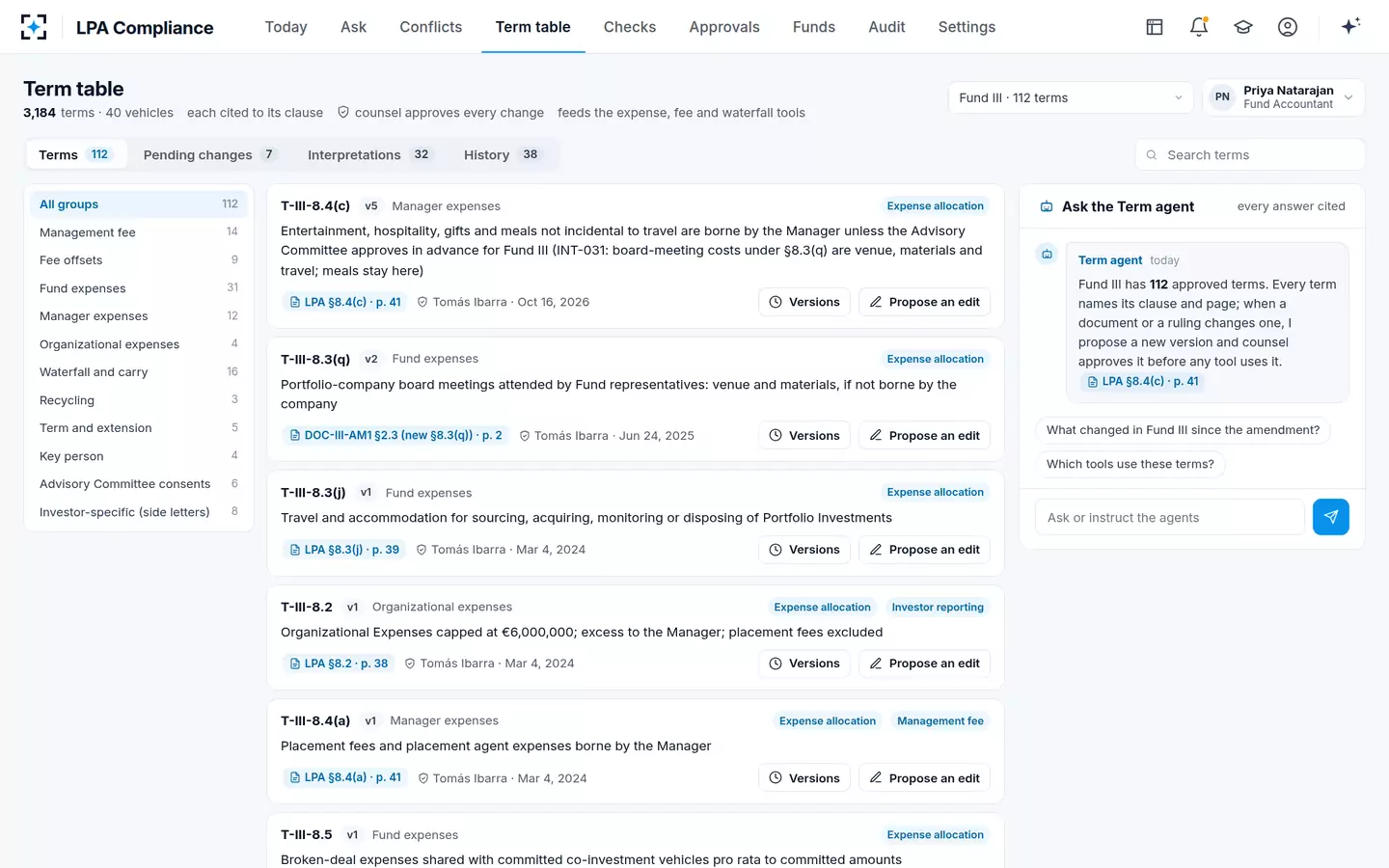
The solution's limits are worth stating. It does not book the distributions or keep investors' unfunded commitment balances; the fund accounting platform and the administrator do. It reads their figures, applies the approved terms and proposes corrections for a person to approve. The LPA key terms, annotated places recycling among the ten clauses a CFO tests, and the LPA compliance checklist turns it into a measured quarterly test. To see the term table on the sample funds, start from LPA Compliance.
Questions people ask
Do I have to fund a recycled capital call?
Yes, if the distribution was validly recallable under the LPA: it restored your unfunded commitment, and a call against it is a call like any other. Delaware lets the LPA attach penalties to a failure to fund, including reducing the defaulting partner's interest or forcing a sale of it (6 Del. C. §17-502(c)).
Is recycled capital counted in a fund's IRR?
It should be counted as a new contribution when it is recalled. The SEC wrote in 2023 that performance that does not treat recalled distributions "as additional contributions may be misleading"; the rule in that release was vacated in 2024, but the point about what investors expect stands.
Can recycling happen after the investment period?
Only if the clause allows it. A recycling clause may tie recalls to the investment period, or to investments realized within a set time of purchase, so that the fund is not reinvesting in its harvest years; the clause in force decides.
How should an investor track recallable distributions?
Separately from final distributions, with the amount, date and clause for each, and the running total against any cap. The distribution notice is the document to check: if the clause requires designation, an amount not designated when paid may not be recallable later.
Did the SEC find problems with recycling?
Yes. Its January 2022 risk alert lists "Failures relating to recycling practices" among the private fund deficiencies examiners observed: recycling described inaccurately or material information omitted, which in some instances "may have caused private fund advisers to collect excess management fees."