Private equity software solutions cover a manager's back office in pieces: fund accounting platforms keep the general ledger and calculate fees, administrators' portals show what the administrator booked, investor portals and CRMs handle communications, document systems hold the agreements, and separate tools run waterfalls and expense allocations. What none of them does on its own is read the LPA, with its amendments, side letters and consents, and check every booked fee and expense against it. That is the gap examiners keep finding. Botminds' LPA Compliance is built as a layer beside those systems rather than a replacement for them: it reads the documents and the books already held elsewhere, and writes back findings and approved corrections, never accounting entries of its own.
Examples come from a fictional sample manager, Quillfield Capital, with 40 vehicles and 612 governing documents in the solution.
The scale of what private equity software has to keep straight
27,682
private equity funds reported to the SEC at the end of 2025
612
governing documents across 40 vehicles at the fictional sample manager
2025
the year the SEC withdrew its 2022 proposal for an outsourcing rule for investment advisers
What do private equity software solutions cover?
They cover the books, the investors and the documents, usually in separate systems. A typical stack has a fund accounting platform, often run by or alongside a fund administrator; an investor portal and CRM; a document management system for executed agreements; and specialised tools for waterfalls, management fees, expense allocation, portfolio monitoring and investor reporting. Private equity management software providers and private equity accounting software providers sell different parts of that list, and many managers run several.
Each system is accurate about what it holds. The fund accounting platform knows what was booked; the document system knows what was signed. The question "was this booking allowed by what was signed?" sits between them, and in most stacks it is answered by people reading email and spreadsheets.
Does LPA compliance replace our fund accounting system?
No. An LPA compliance layer reads the fund accounting platform and the administrator's figures; it does not keep books, calculate NAV, post journal entries or send capital calls. What it adds is the test those systems cannot run themselves: each booked expense and fee calculation compared with the governing terms in force, cited to the clause.
The design choice is deliberate. A fund's books have one owner, and a second system posting to them would create two versions of the truth. In the sample, when an expense is not chargeable to a fund, the agents propose a move to the manager; a fund accountant confirms it as maker, the CFO approves it, and the approved move goes to the expense allocation tool and to the administrator as a correction. The books are changed by the people and systems that own them.
An LPA compliance layer reads from the systems you have and writes back only what people approve
Agent
Read the documentsLPAs, amendments, side letters, MFN elections and committee minutes from the document system, with access inherited.
A person decides
Fund counselApproves the term table built from them, and every later change.
Agent
Read the booksBooked expenses and fee calculations from the fund accounting platform and the administrator, overnight.
Never: posts to the books
Agent
Test and proposeEach line and fee against the approved terms; moves proposed for lines that do not follow them.
Never: moves money
A person decides
Fund accountant and CFOThe accountant confirms as maker; the CFO approves, with a reason.
Agent
Write backApproved terms to the expense, fee and waterfall tools; approved corrections to the administrator.
The gap between the books and the LPA
The SEC's examiners have described the gap precisely. In 2020 they found advisers that promised investors management fee offsets but had no adequate way of tracking the portfolio company fees they or their operating professionals received, so investors may have overpaid (SEC risk alert, June 23, 2020). The fees were in some system; the offset clause was in another; nothing connected them.
The 2025 TZP order is the same gap in a single paragraph: the LPAs' exclusion list did not name interest on deferred fees, the adviser left that interest out of the offset, and $423,065 that should have reduced fees did not (SEC order IA-6908). In the sample, the Expense check agent finds the pattern in Fund V, $38,200 of interest on deferred monitoring fees left out of a 100% offset, by reading the fee data and the clause together. In the sample's words, the administrator books what it is sent; the layer's job is to check what it was sent.
What does private equity software need to connect to?
For LPA compliance, six connections: the document system, the fund accounting platform, the administrator, the tools that apply terms, the investor portal and the identity provider. The map below shows what the layer reads from each and what, if anything, it writes back.
LPA Compliance's integration map: what it reads from each system, and what it writes back
Document management
ReadsLPAs, amendments, side letters, MFN elections, advisory committee minutes, PPMs; who may open each.
Writes backNothing. Documents stay where they are, and access follows them.
Fund accounting platform
ReadsBooked expense lines, the general ledger, management fee accruals.
Writes backApproved moves between a fund and the manager, with clause and approver, for posting by the team that owns the books.
Fund administrator
ReadsExpenses as booked, fee calculations, the administrator’s term sheet.
Writes backCorrections and approved terms, version by version, with the clause behind each.
Expense, fee and waterfall tools
ReadsWhat they have already applied.
Writes backApproved terms only, each with its version and clause.
Investor portal and CRM
ReadsWho owns each side letter relationship.
Writes backInvestor replies, once fund counsel has approved them.
Single sign-on
ReadsPeople, groups and roles.
Writes backNothing.
Two details in the map matter for security reviews. Access follows the document system: the agents answer only from documents the person asking may open, and for confidential side letters they state the effect without showing the text. And platform administrators manage roles and connections but approve nothing, so the people who run the system cannot also clear its findings.
What it writes back: approved terms and corrections, never entries
The layer writes back two things. Approved terms, each with its version and clause, go to the tools that apply them, so the expense allocation, fee and waterfall calculations use the version counsel approved rather than the one someone typed at launch. Approved corrections go to the administrator and the expense allocation tool, carrying the clause, the amount, the maker and the approver.
Delaware law is relaxed about where those records live. A limited partnership "may maintain its books, records and other documents in other than paper form, including on, by means of, or in the form of any information storage device, method, or 1 or more electronic networks or databases," provided the form "is capable of conversion into paper form within a reasonable time" (6 Del. C. §17-305(c)). The adviser's own books and records under Rule 204-2 must be kept "for a period of not less than five years" (17 CFR 275.204-2(e)(1)). Exportable evidence is a requirement, not a feature.
What the systems you have already do, and what the LPA layer adds
Private equity software you already run: Books expenses, keeps the general ledger, accrues fees as configured.
An LPA compliance layer beside it: Tests each booked line and fee against the terms in force; proposes corrections.
Private equity software you already run: Calculates fees and books what it is sent, from its own term sheet.
An LPA compliance layer beside it: Recomputes fees from approved terms; sends corrections and term versions back.
Private equity software you already run: Stores the executed agreements, with access control.
An LPA compliance layer beside it: Reads them as a set in force on a date, with precedence and original languages.
Private equity software you already run: Apply the terms they were configured with.
An LPA compliance layer beside it: Feed them approved, versioned terms, each with its clause.
Private equity software you already run: Track policies, attestations and personal trading.
An LPA compliance layer beside it: Produce line-level evidence that fund documents were followed.
How long does it take to go live with LPA compliance software?
It depends on the document set more than the software. No regulator or independent study publishes go-live times for this kind of tool, and a vendor's figure is only as good as the documents it assumed. The work is a document set and a data map: every governing document for the funds in scope, a quarter of booked expenses and fee calculations, and counsel's confirmation of the first term table before any check runs on it. In the sample, Fund III alone has 46 governing documents, and 138 of the manager's 612 are in French or German.
What you bring to an LPA compliance go-live
- Every governing document, executed
LPAs, amendments and restatements, side letters, MFN compendia and election forms, advisory committee minutes and consents, PPMs and supplements.
- Originals as well as translations
Where a document was signed in French or German, the original governs; convenience translations are read beside it, not instead of it.
- A quarter of booked expenses
Line level, with vendor, amount, vehicle and booking date, from the fund accounting platform or the administrator.
- Fee calculations
The administrator’s management fee and offset calculations for the same quarter, so differences can be explained.
- Counsel’s existing readings
Memos and emails where counsel has already interpreted a clause, so they become recorded interpretations rather than lost answers.
- Thresholds and approvers
Confidence lines, counsel’s turnaround times, the CFO and any second approver, and the order in which documents override each other.
- Access rules
Who may open which documents, from the document system and the identity provider, including restricted side letters.
- Counsel’s time for the first term table
Each term cited to its clause and page is confirmed once before any test relies on it.
The practical way to judge a tool is to run it on a quarter you have already closed. Its findings can then be compared with what your team found by hand, line by line, and the differences explained. The LPA compliance checklist and its measures gives the counts to compare.
Who controls the layer: thresholds, access and approvals
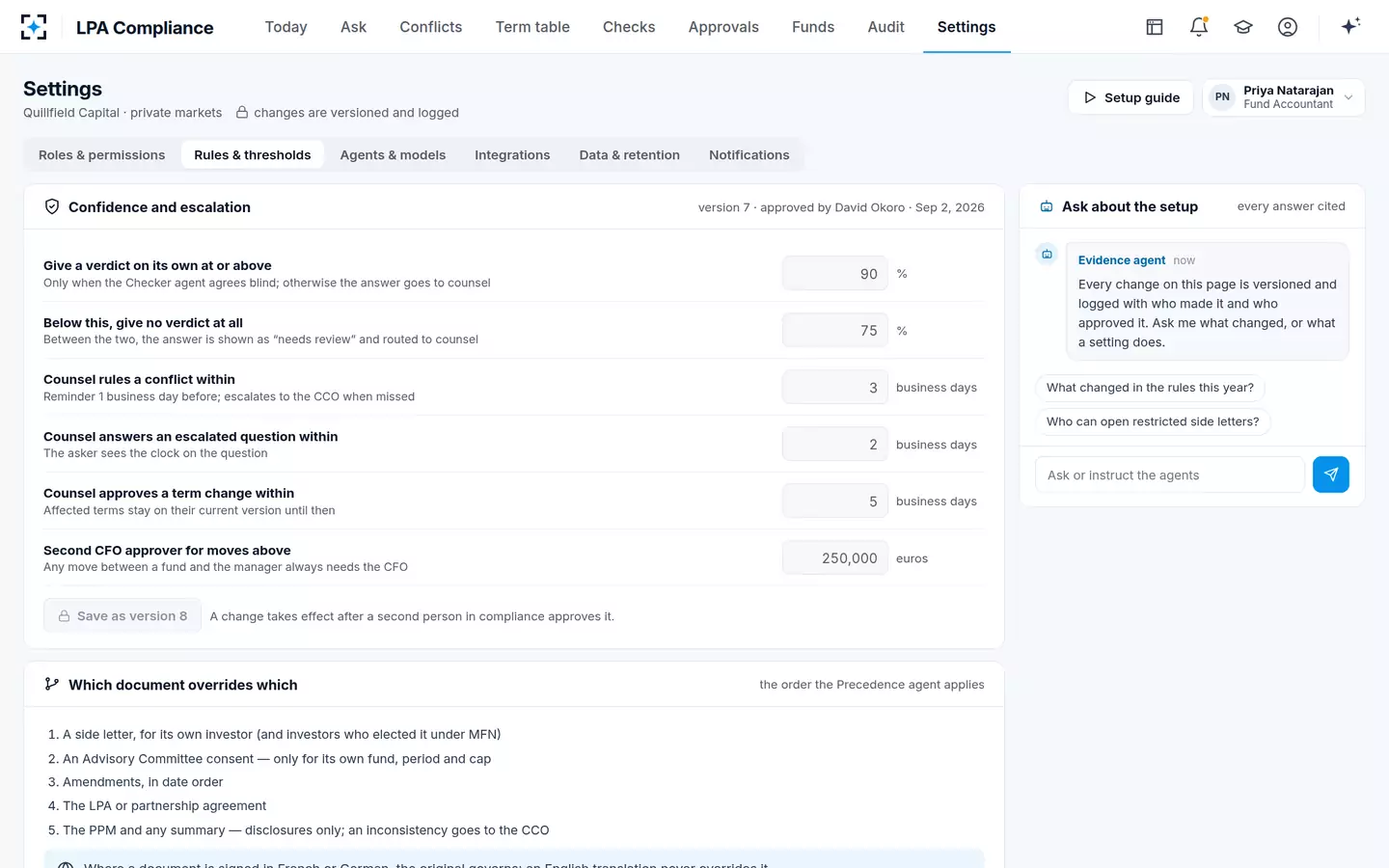
Every setting that decides when the agents answer, when they stop and who approves is the manager's, versioned and approved by compliance before it takes effect. In the sample, the agents answer alone at or above 90% confidence, and only when a second, blind reading agrees; below 75% they give no verdict. Counsel rules on a conflict within three business days; moves above €250,000 need a second approver after the CFO.
Rules and thresholds in LPA Compliance: the manager's settings, versioned and approved
What should a private equity firm ask a software vendor?
Ask what it reads, what it writes, who approves, and what an examiner will see. The SEC's fiscal 2027 priorities say the Division "will also focus on advisers that use certain third-party service providers," and will weigh the risks of advisers' growing reliance on outside providers and shared technology, including how well those risks are managed (SEC, October 23, 2026). The questions below are the ones that diligence should be able to answer in writing.
Eight questions for any private equity software vendor touching fund terms
| Question | Why it matters | A good answer |
|---|---|---|
| Does it post to our books? | Two systems changing the books creates two versions of the truth. | No; it proposes, and the owner of the books posts. |
| Which document governs, and who decided? | Amendments, side letters and consents change the answer. | A precedence order the firm sets with counsel, shown in every answer. |
| What happens below its confidence line? | A tool that always answers is guessing some of the time. | No verdict, or a referral to counsel, at lines the firm sets. |
| Who approves a change to a term? | Terms drive fees for years. | Counsel, with no self-approval and a version history. |
| Does access follow our document system? | Side letters and minutes are often restricted. | Answers only from documents the asker may open; restricted text never shown. |
| Can we export the evidence? | Books and records must be kept and produced. | The full trail and every test, in a form we can keep for five years and more. |
| How does it read originals in other languages? | A convenience translation can differ from the signed text. | The original governs; differences go to counsel. |
| What did it find on a quarter we closed? | Demonstrations use the vendor’s documents. | A line-by-line comparison with our own results, differences explained. |
Where LPA Compliance does not fit
LPA Compliance is not a general ledger, an administrator, an investor portal or a waterfall engine, and it does not calculate NAV. It does not manage side letter negotiation or capital calls; Botminds' Side Letter Management and Capital Call Processing do. It does not know who works where, so key person tests need that from the manager. If a manager's problem is that its books are wrong for reasons unrelated to its fund documents, the fix belongs in the accounting.
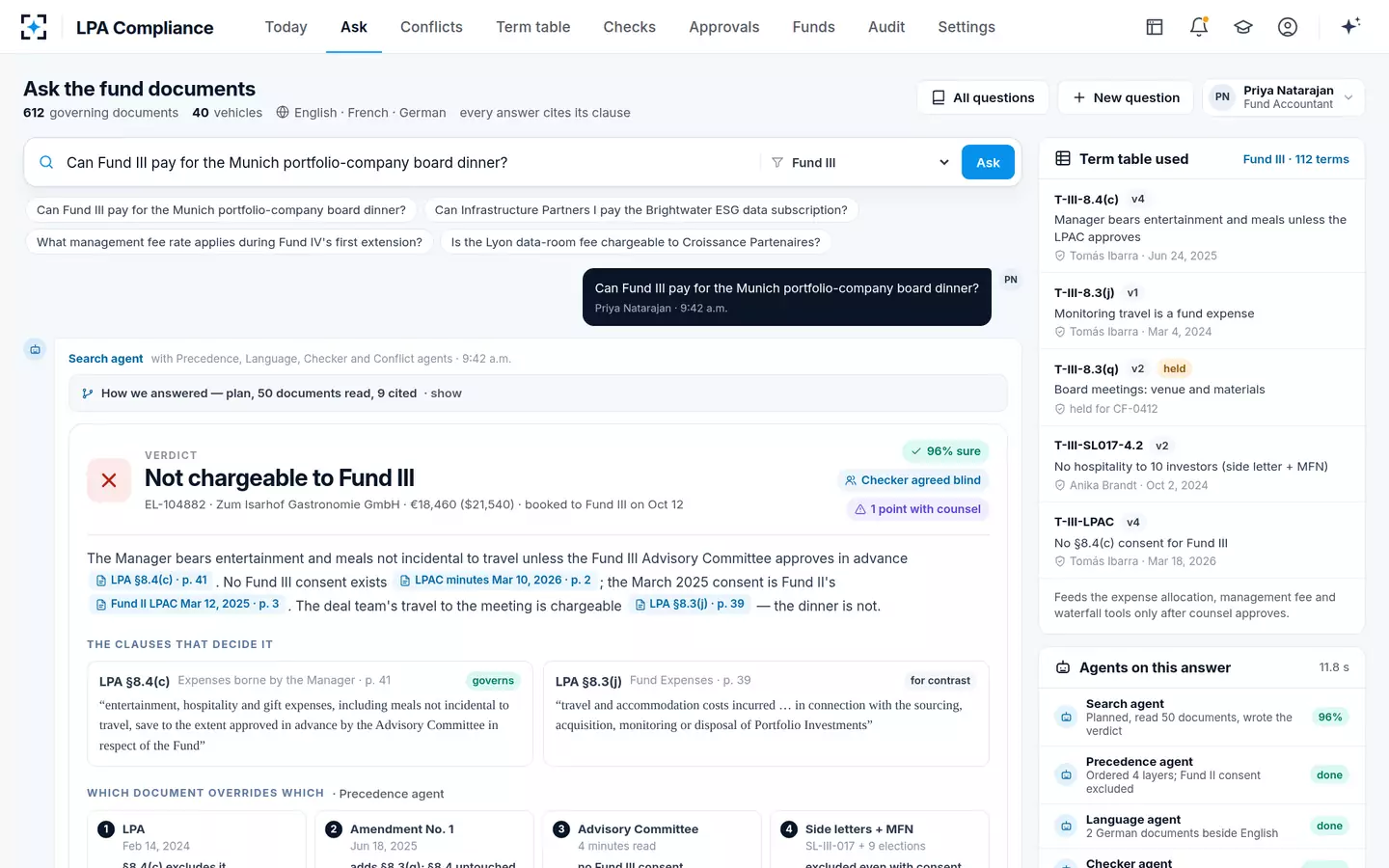
It fits where the question is whether what a fund paid, or was charged, follows what was signed. In the sample, an answer to that question for a €18,460 board dinner took 11.8 seconds, read 50 documents and cited 9, with a blind second reading agreeing; the move it proposed waited for the CFO. What obligation software must do with an undefined term and how legal review AI differs from LPA testing cover the neighbouring categories. To see it on the sample funds, start from LPA Compliance.
Ask the fund documents: a verdict with its clauses, its precedence chain and the terms used
Questions people ask
Which private equity accounting software providers does it work with?
It reads booked expenses, the general ledger and fee accruals from a fund accounting platform, and booked expenses, fee calculations and term sheets from an administrator's portal, through connections set up at go-live. The test is the data, not the brand: line-level expenses and fee calculations it can read, and a way to send approved corrections back.
Does it work if our administrator keeps the books?
Yes; that is the common case it is built for. It reads what the administrator booked and calculated, and sends back approved corrections and term versions, each with its clause, so the administrator's term sheet stays in line with what counsel approved.
Is there an SEC rule on using software providers?
There is no general outsourcing rule for advisers: the SEC proposed one in November 2022 and withdrew it on June 17, 2025. Oversight of a provider rests on the adviser's fiduciary duty, the compliance rule and any rule that reaches what the provider handles, and the fiscal 2027 priorities name third-party service providers as an examination focus.
Can we start with one fund?
Yes, and it is the sensible way to judge it: one fund family's documents and one closed quarter of booked expenses, with counsel confirming the first term table. The results can be compared line by line with what your team already found.
What records does the layer leave?
Every question, answer, source, ruling, term change, test and approval, with who, what, when and why, chained so that a later change shows. Advisers must keep most required books and records for not less than five years under Rule 204-2(e)(1); the trail should be exportable for that period.