A private equity fund term extension lengthens the life a fund's LPA set at launch, by the period or periods its term clause allows, so the manager can sell the remaining investments in an orderly way. The LPA decides who may grant each extension, whether the general partner, the advisory committee or a stated majority of investors, sometimes a different body for each, and it often sets a different management fee for the extra years. Getting either part wrong is a regulatory finding: the SEC's examiners have seen funds extended without the required approvals, with fees charged as a result. Botminds' LPA Compliance reads the term and extension clauses with every amendment and consent, and tests the fee charged during an extension against the rate they allow.
Fee examples come from a fictional sample manager, Quillfield Capital, whose data runs through the solution.
Why the end of a fund's term needs a process
10–15yrs
a private equity fund’s typical total life, start to finish, as two finance researchers describe it
$772,500
one sample quarter’s gap between the extension fee billed and the rate the LPA sets, held for counsel
2026
the Bank of England’s private markets stress scenario explores fund extensions and continuation funds
What is a fund term extension?
A fund term extension is a decision, taken under the LPA's term clause, to keep the partnership in existence beyond the date the clause sets for its end. A private equity fund raises commitments, invests them during an investment period of a few years, and then manages and sells its portfolio before the term ends; Begenau and Siriwardane describe funds whose total life is "typically" ten to fifteen years (NBER working paper 29887). When the last investments are not ready to sell by the term date, an extension buys time. The alternative is to liquidate on schedule, or to move the remaining assets to a new vehicle.
The extension is not the same as the investment period. A fund can be well past its investment period and still need years to exit; extending the term lets it hold and sell, not usually make new investments. Ending the investment period early is a different event, often triggered by a key person clause, and the clock after a key person event follows it.
Who approves a fund extension?
Whoever the LPA names, for that extension. A clause may give the general partner one or two extensions on its own decision, then require the advisory committee or a stated majority in interest of investors for anything more, and cap the number or the total length. Every step of that ladder is a condition: an extension granted by the wrong body, or after the deadline, or beyond the cap, has not been granted.
This is where the SEC found managers going wrong. The 2022 risk alert describes advisers "that extended the terms of private equity funds without obtaining the required approvals or without complying with the liquidation provisions described in the funds’ LPAs, which, among other things, resulted in potentially inappropriate management fees being charged to investors" (SEC risk alert, January 27, 2022). The staff filed it under "Conduct Inconsistent with Disclosures": no new rule was needed to find it, only the LPA.
A fund term extension, step by step: each approval before the date it is needed
Agent
Term agentHolds the term date and each extension option from the approved term table, with the body that must approve it and any cap.
Never: publishes a term counsel has not approved
A person decides
General partnerDecides to propose an extension, with the reason and the exit plan for the remaining assets.
Agent
Search agentAnswers who must approve this extension, by when and on what threshold, citing the clause and any amendment.
Never: answers below its confidence line; the question goes to counsel
A person decides
Fund counsel and the approving bodyCounsel approves the request; the GP, the committee or the investors approve as the clause requires, before the term date.
A person decides
Investor relationsSends the notice the LPA requires, once counsel has approved it.
Agent
Expense check agentRecomputes the management fee at the extension rate from its first day and compares it with the administrator’s.
Never: moves money
A person decides
CFOApproves any fee correction; the difference and its clause go into the quarterly report.
What happens when a fund reaches the end of its term?
Under Delaware law, a limited partnership dissolves and must be wound up "At the time specified in a partnership agreement" (6 Del. C. §17-801(1)). If the term passes without a valid extension, the partnership is in dissolution: the persons winding it up may "gradually settle and close the limited partnership’s business, dispose of and convey the limited partnership’s property, discharge or make reasonable provision for the limited partnership’s liabilities, and distribute to the partners any remaining assets" (§17-803(b)). That is a liquidation mandate, not an investment programme.
Delaware allows a dissolution caused by the term to be revoked, unless the LPA prohibits it, but only "pursuant to such vote or consent that, pursuant to the terms of the partnership agreement, is required to amend the provision of the partnership agreement effecting such dissolution," and before a certificate of cancellation is filed (§17-806). In practice, a manager that misses the term date and then extends by its own decision may have needed an amendment-level vote. The approval threshold rises the moment the date passes.
Can management fees continue during an extension?
Usually yes, at whatever rate the clause sets for extension periods. An LPA may reduce the fee during extensions, charge it on a smaller basis, remove it for a second extension, or leave it unchanged; the clause, not habit, decides. The SEC's finding was about fees charged where the extension itself lacked approval, which means the whole fee for the period, not just the rate, was at risk.
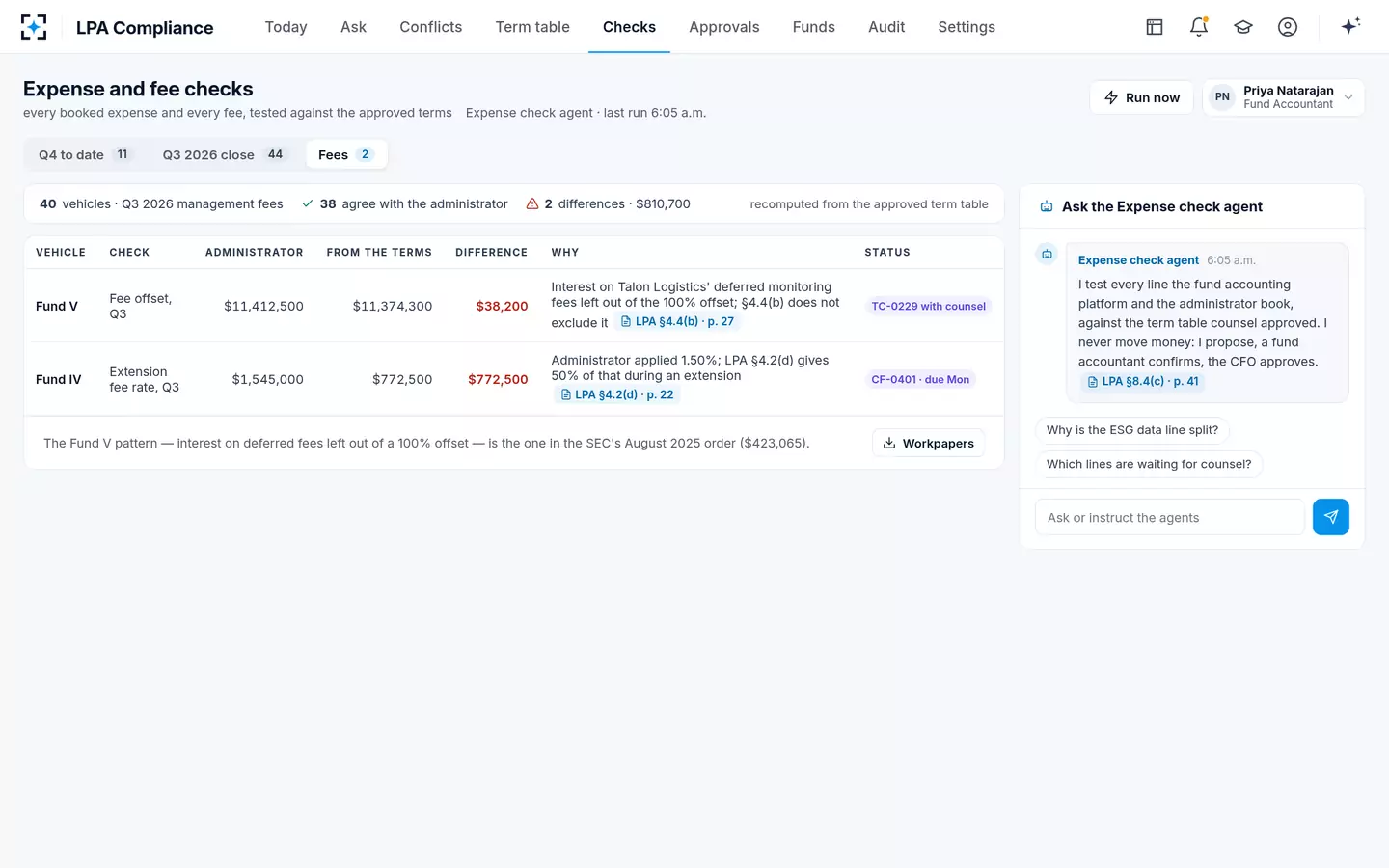
In the sample, the extension rate is the error. Fund IV's LPA §4.2(d) gives 50% of the normal rate during an extension. The administrator billed the fund's first extension at the full 1.50%. The Expense check agent recomputed the third-quarter fee from the approved terms and found $772,500 between the two. It did not decide which was right, because a June 2026 consent says the full rate applies; whether that consent can change a fee set in §4.2(d) is a question for counsel, opened as CF-0401.
One quarter's extension fee in the sample, read two ways: $772,500 apart
The example shows why a fee check needs the whole document chain. Tested against the LPA alone, the administrator is wrong. Tested against the consent alone, it is right. The answer depends on whether the committee had power to change the fee, which is a reading of the LPA's committee clause and amendment clause together. A tool that picks one document has answered a different question.
Management fee checks in LPA Compliance: an extension fee $772,500 apart
Investment period vs fund term: two clocks in one LPA
The investment period is the window for new investments; the term is the life of the partnership. They end at different times and change different things. The end of the investment period usually moves the fee basis from commitments to invested capital, and the SEC noted in 2023 that "following the termination of an investment period, management fees generally “step down” to a percentage of invested capital, rather than a percentage of aggregate capital commitments" (88 FR 38146). The end of the term moves the fund into liquidation unless it is extended.
An extension therefore sits on top of an already stepped-down basis, and the extension rate applies to that basis. A fee check during an extension needs both clauses: the basis from the investment period clause, the rate from the extension clause. Where either has been amended, the version in force on the first day of the extension is the one that counts.
Extension or continuation fund?
A continuation fund moves some or all of the remaining assets into a new vehicle managed by the same adviser, with existing investors offered the choice to sell or roll over. It is an alternative to extending, and a conflicted one, since the adviser sits on both sides. The SEC's 2026 description is neutral about why advisers use them: "continuation funds have become increasingly common as an industry trend, but an adviser might raise one for any number of reasons, many of which do not signal systemic risk, such as continuing to maximize the value of a high performing asset or providing existing investors liquidity while attracting new investors" (91 FR 22232).
Its 2023 release named the investor's risk: "an investor may be forced to liquidate a position it would otherwise wish to retain if it is unable to adequately conduct diligence or negotiate the terms of the continuation fund before its election is due." And the 2020 alert found advisers that "did not provide adequate disclosure about investor options during restructurings, potentially impacting the decisions made by investors" (SEC risk alert, June 23, 2020). The Bank of England's 2026 stress scenario for private markets lists both routes, exploring tools "to mitigate these impacts and prolong asset life, including fund extensions, continuation funds and extension of loans" (Bank of England).
Extending the term or moving assets to a continuation fund: what each asks of the LPA
Term extension: The fund’s end date, under its own term clause.
Continuation fund: Ownership of the assets, sold from the old fund to a new one.
Term extension: The GP, the committee or investors, as the clause sets for each extension.
Continuation fund: Investors choose to sell or roll; the sale usually needs committee consent as a conflicted transaction.
Term extension: The extension rate, often reduced, on the stepped-down basis.
Continuation fund: New terms in the new vehicle, negotiated with its investors.
Term extension: Fees continue while exits wait.
Continuation fund: The adviser sets or accepts the price on both sides of the sale.
Term extension: Extensions granted without required approvals, with fees charged (2022).
Continuation fund: Inadequate disclosure of investor options in restructurings (2020); diligence time before elections (2023).
How many extensions can a private equity fund have?
As many as its LPA allows, with the approvals it requires; there is no regulatory limit. No regulator or independent study publishes how many extensions funds typically take, so the practical guide is the clause: count the extensions already granted, check which body approved each, and compare the total with any cap. An extension beyond the cap is an amendment to the term clause, which under most LPAs needs the amendment vote.
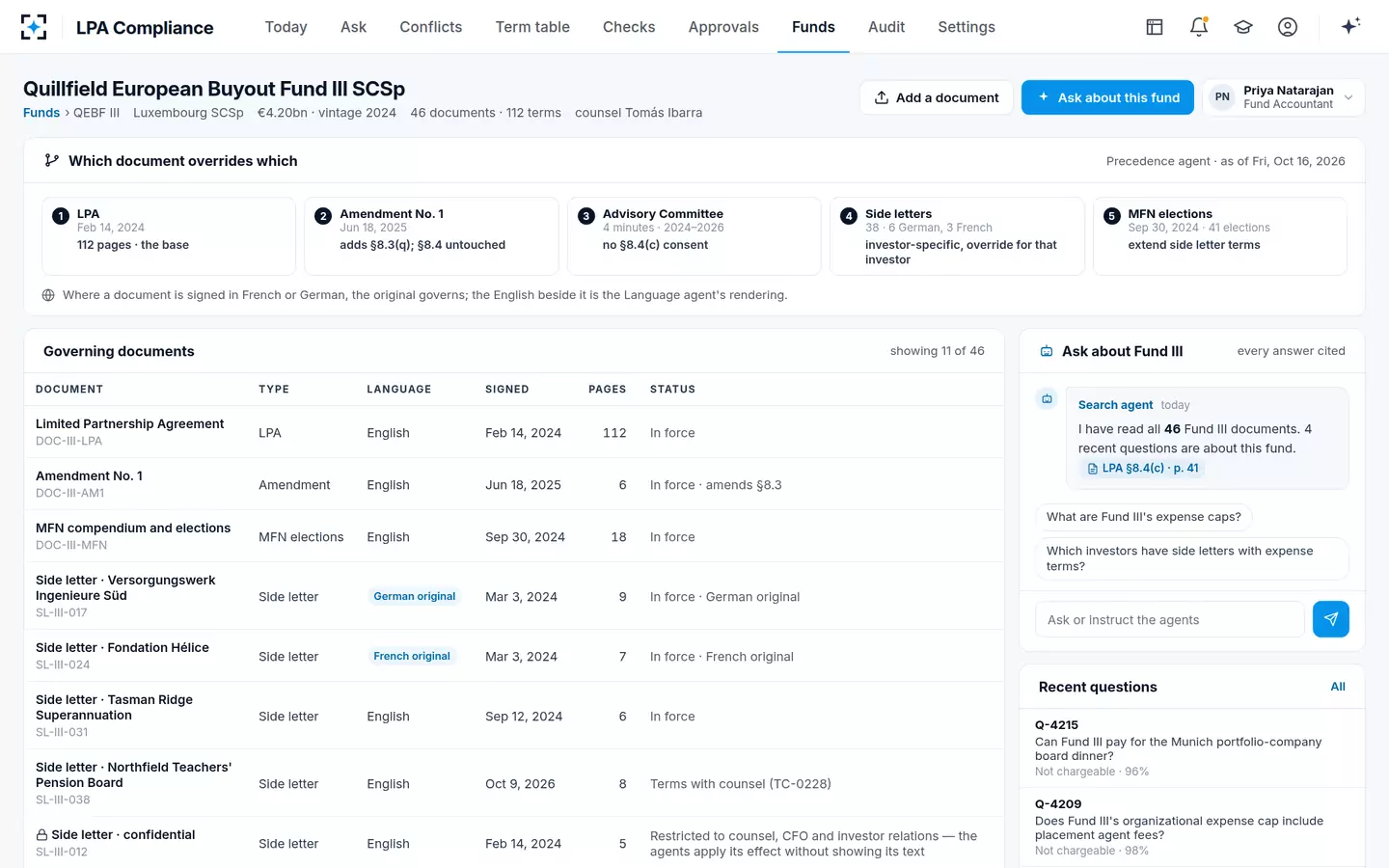
The count matters for fees as well as validity. Where a clause steps the fee down again for a second extension, or removes it, the administrator's billing should change on the first day of that extension. In the sample term table, term and extension terms form their own group of five for Fund III, each cited to clause and page and approved by counsel.
The extension file: what to keep
The SEC's finding is tested with documents, and an extension that was properly granted can still fail an exam if its approval cannot be shown. The file below answers the examiner's questions in the order they ask them.
Eight documents that prove a fund term extension was granted and charged correctly
- The term clause in force
With every amendment, showing the end date, the extension options, who approves each and any cap.
- The extension request
Who proposed it, when, why, and the exit plan for the remaining assets.
- The approval, dated before the term date
GP decision, committee minutes or investor consents, matching the body and threshold the clause requires.
- The investor notice
Sent as the LPA requires, approved by counsel before it went.
- The fee rate and basis for the extension
The clause that sets them, and the first fee period they apply to.
- The fee recalculation
The administrator’s figure, the recomputed figure and any difference, quarter by quarter.
- Any ruling on a conflicting document
Counsel’s written reading where a consent or side letter changes the rate, applied to every fund with the same words.
- The count of extensions
Each extension granted so far, against the clause’s cap.
Where LPA Compliance fits at the end of a fund's term
LPA Compliance does not decide whether a fund should be extended or sold; the general partner proposes and the body named in the clause approves. The solution holds the term and extension terms from the approved term table, answers who must approve the next extension and by when, and tests every fee charged during an extension against the rate and basis in force. Where a consent or side letter could change the answer, the Conflict agent sends both texts and the amount to counsel, who rules once.
The same quarterly fee check found the sample's $772,500 difference and a $38,200 offset shortfall, and found the other 38 vehicles in agreement with the administrator. The LPA compliance checklist puts the extension test among twelve, with what each is worth; what LPAC consent requires covers the committee's role when it is the approving body. To see the fee checks on the sample funds, start from LPA Compliance.
One fund's documents in LPA Compliance, with the chain the extension clause sits in
Questions people ask
Does an extension need investor approval?
Only if the LPA says so for that extension. Some clauses let the general partner grant the first one or two and reserve later ones for the advisory committee or a majority in interest of investors; the SEC's 2022 alert found extensions granted "without obtaining the required approvals," whichever body that was.
What happens if the term expires before an extension is approved?
Under Delaware law the partnership dissolves at the time the agreement specifies and must be wound up. The dissolution can be revoked, unless the LPA prohibits it, but only by the vote needed to amend the provision that caused it and before a certificate of cancellation is filed (6 Del. C. §17-806).
Can the general partner keep charging the full fee during an extension?
Only if the LPA sets the full fee for extension periods. Where it sets a lower rate, a different basis or none, charging the normal fee overcharges investors, and if the extension itself lacked the required approval, the SEC's 2022 alert treats the fees charged as potentially inappropriate.
Is a fund extension reported to the SEC?
An extension as such is not a Form PF section 6 event. The events reported there are an adviser-led secondary transaction, general partner removal, termination of the investment period and termination of the fund, under amendments in force since December 2023 and proposed for elimination in April 2026.
Can a fund invest during an extension?
Usually only in what the LPA still permits after the investment period, such as follow-on investments in existing portfolio companies. An extension keeps the partnership alive to hold and sell; it does not normally reopen the investment period.