AI tools for legal document review help lawyers read agreements faster: they find and summarise clauses, compare them with a preferred position, flag deviations and draft mark-ups, and they are used at diligence, negotiation and signing. A private equity LPA needs that once, and then needs something different for the ten or more years it governs the fund: every booked expense and every fee calculation tested against the agreement as amended, narrowed by side letters and opened by consents, with the clause behind each answer. The two jobs read different inputs and produce different outputs, and many fund managers need both. Botminds' LPA Compliance does the second job: it reads the whole governing set and the fund's books, answers "can the fund pay for this?" with the clause, and sends anything ambiguous to fund counsel rather than deciding it.
Examples come from a fictional sample manager, Quillfield Capital, whose data runs through the solution.
Two layers on one LPA: review at signing, testing for the life of the fund
At signing
Legal review AI, with counsel
What does this agreement say, and is it what we wanted?
ReadsThe draft or executed agreement, a playbook of preferred positions, sometimes the other side’s mark-up.
ProducesClauses found and summarised, deviations flagged, a redline, an abstract of key terms.
Every booking and every fee period
LPA compliance, with counsel and the CFO
Did what the fund paid follow what was signed, as it stood that day?
ReadsThe full governing set in force on a date, and the fund’s booked expenses and fee calculations.
ProducesA verdict on each line and fee with its clause, conflicts sent to counsel, corrections for the CFO, evidence for the examiner.
The hand-off: the executed set becomes a term table counsel approves, and every later amendment, side letter and consent changes the table, not the abstract.
What do AI tools for legal document review do?
They read contracts and point a lawyer at what matters. Typical uses are finding defined clause types across a data room, summarising agreements, comparing a counterparty's draft with a playbook, flagging unusual terms and producing first-draft redlines. One research dataset built to measure the core task, CUAD, defines it as pointing a human reviewer to the parts of a contract that matter (Hendrycks et al., CUAD, NeurIPS 2021). The output is attention, directed: the lawyer still decides.
That is the right design for review. A negotiating lawyer needs to know where the indemnity, the key person clause and the fee offset are, and whether they say what the client asked for. The tool's job ends when the document is signed. The fund's job with the document has only begun.
Can legal review AI check fees against an LPA?
It can find and summarise the fee clause; on its own it cannot check the fee. A fee check needs three things a review tool does not usually hold: the fund's booked figures, from the fund accounting platform or the administrator; the version of the clause in force on the date, after every amendment, side letter and consent; and a settled meaning for words the LPA does not define. Without the books it has nothing to check; without the version history it may check against the wrong clause; without settled meanings it guesses.
The SEC's 2025 order against TZP Management Associates is a fee check, not a reading exercise. The LPAs' offset clause was clear enough to summarise: all transaction fees, less a short list of named exclusions. The error lay in the books: interest the adviser collected on deferred fees, which the list did not name, never reached the offset, and $423,065 of it should have (SEC order IA-6908). Finding it meant comparing what the manager received with what the clause required, period by period.
Review asks what an agreement says. Testing asks whether the fund did it, on every line, in the version that applied that day.
Reading once vs testing every quarter
An LPA is negotiated over months and then applied for a decade. Begenau and Siriwardane put the life of a typical private market fund at ten to fifteen years (NBER working paper 29887), and over that life the agreement is amended, side letters accumulate, advisory committees consent to specific matters and counsel rules on ambiguous words. The abstract a review tool produced at signing describes the first day.
The sample manager shows the scale. Its 40 vehicles are governed by 612 documents, 138 of them in French or German; Fund III alone has 46, including an amendment that inserted a new expense category and side letters elected by other investors under most-favoured-nation rights. A third-quarter test ran 2,318 booked expense lines against the term table built from those documents. None of that is a reading problem a lawyer wants to repeat each quarter, and the SEC's 2022 findings, from consents obtained late to funds extended without approval, are all failures of application rather than of reading (SEC risk alert, January 27, 2022).
Legal document review AI and LPA compliance: different inputs, outputs and owners
AI for legal document review: Diligence, negotiation, signing, or a one-off review project.
LPA compliance testing: At every booking and fee period, for the life of the fund.
AI for legal document review: The agreement in front of it, often one at a time.
LPA compliance testing: The whole governing set in force on a date, and the fund’s books.
AI for legal document review: Highlights, summaries, deviations from a playbook, a redline.
LPA compliance testing: A verdict on each line and fee with its clause, conflicts for counsel, corrections for the CFO.
AI for legal document review: Flagged for the reviewing lawyer.
LPA compliance testing: Sent to fund counsel with both readings and the impact; the ruling applies wherever the words recur.
AI for legal document review: The lawyer, who checks it before advising.
LPA compliance testing: Finance, compliance and, through the evidence, the examiner.
How accurate are AI legal tools?
Accurate enough to help a reviewer, not enough to replace one, on the evidence published so far. Researchers measure narrow tasks. CUAD's authors found transformer models only beginning to manage the job of finding clauses for human review. LegalBench, built with legal professionals, spans 162 tasks across six types of legal reasoning and "presents an empirical evaluation of 20 open-source and commercial LLMs" (Guha et al., LegalBench, arXiv 2023, not peer reviewed in that version). Neither benchmark measures applying a fee clause to a fund's books.
What the research on legal AI has measured, and what it has not
13,000+
expert annotations in CUAD, a dataset for finding clauses for human review
162
legal reasoning tasks in LegalBench, built with legal professionals
17–33%
of answers from two leading publishers’ AI legal research tools contained hallucinations
Do AI legal tools hallucinate?
Yes, including tools built specifically for lawyers. In the first preregistered evaluation of AI legal research tools, published in the Journal of Empirical Legal Studies in 2025, Magesh and colleagues found that hallucinations were reduced relative to a general-purpose chatbot, but that the AI research tools from two major legal publishers "each hallucinate between 17% and 33% of the time." They concluded that providers' claims to have eliminated hallucination "are overstated," and that their findings bear on "the responsibilities of legal professionals in supervising and verifying AI outputs" (Magesh et al., 2025).
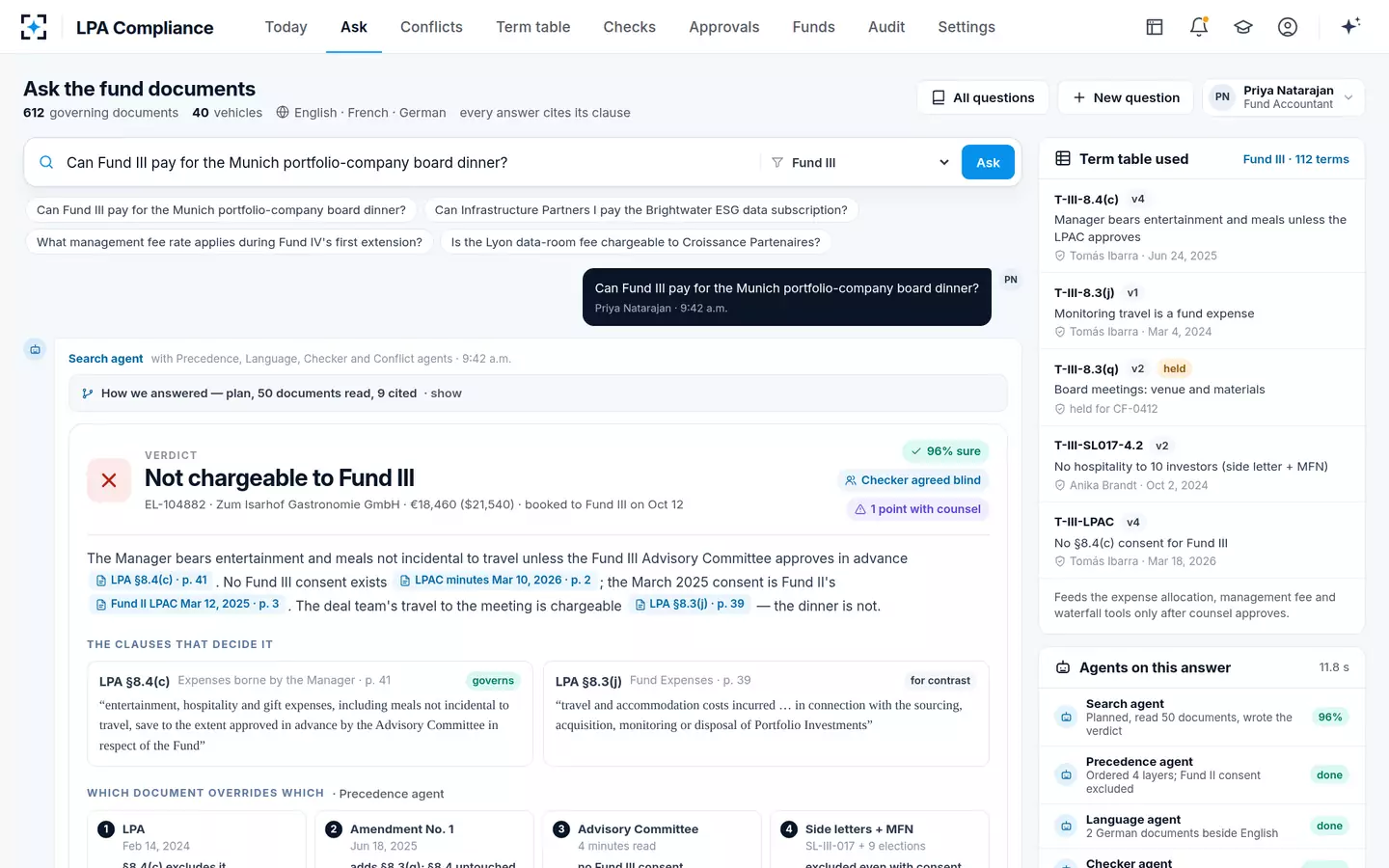
That study measured case-law research, which is not contract review. But its lesson carries to fund compliance: a tool that always answers will sometimes answer wrongly with confidence. The design response is to make every answer cite the passage it relied on, so a person can check it in seconds, and to make the tool stop below a confidence line, so it sends hard questions to a person instead of answering them. In the sample, LPA Compliance answers alone only at or above 90% confidence, and only when a second reading made without seeing the first agrees; below 75% it gives no verdict. Of 1,012 questions in the sample quarter, the two readings disagreed 23 times, and a person decided each.
An answer in LPA Compliance: every sentence cited, and a blind second reading
Original languages: the translation is not the agreement
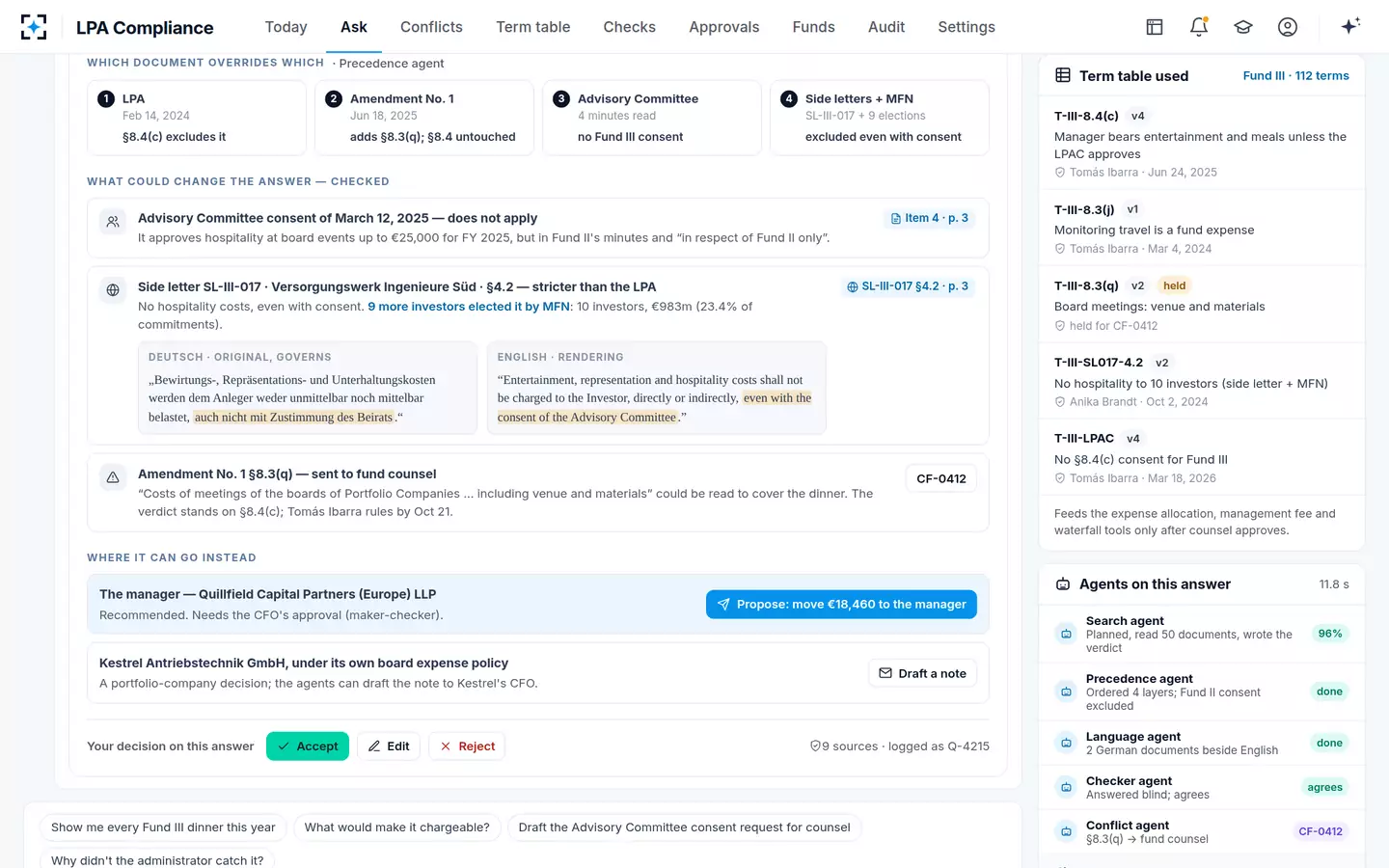
Many European funds sign in French or German and circulate English convenience translations. A review tool that reads the English reads a document nobody signed. In the sample, 138 of the manager's 612 governing documents are French or German originals; one English translation says 50% where the French original says 100%, and LPA Compliance raised it to counsel as a conflict rather than applying either.
A German side letter in LPA Compliance: the original governs, the English is labelled a rendering
Using both: the hand-off from review to testing
The two layers meet at the term table. Legal review at signing, by a lawyer with or without AI help, produces the reading of the executed agreement. LPA compliance turns that reading into terms cited to clause and page, which counsel approves, and from then on every amendment, side letter, consent and ruling changes a term version rather than an abstract nobody updates. The tests run against the approved version.
For counsel the hand-off removes repetition. In the sample, the question "can the fund pay for this?" used to arrive by email 20 to 30 times a week from one fund accountant alone; with the term table, counsel sees only the questions where the words can be read two ways or the agents are not confident, each with both texts and the money at stake, and rules once. How undefined terms are sent to counsel and ruled once follows one such question; the LPA key terms, annotated lists the clauses the table holds.
Questions to ask before using legal AI for fund compliance
A legal review tool can be part of a fund compliance process if it can answer these questions well. Most were not built to, which is no criticism of their design; it is a different job.
Eight questions for any AI tool asked to check a fund against its LPA
- Does it read the books?
A fee or expense check needs the booked figures and the administrator’s calculation, not just the clause.
- Does it know which version applied?
Amendments, side letters and consents in date order, and the version in force on the date of each line.
- Does every sentence cite its passage?
So a person can check the answer in seconds rather than trust it.
- When does it stop?
A confidence line below which it gives no verdict, set by the firm, and a second independent reading above it.
- What does it do with an undefined word?
Send it to counsel with both readings and the impact, then apply the ruling wherever the words recur.
- Does the signed original govern?
For documents signed in another language, with divergences raised rather than resolved.
- Who approves what it proposes?
Counsel for terms, the CFO for money moved between a fund and the manager, nobody for their own proposal.
- What will an examiner see?
Who asked, what was read, what was decided and by whom, kept so that a later change shows.
Where LPA Compliance fits beside legal review AI
LPA Compliance does not negotiate agreements, produce redlines or review data rooms; a legal review tool, or a lawyer, does that work before signing. It begins where review ends: with the executed set, the fund's books and the questions finance asks every day. It answers with the clause, tests every booked expense and fee against terms counsel approved, and keeps the decisions with people. The SEC's examiners frame the standard the same way for any technology: the obligations are the existing ones, and they apply whatever the technology (SEC, October 23, 2026), and the tool has to help a firm meet them, not replace the people who answer for them.
Where LPA compliance fits beside private equity software maps the connections a go-live needs. To see an answer, a conflict and a ruling on the sample funds, start from LPA Compliance.
Questions people ask
What is the best AI tool for legal document review?
It depends on the task: clause finding in a data room, playbook comparison in negotiation and case-law research are different jobs with different published accuracy. Judge any tool on your own documents, on whether it cites its passages and on when it declines to answer; for checking a fund's books against its LPA, a review tool is the wrong category.
Can AI document review tools read side letters and MFN elections?
They can read them as documents. Applying them is the harder part: a side letter binds its own investor and those who elect it, sometimes even against an advisory committee consent, so the tool must know who elected what. In the sample, one German side letter and nine elections protect ten investors holding 23.4% of a fund's commitments.
Is AI legal document review accurate enough to rely on?
Not without a person checking it, on current evidence. CUAD's authors found performance at clause finding "strongly influenced by model design and training dataset size," and the 2025 study in the Journal of Empirical Legal Studies found AI legal research tools hallucinated between 17% and 33% of the time.
Does the SEC allow AI in compliance work?
The SEC regulates obligations, not tools: its fiscal 2027 priorities say examiners will check that firms still meet their existing obligations as registrants adopt what it calls super intelligence, and will prioritise policies for monitoring its use in back-office operations.
Will AI replace fund counsel on LPA questions?
Not in the design described here. The agents answer the questions the clause settles and send the rest to counsel; in the sample's third quarter, 51 of 1,012 questions went to counsel, and every term change and ruling was counsel's.