Contract obligation management software reads agreements, extracts the obligations in them, such as payments, notices, deadlines, approvals and limits, and tracks each one to an owner and a date. Applied to a private equity LPA, it meets two problems general contract tools were not built for. Most of an LPA's obligations are not dates but rules the fund's books must obey every quarter, like the management fee basis or what the fund may pay for. And many of those rules turn on words the LPA never defines, such as "impaired" or "written down," which the SEC's examiners have found managers applying inconsistently. Botminds' LPA Compliance is built around that second problem: when a word can be read two ways, its agents ask fund counsel once, keep the ruling in writing, and apply it wherever the same words appear, instead of guessing again each quarter.
Examples come from a fictional sample manager, Quillfield Capital, whose 40 vehicles and 612 governing documents run through the solution.
What is contract obligation management software?
Contract obligation management software is the part of contract management that works after signing: it identifies what each party must do, and when, and makes sure someone does it. Typical tools extract obligations from executed contracts, store them as structured entries, assign owners, send reminders before deadlines and log completion. Contract lifecycle management covers the earlier stages too, from drafting and negotiation to signature.
Finding the clauses is itself hard. One research dataset built to measure it, CUAD, was annotated by legal experts more than 13,000 times and defines the task as pointing a human reviewer to the parts of a contract that matter. Its authors found transformer models only beginning to manage it, with results that depended heavily on model design and the amount of training data (Hendrycks et al., CUAD, NeurIPS 2021). Highlighting for a human is a useful step. It is not the same as deciding what a clause means for a fund's books.
Can software track LPA obligations?
Yes, but an LPA holds three kinds of obligation, and only one of them is a date. Notices and reports have deadlines that a reminder can track. Permissions, such as a cost the fund may bear only with advisory committee consent, need a check against documents each time money moves. Calculations, such as the management fee after the commitment period, need the clause applied to the books every period. Generic obligation tools are strongest on the first kind; LPA compliance is mostly the second and third.
Three kinds of LPA obligation, and what software has to do with each
| Kind | Example in an LPA | What tracking means | What goes wrong |
|---|---|---|---|
| Dated duty | Annual audited statements to investors; notice of a key person event within a set number of days. | A due date, an owner, a reminder and proof of delivery. | A missed date. Visible, and easy to fix with a calendar. |
| Conditional permission | Entertainment borne by the manager unless the advisory committee approves in advance. | A check, at booking, for the condition: which consent, for which fund, dated when, capped at what. | Consent from another fund, or given after the fact, treated as valid. |
| Calculation | Management fee on invested capital, reduced for investments permanently impaired. | The clause applied to the books every period, with every word in it given one meaning. | An undefined word read differently from one quarter, fund or person to the next. |
What does it do with an undefined term?
It should stop and ask. An undefined word in a fee or expense clause is a decision someone has to make; software that fills it in silently makes that decision without anyone signing it, and may make it differently next quarter. The design that holds up is a short sequence: use the LPA's definition if it has one, use counsel's earlier ruling if there is one, and otherwise send the question to counsel with both readings and their effect in money, then apply the answer everywhere the same words appear.
When a word in the LPA is undefined: the four questions LPA Compliance asks before it answers
1Is the word defined in the LPA as amended?
YesApply the definition and cite it, clause and page.
NoGo on: an undefined word is the start of the risk, not the end of the answer.
2Has counsel already ruled on this wording?
YesApply the recorded interpretation, in this fund and every fund with the same words, and cite it.
NoGo on.
3Can the words be read two ways that change the answer?
YesHold the affected terms. Send counsel both texts, the readings and the impact in lines and amounts.
NoGo on.
4Is the answer at or above the confidence line, with a blind second reading agreeing?
YesAnswer with the clause behind every sentence.
NoBelow the lower line, no verdict; between the lines, “needs review”. Either way, counsel.
Counsel rules once, in writing. The ruling is recorded as an interpretation, applied to every fund with the same wording, and earlier answers that relied on the old reading are re-checked.
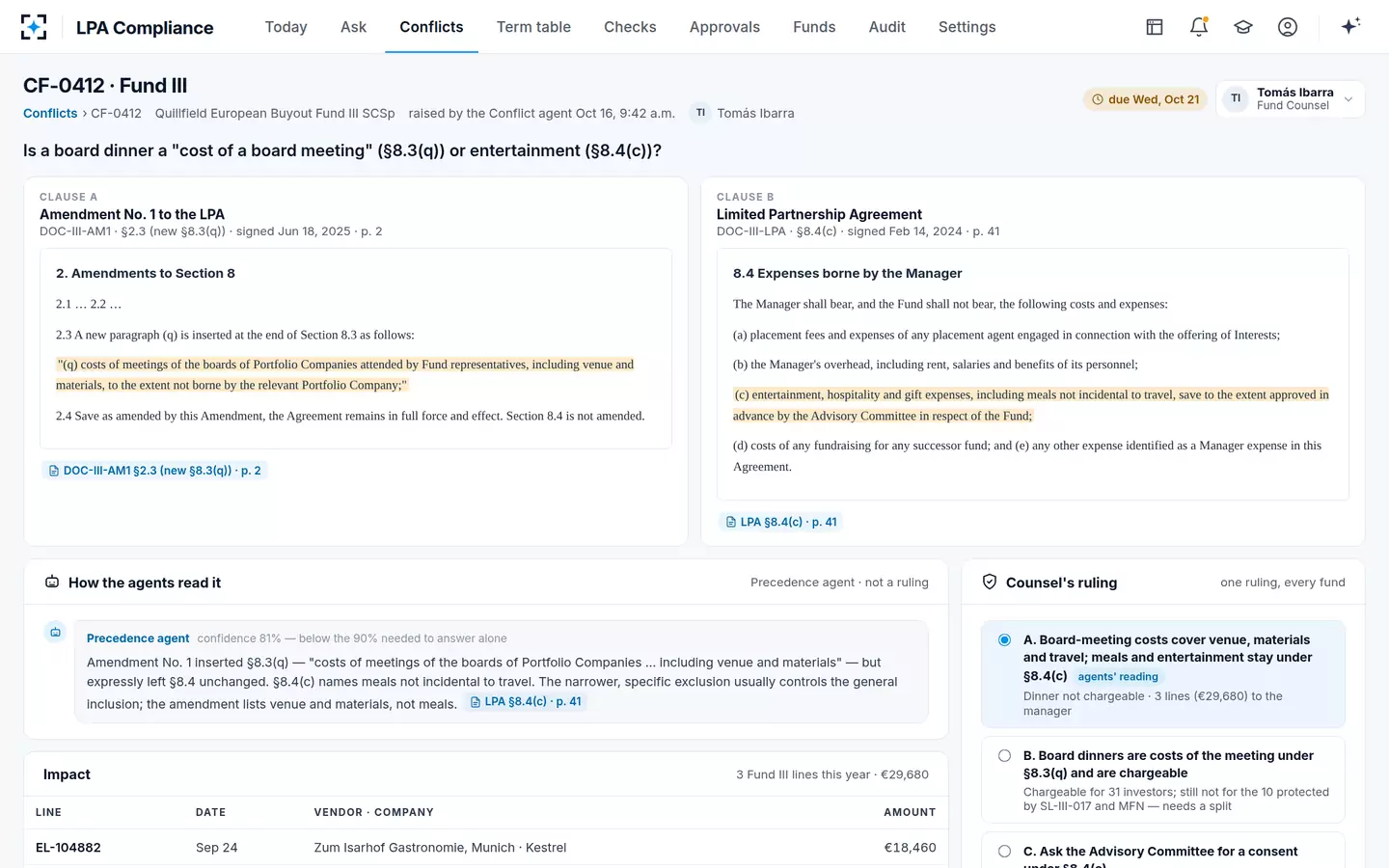
Two details make the sequence work. The second question means a ruling is never asked twice: once counsel has decided that board-meeting costs cover venue, materials and travel but not meals, that reading is the answer in every fund whose clause says the same thing. The third question means the software looks for ambiguity rather than resolving it: a clause that an amendment could have changed is held, not guessed, until someone with authority reads it.
The examiners' finding: undefined fee terms, applied inconsistently
The SEC's 2022 risk alert described advisers whose LPAs used broad words for when an investment's value had fallen, such as impaired or written down, without defining them, and who had no policies to apply those words the same way each time they calculated the post-commitment management fee. The staff's concern was inaccurate fees (SEC risk alert, January 27, 2022). It is the clearest regulatory statement of the risk obligation software creates when it reads an undefined word as if it were defined.
The Commission's 2023 order against Insight Venture Management shows the cost. The funds' LPAs reduced the fee basis when a portfolio investment suffered a "permanent impairment," but "did not disclose the criteria that Insight would use to evaluate whether a portfolio investment suffered a permanent impairment." In practice the adviser used a four-part test, looked for all four parts to be met, and applied it to its aggregated holdings in each company rather than to each investment the LPA named. The order found excess management fees of $773,754.41 from August 2017 to April 2021 and a $1,500,000 civil penalty, and described the undisclosed criteria as "narrow and subjective" (SEC order IA-6332, June 20, 2023).
Read as a software problem, the Insight case has two parts. One word, "permanent impairment," needed a definition investors had never seen. And one level, investment or company, needed to match the LPA's own unit. A tool that extracts "fee basis reduced on permanent impairment" as an obligation has captured the clause and missed both decisions.
Ask, don't guess: confidence lines and a blind second reading
An agent that asks needs a rule for when to ask. In the sample, LPA Compliance answers on its own only at or above 90% confidence, and only when the Checker agent, which re-answers every question without seeing the first answer, agrees. Below 75% it gives no verdict at all; between the two lines the answer is marked "needs review" and goes to counsel. Counsel has three business days to rule on a conflict, two to answer an escalated question and five to approve a change to a term; the asker sees the clock.
The numbers from the sample's third quarter show what the lines do. Of 1,012 questions, 961 were answered without counsel; 51 went to counsel. The Checker agent disagreed with the first answer 23 times, and each of those was decided by a person. Nineteen conflicts were ruled, and 31 written interpretations are kept. The point is not that the agents are usually right. It is that every answer a person did not see met a stated test, and every one that failed the test reached a person.
A conflict for fund counsel in LPA Compliance: two clauses, the agents' reading at 81%, and the impact
One ruling, applied wherever the words are the same
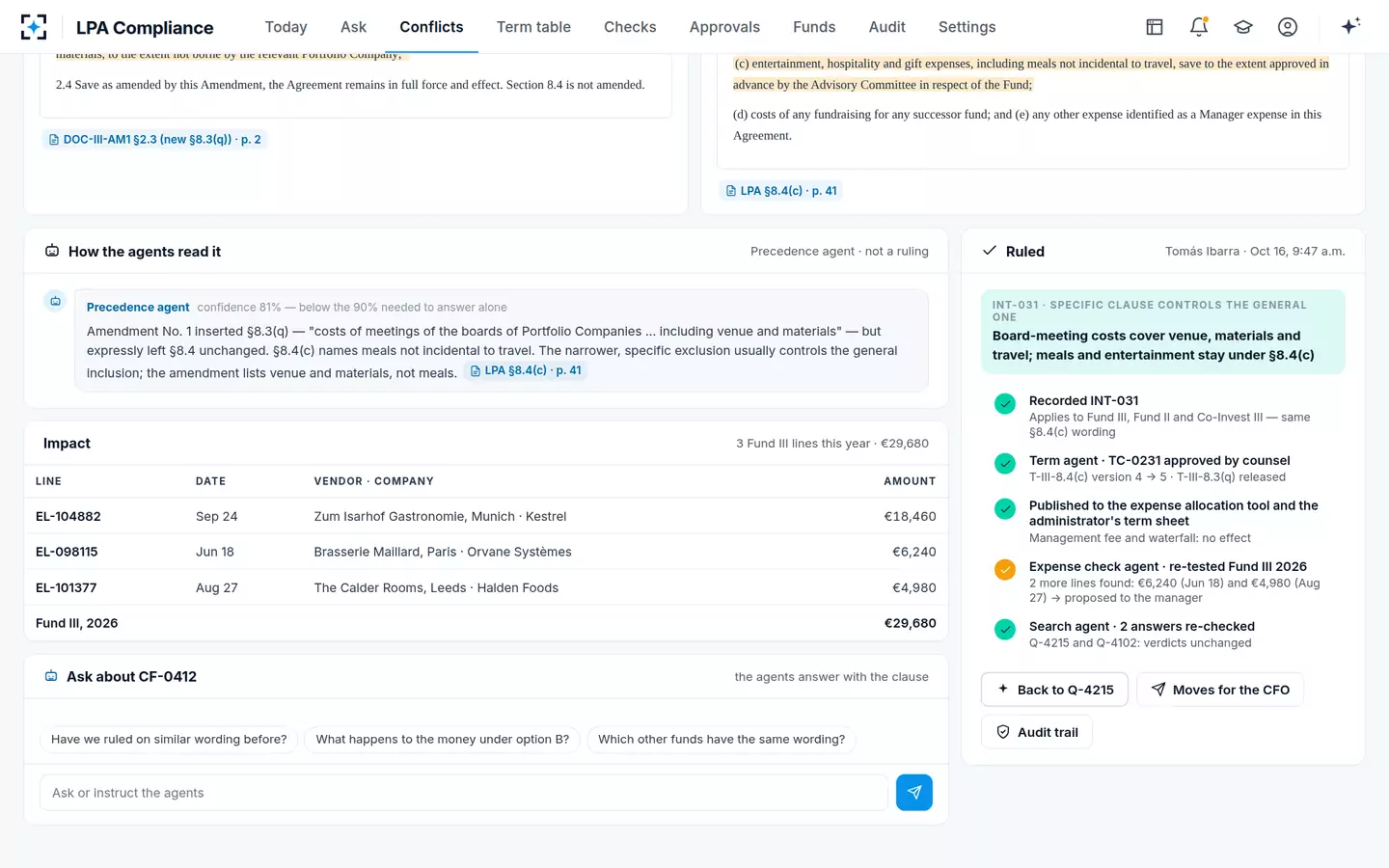
A ruling is only useful if it travels. In the sample, fund counsel read both clauses and chose option A: board-meeting costs cover venue, materials and travel, while meals and entertainment stay under §8.4(c), because the specific clause controls the general one. The ruling was recorded as interpretation INT-031 for Fund III, Fund II and Co-Invest III, which share the wording. The term was updated to a new version, the Expense check agent re-tested Fund III's year and found two more lines, €6,240 and €4,980, and two earlier answers were re-checked, with their verdicts unchanged.
The ruling, applied: one interpretation, three funds, a year re-tested
From an undefined word to a recorded ruling: what the agents do and what people decide
Agent
Search agentAnswers the question, citing every clause, or stops when the confidence line is not met.
Never: gives a verdict without a clause and a page
Agent
Checker agentRe-answers blind and compares verdict, quotes and numbers.
Never: sees the first answer before its own
Agent
Conflict agentWrites the question for counsel: both texts, the readings, the lines and amounts affected.
Never: resolves a conflict; it holds the affected terms
A person decides
Fund counselRules in writing. A ruling counsel proposes on their own term needs a second counsel.
Agent
Term agentRecords the interpretation and proposes the new term version for approval.
Never: publishes an unapproved term
Agent
Expense check agentRe-tests the year’s lines under the new version and proposes moves.
Never: moves money
A person decides
CFOApproves each move between a fund and the manager, with a reason.
Generic obligation software or LPA compliance?
The choice depends on which obligations hurt. If the problem is missed notices and reporting dates across many agreements, general obligation software is built for it. If the problem is whether the fund's fees and expenses follow its documents, the tool has to read the books as well as the contracts, and its hardest work is the words between them.
Contract obligation management software and LPA compliance do different jobs on the same document
General obligation software: Executed contracts, often one at a time.
LPA compliance: The LPA with every amendment, side letter, MFN election and committee minute, as a set in force on a date.
General obligation software: A list of obligations with owners and due dates.
LPA compliance: A verdict on each fee and expense, cited to its clause, and a term table counsel approves.
General obligation software: Captured as written; meaning left to the reader.
LPA compliance: Sent to counsel with both readings and the impact, then applied as ruled.
General obligation software: Usually none.
LPA compliance: Booked expenses and fee calculations from the fund accounting platform and the administrator.
General obligation software: The obligation owner marks it done.
LPA compliance: Counsel rules on terms; the CFO approves every cost moved between a fund and the manager.
What to ask a vendor of contract obligation software for LPAs
Every vendor demonstrates extraction. The questions below test what happens after it, on the cases that produced the SEC's findings. Ask to see each one on your own documents.
Questions that separate obligation tracking from LPA compliance
- Show me an undefined term
What does it do with "impaired" in a fee clause: define it, guess it, or ask? Who signs the meaning, and where is it kept?
- Show me a ruling travel
Once counsel rules, does the ruling apply to every fund with the same words, and are past answers re-checked?
- Show me the document set on a date
An amendment, a side letter and a committee consent: which governs this line, on this date, and why?
- Show me a consent from the wrong fund
Does it notice that a consent covers another fund, a different period or a lower cap?
- Show me the stopping rule
What confidence does it need to answer alone, who set that line, and what happens below it?
- Show me the books
Can it test booked expenses and fee calculations, not just list the clauses that govern them?
- Show me the originals
For a French or German document, does the original govern, and are differences from the English raised?
- Show me the trail
Who asked, what was read, who ruled, who approved: can an examiner follow one answer end to end?
Regulators are asking a version of the same question about any automated tool. ESMA warned in 2024 that many AI systems work as black boxes whose reasoning staff, from control functions to senior management, cannot follow (ESMA public statement, May 30, 2024). The SEC's examination priorities for fiscal 2027 put firms' policies for monitoring what the SEC calls super intelligence on the examination list, covering its use in fraud detection, back-office operations, anti-money-laundering and trading (SEC Division of Examinations, October 23, 2026). A tool that shows its clause, its confidence and its stopping rule is one a compliance function can monitor.
Where LPA Compliance fits, and where it does not
LPA Compliance is not a contract lifecycle system. It does not draft, negotiate or route agreements for signature, and it is not the place to track every reporting date across a firm's vendor contracts. It reads a fund's governing documents as a set, keeps a term table that stays current with counsel's approval, and tests the fund's booked expenses and fees against it. The obligations it tracks are the permissions and calculations that move a fund's money.
Where a firm already runs obligation software, the two meet at the term table: the dated duties can stay where they are, and the fee and expense rules move to a place where undefined words get a ruling. Legal review AI and LPA testing draws the same line for review tools; where LPA compliance fits beside private equity software maps the connections. To see a conflict sent to counsel and the ruling applied on the sample funds, start from LPA Compliance.
Questions people ask
What are examples of contract management software?
The category covers contract lifecycle tools that run drafting, negotiation and signature; repositories that store executed contracts and extract their terms; and obligation tools that track duties after signing. LPA compliance sits beside them as a narrower tool for fund documents and fund books.
How accurate is AI contract review?
It depends on the task and the model, and published benchmarks measure narrow tasks. CUAD's authors found transformer models only beginning to manage the highlighting of contract clauses for human review, and LegalBench, built with legal professionals and posted on arXiv without peer review, spans 162 tasks across six types of legal reasoning; neither measures applying a fee clause to a fund's books.
Does obligation software replace fund counsel?
No. In the design described here it brings counsel fewer, better questions: the ones where the words can be read two ways or the agents are not confident enough, each with both texts and the impact in lines and amounts. Counsel's rulings are what let the software answer the rest.
What is a recorded interpretation?
Counsel's written reading of a clause, kept with the term it affects and applied wherever the same wording appears. In the sample, INT-031 settled that board-meeting costs cover venue, materials and travel but not meals, for three funds that share the wording.
Can obligation software read LPAs in other languages?
It should read the original and say so. In the sample, 138 of 612 governing documents are in French or German; the original governs on screen, with English beside it, and a translation that differs from the original is raised to counsel as a conflict.