The SEC's risk alerts on private funds are two staff reports, from June 23, 2020 and January 27, 2022, in which the Division of Examinations listed the deficiencies its examiners found at advisers to private equity and hedge funds: conflicts not disclosed, expenses charged that the fund documents did not allow, fee offsets missed, advisory committee consent obtained late, funds extended without approval, recycling and key person terms not followed. They are not rules, but they are the examiners' own checklist, and the SEC's fiscal 2027 priorities keep fees and expenses in scope. A file is defensible when each of those findings has become a test with dated evidence. Botminds' LPA Compliance produces that evidence as the work happens: every answer, ruling, test and approval, with its clause, on one trail.
Examples of the evidence come from a fictional sample manager, Quillfield Capital, whose data runs through the solution.
What the SEC's private fund alerts rest on
5+yrs
of private fund examinations behind the 2020 and 2022 observations
$18T
private fund assets managed by more than 5,000 SEC-registered advisers, about 35% of all, in the 2022 alert
10
LPA-related findings across the two alerts, from consent to recycling to fee offsets
What do the SEC risk alerts on private funds say?
They say that many private fund advisers did not do what their own documents said. The 2020 alert covered three areas, "(A) conflicts of interest, (B) fees and expenses, and (C) policies and procedures relating to material non-public information," and observed that "Many of the deficiencies discussed below may have caused investors in private funds (“investors”) to pay more in fees and expenses than they should have" (SEC risk alert, June 23, 2020). The 2022 alert added four groups: failures to act consistently with disclosures, misleading performance and marketing, due diligence failures and potentially misleading hedge clauses (SEC risk alert, January 27, 2022).
For LPA compliance, the useful parts are the fee and expense findings of 2020 and the first section of 2022, "Conduct Inconsistent with Disclosures," which measures advisers against their "fund disclosures": LPAs, operating agreements, private placement memoranda, due-diligence questionnaires and side letters. Each finding names a clause type and a way it was broken. Each can therefore be turned into a test.
Every finding as a test: what examiners scored, and the evidence that answers it
A finding becomes defensible when three things exist for it: a test that could fail, evidence that the test ran on the date it mattered, and a cadence matched to the risk. The table below sets out all ten LPA-related findings that way.
Ten SEC private fund findings, each turned into a test, the evidence an examiner can open, and how often it runs
2022Consent from the advisory committee missing, late or on incomplete information
The testEvery conflicted transaction matched to a consent dated before it, for this fund, within scope and cap.
Evidence an examiner can openThe request as sent, the minutes, and the dated bookings it covers.
RunsAt booking
2022Post-commitment fee basis not reduced as disclosed
The testFee recomputed each period from invested capital less dispositions and write-downs, as the clause defines them.
Evidence an examiner can openThe recomputation beside the administrator’s figure, with the clause and any ruling on undefined words.
RunsEach fee period
2022Fund extended without the required approvals
The testEach extension matched to the approving body and date the term clause requires; fee rate checked.
Evidence an examiner can openTerm clause in force, the approval dated before the term date, fee recomputation.
RunsAt each extension
2022Investment strategy or leverage limits exceeded
The testEach new investment and borrowing tested against the limits on the date it was made.
Evidence an examiner can openThe limit clause, the test result, any consent to an exception.
RunsAt each investment
2022Recycling described inaccurately
The testEach distribution decided as recallable or not when paid; cap tested as a running total.
Evidence an examiner can openDistribution notices with the designation, the running total, the fee basis effect.
RunsAt each distribution
2022Key person process not followed
The testNamed persons compared with who is actually in place; notice, suspension and calls checked after an event.
Evidence an examiner can openQuarterly attestation, the notice, every call’s permitted purpose.
RunsQuarterly, and at an event
2020Shared expenses allocated inconsistently with disclosures
The testEach shared cost allocated by the method the documents disclose, across funds, co-investors and the manager.
Evidence an examiner can openThe allocation, the method cited, the clause for each vehicle.
RunsEach invoice
2020Expenses charged that the fund documents did not permit
The testEvery booked line tested against the fund and manager expense lists.
Evidence an examiner can openLine-level verdicts with the clause; moves to the manager with approver and reason.
RunsEach line
2020Contractual expense limits exceeded
The testRunning totals against each cap; the line that crosses it split.
Evidence an examiner can openThe cap clause, the running total, the split.
RunsEach line
2020Fee offsets not applied or miscalculated
The testEvery portfolio company fee received, including by affiliates, matched to the offset and its exclusion list.
Evidence an examiner can openThe fee list, the offset calculation, the exclusions read as written.
RunsEach fee period
The cadence column is the one most programmes get wrong. A quarter-end sample of expense lines can find an expense the LPA forbids, but it finds it after investors have borne it, and it cannot prove the other lines were tested. A consent check that runs at booking prevents the 2022 timing finding instead of documenting it. The further a test runs from the moment money moves, the more of the file is reconstruction.
The 2020 alert: conflicts, fees and expenses
The 2020 alert's fee and expense findings read as a list of expense-clause failures. Advisers split shared costs across funds, co-investors and themselves in ways their disclosures did not describe; charged funds for costs the operating agreements did not permit; exceeded contractual caps on particular expenses; and applied management fee offsets wrongly or not at all. Each is a clause read one way in the documents and another in the books. On offsets the staff also found advisers with no reliable way to track which portfolio company fees they had received.
That last finding is still being enforced. In August 2025 the Commission found that TZP Management Associates had collected $701,522 of interest on deferred portfolio company fees, of which $423,065 should have increased the funds' fee offsets, because the LPAs' list of exclusions did not name that interest (SEC order IA-6908). The adviser paid disgorgement of $502,041, prejudgment interest of $6,836 and a civil penalty of $175,000 into a fund for harmed investors.
The 2022 alert: six ways practice drifted from the LPA
The 2022 alert's first section reads as an annotated LPA. Advisers failed to obtain informed consent from advisory committees, or obtained it after the transaction or on incomplete information. They did not reduce the post-commitment fee basis as disclosed. They extended funds without the approvals or liquidation steps their LPAs required. They breached investment strategy and leverage limits. They described their recycling practices inaccurately. And they let the key person process lapse after principals left.
Each of these has its own guide in this series, because each has its own mechanics: what LPAC consent requires, the approvals behind a fund term extension and the clock after a key person event. What they share is the remedy. None needed a new rule to find; each needed someone to read the clause in force and compare it with what happened.
Did the vacated private fund adviser rule change any of this?
No. The private fund adviser rules adopted in August 2023, including quarterly statements, mandatory audits and restrictions on certain activities, were vacated by the Fifth Circuit on June 5, 2024: "For the following reasons, we VACATE the Final Rule" (Nat'l Ass'n of Private Fund Managers v. SEC, No. 23-60471). The SEC removed them from the Code of Federal Regulations on November 19, 2024, which also reversed the 2023 amendments to the books and records rule and the compliance rule (89 FR 91252).
Nothing in the alerts depended on those rules. The 2022 alert rests its findings on the adviser's fiduciary duty, Rule 206(4)-8's ban on untrue or misleading statements to investors in pooled vehicles, and the compliance rule's requirement to "Adopt and implement written policies and procedures reasonably designed to prevent violation" (17 CFR 275.206(4)-7). All three are in force.
What the 2024 vacatur removed, and what examiners still test
Removed with the 2023 rules: A mandatory quarterly statement of fees, expenses and performance in a set form.
Still in force, and in the alerts: Fees and expenses must match the fund documents; misstatements to investors are fraud under Rule 206(4)-8.
Removed with the 2023 rules: Investor consent to charge the fund for an investigation of the adviser; written notice for regulatory, compliance and examination costs.
Still in force, and in the alerts: Expenses the LPA does not permit may not be charged; contractual caps apply.
Removed with the 2023 rules: Disclosure of preferential terms given to investors, and limits on some.
Still in force, and in the alerts: Side letters are fund disclosures; conduct must be consistent with them.
Removed with the 2023 rules: A written record of the annual review, added in 2023.
Still in force, and in the alerts: The annual review itself, of adequacy and effectiveness, and records of it under Rule 204-2.
Removed with the 2023 rules: An annual audit of each private fund.
Still in force, and in the alerts: The custody rule’s audit route where an adviser relies on it.
What does the SEC look for in a private fund exam?
For fiscal 2027, the SEC's examiners say they will look at controls for both the fund and the deals inside it. When examining advisers to private funds, "reviews will assess investment-related disclosures of risks for consistency with fiduciary standards, and whether compliance policies, procedures, and controls are designed to address both fund-level and investment-level risks." The examples it gives include the use of affiliated service providers and whether fee and expense calculations are right, at the level of the fund and of each investment (SEC Examination Priorities, fiscal year 2027, October 23, 2026).
The same statement says examinations "will focus on whether the policies and procedures are implemented," and the staff's June 2026 alert on economic conflicts checked whether advisers calculate and charge fees and expenses the way their disclosures say (SEC risk alert, June 9, 2026). Implemented is the operative word. A policy that says expenses are tested against the LPA is evidence of intent; a line-by-line test with dates is evidence of implementation.
What evidence shows an LPA term was followed?
Evidence that an examiner can follow from the clause to the money without asking anyone to explain it. That means the clause as it stood on the date, the decision made under it, the person who made or approved the decision, and the reason, kept in a form that cannot be quietly changed. For fee and expense terms it also means coverage: proof that every line was tested, not a statement that a sample was.
What the exam file should hold for each LPA term
- The clause in force on each date
The LPA with each amendment, side letter and consent, and the version of the term used for each test.
- Counsel’s rulings
Every reading of an ambiguous or undefined word, in writing, with the funds it applies to.
- Every test, not a sample
Each expense line and fee calculation, with its verdict and the clause behind it.
- Every correction, with its approver
Costs moved between a fund and the manager, who proposed and who approved, with a reason code.
- Consents, requests and minutes
For each conflict: the request as sent, the minutes, the dates, and the lines that relied on it.
- Exceptions kept on the fund
Lines flagged and kept by a person, each with the reason, so the examiner sees judgement, not silence.
- The annual review
What was tested, what failed and what changed: the records Rule 204-2 requires of the annual review.
- A trail that cannot be edited
Who, what, when and why for each step, protected so a later change shows.
The annual review: where the tests meet Rule 206(4)-7
The compliance rule requires each registered adviser to "Review, no less frequently than annually, the adequacy of the policies and procedures established pursuant to this section and the effectiveness of their implementation" (17 CFR 275.206(4)-7(b)). Effectiveness is a question about results: how many tests ran, what they found, what changed. A programme that tests every line and fee each quarter answers it with counts rather than assurances.
Records of that review must be kept. Rule 204-2(a)(17)(ii) lists "Any records documenting the investment adviser's annual review of those policies and procedures," and the general retention period is "not less than five years from the end of the fiscal year during which the last entry was made" (17 CFR 275.204-2). The LPA compliance checklist and its measures sets out the counts worth reporting.
Building the exam file in LPA Compliance
LPA Compliance builds the file as a by-product of the work rather than at exam time. Each question, answer, source, ruling, term change, test and approval is logged with who acted, what they did, when, why and the evidence, and each entry is chained by a hash so a later change shows; in the sample, 18,402 entries have been logged since January 1, and the chain is verified every morning. The quarterly report is prepared from the same trail.
LPA Compliance's audit trail: who, what, when, why and the evidence, chained and verified
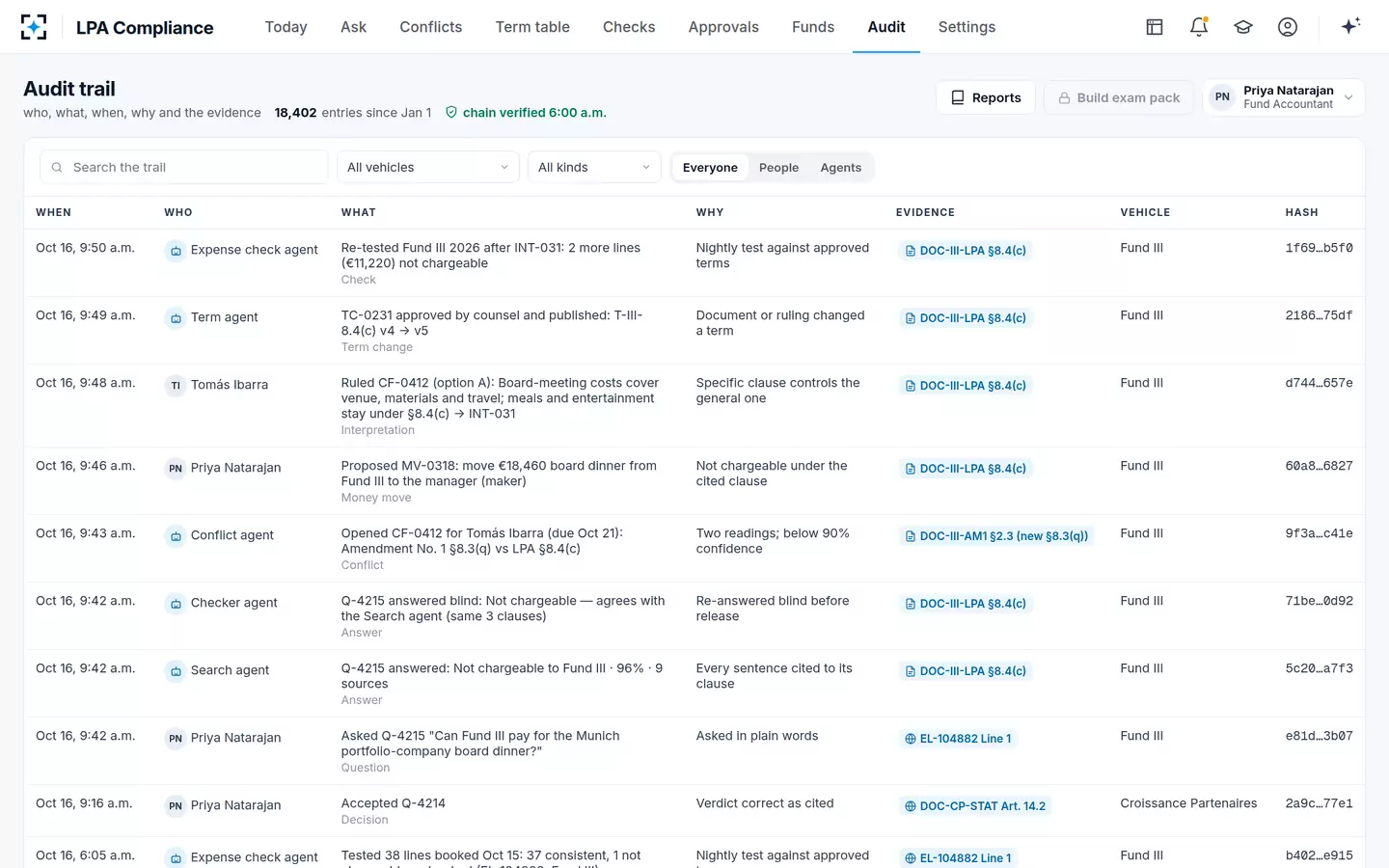
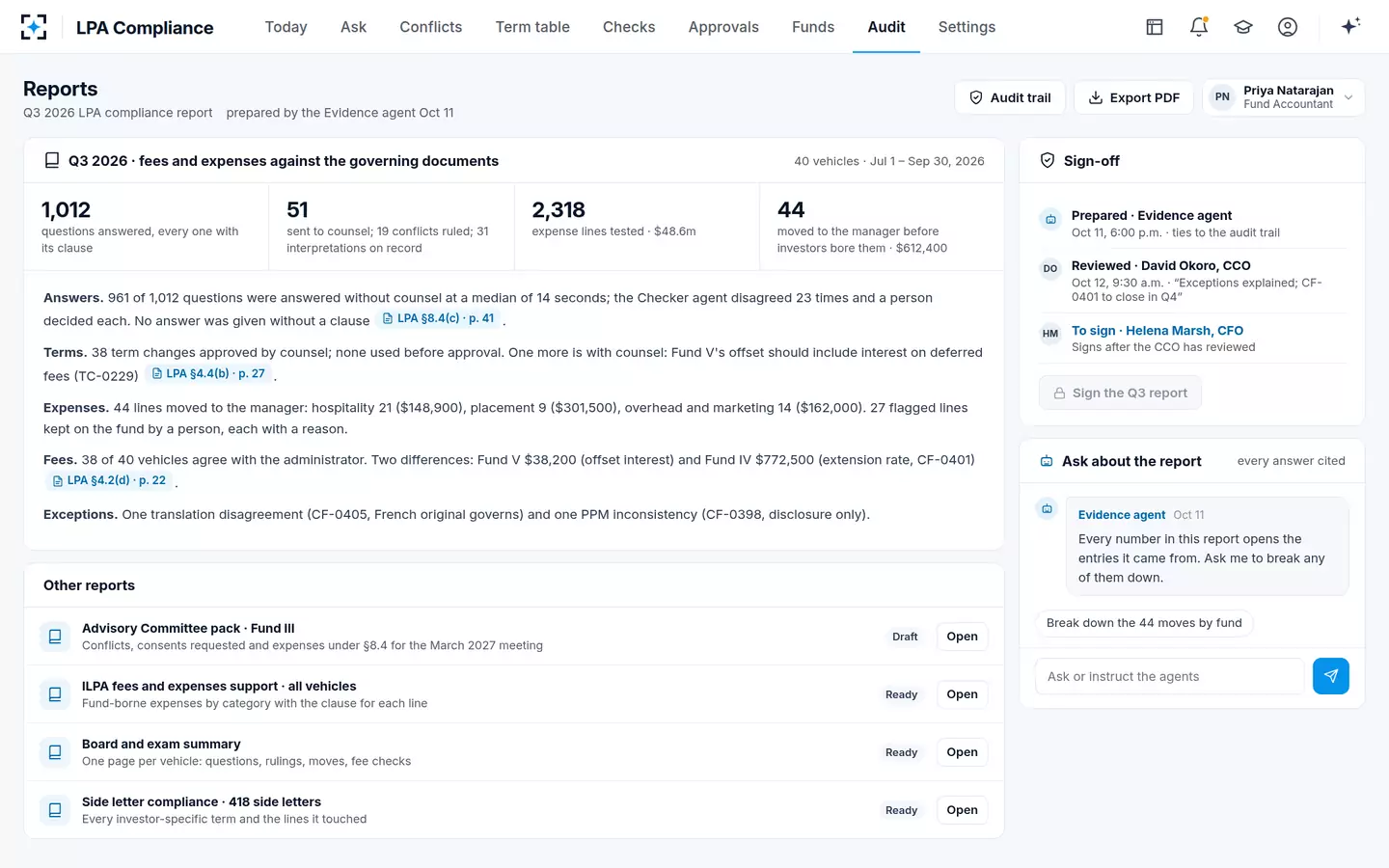
The chief compliance officer assembles the exam file from it: every question and answer with its clause, term versions and who approved them, counsel's rulings, expense tests and moves, fee checks, and the trail itself as data an examiner can sort. Nothing leaves the firm until the CCO releases it. In the sample's third-quarter report, all 2,318 expense lines were tested, 44 were moved to the manager with the CFO's approval, 27 flagged lines were kept on the fund by a person with a reason, and 38 of 40 vehicles' management fees agreed with the administrator.
The quarterly LPA compliance report: fees and expenses against the governing documents
To see the trail and the report on the sample funds, start from LPA Compliance.
Questions people ask
Are SEC risk alerts binding?
No. Each alert states that it "represents the views of the staff" and "has no legal force or effect." They matter because they describe what examiners test, and the conduct they describe can breach rules that are binding, such as the compliance rule and Rule 206(4)-8.
What SEC risk alerts were published in 2026?
Among them, on June 9, 2026, the Division of Examinations published observations on advisers' obligations around economic conflicts of interest, including fee calculations "inconsistent with the advisers’ agreements, disclosures, or both." The fiscal 2027 examination priorities followed on October 23, 2026.
How many private fund advisers does the SEC examine?
The 2020 alert said the examination office "examines hundreds of private fund advisers each year"; the alerts' observations were drawn from over five years of those examinations. No public figure breaks the count down by finding.
How long must the evidence be kept?
Most books and records an adviser must make under Rule 204-2 are kept for not less than five years from the end of the fiscal year of the last entry, the first two in an appropriate office of the adviser. Fund agreements and side letters may require longer.
Does the SEC still care about private fund fees after the rule was vacated?
Yes. The fiscal 2027 priorities name fee and expense calculations, at fund and at investment level, among the controls examiners will review at private fund advisers, and the Commission's August 2025 TZP order found excess fees from offset practices inconsistent with the LPAs.