The secondary discount is how far below a private fund's reported net asset value an LP stake sells, stated as a percentage of that NAV. Research on secondary sales finds most LP stakes change hands at a discount: in one study of every sale a large intermediary handled from 2006 to 2014, the average discount was 13.8% of NAV, and about 9% for the most common sale, a stake in a fund four to nine years old (Nadauld, Sensoy, Vorkink and Weisbach, NBER Working Paper 22404). The discount is agreed between seller and buyer, but it is priced on a NAV that is already months old, and the transfer then waits for the fund's consent. Every week of that wait moves distributions, capital calls and risk between the two parties. Botminds' LP Interest Transfer Processing takes each LP-led transfer from request to GP consent and shows what the wait moved, so the fund's own process is not what the price ends up paying for.
The research figures below come from the 2016 NBER working paper of a study later published in the Journal of Financial Economics. The transfer figures come from the solution's sample data, on fictional funds and investors.
The same sale, consented in six days or in six weeks: the effective date stays, the gap grows
- Effective date (Sep 30) to request13 days
- Request to GP consent6 days
- Consent to the buyer's closing (Oct 30)11 days
- Effective date to request13 days
- Request to GP consent42 days
What is a secondary discount?
A secondary discount is the gap between the price a buyer pays for an LP's stake in a private fund and the stake's share of the fund's reported NAV, usually quoted as a percentage of NAV. A stake with a $16.84 million capital account sold for $15.16 million is sold at a 10% discount. The word is the market's, and so is the measure: practitioners price secondaries against NAV because it is the only value the fund publishes.
The term can mislead in both directions. NAV is the manager's valuation, not a market price, and the NBER authors note that it is "not a market-based assessment of the fund's underlying value" and that GPs can influence it. And NAV covers only the drawn part of the commitment. A discount says something about the price of what the fund holds, and little about the obligation the buyer takes on.
Why do LP stakes sell below NAV?
Because the buyer is pricing a bundle of private companies it cannot see well, in a market with few buyers, and because the seller often needs the cash more than the buyer needs the stake. The NBER study relates both the discount and the buyers' later advantage to "factors associated with asymmetric information and market depth" (NBER w22404). Discounts were larger for smaller funds, where information is scarcer, and for smaller transactions, where the buyer's cost of learning is spread over less.
The authors of the 2025 NBER study of continuation funds make the same point about information: in an LP-led sale "a claim on a bundle of companies is being sold, and both the buyer and the seller may lack access to important company-level information" (NBER w34471). A seller who holds better information than the buyer could, in principle, sell high. The data suggest the opposite: buyers did better.
How big is the discount? What one study of 2006–2014 sales measured
In the study's full sample the average discount was 13.8% of NAV, but the figure varies with fund age and with the market. The average is pulled up by very young funds sold at deep discounts during the financial crisis and by some very old funds after it; the most common sale, a fund four to nine years old, averaged about 9%, and funds ten years old or older sold at about 10%.
Discounts to NAV in secondary sales of LP stakes, 2006–2014
The buyers' side of the same trades is the starker number. For the most common sale, buyers who held to liquidation earned average annualised IRRs of 19.8% (median 15.6%), against 2.1% (median 2.4%) for the sellers. Much of that gap is timing, the authors note; against the public market, the difference for those funds was about three percentage points a year. The authors conclude that the market's costs "appear to be borne primarily by the sellers, not the buyers." The investment committee's view of whether a sale is worth it, and when a denominator problem makes one tempting, is the subject of the denominator effect in private equity.
Why a discount to NAV can mislead: the unfunded commitment
A discount to NAV prices only the money already drawn, while the buyer also takes on every future capital call. The working paper is explicit about it.
"It is important to remember that the purchase price of the stake, and consequently any discount to NAV, only applies to the drawn down portion of the commitment."
Nadauld, Sensoy, Vorkink and Weisbach, NBER Working Paper 22404 (2016)
The authors' own example: if a fund has drawn 5% of commitments, a seller who accepts a 50% discount is paying 2.5% of its commitment to be rid of the future calls. The same arithmetic applies to a mature stake. The sample transfer shows no price, so the table below applies an assumed 10% discount to the sample's figures to show the effect.
What a 10% discount means on the sample stake, measured three ways
| Measure | Amount | Discount as a share |
|---|---|---|
| Capital account moving (the NAV base) | $16,840,000 | 10% of NAV: $1,684,000 |
| Unfunded commitment the buyer assumes | $7,400,000 | Not priced by the discount |
| Total exposure taken on: NAV plus unfunded | $24,240,000 | $1,684,000 is 6.9% of it |
| Commitment transferred | $20,000,000 | $1,684,000 is 8.4% of it |
Is there a GP-led secondary discount?
In a GP-led deal the exiting investors sell at a price the manager negotiates with the buyers of the new vehicle, so whether it is a discount depends on what it is measured against, and the research cited here does not measure it. The NBER continuation-fund study describes the structure: investors "can exit at the negotiated price", the GP represents and charges fees to both sides, and investors are often pushed to decide quickly. It reports that only about 6% of legacy investors roll.
For the fund's operations the distinction is practical. In an LP-led sale the discount is the parties' business and the fund's job is to process the transfer cleanly. In a GP-led deal the price is the manager's proposal and the conflict is the fund's business. LP vs GP-led secondaries sets the two side by side.
Does a slow transfer cost the seller?
Yes, in three ways that do not show up in the discount. The seller remains the partner of record until consent and posting, so it keeps receiving distributions and capital calls that the transfer agreement says belong to the buyer; each one must be found, re-attributed and settled. The NAV the price was based on ages; NBER's authors note that bidders "are often making bids based on 1 to 2 quarter old NAVs", and a new quarter's statement arriving mid-review gives either side a reason to revisit the price. And a transfer that runs past the buyer's closing date puts the agreement's own terms in play.
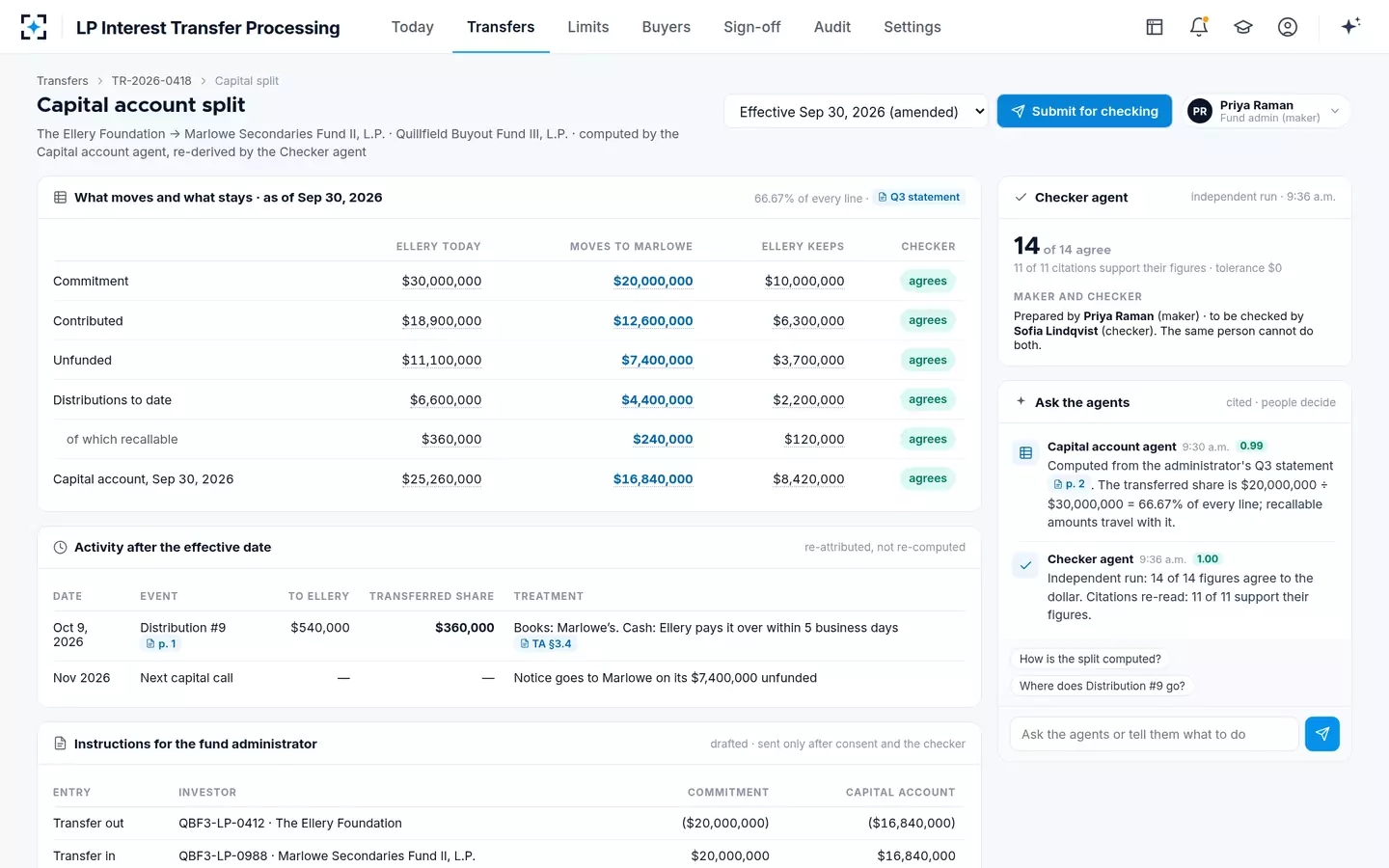
In the sample, a distribution of $540,000 was paid to the seller on October 9, nine days after the effective date; $360,000 of it belonged to the share being sold. Because the transfer was consented six days after the request, that was the only post-effective activity to unwind, and the screen shows the next capital call, in November, going to the buyer. A six-week review would have pushed consent past the buyer's October 30 closing and past that call.
Activity after the effective date: one distribution re-attributed, and the next call going to the buyer
How do NAV dates and effective dates interact?
Three dates govern a secondary sale, and they are rarely the same. The reference date is the NAV the price was set against, often a quarter or two old. The effective date is the moment the interest moves for the fund's books, usually a quarter end the LPA allows. The closing date is when the parties exchange the price. The fund's capital account split runs from the effective date, using the administrator's statement for it.
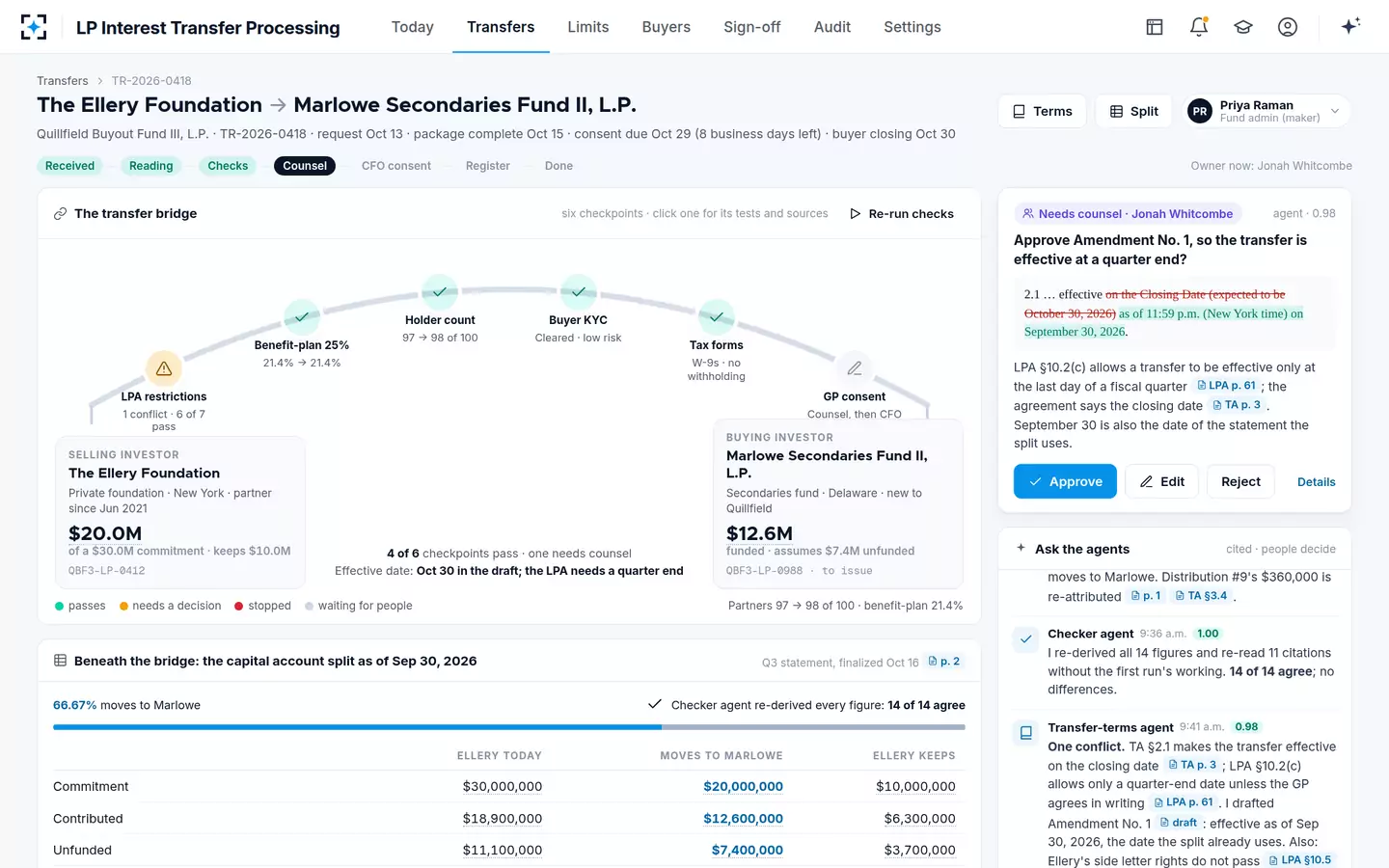
The sample shows how easily they collide. The transfer agreement made the transfer effective "on the Closing Date (expected to be October 30, 2026)"; the LPA allows a transfer only "as of the last day of a Fiscal Quarter". A split as of October 30 would have needed estimated balances and a later true-up on two accounts. The agents drafted a one-line amendment making the transfer effective as of September 30, the date of the statement the split uses, and counsel approved it. The price stayed the parties' business; the fund's books simply started from a date they could support.
The effective date conflict, flagged on the transfer bridge before counsel reviews
Who bears the cost of a delayed closing?
Between the parties, whoever the transfer agreement says; for the fund, the cost of its own delay is reputational and operational rather than contractual. A transfer agreement can allocate post-effective-date cash between buyer and seller, as the sample's §3.4 does, and can set an outside date after which either side may walk away. The fund is not a party to that bargain, but its consent is a condition of it, and a fund that routinely takes six weeks becomes a cost both sides price.
The fund's levers are its own service level and its quarter-end calendar. In the sample settings, consent is due 10 business days after a complete package, with escalation to the CFO on day 7, and requests that arrive within five business days of a quarter end roll to the next quarter. Both are settings a fund chooses, and both are visible to sellers and buyers before they sign.
How to measure transfer cycle time on your own files
No regulator or independent study publishes LP transfer cycle times or the cost of a delayed consent, so the fund has to measure its own. Take last year's transfers and record five dates for each: the request, the complete package, counsel's approval, consent and posting. The first gap belongs to the parties, the others to the fund.
Then count what the delays moved: distributions and capital calls between the effective date and posting, each one a re-attribution and a settlement between the parties; transfers that crossed a quarter end and needed a new statement; and transfers that ran past the buyer's closing date. In the sample queue, 16 transfers were consented in the quarter with none failing a test, and nine were due that week, three at risk of the 10-day service level. That is the shape a CFO should see every Monday.
LP Interest Transfer Processing records those dates on every transfer as it runs, so the measurement is a report rather than a project. Sellers who want to shorten their own wait will find what the GP's desk needs from a seller useful. The solution itself is at LP Interest Transfer Processing.
Questions people ask
What is a secondary discount in private equity?
It is the difference between the price paid for an LP's stake in a fund and the stake's share of the fund's reported net asset value, as a percentage of NAV. In the NBER study of 2006–2014 sales, the average was 13.8%, and about 9% for funds four to nine years old.
Why do private equity secondaries trade at a discount to NAV?
Mostly because of information and market depth: buyers price portfolios they cannot see well, in a thin market, often from sellers who need liquidity. The NBER study found discounts larger for smaller funds and smaller deals, consistent with information costs.
Do LP stakes ever sell at a premium?
Some do; the study reports transactions on average at a discount, not every one. NAV is reported with a lag and usually rises over time, so a price that looks like a discount to a stale NAV can be closer to par on the current one.
Does a discount to NAV include the unfunded commitment?
No. The discount applies only to the drawn part of the commitment, while the buyer also takes on the future calls. A stake with large unfunded commitments can carry a large headline discount that is small relative to everything the buyer assumes.
Who gets distributions paid between signing and consent?
Whoever the transfer agreement gives them to, measured from the effective date. In the sample, $360,000 of a distribution paid to the seller after the effective date was re-attributed to the buyer and settled between the parties within five business days.
How long should an LP transfer take?
There is no published standard. A fund can set its own service level from a complete package and hold itself to it; the sample uses 10 business days with escalation to the CFO on day 7, and its sample transfer was consented in four business days from the request.