The sale of a limited partnership interest in a private fund has two halves. The first is the seller's: find a buyer, agree a price and sign a transfer agreement. The second is the fund's: the general partner must consent and admit the buyer, and before it does it will read the agreement against the LPA, count the fund's partners and plan investors, screen the buyer and check both sides' tax forms. From the seller's side that second half looks like delay. Each request has a reason, and a seller who supplies everything up front shortens the wait. Botminds' LP Interest Transfer Processing is the GP's side of the same sale: it takes each transfer of an LP interest from request to GP consent, and asks for everything missing in one go.
The examples come from the solution's sample data, with fictional people and firms: the Ellery Foundation, a private foundation, selling $20 million of its $30 million commitment in Quillfield Buyout Fund III to a secondaries fund.
Five people at the fund will touch your sale: what each needs, and how it changes when agents do the reading
Today
Writes to you or your counsel each time a reviewer finds a missing document, often one gap at a time.
With agents
Sends one request listing everything missing, drafted the day your package arrives and approved before it goes.
Still theirs: Every message that reaches you
Today
Returns comments on the transfer agreement after reading it by hand against the LPA and your side letter.
With agents
Sees each conflict with both clauses cited and a drafted fix, so comments come back as one amendment.
Still theirs: Approval of the documents
Today
Asks your buyer for owners, IDs and tax forms, sometimes in rounds and in more than one language.
With agents
Gets your buyer's owners and control persons mapped and screened from the papers it sent.
Still theirs: KYC clearance of your buyer
Today
Decides consent from numbers others gathered, and holds any sale that might breach a fund limit.
With agents
Decides on one page; a limit problem arrives with options, such as a later effective date, rather than a no.
Still theirs: GP consent
Today
Re-adds the split of your capital account before your interest is reduced on the register.
With agents
Checks a split a second agent has already re-derived to the dollar, then posts it.
Still theirs: Posting the register
How do I sell a limited partnership interest?
Find a buyer, agree a price, sign a transfer agreement conditional on the GP's consent, and send the package to the fund. Buyers are often funds that specialise in secondaries; the NBER study of secondary transactions found buyers tended to be funds of funds and sellers more often endowments and pension plans (NBER w22404). The fund is not a party to the price.
The package the fund needs is larger than the agreement. It includes the buyer's transferee questionnaire and joinder to the LPA, its ownership papers, both sides' tax forms, and anything the LPA makes a condition of transfer. In the sample, the seller's counsel sent five documents and 112 pages; one was missing, the buyer's owner list, and the fund asked for it on the first day. The package was complete two days later and consent came two business days after that.
Is a limited partnership interest a security?
An interest in a private fund is sold as a security, in an offering exempt from registration, and its resale needs an exemption too. The SEC's own data treat "limited partnership securities" as a class of securities that transfer agents service (SEC, Transfer Agent Rules, 91 FR 56946), and the fund's tax safe harbor depends on the interests having been issued in offerings exempt from Securities Act registration (26 CFR 1.7704-1(h); counted in the publicly traded partnership safe harbor).
One statutory route for a private resale is section 4(a)(7) of the Securities Act. It requires, among other things, that "Each purchaser is an accredited investor", that neither the seller nor anyone acting for it uses general solicitation, that the class has been outstanding for at least 90 days, and, for an issuer that does not file reports, that the seller makes certain information available to the buyer (15 U.S.C. §77d(d)). Securities bought this way are restricted securities, and the statute says it is not the only exemption available. Which route a sale uses is for the parties' counsel; the fund's interest is that the buyer can make the investor-status representations its LPA requires.
Do I need the GP's consent to sell?
Almost certainly, because your LPA will say so, and without it your buyer would not become a partner. Delaware's default lets a partnership interest be assigned "in whole or in part" unless the LPA says otherwise, but the assignment alone does not entitle the buyer "to become or to exercise any rights or powers of a partner"; the buyer would get your share of profits, losses and distributions and nothing else (6 Del. C. §17-702(a)). An assignee becomes a limited partner as the agreement provides or, failing that, with the consent of all partners (§17-704(a)).
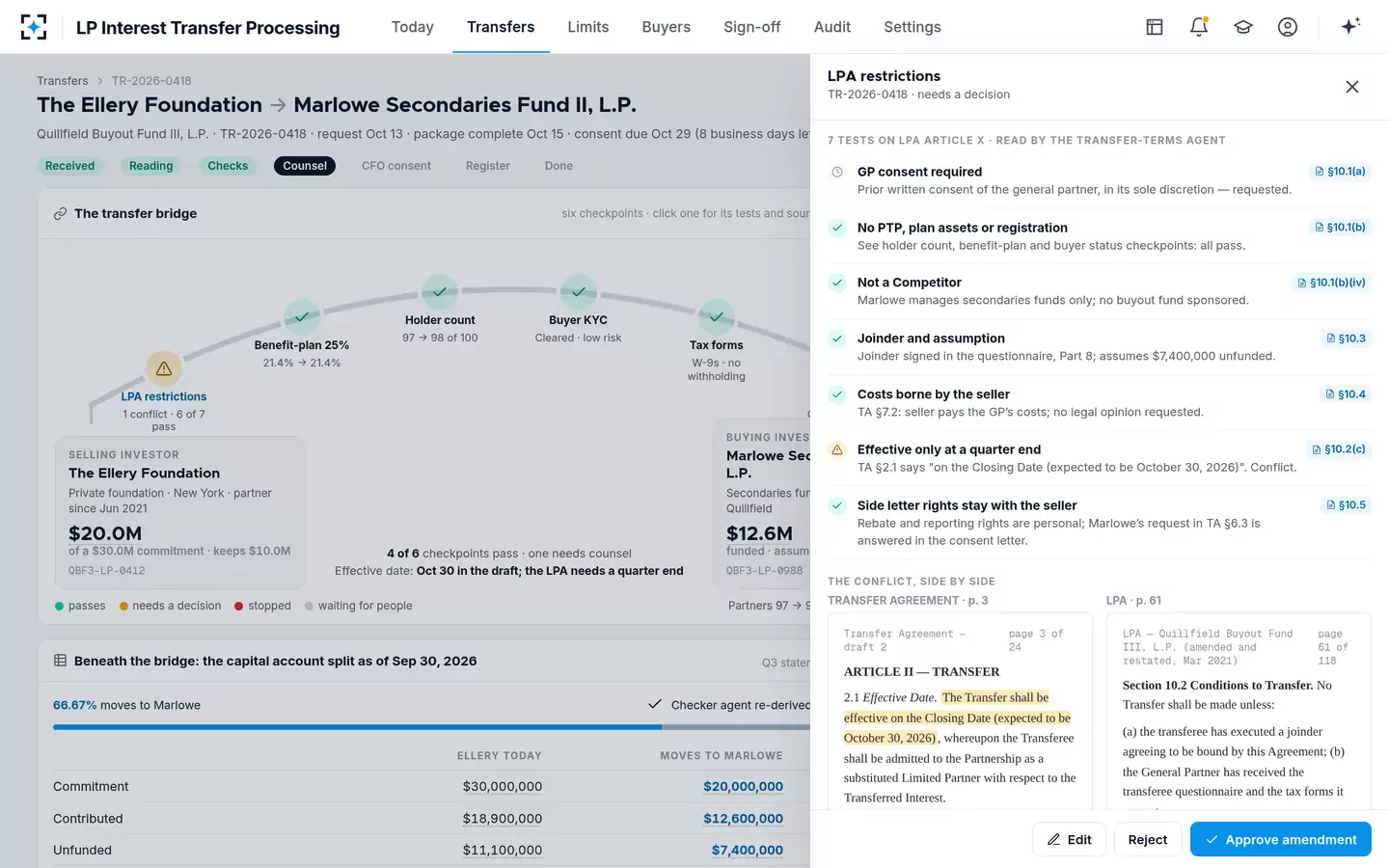
LPAs therefore put the decision with the GP, often in its sole discretion, and list conditions. In the sample LPA, the GP's prior written consent is required, the transfer may not make the fund a publicly traded partnership, put its assets under ERISA or require it to register, the buyer may not be a competitor, the buyer must sign a joinder, the seller pays the GP's costs, and the transfer may be effective only at a quarter end. GP consent to an LP transfer: the six checks explains each from the GP's side.
What documents will the fund ask for?
The fund will ask for everything it needs to test the transfer against its LPA and its limits, and the fastest sales send it all at once. The checklist below is what a seller can assemble before the request goes in.
Ten things to send the GP with your transfer request
- The transfer agreement, with an effective date the LPA allows
Usually a quarter end. In the sample, a closing-date effective date was the one conflict the fund found.
- The buyer's transferee questionnaire and joinder
The questionnaire is how the fund counts the buyer against its limits; the joinder binds it to the LPA.
- The buyer's owners, control persons and entity papers
The fund screens them before admission; foreign-language papers slow nothing if they arrive with the rest.
- Your tax form
A W-9 if you are a US person. If not, a W-8 and any section 1446(f) certification, dated no earlier than 30 days before the transfer.
- The buyer's tax form
A W-9, W-8BEN-E or W-8IMY, for the fund's withholding on the buyer's future income.
- How much you are selling, and how much you keep
A part sale adds a partner to the fund's count; a sale to several buyers adds several.
- Your side letter and any earlier consents
Say which rights you expect to keep; personal rights often do not pass to a buyer.
- Whether the buyer is related to you
Transfers to family, to an estate or to your own vehicle can be treated differently in the fund's counts.
- How post-effective cash will be settled
Distributions and calls after the effective date belong to the buyer; the agreement should say how they move.
- Who signs for you, and with what authority
Certifications from an entity must be signed by an officer, director, general partner or someone else authorised.
Why the fund asks: what you see, and what it protects
Every request on that list protects something the fund cannot afford to lose, and most of it protects the other investors as much as the GP. Seen from the seller's desk the requests look like friction; seen from the fund's, each is a rule.
What a seller is asked, and why the fund asks it
What you are asked: Your buyer's owners, control persons and their IDs.
Why the fund asks: The buyer becomes the fund's partner. Sanctions law applies to the fund whether or not a federal AML programme rule does.
What you are asked: Move the date in your agreement to a quarter end.
Why the fund asks: The administrator splits a finalised quarter-end capital account; a mid-quarter date means estimates and a true-up on two accounts.
What you are asked: Your buyer's investor status, ERISA status and ownership.
Why the fund asks: The fund must stay under 25% benefit-plan money in each class, inside its partner or 2% safe harbor and inside its Investment Company Act exclusion.
What you are asked: A W-9, or a W-8 and a certification.
Why the fund asks: If a foreign seller's buyer fails to withhold 10% of the amount realized, the fund must withhold from the buyer's distributions.
What you are asked: A note on which of your rights stay with you.
Why the fund asks: Personal rights do not pass silently; the consent letter says which stay, so no one argues about them later.
What you are asked: A pause while other transfers in the fund are considered.
Why the fund asks: Your sale may be fine alone and a breach after two others close; the fund tests the whole queue in closing order.
Will tax be withheld from my sale?
Not if you are a US person and give a valid W-9. If you are not, your buyer must withhold 10% of your amount realized unless you, or the fund, can certify one of six exceptions (26 CFR 1.1446(f)-2). The amount realized includes your share of fund liabilities that you are relieved of, so 10% of it can be more than 10% of the cash you receive.
The exception most foreign sellers of private fund interests need comes from the fund: a statement that the fund's effectively connected gain on a deemed sale of its assets, or your share of it, is under 10% of the total, or that the fund was not engaged in a US trade or business during the year up to the transfer. Ask for it early, because certifications obtained more than 30 days before the transfer cannot be relied on. In the sample queue, a non-US seller's transfer shows $860,000 to withhold, 10% of an $8.6 million amount realized, unless an exception is certified. 1446(f) withholding on an LP interest sale has the calculation and the exceptions.
Am I still liable for my unfunded commitment after the sale?
Possibly, unless the LPA or the consent releases you. Delaware's act says that whether or not the buyer becomes a limited partner, "the assignor is not released from liability to the limited partnership" under its subchapters on contributions and distributions (6 Del. C. §17-704(c)). The buyer, once admitted, is also liable for your obligations to contribute, except those it did not know of and could not have found in the partnership agreement (§17-704(b)).
In the sample the buyer assumes the unfunded commitment in its joinder: Marlowe assumed $7.4 million, and the consent letter records it. What protects the seller is the wording: a consent or LPA provision that releases the seller from the transferred commitment, or a clear assumption by the buyer that the fund accepts. A seller should read the consent letter for that sentence before treating the commitment as gone.
Transfer of a partnership interest upon death, to a spouse or to a family trust
Transfers that are not sales are handled differently in almost every count the fund keeps, which usually helps. Under Delaware law, a deceased individual partner's personal representative may exercise the partner's rights to settle the estate, including any power the LPA gives an assignee to become a limited partner (6 Del. C. §17-705). The table sets out the other rules.
How estate, family and gift transfers are treated in a fund's counts
| Rule | Transfer at death or to an estate | To a spouse or family member | To your own vehicle or trust |
|---|---|---|---|
| 2% safe harbor (26 CFR 1.7704-1(e)) | Disregarded | Disregarded between family members | Disregarded only if it fits a listed private transfer |
| 3(c)(1) owner count (Rule 3c-6) | Counted as the transferor's ownership | Gifts and divorce: counted as the transferor's | If set up exclusively for you and those family recipients: counted as yours |
| 3(c)(7) qualified purchasers | Deemed a qualified purchaser | Gift or divorce: deemed a qualified purchaser | Under Rule 3c-6, as above |
| GP consent and admission | Still under the LPA; the representative may act | Still under the LPA | Still under the LPA |
The sample queue has one: a family trust transferring an $8 million interest in Buyout Fund II to a dynasty trust, consented and waiting for the register update to be checked. Family transfers still need the LPA's consent and the fund's paperwork; they just cost the fund less of its limits.
How long will the fund take, and how can I shorten it?
No regulator or independent study publishes how long funds take to consent to transfers, so ask the fund for its service level and its quarter-end cut-off before you sign. In the sample, consent is due 10 business days after a complete package, and requests within five business days of a quarter end roll to the next quarter. The sample sale was consented four business days after the request.
Three things shorten the wait more than anything a seller can say. Send the whole package at once, including the buyer's questionnaire and owner list. Draft the effective date to the quarter end the LPA allows. And if you are selling to several buyers, or another sale is open in the same fund, say so: the fund will test them together anyway.
Your sale as the fund sees it: seller on the left, buyer on the right, six checkpoints between
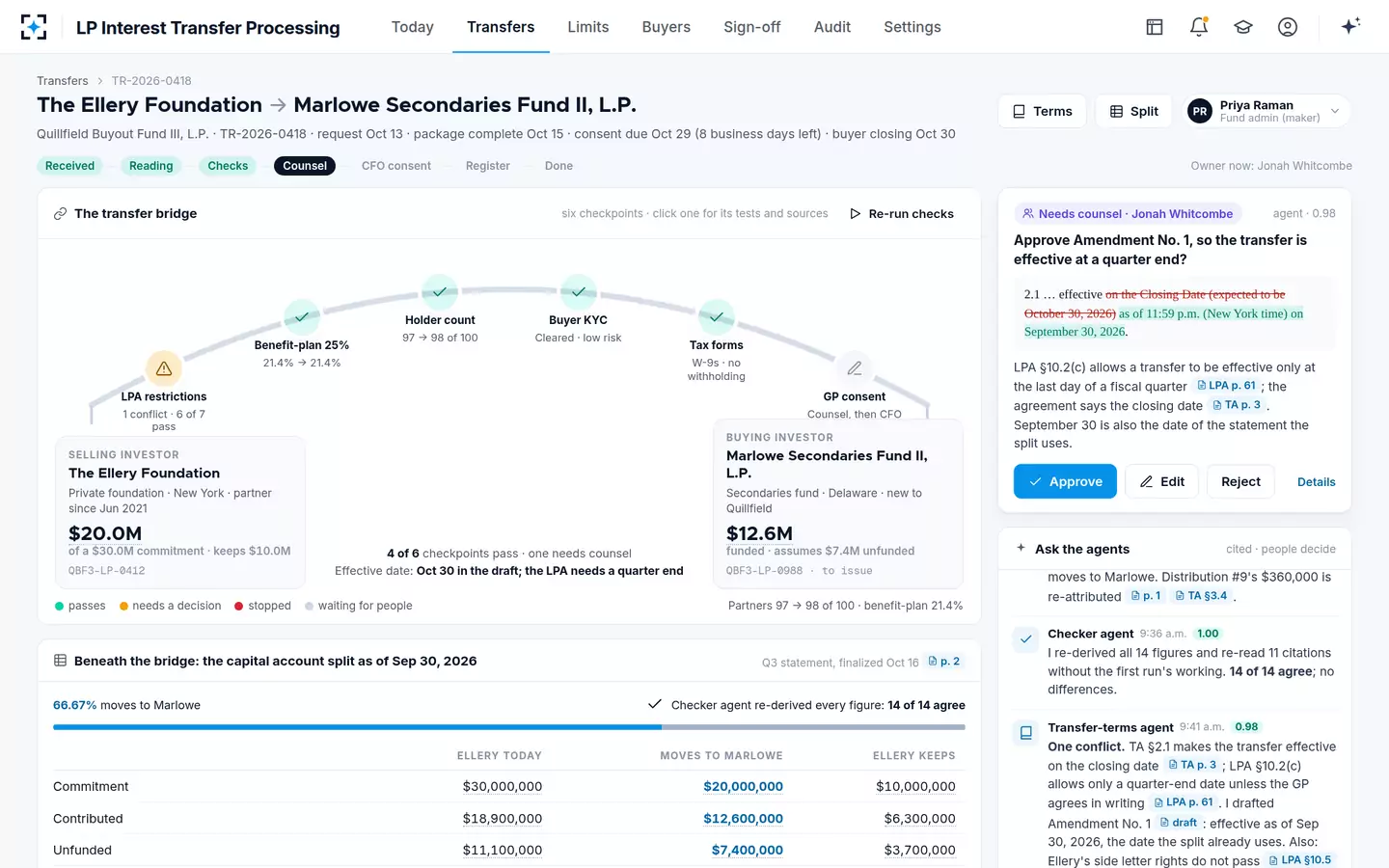
The one conflict in the sample was a line the seller's counsel could have avoided. The agreement made the transfer effective on the closing date; the LPA allows a quarter end only.
The clause that held the sale: closing-date effectiveness against a quarter-end LPA
Reporting the sale of a partnership interest on your tax return
The fund will send you a K-1 for the part of the year you were a partner, and if the fund holds section 751 assets you may also receive a Form 8308 statement. A seller in a sale involving those assets must notify the partnership in writing within 30 days of the exchange, or by January 15 of the following year if earlier, and the partnership must furnish the statement by January 31 or, if later, 30 days after it is notified (26 CFR 1.6050K-1). Your adviser will need both, along with the transfer agreement and the capital account split as of the effective date.
How the fund divides the year's income between you and your buyer depends on the LPA and on the method the fund uses under section 706; the K-1 preparation series explains interim closing and proration. To see the fund's side of the whole sale, start from LP Interest Transfer Processing.
Questions people ask
Can I sell part of my limited partnership interest?
Usually, if the LPA allows it; Delaware's default makes an interest assignable in whole or in part. A part sale keeps you in the fund and adds your buyer, so it raises the fund's partner count, which the GP will test before consenting.
Does my buyer have to be an accredited investor?
Often, in practice. The section 4(a)(7) resale exemption requires every purchaser to be accredited, and a fund's LPA may require a buyer to make the same investor-status representations as the original subscribers, such as qualified purchaser status for a 3(c)(7) fund.
Who pays the GP's legal costs on a transfer?
Whoever the LPA says. The sample LPA puts the GP's costs on the selling investor, and the transfer agreement repeated it; checking that the two match is one of the tests the fund runs.
Can the GP stop my sale?
Usually. A GP with consent in its sole discretion can refuse, and an LPA can require refusal where a sale would breach a tax safe harbor, the 25% plan-asset limit or the fund's exemption. A refusal on a limit may come with an alternative, such as a smaller sale or a later effective date.
What happens to my side letter when I sell?
It depends on its terms. Rights that are personal to you, such as fee rebates or reporting rights, may stay with you and do not pass to the buyer; in the sample they were personal under the LPA and the consent letter said they remained with the seller.
Is a transfer at death treated as a sale?
Not for the fund's 2% safe harbor count, which disregards transfers at death and from estates, and not for its 3(c)(1) or 3(c)(7) status, which treat an estate's ownership as the deceased's. The heir still needs to be admitted under the LPA to become a limited partner.