The publicly traded partnership safe harbor is the set of tests in Treasury Regulation §1.7704-1 that keep a private fund's interests from being treated as "readily tradable on a secondary market", and so keep the fund from being taxed as a corporation under section 7704. Two of them carry most private funds. The private placement safe harbor needs every interest to have been sold in an unregistered offering and that the fund "does not have more than 100 partners at any time during the taxable year". The lack-of-actual-trading safe harbor needs the interests transferred in the tax year, leaving out disregarded transfers, not to exceed 2% of the fund's total interests (26 CFR 1.7704-1(h) and (j)). The 2% test is a running count, so every LP interest transfer the GP approves uses some of it. Botminds' LP Interest Transfer Processing keeps the count for each fund and replays every open transfer against it before consent.
The fund examples below come from the solution's sample data, on fictional funds managed by a fictional firm, Quillfield Capital. The worked arithmetic of the month convention is the regulation's own example.
The same sales pass or fail the 2% test depending on the month convention
What is the publicly traded partnership safe harbor?
It is a list of situations in which the IRS treats a partnership's interests as not readily tradable, whatever else is true. Section 7704 says a publicly traded partnership "shall be treated as a corporation" unless an exception applies, and defines one as a partnership whose interests are traded on an established securities market or are "readily tradable on a secondary market (or the substantial equivalent thereof)" (26 U.S.C. §7704(a)–(b)). The regulation then gives a facts-and-circumstances test, whether partners can trade in a way "comparable, economically, to trading on an established securities market", and a set of safe harbors that answer the question without it.
Three details of the regulation shape how a fund runs transfers. First, falling outside a safe harbor is not itself fatal: the regulation says that fact "is disregarded" in deciding whether interests are readily tradable (§1.7704-1(c)(3)). Second, the partnership's own involvement is required. Interests are not readily tradable unless the partnership takes part in the market or recognises transfers made on it, for instance by "Admitting the transferee as a partner" (§1.7704-1(d)). Third, the measure is interests in capital or profits, counted month by month, not deals or dollars of price.
So the safe harbors are a discipline, not a formality. A fund that wants certainty counts every transfer it recognises, every year, in the way the regulation prescribes.
Why a private fund cares: corporate tax, and the 90% income exception
A partnership that becomes publicly traded is treated, from that day, as transferring all its assets to a new corporation for stock and distributing the stock to its partners (§7704(f)). For a fund that means entity-level tax and the loss of flow-through treatment its investors bought.
There is a statutory way out that some funds rely on and others cannot. A publicly traded partnership is not taxed as a corporation if 90% or more of its gross income in every year is "qualifying income": interest, dividends, real property rents, gains from real property and from capital assets held to produce those kinds of income, and certain natural-resource income (§7704(c)–(d)). Two limits matter to fund managers. Interest "derived in the conduct of a financial or insurance business" does not qualify, which a lending fund has to consider, and income that is not on the list, such as fees, or operating income passed up from portfolio companies that are themselves partnerships, counts against the 90%. Whether a particular fund can lean on the income exception is a question for its tax advisers. The safe harbors are what let it avoid having to ask.
What is the 100-partner private placement safe harbor?
The private placement safe harbor treats a fund as not readily tradable if all its interests were issued in offerings that did not have to be registered under the Securities Act of 1933 and the fund "does not have more than 100 partners at any time during the taxable year" (§1.7704-1(h)(1)). At exactly 100 a fund is inside; at 101 at any moment it is outside for that year.
The count has two traps. One is an anti-avoidance rule: a person who invests through a partnership, grantor trust or S corporation is counted as a partner of the fund if substantially all of that vehicle's value is the fund interest and a principal purpose of the structure was to stay under 100 (§1.7704-1(h)(3)). The other is offshore offerings: interests sold abroad under Regulation S do not count as unregistered for this purpose unless the sale would also have been exempt inside the United States (§1.7704-1(h)(2)).
The 100 here is not the Investment Company Act's 100. A 3(c)(1) fund counts beneficial owners, with its own look-through for investing companies that hold 10% or more of its voting securities (15 U.S.C. §80a-3(c)(1)(A)). The two counts often differ, and a transfer desk has to keep both.
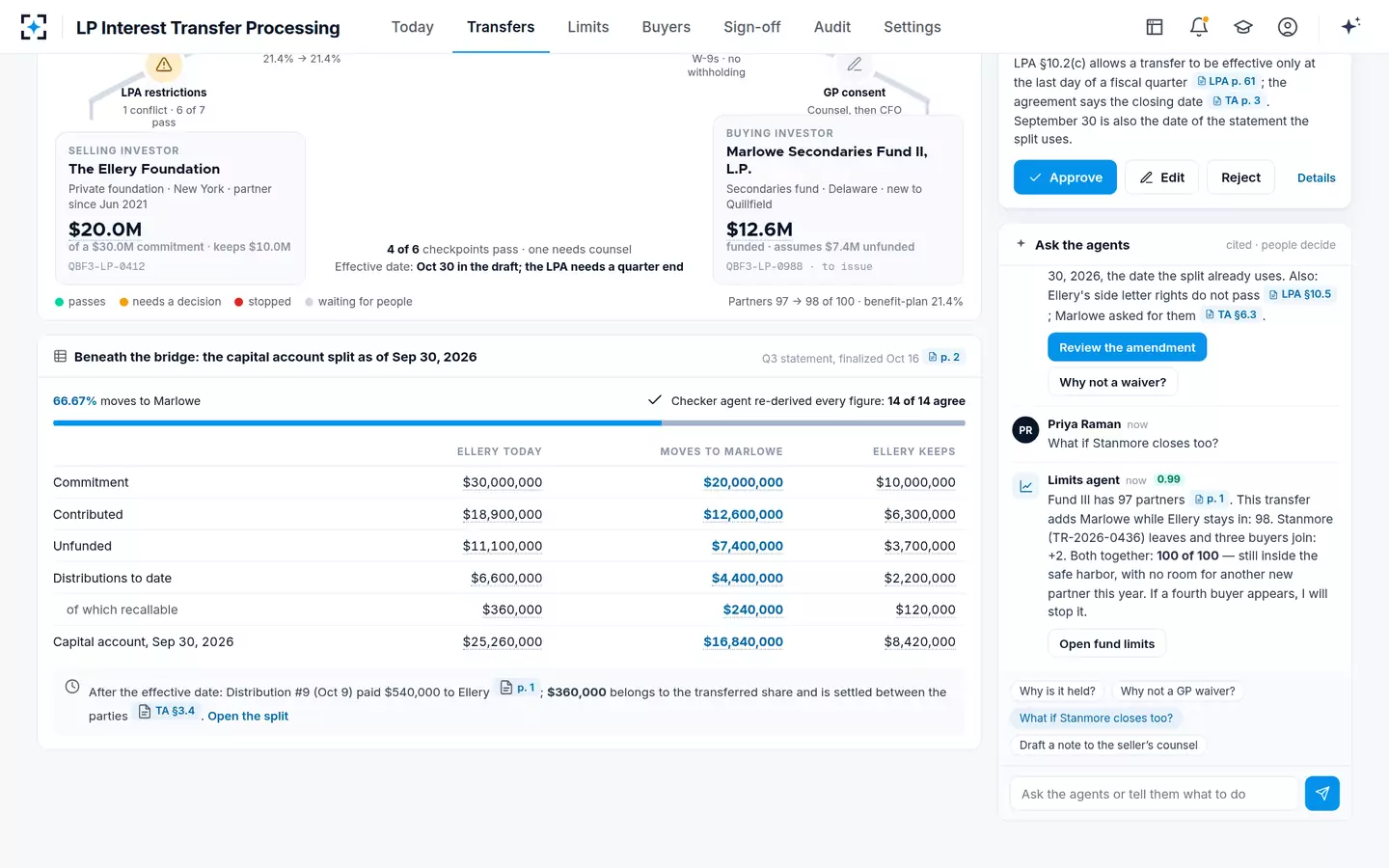
Part sales are what move the count. In the sample, Quillfield Buyout Fund III had 97 partners. Ellery's part sale to Marlowe added a partner because Ellery stayed in, making 98. A second open transfer, Stanmore County Employees' Retirement System selling $60 million to three buyers, would add two more, because Stanmore leaves and three buyers join. If both close, Fund III sits at 100 of 100: still inside, but any further new partner would need an existing one to leave at the same moment.
A plain question about the 100-partner safe harbor, answered from the register
What is the 2% safe harbor?
The 2% safe harbor, which the regulation calls lack of actual trading, treats a fund as not readily tradable if "the sum of the percentage interests in partnership capital or profits transferred during the taxable year" does not exceed 2 percent of the total, leaving out the private transfers in paragraph (e), redemptions under a qualifying plan in (f) and sales through a qualified matching service in (g) (§1.7704-1(j)). It is the harbor a fund with more than 100 partners lives on.
Three rules decide the arithmetic. The count is monthly: each calendar month with a counted transfer adds the share transferred, measured against the interests outstanding that month (§1.7704-1(k)(2)). The denominator is all outstanding interests, except that if the general partners and their related persons own more than 10% at any time in the year, their interests are left out of the total (§1.7704-1(k)(1)(ii)(A)). And the fund may pick any reasonable convention for "interests outstanding" in a month, start, middle or end, but must keep it from month to month and year to year (§1.7704-1(k)(3)). The regulation's own example, drawn above, shows the convention alone moving one year from 1.6625% to 2.375%.
In the sample, Quillfield Buyout Fund IV has 214 partners and relies on the 2% test. The agents count its 2026 transfers at 1.62% so far; Harwell University Endowment's $15 million sale would add 0.39% and take the year to 2.01%. The solution stops the transfer before consent and recommends making it effective on January 1, 2027, a quarter start the Fund IV LPA allows, so it falls in next year's count instead.
Which transfers don't count toward 2%?
Ten kinds of transfer are disregarded for the 2% test, and most estate, family and pension movements are among them. The regulation calls them "private transfers" (§1.7704-1(e)(1)). The list is the first thing a transfer desk checks, because a disregarded transfer costs the year nothing.
Ten kinds of transfer that do not count toward the 2% limit
- Carryover-basis transfers
The buyer's basis is determined, wholly or partly, by the seller's, or under section 732: many contributions and distributions in kind.
- Transfers at death
Including transfers from an estate or a testamentary trust.
- Transfers within a family
Between members of a family as section 267(c)(4) defines them.
- Issuances by the partnership
New interests issued for cash, property or services: a later close is not a transfer for this test.
- Distributions from qualified plans and IRAs
Transfers involving distributions from a section 401(a) plan or an individual retirement account.
- Block transfers
More than 2% transferred by one partner and related persons within 30 calendar days.
- Redemptions on death, disability or retirement
Under a redemption or repurchase agreement exercisable only on those events.
- Closed-end redemption plans
Where the partnership issues no interests after its initial offering.
- Sales of 50% or more at once
One transaction or related series transferring half or more of capital and profits.
- Transfers the partnership does not recognise
A sale the fund never admits or pays on is not counted at all.
Two items in that list need a decision, not a lookup. A transfer to a family member's trust may or may not be "between members of a family", depending on who the trust is for. And a sale the fund does not recognise is disregarded only while it stays unrecognised: the moment the GP admits the buyer or pays it distributions, it counts.
What is a block transfer?
A block transfer is a transfer by one partner, together with related persons, of interests representing in total "more than 2 percent of the total interests in partnership capital or profits" within any 30 calendar day period (§1.7704-1(e)(2)). It is disregarded for the 2% test, and its percentage is measured against the interests outstanding immediately before each transfer in the window (§1.7704-1(k)(4)).
The rule rewards large sales and penalises small ones, which surprises sellers. An endowment that sells 3% of a fund in one go uses none of the year's 2%. The same endowment selling 1.5% in March and 1.5% in May uses all of it and more. A transfer desk that sees a seller splitting a stake across buyers and dates should ask whether the pieces can close inside one 30-day window.
Counting across open transfers: why the order of closing matters
The safe harbors are tested on the year as it turns out, but the GP has to decide each consent before the year is over. That makes the useful question not "is the fund inside today?" but "is it inside if everything in the queue closes, in the order it will close?" A transfer that is harmless alone can be the one that breaks the limit after two others close ahead of it.
LP Interest Transfer Processing answers that question for every fund with an open transfer. Its Limits agent tests the partner count against the 100-partner private placement safe harbor, applies the 2% test with disregarded transfers left out, checks the benefit-plan share per class against 25%, and replays every open transfer in the fund in closing order. In the sample's Monday screen it found three issues across 23 funds: one benefit-plan stop, one fund over its 2% budget, and one fund that reaches its partner ceiling only if two transfers both close.
Fund limits in LP Interest Transfer Processing: partners, the 2% budget and the plan share, now and after the queue
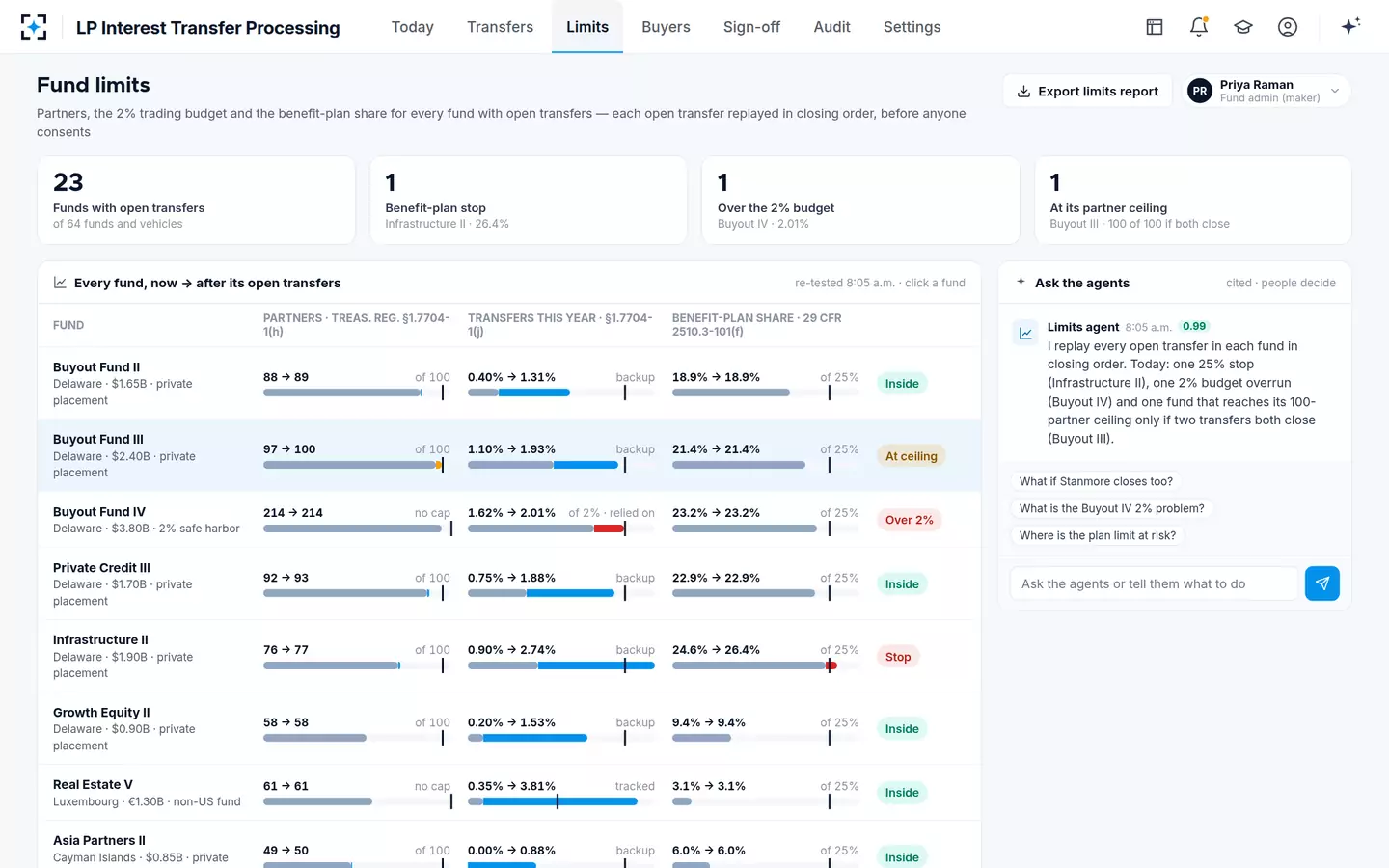
The agent never decides the order of closing and never waives a limit. It shows the arithmetic and the options, such as moving an effective date into the next tax year, and the fund CFO decides. The settings warn when a fund's 2% budget reaches 1.75%, so a fund nearing the line is visible a few transfers before it gets there. Inside the agent that re-tests every fund limit follows one change through the queue.
What happens if a fund fails both safe harbors?
Failing both safe harbors does not by itself make a fund publicly traded; it sends the fund back to the facts-and-circumstances test. The regulation says interests are readily tradable if, on all the facts, partners can buy, sell or exchange interests in a way economically comparable to an exchange, and gives examples: regular quotes by a market maker, public bid and offer quotes, or a "readily available, regular, and ongoing opportunity to sell or exchange" through a public means (§1.7704-1(c)(2)). A fund whose LPA requires the GP's consent to every transfer, with a quarter-end effective date, is a long way from that.
Long way is not certainty, which is why funds want a harbor. A fund over the line late in a year has three practical levers, each of which changes facts rather than arguments: move an effective date into the next tax year, ask the seller to sell in a single block within 30 days, or check whether the transfer is one of the private transfers the regulation disregards. If none applies and the fund still fails, it may yet have the 90% qualifying-income exception, and its tax advisers will want the year's full transfer history to decide.
Redemption plans and matching services: the two 10% harbors
Two more harbors take whole channels of transfers out of the 2% count, in exchange for limits of their own. Redemptions under a plan that needs at least 60 days' written notice, and sets the price at least 60 days after notice or no more than four times a year, are disregarded if no more than 10% of interests go that way in the year (§1.7704-1(f)). Sales through a qualified matching service are disregarded too, if the service meets a strict clock and the year's total through it stays within 10% (§1.7704-1(g)).
A qualified matching service runs on a 15-, 45- and 120-day clock
- Listed; no binding sale before day 15day 0–15
- Sale may be agreed; no closing before day 45day 15–45
- Closing allowed until removalday 45–120
- If unsold: 60 days before relisting60 days
- Written notice to redemptionat least 60 days
These harbors are why a fund should know how a buyer found the seller. A sale arranged through a listing service may be disregarded for 2% if the service qualifies, or counted in full if it does not; the regulation's own example counts 50 units sold through a non-qualifying service and disregards 800 sold through a qualifying one. What a secondaries platform must get right starts from that distinction.
Five safe harbors in §1.7704-1, and what each asks of a transfer
| Harbor | Paragraph | The test | What it asks of each transfer |
|---|---|---|---|
| Private placement | (h) | All interests sold in unregistered offerings; not more than 100 partners at any time in the year | Count partners after the transfer, with the look-through rule; a part sale adds one |
| Lack of actual trading | (j) | Counted transfers in the tax year do not exceed 2% of capital or profits | Classify the transfer, then add its monthly share to the year |
| Private transfers | (e) | Ten kinds of transfer are disregarded | Decide whether the transfer is one of them, and keep the evidence |
| Redemption plans | (f) | 60-day notice; price fixed late or at most four times a year; 10% a year | Applies to redemptions, not to sales between investors |
| Qualified matching services | (g) | 15, 45 and 120-day rules; nonfirm quotes only; 10% a year | Ask how the buyer found the seller; ask the operator for its records |
A fund with a foreign seller has one more interaction to watch: the regulations under section 1446(f) treat interests that are publicly traded quite differently from interests that are not. 1446(f) withholding on an LP interest sale covers the private-fund case. To see the limits tested across a whole queue, start from LP Interest Transfer Processing.
Questions people ask
What is the 2% safe harbor?
It is the lack-of-actual-trading safe harbor in 26 CFR 1.7704-1(j). A partnership's interests are not readily tradable if the percentage interests in capital or profits transferred during the tax year, leaving out private transfers, qualifying redemptions and qualified matching-service sales, do not exceed 2% of the total.
Does a fund at exactly 100 partners pass the private placement safe harbor?
Yes. The test is that the fund "does not have more than 100 partners at any time during the taxable year", so 100 passes and 101 at any moment in the year fails. Partners who invest through a flow-through vehicle can be counted through it if the vehicle exists mainly to keep the fund under 100.
Do new subscriptions at a later close count toward the 2%?
No. Transfers "involving the issuance of interests by (or on behalf of) the partnership in exchange for cash, property, or services" are private transfers under §1.7704-1(e)(1)(iv). The new interests do enlarge the total, and so the denominator, for the months after they are issued.
Is a transfer at death counted?
No. Transfers at death, including from an estate or testamentary trust, are disregarded under §1.7704-1(e)(1)(ii), as are transfers between members of a family. An heir's later sale to an outside buyer is counted in the usual way.
Can a fund switch month conventions to pass the 2% test?
Not from year to year at will. The regulation lets a partnership choose any reasonable convention, such as interests outstanding at the start, the 15th or the end of each month, but requires it to be used consistently from month to month within a year and from year to year.
Are the general partner's interests in the 2% denominator?
Usually yes, but not when the general partners and related persons own more than 10% of capital or profits at any time during the year. In that case the total interests are measured without them, which makes each transfer a larger share of a smaller total.