GP consent, in a private fund, is the general partner's written approval of a transfer of a limited partnership interest, and with it the admission of the buyer as a limited partner. LPAs usually make it a condition of a transfer, and researchers studying secondaries note that the GP must usually approve an LP-led sale, because Delaware's default would let an interest be assigned but would not let the buyer become a partner without the fund's say. Consent is therefore the moment the fund accepts every consequence of the transfer: for its tax status, its ERISA position, its Investment Company Act exclusion and its register. Six checks come before it. Botminds' LP Interest Transfer Processing runs those six checks for each transfer, cites the rule and the page behind each result, and puts them on one page for the person who signs.
The examples come from the solution's sample data: fictional funds managed by a fictional firm, Quillfield Capital, and its sample transfer of $20 million of the Ellery Foundation's interest in Buyout Fund III to Marlowe Secondaries Fund II.
The six checks before GP consent: the rule behind each, what fails it, and who clears it
1
LPA transfer article and side letters
The ruleThe partnership agreement: Delaware lets it decide whether and how an assignee is admitted
What fails itAn effective date the LPA does not allow; a buyer the LPA bars; a missing joinder; side letter rights assumed to pass
Who clears itGP counsel
2
Benefit-plan share
The rule29 CFR 2510.3-101(f): 25% or more of any class held by benefit plan investors, measured after each acquisition
What fails itA pension or plan-asset buyer lifting a class to 25% or more
Who clears itFund CFO, with counsel
3
Investment Company Act status
The ruleSection 3(c)(1): not more than 100 beneficial owners; 3(c)(7): qualified purchasers only
What fails itA 101st owner in a 3(c)(1) fund; a buyer that is not a qualified purchaser in a 3(c)(7) fund
Who clears itGP counsel
4
Tax safe harbors
The rule26 CFR 1.7704-1(h) and (j): not more than 100 partners, or not more than 2% transferred in the year
What fails itA part sale that adds a 101st partner; a sale that takes the year past 2%
Who clears itFund CFO, with tax
5
The buyer
The ruleThe fund's KYC and sanctions policy; the LPA's investor-status conditions
What fails itOwners or control persons not identified; a possible sanctions or PEP match; a missing status representation
Who clears itOnboarding specialist; AML officer for any hit
6
Tax forms and withholding
The rule26 CFR 1.1446(f)-2: 10% of the amount realized from a foreign seller unless an exception is certified
What fails itA foreign seller with no certification; forms older than the rules allow
Who clears itFund tax, with operations
What is GP consent?
GP consent is the general partner's approval, under the LPA, of a limited partner's transfer of its interest, and in most funds it is also the act that admits the buyer. Delaware's limited partnership act sets the default and lets the agreement override it. Unless the partnership agreement says otherwise, an interest "is assignable in whole or in part", but an assignment does not entitle the buyer to become a partner or exercise a partner's rights; the buyer receives only the seller's share of profits, losses and distributions (6 Del. C. §17-702(a)).
To be admitted, an assignee becomes a limited partner "As provided in the partnership agreement" or, failing that, on the consent of all partners (§17-704(a)). LPAs replace that unanimous consent with the GP's. In the sample LPA, §10.1(a) requires the general partner's prior written consent, in its sole discretion, and §10.2 lists the conditions for any transfer, among them a signed joinder and the transferee questionnaire and tax forms. The consent letter then does two things in one sentence: it consents to the transfer and admits the buyer as a substituted limited partner.
What are the GP consent requirements? Six checks, each with its rule
The requirements come from two places: the LPA, which sets the conditions, and the law, which sets limits the fund cannot breach whatever the LPA says. The six checks in the figure above cover both. Each has a rule, a way to fail and a person who clears it, and none of them is the CFO's to do alone.
The order matters less than the rule that all six are done before consent and re-done if anything changes. In the solution, the six are checkpoints on one screen, a bridge between the seller and the buyer, and the GP consent checkpoint at the end of it stays closed until counsel has approved the documents. The CFO cannot edit the transfer documents, and counsel cannot grant consent.
Check 1: the LPA's transfer article and the side letters
The first check reads the transfer agreement against the LPA's transfer article, the seller's side letters and any prior consents, clause by clause. It is the check most likely to find something, because the agreement was drafted by the parties for their deal and the LPA was drafted years earlier for every deal. In the sample, the Transfer-terms agent ran seven tests on LPA Article X and six passed. The seventh failed on a single line.
Seven tests on the LPA's transfer article, and the one that failed
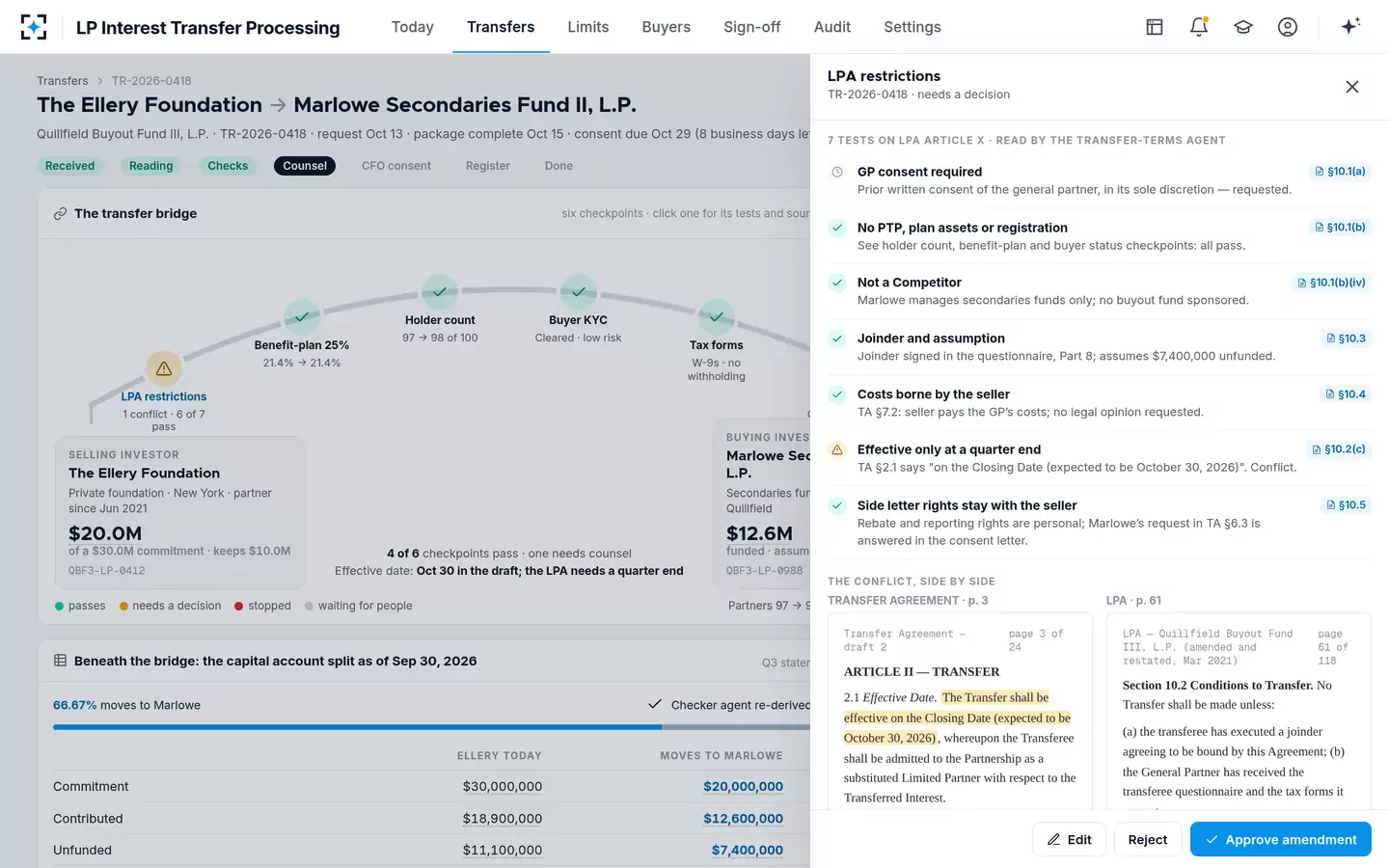
The conflict was the effective date. The transfer agreement made the transfer effective "on the Closing Date (expected to be October 30, 2026)"; the LPA allows a transfer only "as of the last day of a Fiscal Quarter". The agent drafted Amendment No. 1, moving the effective date to September 30, the date of the statement the capital account split uses, and noted that the GP could also agree otherwise in writing. It recommended the amendment because the administrator closes capital accounts only at quarter ends. GP counsel decided, approved it with a reason code, and both parties signed it the same morning.
The same check caught a quieter point. The seller's side letter rights were personal under LPA §10.5, so they did not pass to the buyer, though the buyer had asked for them in the agreement. A consent letter that said nothing would have left that argument for later.
Checks 2 to 4: the plan share, the investor count and the tax safe harbors
Three of the six checks are counts the fund must keep inside a line, and each counts something different. Getting any one wrong is expensive in its own way.
The benefit-plan share decides whether the fund's assets become ERISA plan assets. Under the Labor Department's rule, benefit plan participation is significant once plan investors hold 25% or more of the value of any class of equity, measured straight after the latest acquisition of an interest (29 CFR 2510.3-101(f)(1); worked through in the ERISA 25% plan asset rule), with the interests of the GP and its affiliates left out of the calculation. A transfer is an acquisition, so the test re-runs at every one, class by class. In the sample, a pension trust's $35 million purchase would have lifted Infrastructure II's share from 24.6% to 26.4%; the agents stopped it before consent and gave the CFO three options, the first to scale the purchase back within the $7.4 million of headroom.
The Investment Company Act count protects the fund's exclusion. A 3(c)(1) fund may have no more than 100 beneficial owners, with a look-through for a holder of 10% or more of its voting securities that is itself an investment company or would be one but for those exclusions, and a 3(c)(7) fund may admit only qualified purchasers (15 U.S.C. §80a-3(c)). The SEC's Rule 3c-6 eases estate, gift and divorce transfers: for a 3(c)(1) fund the recipient's ownership is treated as the transferor's, and for a 3(c)(7) fund the recipient is treated as a qualified purchaser (17 CFR 270.3c-6). A sale to an outside buyer gets no such help.
The tax count protects partnership status. A fund relying on the private placement safe harbor must never pass 100 partners at any point in the tax year; a fund relying on the 2% safe harbor must keep counted transfers within 2% of its interests for the year (26 CFR 1.7704-1(h) and (j)). The publicly traded partnership safe harbor, counted transfer by transfer, shows why each count has to include the other open transfers in the same fund.
Checks 5 and 6: the buyer, its papers and its tax forms
The fifth check asks who the buyer is: its owners, its control persons, whether any of them is sanctioned or politically exposed, and whether it makes the investor-status representations the LPA requires. There is no federal anti-money-laundering programme rule for private fund advisers yet: FinCEN's investment adviser rule was delayed until January 1, 2028 (FinCEN final rule, Federal Register, January 2, 2026). Sanctions law applies now. In June 2025 OFAC imposed a $215,988,868 penalty, the statutory maximum, on a San Francisco venture firm that kept managing a sanctioned investor's money by working through his nephew as a proxy (OFAC, GVA Capital penalty notice). A buyer admitted without its owners screened is a risk the GP signs for.
In the sample, the Buyer onboarding agent mapped Marlowe's general partner and two control persons, found no one with 25% or more, and screened them against OFAC, UN, EU and UK lists; the onboarding specialist cleared KYC. Only the AML officer may clear a possible match, and in the same queue another buyer, Altamira Secondary Partners, was held for one.
The sixth check is the seller's and buyer's tax forms. If the seller is foreign, the buyer must withhold 10% of the amount realized unless one of six certifications applies, and if the buyer fails, the fund must withhold from the buyer's distributions (26 CFR 1.1446(f)-2). 1446(f) withholding on an LP interest sale works the calculation through.
Can a GP refuse a transfer?
Usually yes. Under Delaware law the partnership agreement decides how an assignee is admitted, and an LPA that gives the GP consent "in its sole discretion" lets it refuse without a stated reason. An LPA can go further and say when the GP must refuse: when a transfer would make the fund publicly traded, cause its assets to be plan assets or require it to register, as the sample LPA does in §10.1(b).
Refusal has consequences for both sides. An assignment the LPA permits but the GP does not consent to may still pass economic rights, but the buyer is not a partner. And a transfer the fund never recognises is one the publicly traded partnership rules disregard: the regulation lists "Transfers not recognized by the partnership" among the private transfers that do not count toward 2% (26 CFR 1.7704-1(e)(1)(x)). A reasoned refusal, with the rule cited, is easier to defend than a silence.
What does a GP consent form include?
A GP consent letter is short, and every line of it should come from a decided fact. The sample letter consents "to the transfer by The Ellery Foundation of $20,000,000 of its $30,000,000 Capital Commitment", names the capital account moving and its date, fixes the effective date and time, admits the buyer and records what it assumes. The checklist below is what a consent form should carry, drawn from that letter and from Delaware's defaults.
What a GP consent form should include, line by line
- The LPA section the consent is given under
In the sample, Section 10.1(a) of the amended and restated LPA.
- Seller, buyer and the interest transferred
The commitment transferred and the commitment the seller keeps, so a part sale is unambiguous.
- The capital account moving, and its date
$16,840,000 as of September 30, 2026 in the sample, from the administrator's finalised statement.
- The effective date and time
One that the LPA allows: here 11:59 p.m. New York time on a quarter end, as amended.
- Admission as a substituted limited partner
With the buyer's investor ID; without admission the buyer holds only economic rights.
- The unfunded commitment assumed
$7,400,000 in the sample. Delaware makes an admitted assignee liable for the assignor's known contribution obligations unless the LPA says otherwise.
- Whether the seller is released
Delaware does not release the assignor by default (6 Del. C. §17-704(c)); any release must be said.
- Side letter rights
Which stay with the seller and which, if any, pass; personal rights do not pass silently.
- Conditions still open
Joinder, tax forms, withholding certification, payment of the GP's costs.
- The authorised signatory and date
Signed for the general partner by the person the LPA and the GP's own authority name.
The release line is the one sellers ask about most. Whether or not an assignee becomes a limited partner, the seller stays liable to the partnership under the act's contribution and distribution subchapters (6 Del. C. §17-704(c); the sale of a limited partnership interest sets out what the GP needs from each side). An LPA or a consent letter can say otherwise. If neither does, a seller of a fund with unfunded commitments has sold its upside and kept a contingent liability.
Who signs the consent, and in what order, in LP Interest Transfer Processing?
The consent is signed by the person the LPA and the GP's own governance authorise, in the sample the fund CFO as GP signatory, and it should be the last signature, not the first. In the solution the order is fixed: counsel approves the documents and any amendment, then the CFO grants consent, then a second person checks and posts the register. Each decision takes a reason code and an electronic signature.
Who prepares, approves, clears and consents, in the sample's roles
| Decision | Who | Who may not |
|---|---|---|
| Prepare the transfer, the split and the register update | Fund administration (maker) | Check or post their own work |
| Approve transfer documents and amendments | GP counsel | Grant consent |
| Clear buyer KYC | Investor onboarding specialist | Clear a sanctions or PEP hit |
| Clear a sanctions or PEP hit | AML officer only | Anyone else, agents included |
| Grant GP consent | Fund CFO / GP signatory, after counsel | Edit transfer documents |
| Check and post the register update | Senior fund accountant (checker) | The person who prepared it |
One transfer on one page, with the consent letter drafted from the decided facts
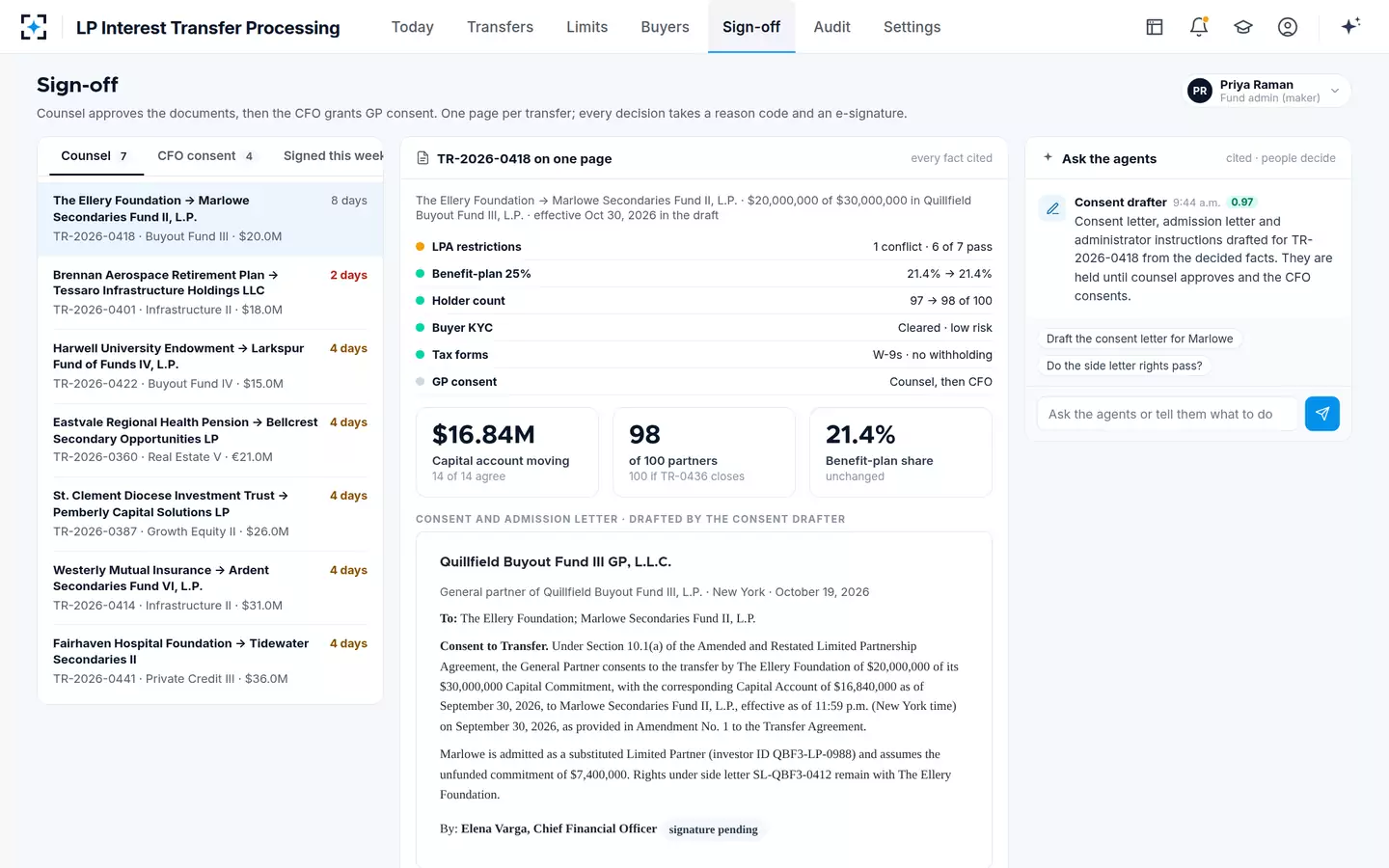
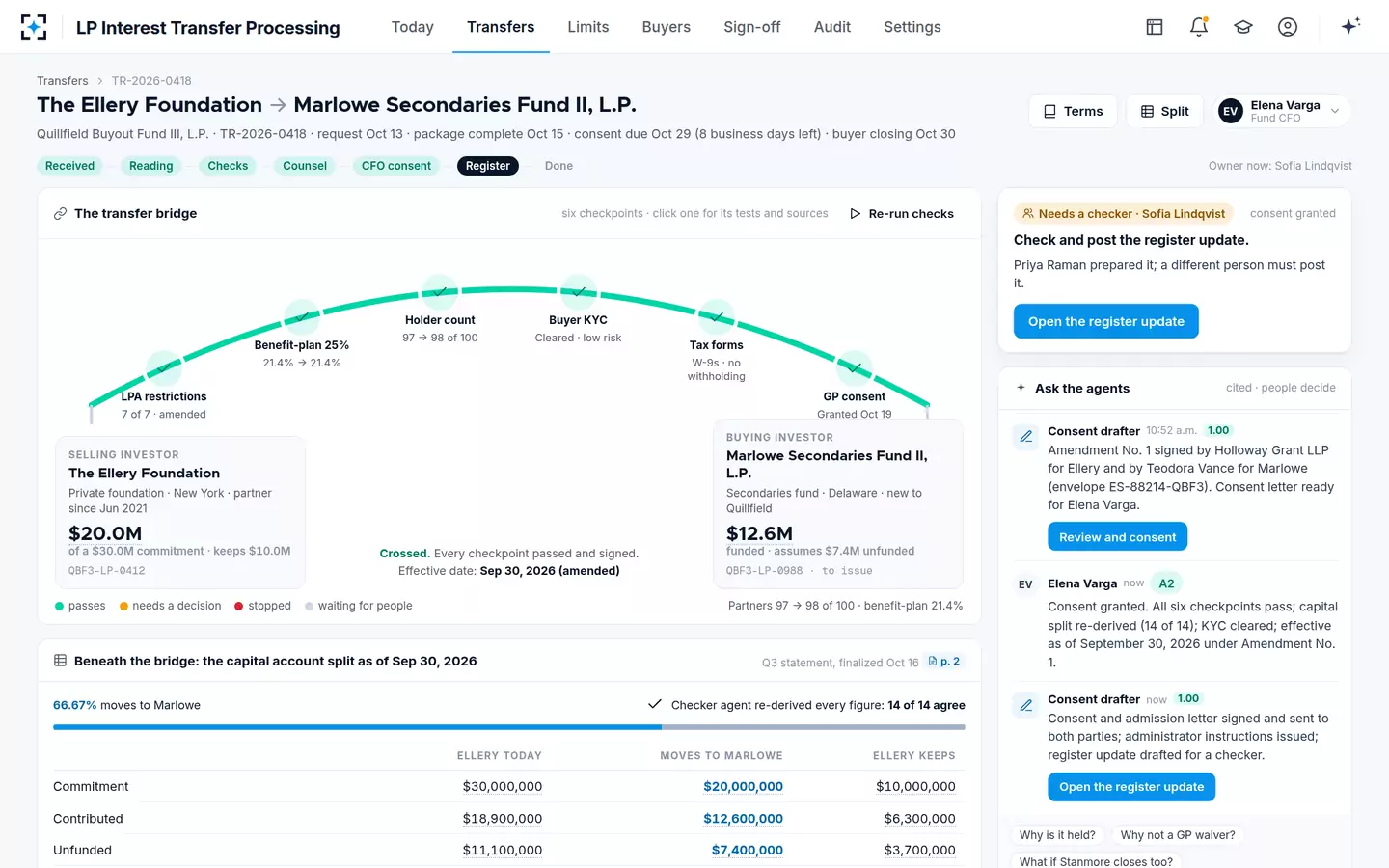
Once consent is granted, the transfer is not finished. The register still has to move, and the person who prepared that update may not post it. The sample's consented screen shows every checkpoint passed and signed, effective as of the amended date, and the register update waiting for its checker. The LP transfer process follows it there.
Consented: every checkpoint passed and signed, effective as of the amended date
To see the six checks run across a whole queue, start from LP Interest Transfer Processing.
Questions people ask
Is GP consent the same as advisory committee consent?
No. GP consent to a transfer is the general partner's approval under the LPA's transfer article. Advisory committee consent is usually reserved for conflicts, such as a transaction between the fund and the manager's affiliates. What an LPAC may approve covers that side.
Can GP consent be conditional?
Yes, and it often is. The sample LPA conditions every transfer on a joinder signed by the buyer and on the general partner receiving the transferee questionnaire and tax forms. A consent letter can also make itself effective only once a withholding certification arrives or the GP's costs are paid.
Does GP consent release the seller from its unfunded commitment?
Not by default under Delaware law. Section 17-704(c) says the assignor is not released from its liability to the partnership for contributions and distributions, whether or not the buyer becomes a limited partner. A release has to be given by the LPA or in writing.
How long does GP consent take?
No regulator or independent study publishes transfer cycle times. In the sample, consent came four business days after the request, against a 10-business-day service level counted from a complete package. A fund can measure its own: days from request to complete package, and from complete package to consent.
Can a GP refuse a buyer that competes with it?
If the LPA says so, or if the GP has sole discretion. The sample LPA lists a competitor buyer as a ground for refusal in §10.1(b)(iv), and the Transfer-terms agent tested it against the buyer's description before counsel saw the file.