The ERISA 25% plan asset rule says that a private fund's underlying assets are not plan assets of its pension investors so long as benefit plan investors hold less than 25% of the value of each class of its equity, measured immediately after the most recent acquisition of any interest, with the interests of the manager and its affiliates left out of the count. Cross that line and the fund's portfolio is treated as the plans' own assets, and the people managing it become ERISA fiduciaries. The hard part is that the test is not run once: every subscription and every transfer to a new holder is an acquisition, so the share has to be recomputed on each booklet. Botminds' LP Onboarding keeps that calculation live for each fund vehicle and stops a booklet that would cross before fund counsel sees it.
The worked example on this page uses fictional sample data: the Delaware vehicle of Quillfield Private Credit Fund IV, five days before an 84-investor first close.
The rule in four numbers
25%
of the value of any class held by benefit plan investors makes the fund’s assets plan assets
3kinds
of benefit plan investor: Title I plans, plans under IRC §4975 such as IRAs, and plan-asset entities
15%
first-tier excise tax on the amount involved in a prohibited transaction, paid by the disqualified person
1986
year the Labor Department’s regulation was issued; the statute added the 25% definition in 2006
What is the ERISA 25% plan asset rule?
It is the threshold that decides whether a pension plan investing in a private fund owns only its fund interest, or also an undivided share of everything the fund holds. The Labor Department's plan asset regulation sets the default: when a plan buys an equity interest in an entity that is neither publicly offered nor a registered investment company, the plan's assets include "both the equity interest and an undivided interest in each of the underlying assets of the entity", unless the entity is an operating company or equity participation by benefit plan investors "is not significant" (29 CFR 2510.3-101(a)(2)).
Congress wrote what "not significant" means into the statute in 2006. Section 3(42) of ERISA now provides the test in one sentence:
“The assets of any entity shall not be treated as plan assets if, immediately after the most recent acquisition of any equity interest in the entity, less than 25 percent of the total value of each class of equity interest in the entity is held by benefit plan investors.”
ERISA §3(42), 29 U.S.C. 1002(42)
Three phrases in that sentence do all the work: "immediately after the most recent acquisition", "each class" and "benefit plan investors". Each is a reason the test cannot be left to a spreadsheet updated before the final close. A fund that needs no 25% limit at all, because it qualifies as a venture capital or real estate operating company, takes the other route set out in VCOC or the 25% test.
Who counts as a benefit plan investor?
Since 2006, three kinds of investor: an employee benefit plan subject to Part 4 of Title I of ERISA, any plan to which section 4975 of the Internal Revenue Code applies, and any entity whose underlying assets include plan assets because plans invested in it (29 U.S.C. 1002(42)). Everything else is outside the numerator, though it stays in the denominator.
That definition is narrower than the regulation's own text, which has not been rewritten since 1986 and still lists any employee benefit plan "whether or not it is subject to the provisions of title I". The statute governs. Governmental plans, church plans that have not elected in, and plans maintained outside the United States for nonresident aliens are excluded from Title I by ERISA section 4(b) (29 U.S.C. 1003(b)), and governmental and non-electing church plans are also outside section 4975, so none of them counts. One of the regulation's own worked examples, written in 1986, counts a governmental plan toward 25%; read against the 2006 statute, it no longer reflects the law.
Who counts in the 25% test, and who does not
| Investor | In the numerator? | Why |
|---|---|---|
| Corporate or union pension plan (US) | Yes, in full | An employee benefit plan subject to Part 4 of Title I |
| Individual retirement account | Yes, in full | A plan described in IRC §4975(e)(1)(B) |
| US state or city pension (governmental plan) | No | Outside Title I under ERISA §4(b)(1), and outside §4975 under §4975(g)(2); its interest stays in the denominator |
| Non-US pension plan for nonresident aliens | No | Outside Title I under ERISA §4(b)(4), and generally not a §4975 plan |
| Church plan without a §410(d) election | No | Outside Title I under §4(b)(2) and outside §4975 under §4975(g)(3) |
| Fund of funds or feeder whose own assets are plan assets | Only its benefit-plan percentage | ERISA §3(42) treats such an entity as holding plan assets only in proportion to its benefit plan investors’ share of its equity |
| Fund of funds whose own benefit-plan share is under 25% | Generally no | Its assets are not plan assets, so it is not a benefit plan investor; counsel should confirm any other basis |
| GP, manager, employees and affiliates | Left out of both sides | Value held by a person with discretionary authority or control, or an affiliate, is disregarded |
Is an IRA a benefit plan investor?
Yes. An individual retirement account described in section 408(a) of the Internal Revenue Code is a "plan" for section 4975, and section 3(42) counts any plan to which section 4975 applies (26 U.S.C. 4975(e)(1)). So does an individual retirement annuity under section 408(b). A fund raising from wealthy individuals can therefore cross 25% without a single corporate pension in the room, if enough of them invest through their IRAs.
This is the most common reason a booklet's ERISA page is wrong. An individual answers as a person, not as the IRA that is actually subscribing, or ticks "not applicable" because no employer is involved. The investor-details section and the benefit-plan section must agree on who the subscriber is, which is one of the cross-checks that a subscription booklet can fail while every page is complete.
Are the GP's own interests excluded from the 25% test?
Yes, from both sides of the fraction. The statute disregards the value of any equity interest held by a person, other than a benefit plan investor, who has discretionary authority or control over the entity's assets or provides investment advice on them for a fee, and any affiliate of that person. The regulation's own example shows why it matters: with $10,000 of interests, $1,000 held by benefit plan investors and $6,500 held by the general partner's affiliate, the share is "approximately 28.6% ($1000/$3500)", not 10% (29 CFR 2510.3-101(j)(4)).
The exclusion therefore works against the fund. A large GP commitment does not dilute the plans; it is taken out, and the plans' share of what is left is larger. In the sample Delaware vehicle, the GP and employees' $25.0 million is removed before the division, which is why the counted equity is $614.50 million rather than the vehicle's full size.
Is the 25% test per class or per fund?
Per class of equity interest, and per entity. The statute tests "each class of equity interest in the entity", so a fund with a separate class, for example a no-fee class for insiders or a currency class, runs a separate 25% test for each. A parallel fund, a feeder and a main fund are each their own entity and each runs its own test: in the sample raise, the Delaware fund stood at 23.8%, the Cayman feeder at 10.4% and the Luxembourg vehicle at 0.0% on the same morning.
That is why the limit in the sample settings reads "per class of equity, per vehicle (LPA 5.6)". The limited partnership agreement usually carries its own covenant to stay under 25%, and the onboarding desk is the only place that sees each class's number change booklet by booklet.
When must the test be run: at the close or at every acquisition?
At every acquisition. Status on any date is fixed by the share "immediately after the most recent acquisition of any equity interest", so each subscription accepted at each close, and each transfer of an interest to a new holder, is a moment at which the fund either stays outside the plan asset rules or does not. A first close, two subsequent closes and a handful of secondary transfers make a dozen or more test dates over a fund's life.
Redemptions are the edge case. A redemption by a non-plan investor raises the plans' share without anyone acquiring an interest; whether that alone triggers a new test is a question for the fund's ERISA counsel, and the cautious practice is to re-run the share after redemptions as well. Transfers, which are acquisitions, are worked through, with the 25% check among the six a GP runs before consenting, in GP consent to an LP transfer.
The calculation, worked on one pension booklet
The calculation is a fraction and a headroom formula. Counted equity is the class's total value minus the controlling persons. The numerator is the benefit plan investors' value in it. Headroom is the largest new benefit-plan commitment the class can take and stay under 25%: if B is the plan value and D the counted equity, a new plan commitment x keeps (B + x) ÷ (D + x) under 25% only while x is less than (0.25 × D − B) ÷ 0.75.
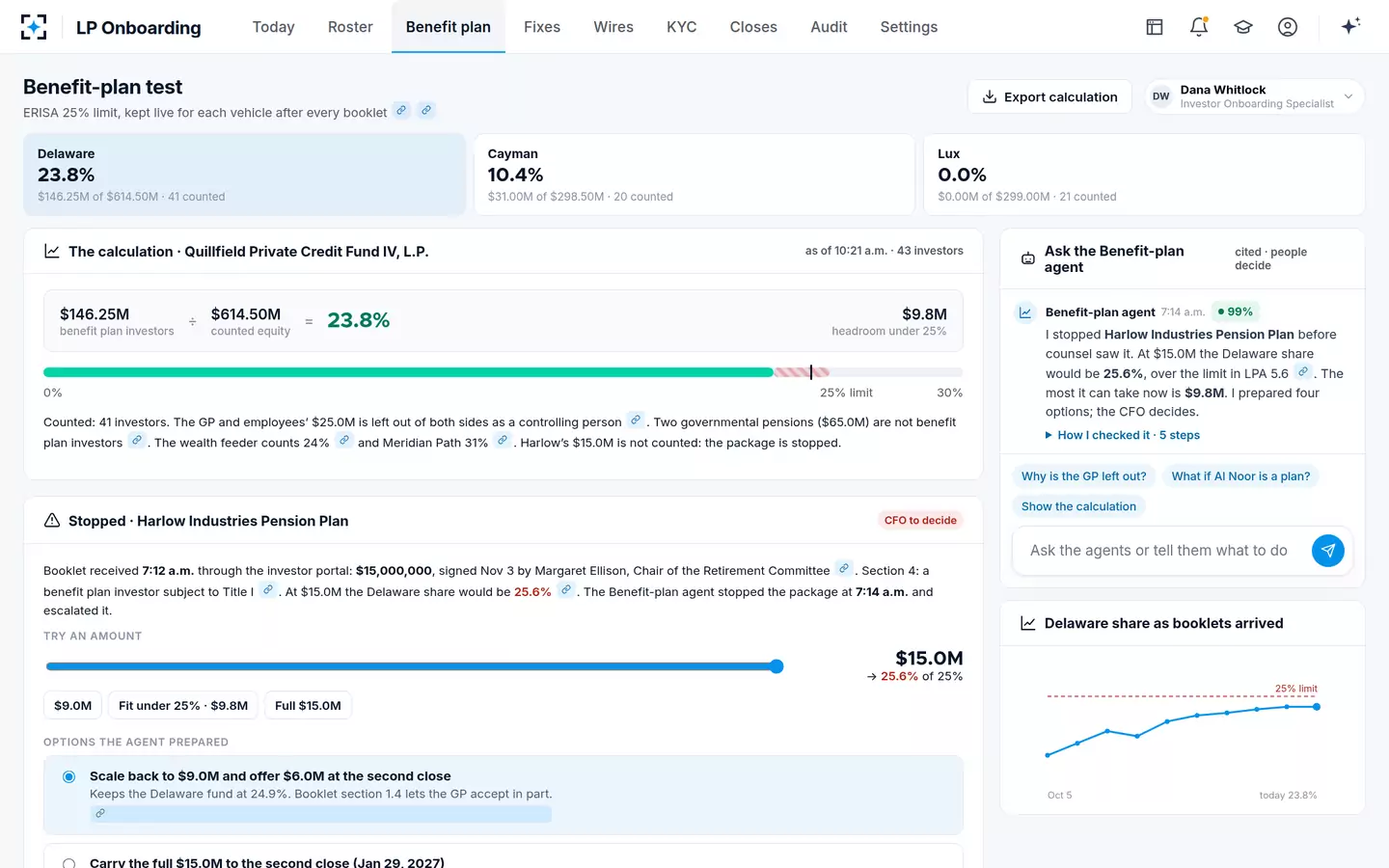
The ERISA 25% test on one booklet: a $15.0M pension commitment against $9.8M of headroom
Counted equity in the class
HowAll interests in the class, less the GP and employees’ $25.0M (a controlling person and its affiliates)
Result$614.50M
Benefit plan investors in it
HowERISA plans and IRAs in full; plan-asset entities only to their benefit-plan percentage; the two governmental pensions ($65.0M) stay in the denominator but out of the numerator
Result$146.25M
Share before the booklet
How$146.25M ÷ $614.50M
Result23.8%
Share with the full booklet
How($146.25M + $15.0M) ÷ ($614.50M + $15.0M)
Result25.6%
Headroom under 25%
How(0.25 × $614.50M − $146.25M) ÷ 0.75
Result$9.8M
Share at the amount decided
How($146.25M + $9.0M) ÷ ($614.50M + $9.0M)
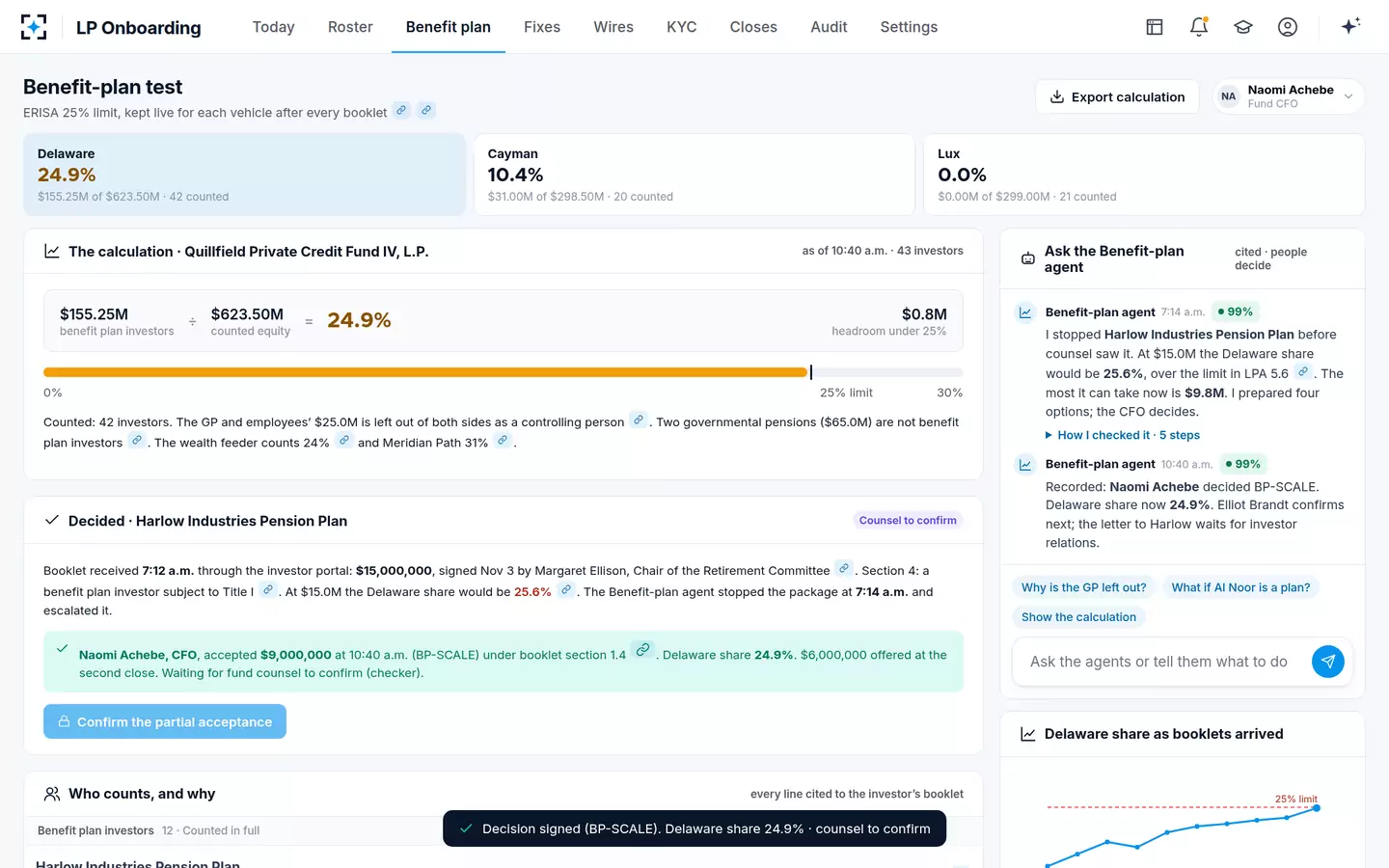
Result24.9%
In the sample close, Harlow Industries Pension Plan's $15.0 million booklet arrived at 7:12 a.m. through the investor portal. Its section 4 answer, on page 23, was that it is a benefit plan investor subject to Part 4 of Title I. Adding it in full would take the Delaware share to 25.6%. At 7:14 a.m. the Benefit-plan agent stopped the package, computed $9.8 million of headroom and laid out four options for the CFO: scale back and offer the rest at the second close, carry the whole commitment to the second close, accept in full (not allowed under the LPA) or decline.
One pension booklet against the 25% line, in points of headroom
The benefit-plan test in LP Onboarding, per vehicle, with the stopped booklet
What happens if a fund crosses 25%?
The fund's underlying assets become plan assets of each investing plan, and the regulation spells out the consequence: "any person who exercises authority or control respecting the management or disposition of such underlying assets, and any person who provides investment advice with respect to such assets for a fee (direct or indirect), is a fiduciary of the investing plan" (29 CFR 2510.3-101(a)(2)). The manager is then held to ERISA's prudence and loyalty duties for the whole portfolio, and ordinary fund transactions can become prohibited transactions.
Prohibited transactions carry their own cost. Section 4975 imposes a first-tier tax of "15 percent of the amount involved" for each year in the taxable period, paid by the disqualified person who participates (26 U.S.C. 4975(a)). For a credit fund that lends to portfolio companies, takes fees from them or deals with affiliates, that exposure is the reason the LPA bars crossing the line. Which is why, in the sample, the agent's option to "accept the full $15.0M" is marked not allowed: the fund's assets would become plan assets.
How LP Onboarding keeps the 25% share live
LP Onboarding re-runs the 25% test for each vehicle and class every time a booklet's benefit-plan section is read, not on a schedule. The Benefit-plan agent applies section 3(42) look-through to plan-asset entities, leaves the GP and its affiliates out of both sides, keeps governmental and non-US plans out of the numerator, and checks each answer against the investor type on the booklet's first pages. When a booklet would cross, it stops the package before counsel sees it, with the calculation, the headroom and the options.
The agent never accepts, scales or declines a commitment. The CFO decides with a reason code, and fund counsel confirms the partial acceptance as checker. The limit, a warning level of 24.0% and a 0.1-point buffer for rounding and late changes are settings the CFO approves. Every decision is on the audit trail with the booklet pages behind it.
Decided at 24.9%: the CFO's choice, waiting for counsel to confirm
A close is the day all of these numbers must hold at once, alongside every other test, which is the subject of the five tests every LP must pass at the fund close. To run the calculation on your own past closes, start from LP Onboarding.
Questions people ask
Is the 25% test applied to commitments or to contributed capital?
The statute speaks of the "total value" of each class of equity interest and does not say how to value an interest that is mostly uncalled. The LPA should fix the method and the fund should apply it the same way at every test, with ERISA counsel's confirmation; the sample fund tests on commitments, which is why a $15.0M booklet moves the share before any capital is called.
Do governmental pension plans count toward 25%?
No. Governmental plans are excluded from Title I of ERISA by section 4(b)(1) and from section 4975 by section 4975(g)(2), so they are not benefit plan investors under section 3(42). Their interests still count in the denominator, which lowers the share.
Does a fund of funds count in full toward the 25% test?
Only if its own assets are plan assets, and then only to the extent of the percentage of its equity held by benefit plan investors. A fund of funds that is 31% owned by benefit plan investors counts 31% of its investment; one whose own share is under 25% generally does not hold plan assets and counts nothing.
What happens if the fund is over 25% for a single day?
Status is fixed immediately after each acquisition, so a fund over 25% after a close holds plan assets until a later acquisition brings it back under. That is why the check belongs before the GP accepts the booklet, not after the close.
Does the 25% test apply to a fund that only takes non-US investors?
The test applies to any entity in which a benefit plan investor holds an equity interest, wherever the entity is formed. A Luxembourg or Cayman vehicle with no US plans or IRAs will simply show 0%, as the sample Luxembourg vehicle did, but it should still be tested at each acquisition in case one arrives.