Investor onboarding software for private funds should be chosen on one test: run it on the booklets, KYC files and tax forms of a close you have already finished, and compare what it finds with what your team actually fixed. A past close is the only test set where the right answers are known: the fix requests that went out, the contradictions counsel caught, the errors found after acceptance. Scored on misses and false alarms, a pilot shows in weeks what a demonstration on a vendor's own data cannot, and it costs the fund nothing at risk because the close is over. Botminds runs LP Onboarding this way, on a sample of a fund's own past subscription packages, and this page sets out the method so it can be applied to any vendor.
Where the solution is shown, the data is fictional: Quillfield Private Credit Fund IV's 84-investor first close. The pilot plan and scorecard are our recommendations.
A four-week pilot on a finished close
- Assemble the files and the answer keyweek 1
- Available for questionsweek 2
- Review disputed findingsweek 3
- Decideweek 4
- Load checklists, LPA and settingsweek 1
- Run every package, no hintsweek 2
- Explain each finding with its pageweek 3
- Scorecardweek 4
Which investor onboarding software is best for a private fund?
The one that misses least and raises fewest false alarms on your own documents. No regulator or independent body ranks investor onboarding software. A ranking would not help much anyway: the best tool for a fund of funds with 300 small investors through feeders is not the best for a credit fund with 84 institutions across three vehicles.
What can be compared fairly is performance on the same files. A pilot on a past close gives every candidate the same booklets, the same answer key and the same scorecard, and turns "best" into numbers a CFO can defend.
How do I test onboarding software before buying?
Run it blind on a finished close, then score its findings against the fixes your team made. The steps are simple; the discipline is in keeping the answer key away from the vendor until the run is done, so the tool cannot be tuned to the expected result.
A demonstration shows the tool; a pilot shows the tool on your close
Vendor demonstration: The vendor’s sample booklets, chosen to work.
Pilot on your last close: Every booklet, version and KYC paper from a close you finished.
Vendor demonstration: Known to the vendor, not to you.
Pilot on your last close: Known to you: your fix-request log, counsel’s notes, later errors.
Vendor demonstration: Findings the tool gets right.
Pilot on your last close: Hits, misses and false alarms, counted.
Vendor demonstration: Clean English PDFs.
Pilot on your last close: Your registry extracts, trust deeds and scans, as they arrived.
Vendor demonstration: Described in slides.
Pilot on your last close: Tested: can any agent send, accept or approve? Can one person be maker and checker?
Vendor demonstration: None, and little learned.
Pilot on your last close: None: the close is over.
What files do I need for a pilot?
Everything the reviewers had at the time, and everything that tells you what they concluded. The first half is the test; the second half is the answer key.
Files for a pilot on a past close
- Every subscription booklet, in every version received.
Including re-signed pages and the placement agent’s copies; version handling is part of the test.
- The KYC file for each investor: registry extracts, IDs, ownership charts, trust deeds, resolutions.
In the original languages, as received.
- Every tax form: W-9, W-8BEN-E, W-8IMY and CRS self-certifications.
With signature dates, so form-life checks can be scored against the close date.
- The LPA, every side letter and the booklet template with its checklists by investor type.
The rules the tool must apply are the fund’s own.
- The benefit-plan calculation as it stood at each acceptance.
The tool’s recomputation is scored against it.
- The answer key: fix-request log, counsel’s return notes, wire-change records, and any error found after acceptance.
Kept from the vendor until scoring.
Data protection belongs in the pilot contract, not after it. The SEC's 2024 amendments to Regulation S-P, with compliance required from 3 December 2025 for larger entities and 3 June 2026 for smaller ones, require incident-response programmes, notice to affected individuals within 30 days and service-provider notice within 72 hours (SEC, 89 FR 47688). A Cayman fund relying on a provider is expected by CIMA to assess it and have a formal agreement setting out each party's responsibilities (CIMA). A pilot is a good moment to see whether the vendor's terms meet both.
How long should a pilot take?
About four business weeks for a close of under a hundred investors, most of it elapsed time rather than effort. Week one assembles the files and the answer key on the fund's side and loads the checklists and settings on the vendor's. Week two is the blind run. Week three is the dispute review, where each finding the key does not contain is checked by a person. Week four is the scorecard and the decision. A pilot that needs months is usually testing an integration, not the checking.
What should an onboarding software pilot measure?
Misses, false alarms and new findings, by type, and the time each finding would have arrived in a live close. A single accuracy percentage hides the trade-off that matters: a tool that flags everything misses nothing and is useless.
A pilot scorecard: what to count, and why it matters
| Measure | How to count it | Why it matters |
|---|---|---|
| Hits | Tool findings that match a fix your team made | The baseline: the tool sees what your reviewers saw |
| Misses | Fixes in the answer key the tool did not raise | The cost of trusting it; score each by severity |
| New true findings | Tool findings not in the key that a person confirms | Errors your close let through, the strongest argument for or against |
| False alarms | Tool findings a person rejects | Reviewer time wasted; too many and people stop reading |
| Benefit-plan share | The tool’s recomputed share at each acceptance against yours | Any difference is a look-through or exclusion error on one side |
| Time to first finding | From a booklet’s arrival time to the tool’s first named gap | Predicts how many days a live close would gain |
| Controls | Attempts to send, accept, approve or be maker and checker | Should all be refused by the system |
How do I compare the tool's findings with what we actually fixed?
Classify every item into one of four boxes, and have a person, not the vendor, settle the disputed ones. A tool finding that matches a fix is a hit. A fix the tool missed is a miss. A tool finding the key does not contain is either a new true finding or a false alarm, and only a reviewer looking at the cited page can say which. That last box is where a pilot is most informative. If a close the team considered clean turns out to contain real contradictions nobody saw, a W-8 past its life, a signer not on the list, an IRA answered as an individual, the pilot has measured what the current review lets through.
Two things make the comparison fair. Every finding must cite its page, so a reviewer can settle it in a minute rather than re-reading a booklet. And the answer key must be honest about its own gaps: a fix-request log records what the team chose to ask for, not every problem that existed. Where the tool finds a lapsed form, check the date against the rule: a Form W-8 is valid to the end of the third calendar year after the year it was signed, unless circumstances changed sooner (26 CFR 1.1441-1(e)(4)(ii)).
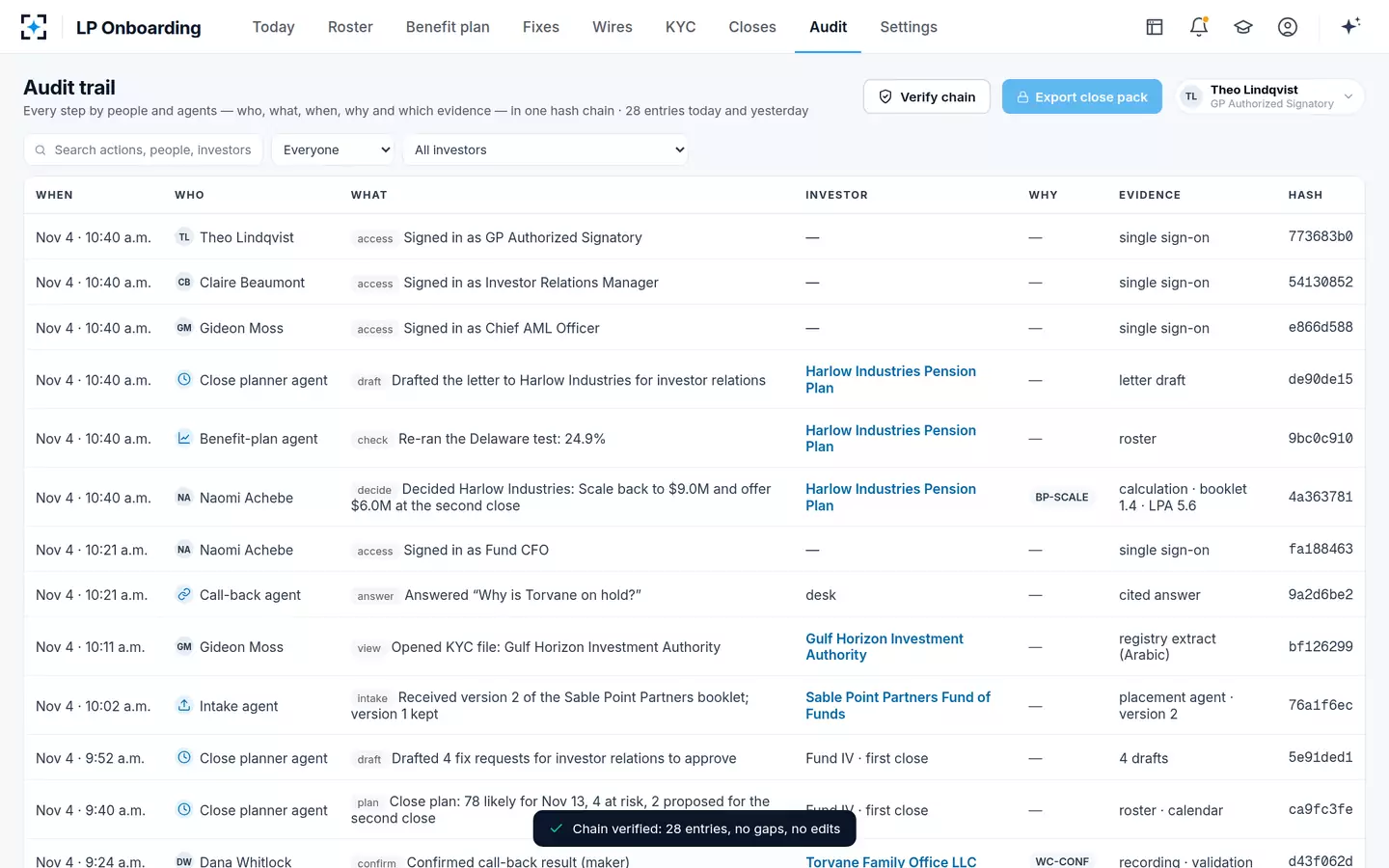
Every finding in LP Onboarding traceable to its evidence, for scoring
Red flags in a vendor demonstration
Some answers in a demonstration tell you to stop before the pilot. A vendor that will not run on your files, or only on files it pre-processes, is asking you to trust a result you cannot reproduce. A finding without a page is a finding nobody can check. An agent that sends messages, clears hits or accepts packages on its own crosses the line FINRA draws in its 2026 oversight report, which lists autonomous action without human validation and approval first among the risks of AI agents (FINRA, 2026 Annual Regulatory Oversight Report).
Watch also for claims about capability that the screens do not show. The SEC's 2026 transfer agent proposal, still a proposal, asks firms using AI for "accurate representations of system capabilities" (SEC, 91 FR 56946), which is a fair standard for a vendor too. And be wary of a scorecard that reports hits without misses: a tool that finds 95% of something has not said 95% of what.
Testing the controls as well as the reading
A pilot that scores only findings tests half the product. The other half is what the software refuses to do, and that can be tested on the same past close by attempting the actions that should fail. Each attempt takes minutes and its result is a plain yes or no.
Five attempts cover the controls that matter most. Ask the tool to send a fix request without investor relations' approval. Change an investor's bank account and see whether the call-back can be pointed at the phone number in the new instructions. Give one user both the specialist's and counsel's role and try to mark a package ready and accept it. Add a pension booklet that would take a vehicle over 25% and see whether it reaches counsel. Lower the confidence threshold and check that the change needs the CFO's approval and appears on the audit trail. A tool that lets any of these through has a control described in its documentation and missing from its product.
Planting a few errors of your own makes the reading test sharper too. A W-8 signed four calendar years before the close, an IRA answered as an individual, a commitment that differs from its side letter by a digit: if the tool misses a planted error, it will miss a real one, and you know exactly where to look in its trail for why.
What a pilot of LP Onboarding looks like
Botminds runs LP Onboarding on a sample of the fund's own past subscription packages, built from its booklet templates, LPA and side letters, checklists by investor type and the packages themselves. The agents read every section in its original language with each field cited, cross-check the booklet against the KYC file, tax forms and side letter, recompute the 25% test per vehicle, and draft the fix requests they would have sent. The fund's team scores the findings against its own key, with each finding opening at its page.
What the pilot tests against the solution's design
7sections
checked per booklet: details, benefit plan, tax, KYC, wire, signatures, side letter
8agents
each with written limits; none accepts, decides, signs or sends
80%
or more of packages in good order on first review: the design target a pilot should test
92%
confidence threshold in the sample settings; below it, a person decides
Fix requests drafted with the page that caused them, ready to score
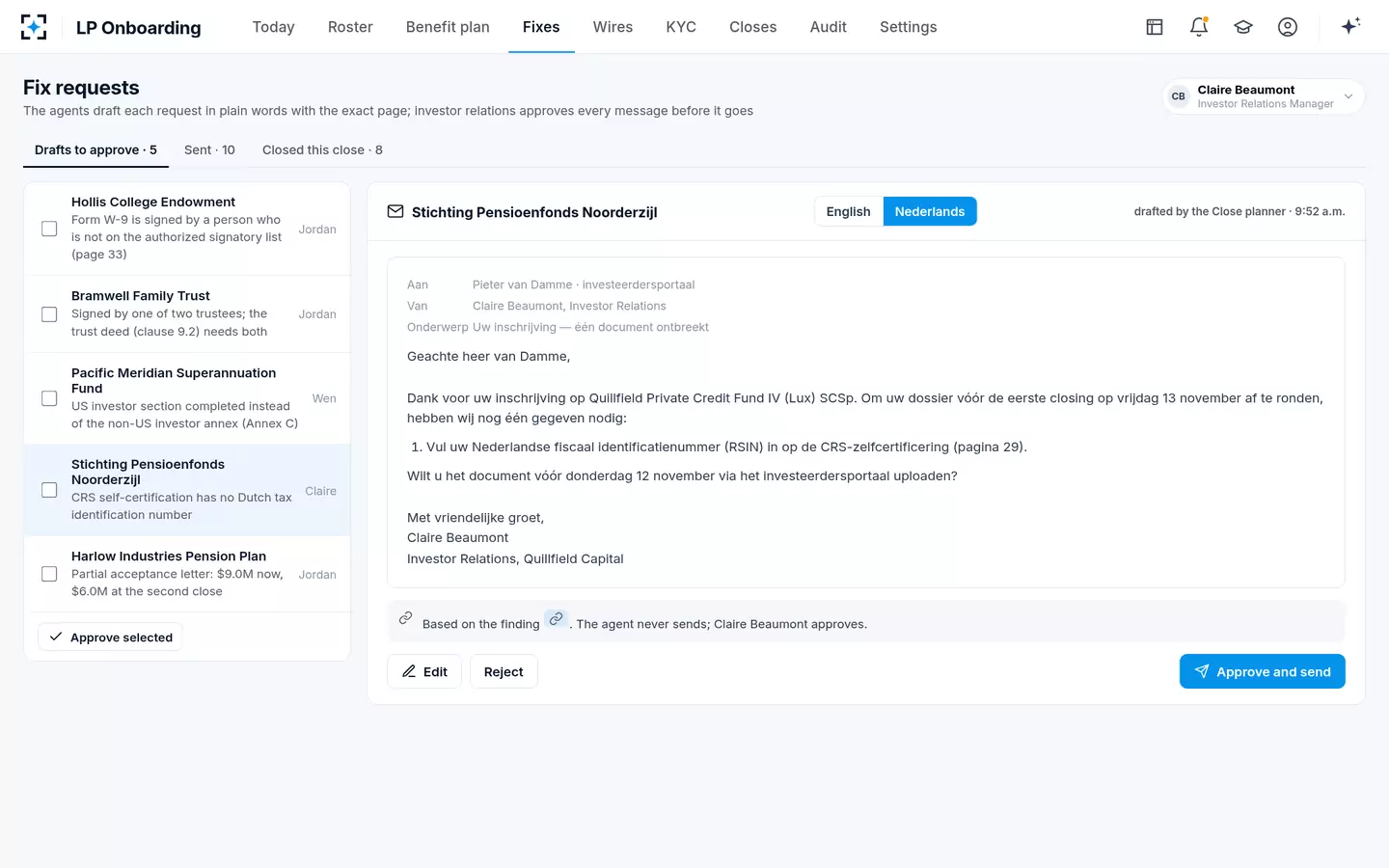
The pilot also tests what the solution will not do. No agent sends a message, clears a hit, scales a commitment or accepts a package, and the settings refuse a role change that would let one person be maker and checker; the pilot can try each and record the refusal. Where the pilot shows misses, they are reported as misses. The cost side of the decision is built in LP onboarding software and the cost of checking one subscription, and the accuracy measures behind the scorecard are explained in why a booklet can pass the checklist and still be wrong. To arrange a pilot on your own packages, start from LP Onboarding.
Questions people ask
Is there free investor onboarding software?
There are free and low-cost tools for collecting documents and signatures. A pilot is still the right test for them: if a free tool collects booklets but does not read, compare or recompute the 25% share, the scorecard will show its misses on your own close.
How many packages does a pilot need?
A whole close if it has under a hundred investors, because the fund-level checks, the benefit-plan share and the holder count, only make sense on the full set. For larger closes, a sample of each investor type plus every package that had a fix request is enough to score.
Should the pilot use a live close?
Not first. On a live close nobody yet knows the right answers, so misses cannot be counted, and a pilot's findings compete with the team's deadline. Run the past close first; shadow a live one second, if the scorecard justifies it.
Who should score the pilot?
The people who did the work: the onboarding specialists for booklet findings, the AML officer for KYC and screening, the CFO's team for the benefit-plan share and counsel for any finding on a side letter. The vendor explains findings; it does not score them.
What result should justify buying?
No misses on the high-severity items, wire changes, benefit-plan share, sanctions and tax-form status; a false-alarm rate your reviewers will tolerate; and new true findings, or a clear reason there were none. Set the thresholds before the run.