A private equity fund close is the date on which the general partner accepts a batch of subscriptions, countersigns them and admits those investors as limited partners; a fund raising over a year usually holds a first close, one or more subsequent closes and a final close. Most of the onboarding work happens in the weeks before, but several of the rules it serves are tested at one instant: the ERISA benefit-plan share immediately after the acquisition, the investment-company holder count or qualified-purchaser status at the time of acquisition, the investor's identity, its sanctions status and the validity of its tax form on that day. So the close is a point-in-time test, and every investor's file must pass all five at the same minute. Botminds' LP Onboarding plans the close backward from its date and lets only packages that pass every check reach the GP's signature.
The close described here is fictional sample data: the first close of Quillfield Private Credit Fund IV on Friday, 13 November, with 84 investors and $1,252.0 million committed across a Delaware fund, a Cayman feeder and a Luxembourg vehicle.
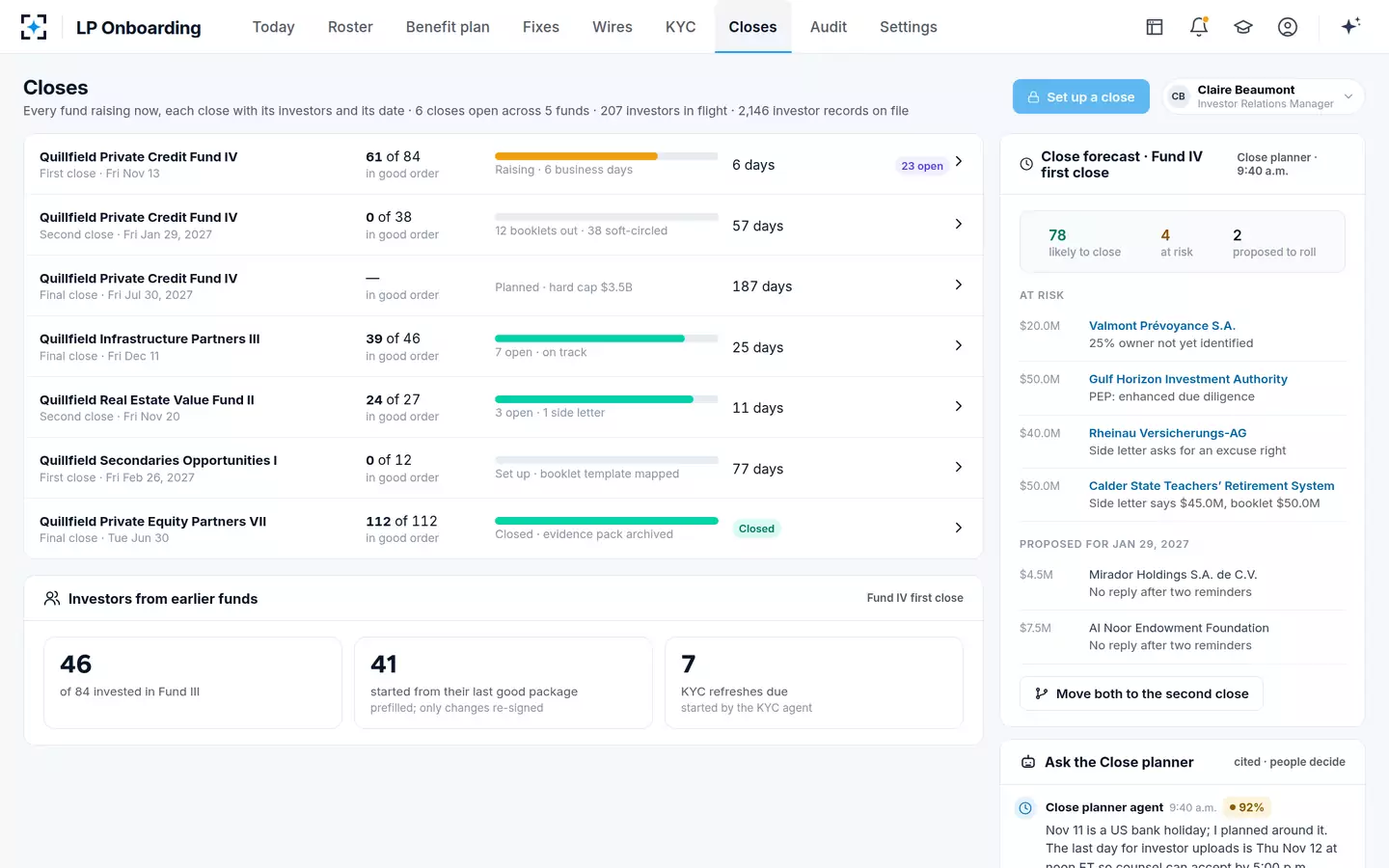
One raise, three closes, the same tests each time
84LPs
in the sample first close, each tested on the closing day
77days
from the first close to the second, when every test runs again on the new investors
259
days from first close to final close in the sample raise
0
benefit-plan, PEP or wire exceptions reaching the countersignature: the solution’s design target
What happens at a private equity fund close?
At a close, the GP accepts the subscriptions it has decided to take, countersigns them, and the investors are admitted to the partnership with the commitments accepted. From that moment they are bound by the LPA, they can be called for capital and they count toward every limit the fund must respect. Before it, they are applicants; the subscription agreement is an offer the GP may accept in whole, in part or not at all.
That legal shape is why the close concentrates risk. Every representation the investor made in its booklet is relied on at the moment of acceptance, and several of the rules behind those representations are written as tests of a moment. A file that was clean on Monday and has a lapsed tax form or a newly designated owner on Friday fails on Friday.
A fund raise is a series of test dates, not one
- First close, Fri 13 Nov 2026, to second close77 days
- Second close, Fri 29 Jan 2027, to final close, Fri 30 Jul 2027182 days
What is a subsequent close?
A subsequent close is any close after the first at which a fund admits new investors or accepts increased commitments from existing ones, up to the final close at which fundraising ends. Investors admitted later are usually brought level with the first-close investors under the LPA: they contribute their share of capital already called, often with an additional amount, sometimes called subsequent close interest, that compensates the earlier investors for having funded first. The LPA sets the method and the rate; no regulation does.
For onboarding, the important point is that a subsequent close is a full test date, not a footnote. New investors must pass all five tests on that day, and because two of the tests are fund-level figures, a subsequent close can change the position of investors admitted months before. A pension commitment carried to the second close, as the sample CFO offered a pension plan when its full commitment would have crossed 25% at the first, is tested again on 29 January against the share as it stands then.
Does the 25% benefit-plan test apply at each close?
Yes. ERISA section 3(42) measures the benefit-plan share straight after each new acquisition of an equity interest, so each close at which new interests are issued is an acquisition, and the share must be under 25% in each class immediately after it (29 U.S.C. 1002(42)). The test is cumulative: the share after the second close includes every benefit plan investor admitted at the first. The arithmetic, class by class, is worked in the ERISA 25% plan asset rule.
In the sample first close, the Delaware vehicle stood at 23.8% on Wednesday morning, a pension booklet would have taken it to 25.6%, and the CFO scaled it back to keep the fund at 24.9%, leaving $0.8 million of headroom for the rest of the close. The number that matters on Friday is the one after the last accepted package, which is why the calculation has to run on each booklet as described in the ERISA 25% plan asset rule.
Does the 100-holder limit count at each close?
Yes, for a fund relying on section 3(c)(1). The exclusion is limited to an issuer whose securities are beneficially owned by no more than 100 persons, and a company investing in the fund counts as one person unless it owns 10% or more of the fund's voting securities and is itself an investment company or a 3(c)(1) or 3(c)(7) fund, when its own holders are counted (15 U.S.C. 80a-3(c)(1)). Each close adds holders, so each close re-tests the count.
A 3(c)(7) fund faces a sharper point-in-time rule: its securities may be owned only by people who are qualified purchasers when they acquire them (15 U.S.C. 80a-3(c)(7)(A); can a trust be a qualified purchaser works through the hardest case). The SEC's rule lets the fund rely on a reasonable belief that an investor meets the definition (17 CFR 270.2a51-1(h)), which makes the evidence in the booklet, dated before the close, the thing the fund is relying on at the close.
Can an LP be admitted with KYC still open?
Not safely, and in the sample fund not at all: the countersignature screen admits only packages whose KYC has been cleared and every screening hit decided. The rules leave the timing to the fund's procedures, but they point to verification before the commitment. CIMA's guidance for mutual funds and their administrators links how long verification may take to what is practical before a commitment is signed and before money changes hands, and tells a fund whose verification is still incomplete when a redemption falls due to pay the proceeds only to the investor, and only once the outstanding documents are collected and verified (CIMA Guidance Notes, February 2024).
For US advisers, FinCEN's 2024 AML rule takes effect on 1 January 2028 and, as adopted, carries no customer identification programme of its own: FinCEN left identity verification out of the final rule and out of its proposal before it (FinCEN, 89 FR 72156); what the 2028 rule does require is set out in the investment adviser AML rule, explained. That leaves timing to the fund's policy and the administrator's. For returning investors, FinCEN's order of 13 February 2026 is a useful model even where it does not apply: it lets covered financial institutions such as mutual funds identify and verify a legal-entity customer's beneficial owners when the customer first opens an account, again when they learn facts that call the earlier information into question, and as their risk-based ongoing due diligence requires, instead of at every new account (FinCEN, FIN-2026-R001).
In the sample raise, 46 of the 84 investors had been in the previous fund, and seven of them had a periodic KYC refresh falling due before the close, on a one-, two- or three-year cycle by risk. The KYC agent started each refresh; a refresh still open on the closing day keeps that investor out of the countersignature batch.
Must sanctions screening be re-run before the closing date?
Yes: status is what it is on the day of admission, not the day the booklet was screened. Sanctions lists change without notice, and an investor or owner can be designated between screening and the close. OFAC's 2025 penalty against a San Francisco venture firm turned on exactly that sequence: the firm's officials met the investor in 2016, he was designated in April 2018, and the firm kept managing his investment through a relative acting as his proxy; OFAC imposed the statutory maximum of $215,988,868 (OFAC, 12 June 2025).
OFAC's compliance framework names the failure to update screening software with changes to the sanctions lists as one of the recurring causes of violations (OFAC, A Framework for OFAC Compliance Commitments, May 2019). For a close, the practical rule is a final screen of every investor and every beneficial owner against the current lists as late as the process allows, with any new hit holding that package out of the batch until the AML officer decides it.
What if a tax form expires or changes before the close?
Then the investor needs a new one, and it is better found a month before the close than on its morning. A Form W-8 remains valid until the end of the third calendar year after the year it was signed, unless a change in circumstances makes it incorrect sooner; a form signed on 30 September 2015, the regulation's own example, was valid through 31 December 2018 (26 CFR 1.1441-1(e)(4)(ii)). A returning investor's W-8 from a 2023 close therefore lapses on 31 December 2026, weeks after a November first close and before a January second close.
A change in circumstances starts a shorter clock: under the FATCA rules a withholding agent may keep relying on the old status for up to 90 days from the date the documentation became invalid, or until it gets a new one if sooner (26 CFR 1.1471-3). And for a Cayman feeder, since 1 January 2026 a valid CRS self-certification must be in hand by the day the account is opened (subscription documents in private equity covers the rule), so an investor admitted at the close without one is a breach that day (Cayman CRS (Amendment) Regulations, 2025).
The five tests of the closing day, and what each is measured against
| Test | Measured at | Fails if | Rule |
|---|---|---|---|
| Benefit-plan share | Immediately after the acquisition, each class | Benefit plan investors hold 25% or more of any class | ERISA §3(42) |
| Holder count or qualified purchaser status | At the time of acquisition | A 3(c)(1) fund passes 100 beneficial owners, or a non-qualified purchaser enters a 3(c)(7) fund | Investment Company Act §3(c)(1), §3(c)(7) |
| Identity and ownership | Before the commitment is accepted | Identity, a 25% owner or the control person is unverified | Fund AML procedures; CIMA guidance for Cayman funds |
| Sanctions status | On the closing day, against current lists | The investor, an owner or a proxy is a sanctioned person | OFAC regulations |
| Tax form | On the closing day | The W-8 has lapsed or changed, or a Cayman self-certification is missing | 26 CFR 1.1441-1, 1.1471-3; Cayman CRS regulation 7(3) |
Planning the last six business days backward from the close
A close is planned backward from the date, around bank holidays, so that every investor's last chance to fix a gap is known in advance. In the sample close, Wednesday 11 November is a US bank holiday, so investor uploads close at noon Eastern on Thursday 12 November, leaving counsel until 5 p.m. to accept, and the GP signs for release at the close on Friday. Fix requests are due back in five business days with a reminder at three, which means any gap that needs the investor must be found by the end of the first week of November.
Every close in the raise, and the forecast for the first one
A closing-day checklist: run it for every LP in the batch, at the same time
- Recompute each vehicle’s benefit-plan share with every package in the batch.
Under 25% in each class after the last acceptance, with the GP and its affiliates left out.
- Recount beneficial owners for a 3(c)(1) vehicle, looking through any 10% fund investor.
Or confirm every investor in a 3(c)(7) vehicle is a qualified purchaser on dated evidence.
- Confirm every KYC file is cleared and every refresh due before the close is done.
An open refresh keeps the investor out of the batch.
- Re-screen every investor and beneficial owner against the current sanctions lists.
A hit holds the package for the AML officer, whatever it showed last week.
- Check each tax form’s life against the closing date.
W-8s signed three calendar years ago lapse on 31 December; Cayman self-certifications are due by account opening.
- Confirm every new or changed bank account was verified by call-back and approved by two people.
An unverified change is held, not paid to.
- Countersign only packages counsel has accepted, with release at the close.
Counsel can still withdraw a package before release.
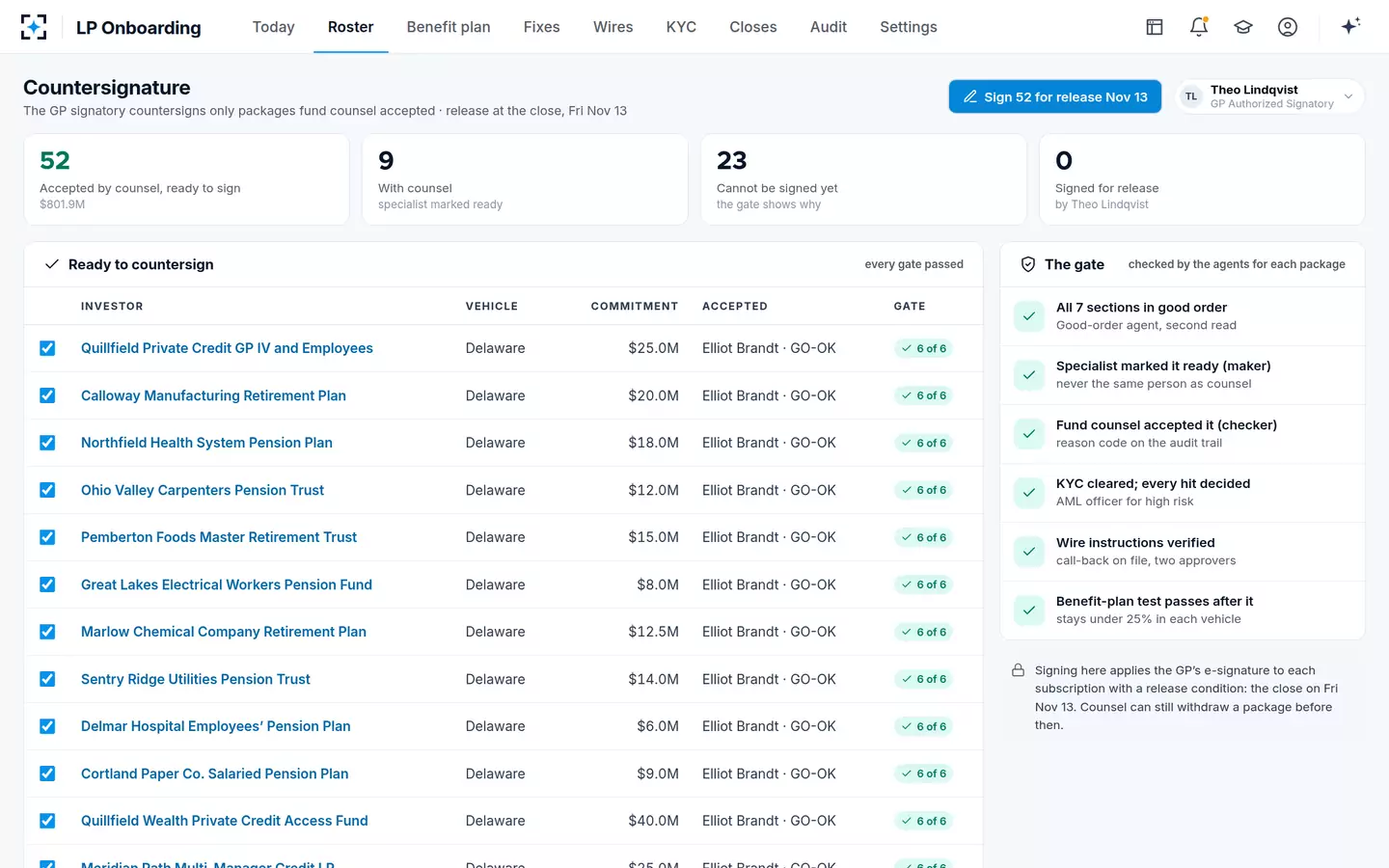
In the sample close, the countersignature screen holds 52 packages worth $801.9 million, each passing six checks: all seven booklet sections in good order, marked ready by a specialist, accepted by counsel, KYC cleared, wire instructions verified and the benefit-plan test still under 25% with that package in. Nine more are with counsel and 23 cannot be signed yet, each with its reason. The signatory signs the batch for release at the close; a package withdrawn by counsel before then is not released.
Only what counsel accepted reaches the GP's signature in LP Onboarding
The days before the close are a relay between seats, set out in the investor onboarding process. Investors that are themselves funds, whose owners and plans must be counted through, are covered in passthrough subscription documents. To plan a close of your own in the solution, start from LP Onboarding.
Questions people ask
What is the difference between first close and final close?
The first close is the first date on which the GP accepts subscriptions and the fund begins to operate; the final close is the last, after which no new investors are admitted. In the sample raise they are 259 days apart, with a second close in between, and each one re-runs the fund-level tests.
What is subsequent close interest?
It is an amount, set by the LPA, that investors admitted at a later close pay on top of their share of capital already called, to compensate the investors who funded earlier. It is a contractual term between the partners; no regulation sets the rate.
Can a GP close with fewer investors than planned?
Yes, if the LPA's conditions to the first close, such as a minimum total commitment, are met. Investors not ready can be rolled to a later close; in the sample raise, two investors with no reply after two reminders were proposed for the second close, and investor relations decides.
Does every investor need to sign on the closing day?
No. Investors sign their booklets beforehand; on the closing day the GP countersigns. In the sample close the GP signs a batch of counsel-accepted packages with a release condition, so the signatures take effect at the close and counsel can still withdraw a package before then.
Does a Cayman feeder have its own close-day tests?
Yes. It is its own entity, so it runs its own benefit-plan share and its own investor checks, and since 1 January 2026 it must hold a valid CRS self-certification for each new account on or before the account is opened. In the sample raise the Cayman feeder stood at a 10.4% benefit-plan share.