Yes, a trust can be a qualified purchaser, and the Investment Company Act gives it three ways in. It qualifies if its trustee and every person who settled or contributed assets to it is a qualified purchaser; if it is a family company with at least $5 million in investments owned by or for related people; or if it owns and invests at least $25 million on a discretionary basis. One rule overrides all three: a trust or company "formed for the specific purpose" of buying into the fund qualifies only if each of its owners does. For a wealth firm's alternatives desk, the hard part is not the law but the file: the answer turns on documents the subscription booklet does not ask for. Botminds' Alternative Investment Subscription Processing reads the trust deed and entity documents, applies these tests to every entity subscription and cites each step, so the reviewer decides from evidence rather than from a ticked box.
Why it matters: a fund that relies on section 3(c)(7) must have its securities "owned exclusively by persons who, at the time of acquisition of such securities, are qualified purchasers" (15 U.S.C. 80a-3(c)(7)). The Act defines a person as "a natural person or a company", and a company to include "a trust" (15 U.S.C. 80a-2(a)(8), (a)(28)), so a trust is tested as an entity, under the clauses below.
Can a trust be a qualified purchaser? Four questions, in order
1Was the trust or entity formed for the specific purpose of buying into this fund?
YesLook through it. It qualifies only if every beneficial owner is a qualified purchaser in their own right.Rule 2a51-3(a)
NoGo to step 2.
2Does it own and invest, on a discretionary basis, $25 million or more in investments, net of debt incurred to buy them?
YesQualified purchaser under clause (iv), whatever kind of entity it is.Section 2(a)(51)(A)(iv); Rule 2a51-1(e)
NoGo to step 3.
3Is it a family company: $5 million or more in investments, owned by or for two or more related people?
YesQualified purchaser under clause (ii). Deduct debt any owner incurred to buy its investments.Section 2(a)(51)(A)(ii); Rule 2a51-1(f)
NoGo to step 4.
4Is it a trust whose trustee (or other decision-maker) and every settlor and contributor is a qualified purchaser?
YesQualified purchaser under clause (iii). The trust’s own size does not matter on this route.Section 2(a)(51)(A)(iii)
NoNot a qualified purchaser. Test the accredited-investor routes for a feeder that accepts them.
Qualified purchaser requirements for a trust: three routes in the statute
The statute's definition has four clauses, and three of them can reach a trust. Clause (ii) covers a company with not less than $5,000,000 in investments "owned directly or indirectly by or for 2 or more natural persons who are related as siblings or spouse (including former spouses), or direct lineal descendants by birth or adoption", with their spouses, estates, and foundations or trusts set up for them. Clause (iii) is written for trusts: "any trust that is not covered by clause (ii) and that was not formed for the specific purpose of acquiring the securities offered", where the trustee or other decision-maker "and each settlor or other person who has contributed assets to the trust" is a qualified purchaser. Clause (iv) covers any person that "in the aggregate owns and invests on a discretionary basis, not less than $25,000,000 in investments" (15 U.S.C. 80a-2(a)(51)(A)).
The routes ask different questions. Clause (ii) asks about the family and $5 million. Clause (iii) asks about the people, not the trust's size. Clause (iv) asks about $25 million and nothing else. A reviewer who only knows that "a trust needs $5 million" will pass some trusts that fail and fail some that pass.
The trustee and every settlor: the test that ignores the trust's size
Under clause (iii), a trust with $2 million of assets can be a qualified purchaser and a trust with $20 million can fail. What decides it is whether the trustee (or whoever is authorised to make the trust's decisions) and each settlor or contributor qualifies under clause (i), (ii) or (iv). A natural person qualifies under clause (i) with not less than $5,000,000 in investments.
Take a fictional example. The Brandt Children's Trust holds $18.4 million in investments. Its settlors, Ines and Walter Brandt, each hold far more than $5 million in their own names, and the trustee is Walter. But in 2019 Ines's mother added $400,000 to the trust, and her own investments total $1.9 million. She is a contributor, she is not a qualified purchaser, and so the trust fails clause (iii). It holds less than $25 million, so clause (iv) is closed too. Whether clause (ii) is open, as a family company owned for related people, depends on how the deed describes ownership, and that is a question for the fund's counsel, not the desk.
The practical lesson is about the file. "Each settlor or other person who has contributed assets" means the desk needs the list of contributors since the trust was formed, not only the original settlors on page one of the deed. Most subscription booklets ask the investor to tick the clause it relies on; few ask for the contributor list behind the tick.
Can an entity be a qualified purchaser? Family companies and the $25 million route
An entity can be a qualified purchaser in two ways that do not depend on its owners: as a family company with $5 million or more in investments, or as any person owning and investing $25 million or more on a discretionary basis. The family-company route has a deduction of its own: besides debt the company itself took on to buy its investments, the rule deducts "any outstanding indebtedness incurred by an owner of the Family Company to acquire such Investments" (17 CFR 270.2a51-1(f)).
For a company in a group, Rule 2a51-1(g)(3) lets the $25 million test include investments owned by majority-owned subsidiaries and by a parent of which the company is a majority-owned subsidiary. And for a fund that is itself excepted under section 3(c)(1) or 3(c)(7) and wants to invest as a qualified purchaser, section 2(a)(51)(C) adds a condition from 1996: its owners who bought on or before April 30, 1996 must have consented, and the statute adds: "Unanimous consent of all trustees, directors, or general partners of a company or trust referred to in clause (ii) or (iii) of subparagraph (A) shall constitute consent for purposes of this subparagraph." Few wealth clients meet that last case, but the desk should know it exists.
Which route each kind of investor can use
| Investor | Qualified purchaser routes | What the file needs | Accredited-investor fallback |
|---|---|---|---|
| Individual, or spouses investing jointly | Clause (i): $5M in investments; spouses may count each other’s investments for a joint investment | Statements dated close to the subscription; debt incurred to buy investments | Net worth over $1M excluding the home, or the income test |
| Revocable or irrevocable trust | Clause (iii) by its trustee and every settlor and contributor; clause (iv) with $25M; clause (ii) if it is a family company | The deed, the trustee’s authority, the list of contributors and each one’s status | Over $5M in total assets, not formed to invest, directed by a sophisticated person |
| Family LLC or partnership | Clause (ii) with $5M owned by or for related people; clause (iv) with $25M | Operating agreement or partnership agreement, ownership, owners’ acquisition debt | Over $5M in assets and not formed to invest, or every equity owner accredited |
| Entity formed to make this investment | Only if each beneficial owner is a qualified purchaser | Formation date and purpose, every owner, each owner’s evidence | Every equity owner accredited |
| Any entity with $25M or more | Clause (iv), on investments owned and invested on a discretionary basis | Statements for the entity; debt incurred to buy the investments | Usually accredited by size |
Is an LLC formed to invest a qualified purchaser?
Only if every one of its owners is. Rule 2a51-3(a) says a company "shall not be deemed to be a qualified purchaser if it was formed for the specific purpose of acquiring the securities offered by a company excluded from the definition of investment company by section 3(c)(7)" unless "each beneficial owner of the company's securities is a qualified purchaser" (17 CFR 270.2a51-3). The statute's trust clause carries the same idea in its own words: a trust qualifies under clause (iii) only if it "was not formed for the specific purpose of acquiring the securities offered".
The rule's second paragraph works the other way, and is often forgotten: any company "may be deemed to be a qualified purchaser if each beneficial owner of the company's securities is a qualified purchaser". So an LLC that fails every size test can still subscribe if all its members qualify. The look-through is a route in, not only a trap.
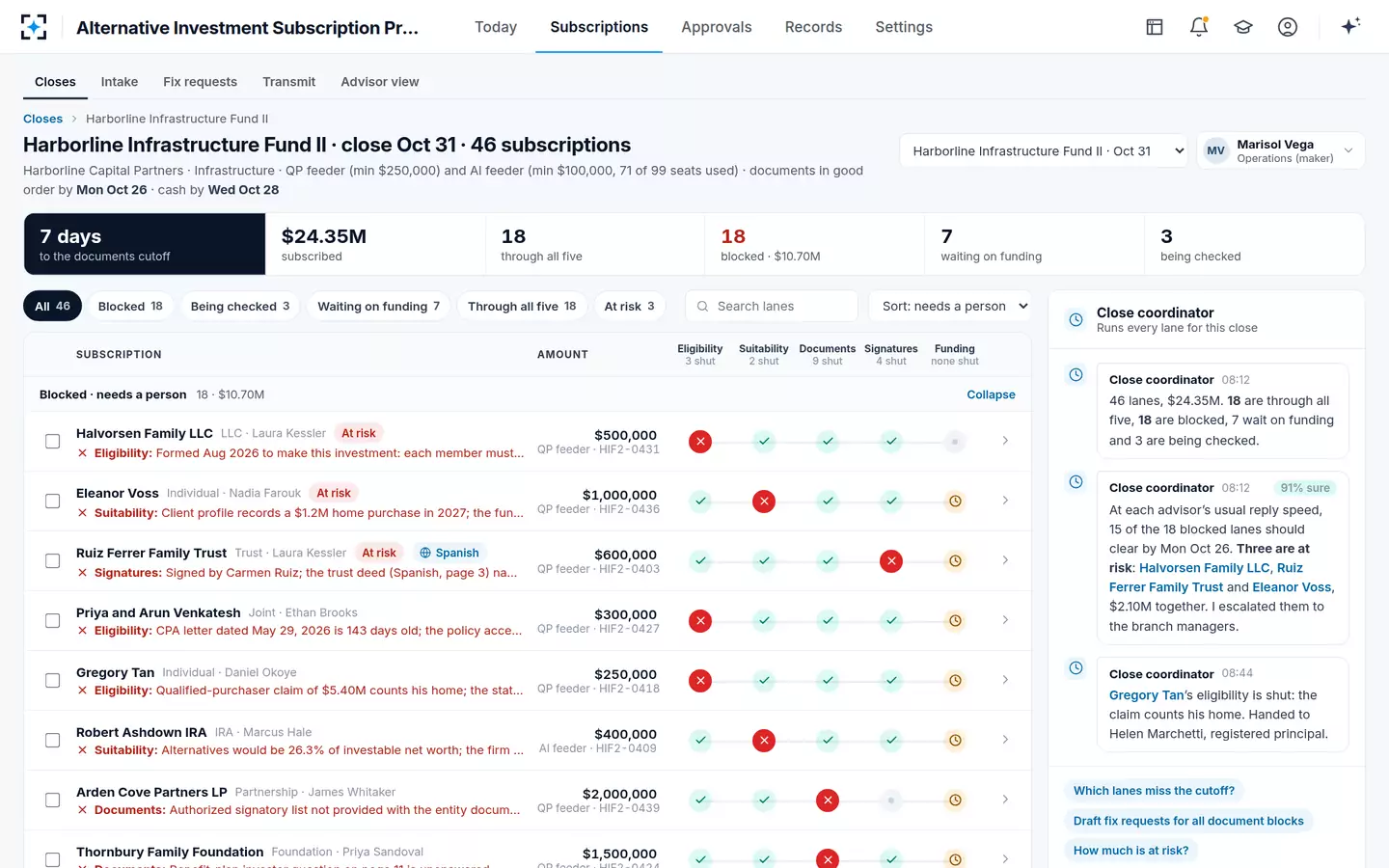
The tell is the formation date. In the sample close used throughout this series, a fictional firm's subscription from Halvorsen Family LLC was blocked because the company was formed in August 2026 to make this investment, two months before the fund's October close, and two of its members had not yet provided evidence. The check is not whether the LLC looks wealthy; it is when and why it was formed, and who is behind it.
An LLC formed to invest, and a trust signed by the wrong trustee
Does debt reduce qualified purchaser investments?
Yes, debt taken on to buy investments is deducted. Rule 2a51-1(e) says "there shall be deducted from the amount of such person's Investments the amount of any outstanding indebtedness incurred to acquire or for the purpose of acquiring the Investments owned by such person". A margin loan used to buy securities, or a mortgage taken out to buy a rental building, comes off. Debt that did not buy investments, such as a mortgage on the family home, does not, because the home is not counted in the first place.
For trusts and entities the deduction follows the money. A family company deducts its own acquisition debt and its owners' (Rule 2a51-1(f)). For spouses investing jointly, each spouse's acquisition debt comes off (Rule 2a51-1(g)(2)). Investments are valued at fair market value on the latest practicable date, or at cost (Rule 2a51-1(d); the evidence question is in qualified purchaser requirements), which is why a statement months old is weak evidence: it may no longer show the value or the debt.
What counts as an investment for a trust or an entity
The same list applies to a trust as to a person. Rule 2a51-1(b) counts securities (with limits on securities of companies the investor controls), "real estate held for investment purposes", commodity interests and physical commodities held for investment, certain financial contracts, and "cash and cash equivalents (including foreign currencies) held for investment purposes", which include an insurance policy's net cash surrender value. Real estate a related person uses for personal purposes, or as a place of business, is not held for investment (Rule 2a51-1(c)(1)).
That last point catches entities as well as individuals. A family company that owns a house the family uses, or the building the family business operates from, holds real estate that the rule may not treat as held for investment. The desk needs to know who uses each property, not only who owns it, and should send the unclear cases to the fund's counsel.
Can a trust be an accredited investor instead?
Often, and that matters when the fund offers an accredited-investor feeder beside its qualified-purchaser one. Rule 501(a)(7) covers "any trust, with total assets in excess of $5,000,000, not formed for the specific purpose of acquiring the securities offered, whose purchase is directed by a sophisticated person". Rule 501(a)(8) covers "any entity in which all of the equity owners are accredited investors", and its note allows the reviewer to "look through various forms of equity ownership to natural persons" (17 CFR 230.501(a)).
The thresholds are lower and the evidence is different: total assets rather than investments, and no deduction of acquisition debt in the (a)(7) test. A trust that fails the qualified-purchaser test by one contributor may still be an accredited investor, and an advisor can offer the client the feeder that fits. In the sample close, the agents proposed exactly that move for an individual who fell short of $5 million, and the registered principal decided it. The full arithmetic for individuals is in qualified purchaser requirements.
A trust's qualified-purchaser status is not in the trust's statement. It is in the deed, the list of everyone who ever put money in, and the statements of each of them.
When the fund charges a performance fee: is the trust also a qualified client?
A trust that passes the qualified-purchaser test also clears the qualified-client test, because Rule 205-3 counts as a qualified client any person or company that is a qualified purchaser under section 2(a)(51)(A) when the advisory contract is signed (17 CFR 275.205-3(d)(1)(ii)(B)). The question matters for feeders that are not 3(c)(7) vehicles. In a 3(c)(1) private fund that pays its adviser a share of the gains, Rule 205-3(b) treats each equity owner charged that fee as the adviser's client, so each investor, trust or individual, must be a qualified client.
For a trust that is not a qualified purchaser, the other routes are the dollar tests, and since June 29, 2026 they are higher: $1.4 million under the adviser's management immediately after the contract, or a net worth the adviser reasonably believes is more than $2.7 million. Unlike the accredited-investor rules, the qualified-client definition uses one net worth threshold for natural persons and entities alike, as the SEC pointed out in its October 2026 proposal (Federal Register, October 6, 2026). The qualified client threshold for 2026 explains which subscriptions the new numbers reach.
Who signs for the trust: authority is part of eligibility
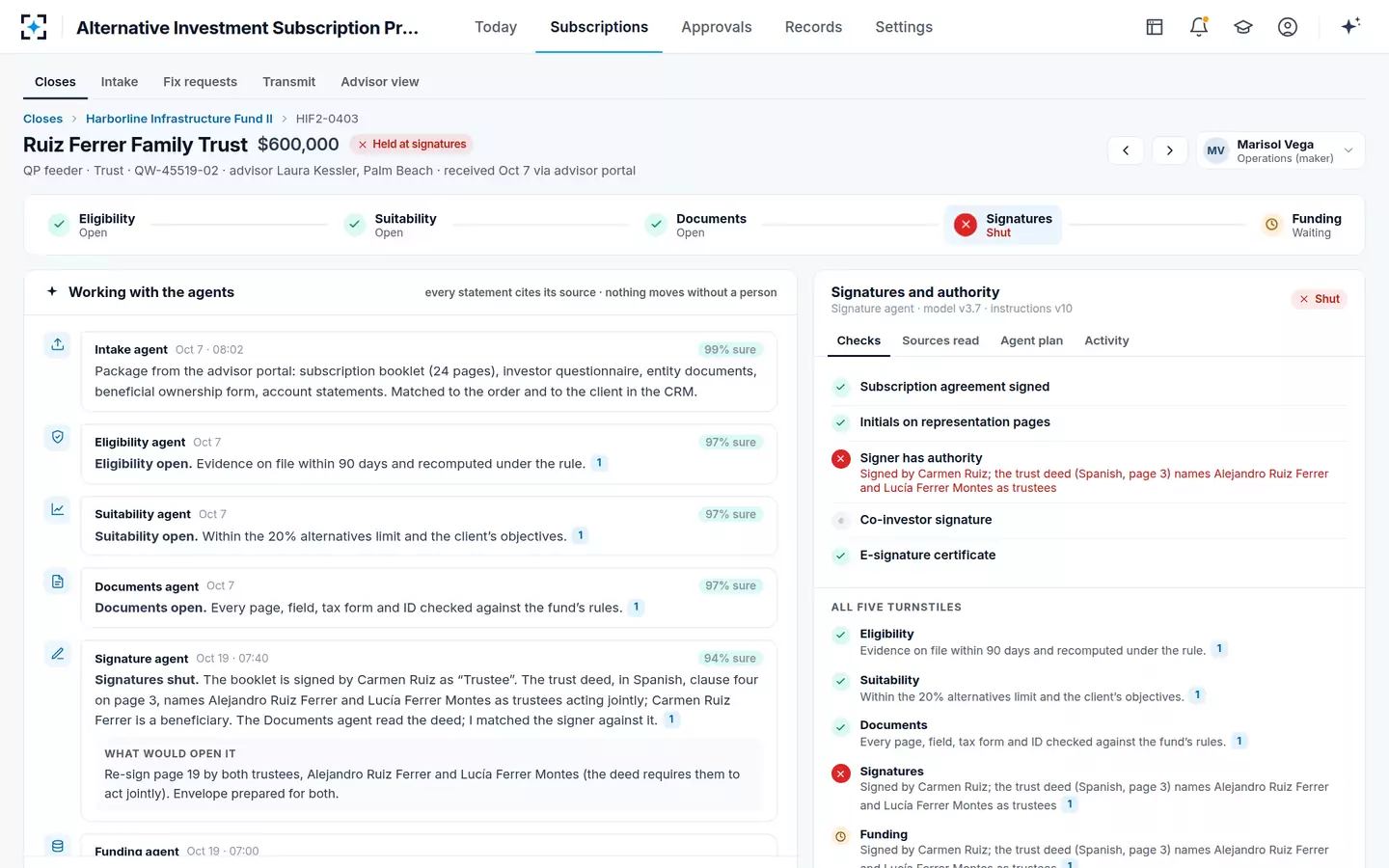
The trustee named in the eligibility test should be the trustee who signs, and the deed decides who that is. Where a deed names co-trustees who must act jointly, one signature is not enough, however senior the signer. In the sample close, a family trust's $600,000 subscription was signed by a beneficiary as "Trustee", while the deed, in Spanish, named two other people as trustees acting jointly. The eligibility test passed; the signature test did not. Both checks read the same deed, which is why the desk should read it once, completely, at intake.
The deed names two trustees; one signature is not enough
What the trust subscription file should hold
The file should let a stranger reach the same answer: which route the trust relies on, the evidence for each person that route depends on, and the authority of each signer. The checklist below is the minimum we would expect an examiner or the fund's counsel to be able to follow. Alternative Investment Subscription Processing assembles it for each entity subscription, cites each item to its page, and keeps the eligibility check shut until the evidence supports a route. It has no override: a reviewer cannot open it by judgment alone, only with documents.
A trust's qualified-purchaser file, item by item
- The route relied on, named
Clause (ii), (iii) or (iv), or the look-through for every owner, with the reason the others do not apply.
- Formation date and purpose
From the deed or certificate. Formed within months of the subscription is a prompt to ask whether it was formed to invest.
- Trustee and decision-maker
Who has authority to make the trust’s decisions, and whether co-trustees must act jointly.
- Every settlor and contributor
Not just the original settlors: anyone who has added assets since, with each person’s qualified-purchaser evidence.
- Investments, valued and net of debt
Statements close to the subscription date; acquisition debt deducted; property used by the family excluded.
- Signers matched to the deed
Each signature against the named trustees or authorised signatories, page by page.
- The fallback tested
If no qualified-purchaser route holds, whether an accredited-investor feeder is available and the trust qualifies for it.
Questions people ask
Can a revocable trust be a qualified purchaser?
The statute does not separate revocable from irrevocable trusts. A revocable trust usually uses clause (iii): if its trustee and every settlor and contributor are qualified purchasers, and it was not formed to make the investment, it qualifies. Where the settlor is also the trustee, the test largely comes down to the settlor's own $5 million of investments.
Can an irrevocable trust be a qualified purchaser?
Yes, on the same routes: the trustee-and-contributor test in clause (iii), $25 million of discretionary investments under clause (iv), or the family-company clause (ii). Irrevocable trusts are more likely to have later contributors, such as grandparents, so the contributor list deserves the most attention.
What is the qualified purchaser definition for an entity?
An entity qualifies as a family company with $5 million in investments owned by or for related people, with $25 million or more owned and invested on a discretionary basis, or when every beneficial owner is a qualified purchaser. An entity formed to buy into the fund qualifies only through that last route.
Does a trust's own size matter for qualified purchaser status?
Only on the $25 million route and the $5 million family-company route. Under the trustee-and-settlor route in clause (iii) the trust's size is irrelevant: a small trust can qualify and a large one can fail.
Can a fund rely on what the trust tells it?
The rule's standard is reasonable belief: "qualified purchaser" includes a person that the fund or someone acting for it "reasonably believes" meets the definition (Rule 2a51-1(h)). What makes a belief reasonable is evidence, which is why the subscription file should hold the documents behind each tick, not only the tick.