The qualified purchaser requirements decide who may invest in a fund that relies on section 3(c)(7) of the Investment Company Act. A natural person must own not less than $5,000,000 in investments as SEC Rule 2a51-1 defines them; a family company needs $5 million; a trust qualifies through its trustee and every settlor; any other person needs $25 million owned and invested on a discretionary basis. The number is simple. Applying it is not: the rule decides which assets count, excludes real estate the investor uses personally, deducts debt incurred to buy investments, and leaves valuation to "the most recent practicable date". Each of those is a judgment, and two careful reviewers given the same file can reach different answers. Botminds' Alternative Investment Subscription Processing recomputes the test line by line from the evidence for every subscription, but the place to start is with your own reviewers: measure where they disagree, write those rules down, and only then let any system apply them.
Two reviewers, forty past files: how far do they agree?
28both pass
4A passes, B fails
Reviewer A: fail2A fails, B passes
6both fail
85%observed agreement, 34 of 40
65%agreement expected by chance
0.57Cohen’s kappa
What are the qualified purchaser requirements?
The statute defines four kinds of qualified purchaser. A natural person, including one who holds a joint or community property interest with a qualified-purchaser spouse, "who owns not less than $5,000,000 in investments, as defined by the Commission". A family company with not less than $5,000,000 in investments owned by or for related people. A trust not formed to make the investment whose trustee and each settlor or contributor qualifies. And any person, acting for itself or for other qualified purchasers, that owns and invests at least $25,000,000 in investments on a discretionary basis (15 U.S.C. 80a-2(a)(51)(A)).
Rule 2a51-1 supplies what "investments" means and how to count them, and adds two practical rules. A qualified institutional buyer acting for itself or other qualified buyers is deemed a qualified purchaser, with conditions. And the definition reaches anyone a fund or a person acting for it "reasonably believes" meets it (17 CFR 270.2a51-1(g)(1), (h)). That reasonable-belief standard is why the file matters: a belief is reasonable because of the evidence behind it. Trusts and entities have their own routes, set out in can a trust be a qualified purchaser; this guide concentrates on individuals, where most of the judgment calls are.
What counts as an investment under Rule 2a51-1?
The rule lists seven categories, and the list is narrower than net worth. Securities count, except securities of a company the investor controls or is under common control with, unless that company is an investment vehicle, a public company, or has at least $50 million of shareholders' equity. Real estate counts only when "held for investment purposes". Commodity interests and physical commodities count when held for investment, and so do certain financial contracts. Cash and cash equivalents count when held for investment, including bank deposits, certificates of deposit and "the net cash surrender value of an insurance policy". The seventh category, binding capital commitments from a fund's own investors, matters only when a fund is itself the investor.
Rule 2a51-1: what counts toward $5 million, and what does not
| Asset or adjustment | Treatment | Where reviewers split |
|---|---|---|
| Listed securities, funds, private fund interests | Count | Whether a private company’s shares are excluded because the investor controls it |
| Real estate held for investment | Counts | Whether the investor or a relative uses it personally or as a place of business |
| The investor’s home | Does not count | Second homes rented part of the year; the rule points to tax law (section 280A) |
| Cash, deposits, CDs held for investment | Count | Operating cash in a business account versus investment cash |
| Net cash surrender value of life insurance | Counts | Using face value or premiums paid instead of the surrender value |
| IRA and similar accounts the investor directs | Count | Accounts the investor does not direct, such as some employer plans |
| Debt incurred to acquire investments | Deducted | Whether a loan was taken “for the purpose of acquiring” investments |
| Value used | Fair market value on the most recent practicable date, or cost | Which date, which currency rate, and whether cost is acceptable |
Does a primary residence count for qualified purchaser status?
No. Rule 2a51-1(c)(1) says real estate "shall not be considered to be held for investment purposes by a Prospective Qualified Purchaser if it is used by the Prospective Qualified Purchaser or a Related Person for personal purposes or as a place of business". A home the investor lives in is used for personal purposes. Related persons are siblings, spouses or former spouses, descendants and ancestors and their spouses, so a house the investor owns and her mother lives in is not held for investment either.
The rule carves out one case that causes most disagreements: "Residential real estate shall not be deemed to be used for personal purposes if deductions with respect to such real estate are not disallowed by section 280A of the Internal Revenue Code". In plain terms, a property rented out with little enough personal use that the tax rules do not disallow its deductions can count. A reviewer needs to know how it is used to decide, which a questionnaire rarely gives.
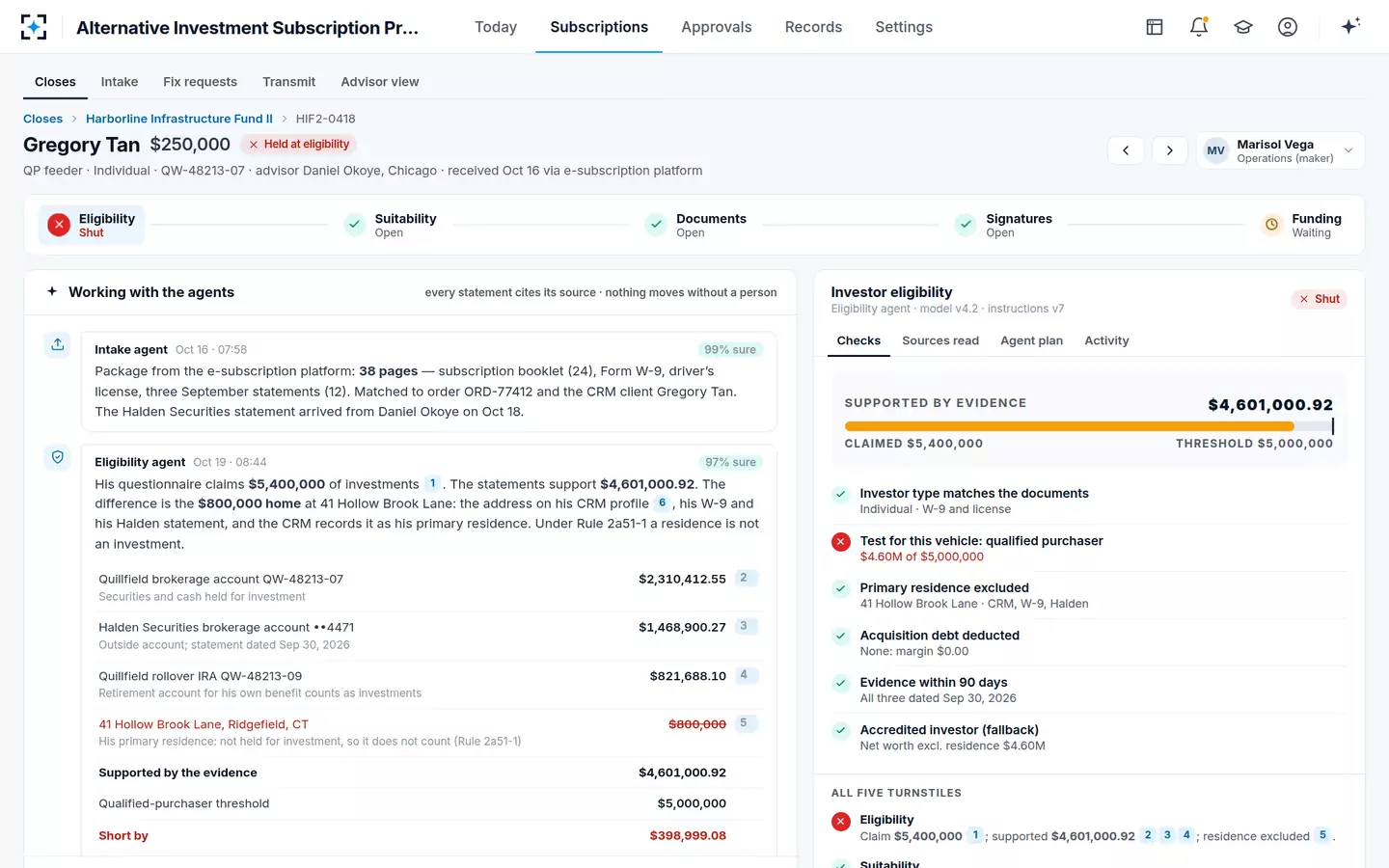
The sample case in Alternative Investment Subscription Processing shows the simple version. A fictional investor claimed $5,400,000 of investments. Three statements, one a rollover IRA, support $4,601,000.92; the other $800,000 is a house at the same address as his brokerage statement, his tax form and his client profile, where his profile lists it as his primary residence. He is short by $398,999.08, and every box on his questionnaire was ticked.
The claim rebuilt from three statements, the home struck out
Can spouses combine investments for qualified purchaser status?
Yes, in two ways. A natural person may include "any Investments held jointly with such person's spouse, or Investments in which such person shares with such person's spouse a community property or similar shared ownership interest". And when spouses invest jointly in a 3(c)(7) fund, each may count investments owned by the other, "whether or not such Investments are held jointly". In each case, each spouse's acquisition debt comes off (Rule 2a51-1(g)(2)).
The judgment calls are about form. Is the subscription in both names, or one? Does the couple live in a community property state? Is an account in one spouse's name but funded by the other? Rule 2a51-1(g)(4) adds that a person may include investments in "an individual retirement account or similar account the Investments of which are directed by and held for the benefit of such person", which is why a rollover IRA counts and an employer plan the person cannot direct may not. Reviewers who have not agreed on these in advance will split on them.
How old can eligibility evidence be?
The qualified-purchaser rule sets no maximum age; it values investments at "fair market value on the most recent practicable date or their cost" (Rule 2a51-1(d)). That gives a reviewer a standard, not a number, and the gap is where firms write policy. The SEC's accredited-investor verification rule offers a benchmark from a neighbouring test: for net worth, it accepts statements from the last three months, and a CPA's, attorney's, broker-dealer's or registered adviser's written confirmation that the investor was verified "within the prior three months" (17 CFR 230.506(c)(2)(ii)). That rule governs issuers in general-solicitation offerings, not qualified-purchaser status; many firms borrow its period anyway.
The sample firm in this series sets 90 days for statements and letters, and its desk blocked one couple's subscription because their CPA letter was dated May 29, 2026, 143 days before the review. The point is not that 90 days is right. It is that two reviewers without a written number will accept letters of different ages, and the fund's administrator, or an examiner, will see the inconsistency before the firm does.
Where two reviewers disagree on the same file
They disagree where the rule needs information the file does not hold, or where the firm has not chosen between two defensible readings. Read the rule for the points that need information and the candidates are few: how a property is used, whether a loan was taken to buy investments, which date and exchange rate to value at, whether a private company is one the investor controls, and how old evidence may be. None of these is a careless error. Each is a judgment, and a judgment made differently by two people is a rule the firm has not written.
In the illustration, six disagreements: where they fell
Measure agreement before you automate the qualified purchaser test
The measurement is simple and old. Take 30 to 50 closed qualified-purchaser files. Give the same files to two reviewers who work independently. Have each note the decision and, for every line of the arithmetic, the value each counted. Then compute observed agreement and Cohen's kappa, a coefficient introduced in 1960 that discounts the agreement two raters would reach by chance alone (Cohen, Educational and Psychological Measurement, 1960): kappa equals observed agreement minus chance agreement, divided by one minus chance agreement.
Kappa matters because raw agreement flatters. When most files pass, two reviewers who pass nearly everything agree often by default. In the illustration, 85% agreement looks reassuring; the kappa of 0.57 says much of it is what chance would produce. The more useful output, though, is not the coefficient. It is the list of elements where the reviewers split, because each one names a rule to write down.
The same exercise then tests any system you consider. Run the solution, or any software, on the same files with the reviewers' answers held back, and compare it with each reviewer the same way: decision by decision and line by line. A system that agrees with your best reviewer on the written rules and flags the elements where the rules are still open is doing what you need; one that agrees with nobody on the open elements is guessing.
Write the rule down, then apply it the same way every time
Each disagreement becomes a written interpretation: how the firm decides whether a property is used personally, what it accepts as proof a loan funded investments, which value date and exchange rate it uses, how old evidence may be. In Alternative Investment Subscription Processing those interpretations are settings with a source and a version; a change needs a reason and a principal's signature and becomes a new version, so a file decided in March can be read against the rules that applied in March.
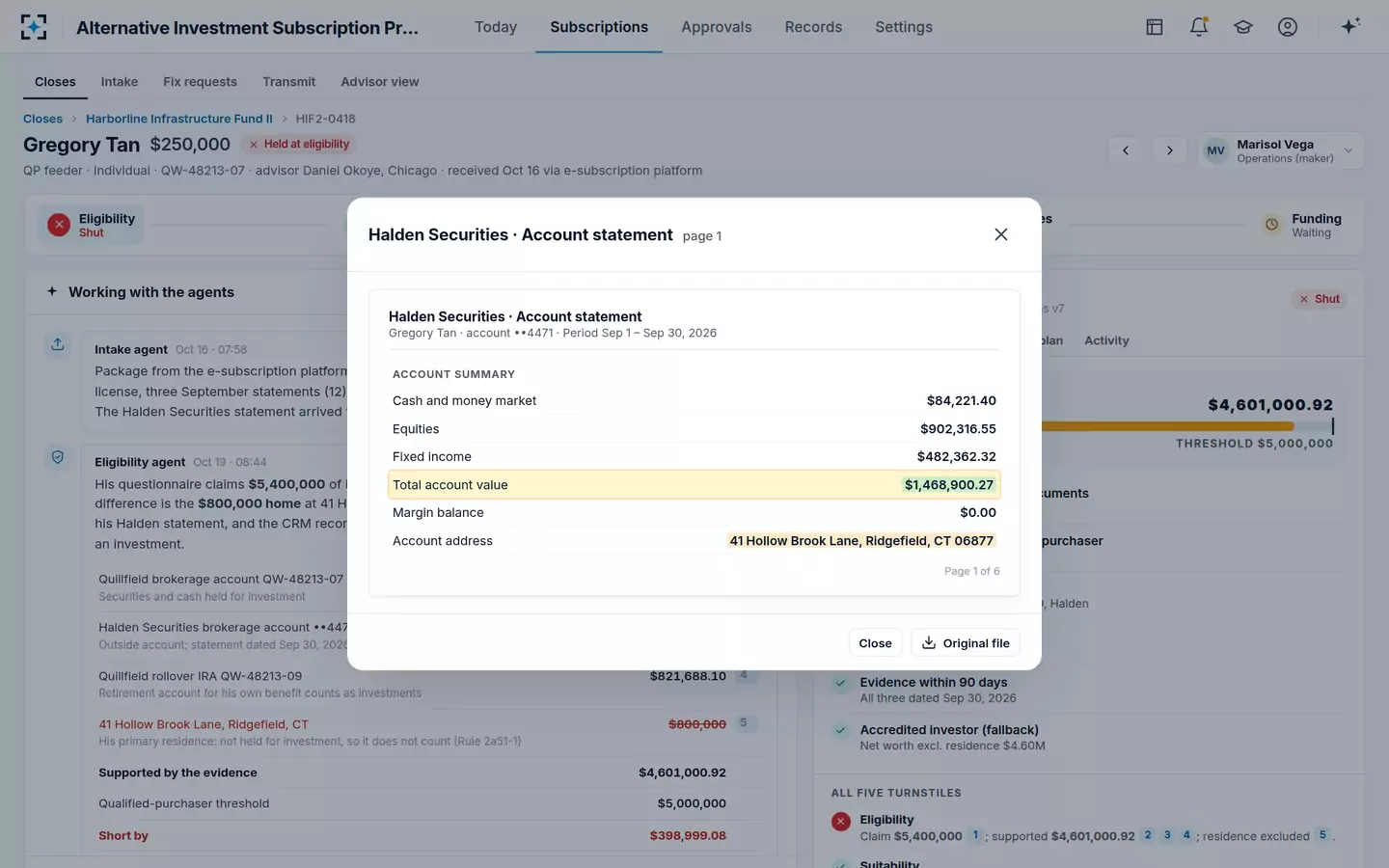
Consistency is the reason to automate, not speed. Once the rules are written, the Eligibility agent applies them to every file in the same way and cites every line to its page, and it has no override: only evidence opens the eligibility check. Where it cannot read a value with confidence, below 90%, a person reviews the value before it counts. What it costs when an eligibility problem is found late, after the documents cutoff, is set out in what each missed close costs.
Every figure opens on its page
A reviewer-agreement exercise for qualified-purchaser files
- Pick 30 to 50 closed files
Include trusts, joint investors and foreign-currency evidence, not only clean individual cases.
- Two reviewers, working blind
Each notes the decision and every counted, excluded and deducted line, with the page relied on.
- Compute agreement and kappa
Observed agreement, chance agreement, and kappa; then the same by rule element.
- List every split by element
Property use, acquisition debt, valuation date, control securities, evidence age: each split names a rule to write.
- Write and version the interpretations
Each with its source, the reason and a principal’s signature.
- Re-run with the written rules
Agreement should rise where rules were written; where it does not, the rule is unclear.
- Test any system against both reviewers
Same files, answers held back, compared line by line.
Questions people ask
What is a qualified purchaser in finance?
A qualified purchaser is an investor eligible to buy into a private fund that relies on section 3(c)(7) of the Investment Company Act. For an individual it means owning not less than $5 million in investments as Rule 2a51-1 defines them, net of debt incurred to buy them; entities and trusts have their own routes.
What is Rule 2a51-1?
It is the SEC rule that defines "investments" for the qualified-purchaser test and says how to count them: which assets qualify, when real estate is held for investment, how to value holdings, which debt to deduct, and how spouses, subsidiaries and retirement accounts are treated. It dates from 1997 and has not been amended since.
Is a qualified purchaser the same as an accredited investor?
No. An individual accredited investor needs net worth over $1 million excluding the home, an income test or certain securities licences; a qualified purchaser needs $5 million in investments. The qualified-purchaser test counts investments rather than net worth, so a client with a valuable home and business can be accredited without being a qualified purchaser.
Does a vacation home count toward qualified purchaser status?
Not if the investor or a related person uses it for personal purposes. A residential property counts only where its use is limited enough that tax deductions for it are not disallowed under section 280A of the Internal Revenue Code, so the reviewer needs to know how it is used, not only its value.
What is a good kappa for eligibility reviewers?
No regulator sets one. Treat any disagreement on a written rule as a defect to fix, and use kappa to compare rounds of the same exercise: it should rise after the firm writes its interpretations down. Where it does not, the written rule is still unclear.