Interval fund vs evergreen fund is not a comparison of two equals. "Evergreen" is a market term for a fund with no fixed end date that keeps taking new money and offers investors some way out from time to time; an interval fund is one specific evergreen structure, defined by SEC Rule 23c-3, that must make repurchase offers at fixed intervals under a fundamental policy. The other evergreen structures sold to wealth clients, tender offer funds, perpetual non-traded BDCs, non-traded REITs and open-ended private funds, buy back shares when their board or manager chooses, in amounts it chooses, and can pause. A Federal Reserve note puts the difference in one line: it "lies in the mandatory versus discretionary nature of their repurchase obligations" (FEDS Notes, October 16, 2026). For the wealth firm placing a client, the question that matters is whether the fund's real terms fit the client's liquidity needs. Botminds' Alternative Investment Subscription Processing reads those terms from the fund's documents and tests them against the client's profile before the subscription leaves the firm.
Interval fund vs evergreen fund: who decides when the client can get out
Interval fund: A fundamental policy under SEC Rule 23c-3; only a shareholder vote changes the interval
Tender offer fund: The board, offer by offer
Non-traded BDC: The fund’s stated repurchase program, with the manager’s discretion
Non-traded REIT: A share redemption program the REIT may change or stop
Interval fund: Every 3, 6 or 12 months; monthly under some SEC exemptive orders
Tender offer fund: When the board decides
Non-traded BDC: “Typically … quarterly or monthly” (SEC)
Non-traded REIT: Set by the program
Interval fund: Not less than 5% nor more than 25% of shares outstanding per offer
Tender offer fund: Whatever the offer states
Non-traded BDC: Most perpetual BDCs intend to cap redemptions at 5% of NAV a quarter (Federal Reserve)
Non-traded REIT: “Typically subject to significant limitations” (SEC)
Interval fund: May buy up to 2% more of shares outstanding; then pro rata
Tender offer fund: As the offer states
Non-traded BDC: Prorated, or the manager may buy more
Non-traded REIT: As the program states
Interval fund: Only in exceptional circumstances, by a board majority including a majority of independent directors
Tender offer fund: Yes: no offer is required
Non-traded BDC: Yes, at the manager’s discretion
Non-traded REIT: “May be discontinued at the discretion of the REIT without notice” (SEC)
Are interval funds and evergreen funds the same?
No: every interval fund is evergreen, but most evergreen funds are not interval funds. What makes a fund an interval fund is a legal commitment. Rule 23c-3 lets a registered closed-end fund or BDC "make repurchase offers to shareholders at net asset value ('NAV') at periodic intervals pursuant to a fundamental policy", and the SEC describes the result as "a mandatory, limited, rules-based liquidity framework" (SEC proposal, Federal Register, October 5, 2026). A fundamental policy can be changed only by a shareholder vote, so the schedule the client reads is the schedule the fund keeps, short of the exceptional circumstances the rule allows.
"Evergreen" carries no such commitment. The word describes a fund's life (no end date, continuous offering), not its exit. The Federal Reserve groups perpetual-life BDCs and interval funds as "semi-liquid" vehicles that "offer investors an option to redeem capital subject to restrictions, such as discretionary redemption caps" (Federal Reserve, Financial Stability Report, May 2026). The restriction is the part to read.
How often can you redeem an interval fund?
At the interval in its fundamental policy: every three, six or twelve months under the rule, and monthly for funds the SEC has given exemptive orders. Each repurchase offer must be for not less than 5% and not more than 25% of the shares outstanding on the repurchase request deadline, with the amount set by the board. The fund notifies shareholders 21 to 42 days before the deadline, prices the repurchase within 14 days after it, and pays within 7 days of pricing.
One repurchase cycle of a quarterly interval fund, at the rule's limits
- Notice to request deadline (21–42 days)21–42 d
- Deadline to pricing (up to 14 days)≤14 d
- Pricing to payment (up to 7 days)≤7 d
The cycle shapes what an advisor can promise. A client who learns on the day after a request deadline that she needs cash has missed that quarter: the next offer comes three months later, its notice up to six weeks before its deadline. The price is struck after the deadline, so the client asks to sell without knowing the price. And a new fund need not make its first offer for up to two intervals after its registration statement takes effect, six months for a quarterly fund, under the current rule.
What happens if an interval fund repurchase is oversubscribed?
When shareholders ask to sell more than the offer amount, the fund may buy up to an additional 2% of shares outstanding; if requests still exceed that, it must repurchase pro rata, with two narrow exceptions. A fund may first take in full the shares of holders of fewer than 100 shares who tender everything, and it may let shareholders who tender their whole position choose all-or-nothing (SEC, describing Rule 23c-3(b)(5)).
Work it through for a fictional client. Adaeze Whitcombe holds $1,000,000 in a quarterly interval fund and asks to sell $400,000 in an offer for 5% of the shares. Shareholders as a whole ask to sell 12%. The fund buys the 5% plus the extra 2% it may take, 7% in all, so every request is filled at 7/12: she receives about $233,000 and still holds the rest, with her next chance three months away. Nothing failed. The fund did exactly what its prospectus said it would; the client's plan assumed it would not happen.
Tender offer fund vs interval fund
A tender offer fund repurchases shares only when its board decides to make an issuer tender offer, under the Securities Exchange Act's tender offer rules rather than Rule 23c-3. The Federal Reserve's description: interval funds are "required to redeem a certain number of shares at specified intervals while tender offer funds have more discretion over the timing, frequency, and offer size". The SEC's own history of the interval fund rule explains why the alternative exists: closed-end funds that relied on periodic tender offers found the Exchange Act framework "operationally cumbersome and costly", and Rule 23c-3 was the answer in 1993.
For the client the difference is certainty. A tender offer fund may state an intention to offer quarterly, and many do; the intention is not a policy. A subscription check that reads "quarterly liquidity" in a marketing sheet and writes it down as a term has written down a hope.
Non-traded BDCs and REIT redemption programs: the caps to read
Perpetual non-traded BDCs and non-traded REITs offer redemption programs, and both cap them. The SEC's investor bulletin says "Typically, a retail-offered BDC will offer to repurchase investors’ shares quarterly or monthly" (SEC Office of Investor Education and Assistance, December 2024), and the Federal Reserve reports that most perpetual BDCs "disclosed an intention to cap total investor redemptions at 5 percent of their NAV per quarter, although managers can exercise discretion regarding whether to accept more or fewer redemptions" (Federal Reserve, May 2026).
For non-traded REITs the SEC's warning is older and blunter: redemption programs are usually tightly limited, can be stopped by the REIT without notice and may pay out below the share price (SEC investor bulletin, August 2015). Fees and concentration for those programs are taken apart in non-traded REITs and the concentration line.
Private evergreen funds: the terms live in the fund's own documents
A private evergreen fund, offered to qualified purchasers under section 3(c)(7) or to a limited number of accredited investors under section 3(c)(1), has no SEC rule setting its liquidity at all. Its redemption frequency, notice period, any lock-up after subscription, any limit on total redemptions in a period and any fee for leaving early are whatever its limited partnership agreement or operating agreement says. The wealth firm's job is to read that agreement, not the fund's marketing summary, and to note each term as it stands on the subscription date.
That makes the private version the hardest one for a subscription desk. The interval fund's schedule is in a fundamental policy; the BDC's cap is in its prospectus; the private fund's terms may sit across the agreement, a supplement and the subscription booklet itself. In Alternative Investment Subscription Processing, the Suitability agent tests the client's needs against the fund's lock-up and terms as its memorandum states them, and every figure an agent states links to the page it came from. The principal sees a term such as quarterly redemptions on 90 days' notice with its citation, not a summary line someone typed months ago.
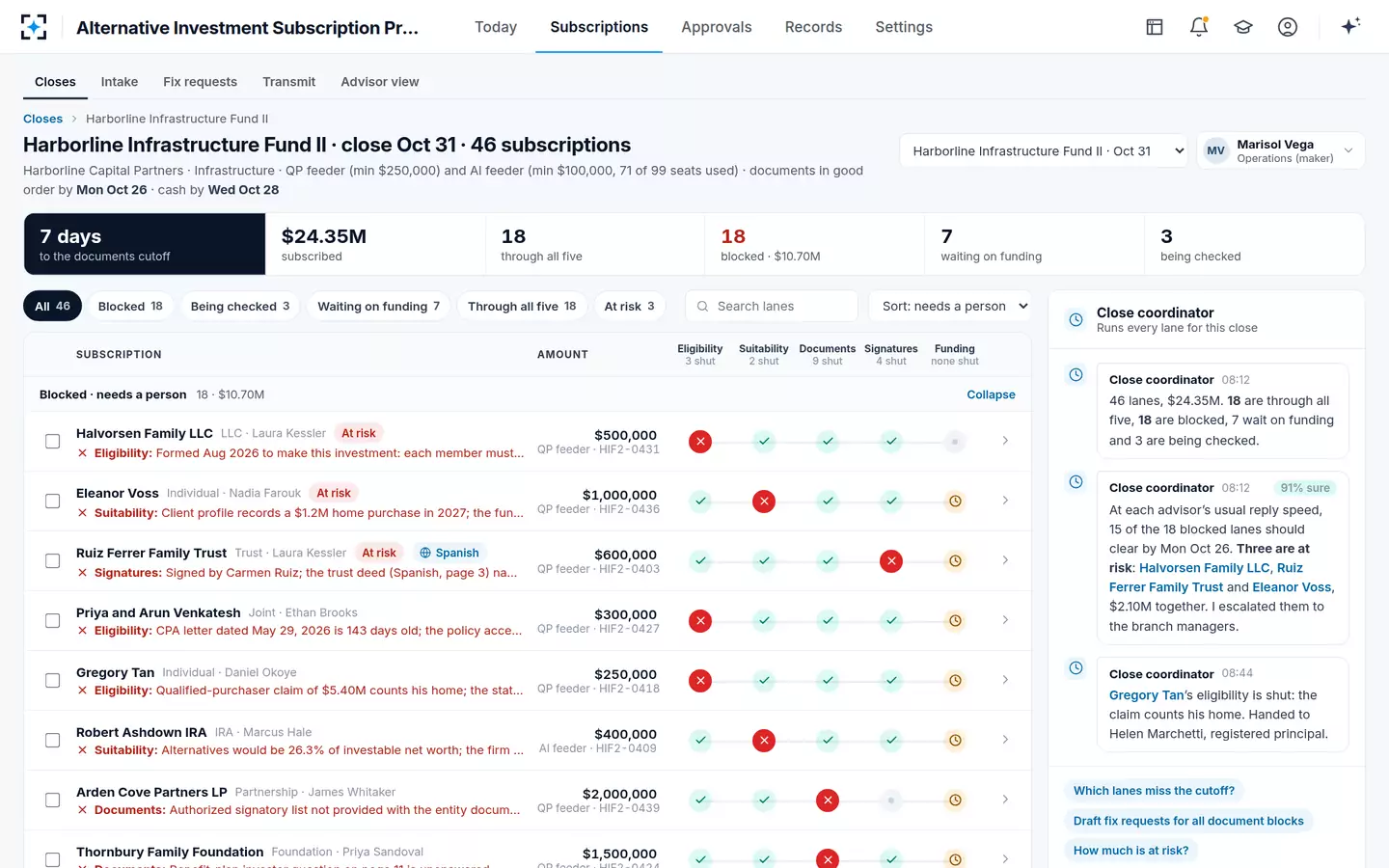
The close view flags a liquidity conflict before the package leaves
What early 2026 showed about semi-liquid funds
The first quarter of 2026 tested the terms, and the structures behaved as written. The SEC reports that "For the five non-traded BDCs that capped and prorated repurchase requests in the first quarter of 2026, there were approximately $6.9 billion in honored repurchase requests (about half the requested amount) versus approximately $4.9 billion in capital inflows", while "interval funds experienced net inflows during the same period, with aggregate net assets up 2.2 percent from the prior quarter" (SEC, October 2026). The Federal Reserve adds that at the largest perpetual BDCs, accepted redemption requests "somewhat exceeded new inflows in the first quarter of 2026, the first time this has occurred since these vehicles were created".
Five capped BDCs in Q1 2026: about half of what investors asked for
Read with the subscription desk in mind, the lesson is not that one structure is safe and another is not. It is that a client who needed more than the cap in that quarter got about half, and a client whose fund was an interval fund got whatever its offer allowed. Both outcomes were in the documents the client signed. The SEC's examiners list "less liquid or illiquid investments, including private credit, and the associated issues regarding valuation, redemptions, and disclosures of conflicts of interest and risks" among the areas they will watch in registered funds (SEC Division of Examinations, FY2027 priorities).
What the SEC proposed for interval funds in October 2026
On October 5, 2026 the SEC proposed changes to Rule 23c-3, with comments due by December 4, 2026; none is in force. The proposal would let interval funds use monthly intervals without an exemptive order, extend how long a new fund may defer its first repurchase offer "from two periodic intervals to two years", allow more frequent discretionary repurchases (today the rule lets any closed-end fund make them "no more frequently than once every two years"), let funds deduct deferred sales loads from repurchase proceeds, and replace the requirement to hold liquid assets equal to the whole repurchase offer with a principles-based approach. It would also let closed-end funds and BDCs issue multiple share classes without individual exemptive orders.
Two of those changes reach the subscription check directly if adopted. A two-year deferral means a client in a newly launched fund could wait up to two years for a first exit, not six months. And deferred sales loads taken from repurchase proceeds mean the amount a client receives on an early exit could be less than NAV. A desk that keeps each fund's terms from its current prospectus, with the date, will pick up both; a desk that writes down "quarterly liquidity" once will not.
Matching the fund's terms to the client's liquidity needs
The check is a comparison, and it needs both sides written down: the fund's actual terms, from its documents, and the client's needs, from the profile, with dates. A home purchase next year, tuition starting in three years, a business sale that may need cash for taxes: each is a date and an amount. Against them sit the fund's interval or cap, its minimum offer, its first possible exit date, any early-repurchase fee or deferred load, and the share of the client's liquid assets that sits outside alternatives.
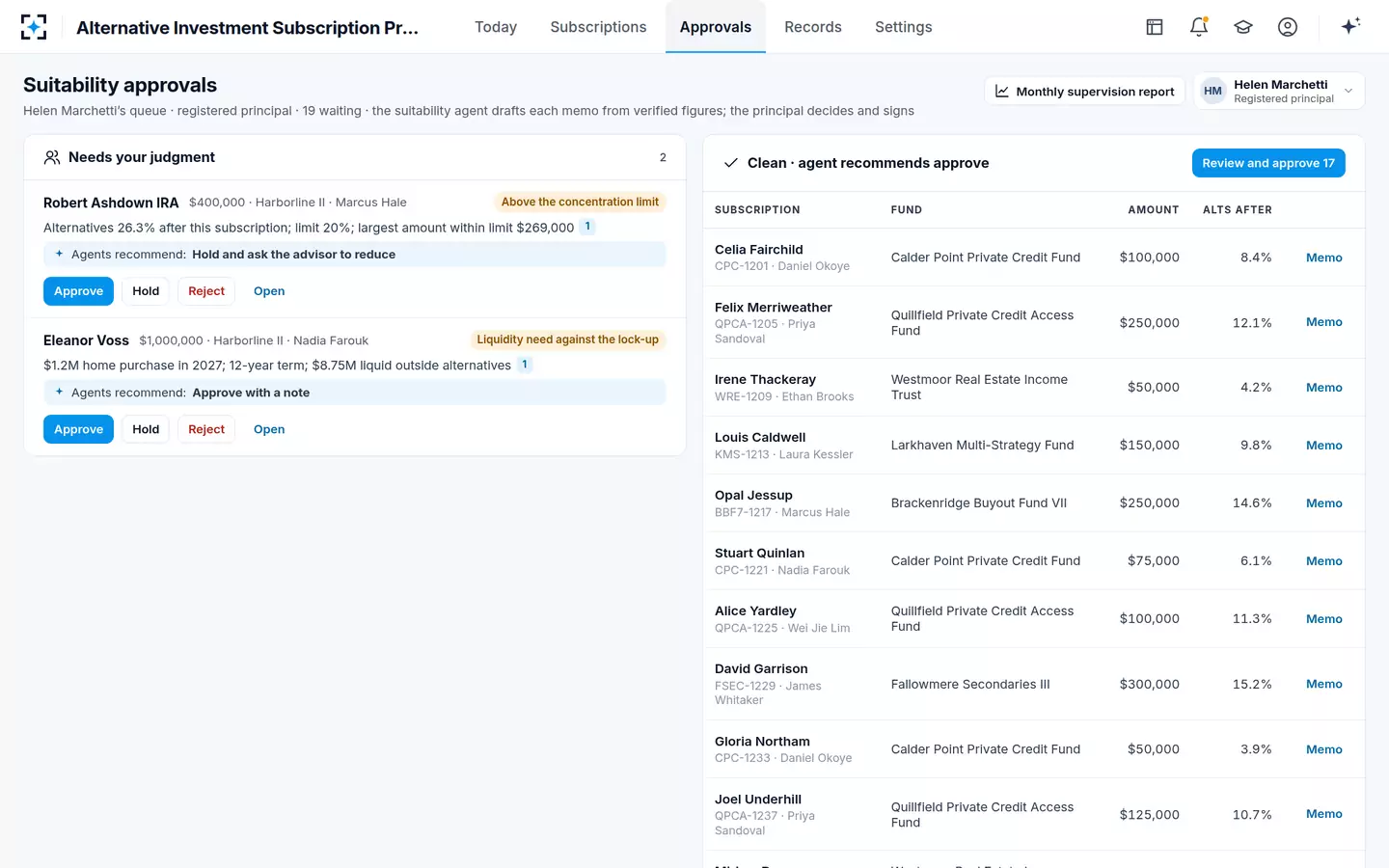
In the sample close used across this series, a fictional client, Eleanor Voss, subscribed $1,000,000 to a fund with a 12-year term while her profile showed a $1.2 million home purchase in 2027. The solution's Suitability agent did not decide; it put the conflict in front of the registered principal with the figure that mattered, $8.75 million of liquid assets outside alternatives, and recommended approval with a note. The principal decides. What the check prevented is the version of this story where nobody noticed until 2027. How a principal's queue separates cases like hers from clean ones is shown in alternative investment operations, seat by seat.
A liquidity need against a lock-up, put to the principal with the figure that matters
Liquidity terms to check before a semi-liquid subscription is sent
- Mandatory or discretionary?
A fundamental policy under Rule 23c-3, or a board’s or manager’s intention. Note which, from the prospectus or offering document.
- Interval and minimum offer
For an interval fund, the interval and the offer range; for others, the stated cap, such as 5% of NAV a quarter.
- First possible exit
A new fund may defer its first offer; under the current rule up to two intervals, under the proposal up to two years.
- What comes off on exit
Early-repurchase fees and deferred sales loads, and any discount a redemption program applies.
- The client’s dated needs
Each known cash need with a date and an amount, from the profile, not inferred from age.
- The proration case
What the client receives if the offer is oversubscribed: at 5% offered and 12% requested, about 42% of the request, or 58% if the fund takes the extra 2%.
- Liquid assets outside alternatives
The cushion that makes a lock-up tolerable; cite it to statements, not the questionnaire.
Questions people ask
What is an evergreen fund?
An evergreen fund is a fund with no fixed end date that continues to accept new capital and offers investors periodic, limited liquidity. The label covers interval funds, tender offer funds, perpetual non-traded BDCs, non-traded REITs and open-ended private funds; the liquidity terms differ by structure, so the structure underneath is what to check.
What are semi-liquid funds?
The Federal Reserve uses the term for perpetual-life BDCs and interval funds, which offer investors an option to redeem subject to restrictions such as redemption caps. Together they held about $425 billion in gross assets and $241 billion in net assets, about 20% of net assets in private credit vehicles, in its May 2026 report.
Can an interval fund suspend repurchases?
Only in exceptional circumstances: the rule lets an interval fund suspend or postpone a repurchase offer by a vote of a majority of its directors, including a majority of the independent directors. Discretionary structures need no such vote, which is why their caps and pauses are more common.
Do interval funds trade on an exchange?
Generally not: an interval fund sells shares continuously and provides liquidity through its periodic repurchase offers. The SEC notes that investors in closed-end funds that are not interval funds can usually exit only through tender offers the fund elects to make or, if listed, by selling on an exchange, often at a discount to NAV.
Is the SEC changing the interval fund rules?
It has proposed to. The October 5, 2026 proposal would allow monthly intervals, a deferral of up to two years for a new fund's first repurchase offer, deferred sales loads deducted from repurchase proceeds and a principles-based liquidity requirement. Comments close December 4, 2026; until the SEC adopts a final rule, the current Rule 23c-3 applies.