The qualified client threshold is the dollar test that lets an SEC-registered investment adviser charge a client a performance fee, a share of the client's capital gains, under Rule 205-3. From June 29, 2026 it is $1,400,000 under the adviser's management immediately after the client enters the contract, or a net worth the adviser reasonably believes is more than $2,700,000 just before, excluding the client's home. Until that date the figures were $1,100,000 and $2,200,000. The SEC's order applies to contracts entered into from June 29, not to those already in place, but a new investor joining an existing private fund is tested at the numbers in force on the day they join. For a wealth firm placing clients in funds that pay performance fees, the change is a subscription check with a date in it. Botminds' Alternative Investment Subscription Processing recomputes qualified-client status from the evidence, alongside the accredited-investor and qualified-purchaser tests, and keeps each threshold as a setting with its source and the date it took effect.
The qualified client threshold, old numbers and new
Before June 29, 2026: $1,100,000 under the adviser’s management immediately after entering the contract.
From June 29, 2026: $1,400,000 under the adviser’s management immediately after entering the contract.
Before June 29, 2026: Net worth the adviser reasonably believes is more than $2,200,000, home excluded.
From June 29, 2026: Net worth the adviser reasonably believes is more than $2,700,000, home excluded.
Before June 29, 2026: Contracts entered into from August 16, 2021, under the previous order.
From June 29, 2026: Contracts entered into from June 29, 2026; earlier contracts keep the test in force when they were made.
Before June 29, 2026: Tested at $1.1M / $2.2M when joining.
From June 29, 2026: Tested at $1.4M / $2.7M when joining, even though the fund’s advisory contract is older.
Before June 29, 2026: A qualified purchaser; certain executive officers, directors and investment employees of the adviser.
From June 29, 2026: Unchanged.
What is the qualified client threshold in 2026?
It is $1.4 million under management or $2.7 million of net worth. The SEC's order says the dollar amount of the assets-under-management test "would increase from $1,100,000 to $1,400,000, and the dollar amount of the net worth test would increase from $2,200,000 to $2,700,000", and that "This Order is effective as of June 29, 2026" (SEC order, Release IA-6961, Federal Register, May 1, 2026). The amounts reflect inflation from 2021 to the end of 2025, rounded to the nearest $100,000 as the statute requires.
The two tests are alternatives and are measured at different moments. Assets under management is counted "immediately after entering into the contract", so the subscription itself can carry a client over the line. Net worth is what the adviser "reasonably believes, immediately prior to entering into the contract", which makes it a judgment about evidence, not a number the client writes in a box (17 CFR 275.205-3(d)(1)).
The 2026 change in four numbers
$1.4M
under the adviser’s management, immediately after the contract
Was $1.1M
$2.7M
net worth, home excluded, immediately before the contract
Was $2.2M
Jun 29
The date in 2026 the new amounts took effect
SEC order, April 28, 2026
Dec 7
The date in 2026 comments close on a proposal to rewrite the definition
A proposal, not a rule
Qualified client definition: the routes in Rule 205-3
A qualified client is anyone who meets one of four routes in Rule 205-3(d)(1). Two are the dollar tests above. The third is status: a natural person or company the adviser reasonably believes "is a qualified purchaser as defined in section 2(a)(51)(A) of the Investment Company Act" at the time of the contract. The fourth covers insiders: an executive officer, director, trustee or general partner of the adviser, or an employee who participates in its investment activities and has done that work for at least 12 months.
The net worth test has its own arithmetic, the same as the accredited-investor test. The person's primary residence "must not be included as an asset". Debt secured by the home, up to its fair market value, is not counted as a liability, except that if that debt grew in the 60 days before the calculation, other than to buy the home, the increase counts. Debt above the home's value counts. For a natural person, assets held jointly with a spouse are included.
For a fictional example, take Lena Okonjo, who has $2.9 million in assets other than her home and a $250,000 personal loan. Her net worth for the test is $2.65 million. Before June 29 she cleared the $2.2 million test easily; from June 29 she misses the $2.7 million test by $50,000. If she commits $1.5 million to a separately managed account with the adviser, she passes the assets-under-management test instead, because that test is counted after the contract. If she buys into a private fund for $300,000, she does not.
Does the new qualified client threshold apply to existing clients?
Generally no. The order says that for "contractual relationships ... entered into prior to the Order's effective date, the dollar amount test adjustments in the Order would not generally apply retroactively", subject to the transition rules in Rule 205-3. Those rules let an adviser that met the conditions in force when a contract was signed keep relying on them. The previous orders, in 2011, 2016 and 2021, worked the same way.
The exception is the one a subscription desk meets every day. Rule 205-3(c)(1) says that "if a natural person or company who was not a party to the contract becomes a party (including an equity owner of a private investment company advised by the adviser), the conditions of this section in effect at that time will apply with regard to that person or company". A new investor in an existing 3(c)(1) fund is a new party, so a subscription accepted after June 29 is tested at $1.4 million and $2.7 million, whatever the fund's launch date. Transfers by gift or bequest, or under a separation or divorce agreement, do not make the recipient a new party (Rule 205-3(c)(3)).
Two cases the text does not settle are worth sending to counsel and writing down as policy: an additional subscription by an investor already in the fund, and a subscription signed before June 29 but accepted after it. The safest default is to test both at the amounts in force on the acceptance date and note which test was used.
Which funds need qualified clients?
A fund needs its investors to be qualified clients when its adviser takes a performance fee and the rule looks through the fund to its investors. Rule 205-3(b) does that for three kinds of fund: a "private investment company", defined as one relying on section 3(c)(1) of the Investment Company Act; a registered investment company; and a business development company. For each, "each equity owner" charged the performance fee "will be considered a client" (17 CFR 275.205-3(b)).
Funds relying on section 3(c)(7) are not on that list, and do not need to be: every investor in them must be a qualified purchaser, and a qualified purchaser is a qualified client. So the practical rule for a wealth firm's alternatives desk is short. In a 3(c)(7) vehicle, the qualified-purchaser test does the work. In a 3(c)(1) vehicle that charges a performance fee, every investor needs a qualified-client route, and the accredited-investor test the fund's offering also requires is not enough on its own: an accredited investor with $1.5 million of net worth can buy a 3(c)(1) fund's interests but its adviser cannot charge that investor a performance fee.
Qualified client vs accredited investor vs qualified purchaser, for an individual
| Test | Accredited investor | Qualified client | Qualified purchaser |
|---|---|---|---|
| What it unlocks | Private offerings under Regulation D | An adviser’s performance fee | A 3(c)(7) fund |
| Wealth test | Net worth over $1,000,000, home excluded | Net worth over $2,700,000, home excluded; or $1,400,000 with the adviser | Not less than $5,000,000 in investments, net of acquisition debt |
| Income test | Over $200,000 a year ($300,000 joint) for two years | None | None |
| Other routes | Series 7, 65 or 82 in good standing; knowledgeable employees of the fund | Qualified purchasers; certain officers and investment employees of the adviser | Family companies, trusts and $25,000,000 entities |
| Inflation adjustment | None | Every five years, by SEC order | None |
Qualified client vs accredited investor: why the gap keeps moving
The two tests drift apart because only one is indexed. The SEC's October 2026 proposal puts it plainly: "the dollar thresholds in the qualified client definition are subject to periodic inflation adjustments at five-year intervals, whereas the accredited investor definition is not subject to inflation adjustment" (SEC proposal, Federal Register, October 6, 2026). An SEC staff paper notes that the accredited-investor net worth and income tests "have not been adjusted for inflation since the early 1980's" (SEC Office of the Investor Advocate working paper, June 2025).
The result is a widening band of investors who are accredited but not qualified clients: above $1 million of net worth and below $2.7 million, or qualifying on income alone. They can buy a 3(c)(1) fund's interests, but its adviser cannot charge them a performance fee. Funds handle that band in different ways, and the subscription check has to know which way: a separate class without the performance fee, a different feeder, or no admission. A trust follows the same logic on its own routes, set out in can a trust be a qualified purchaser.
How the SEC sets the number, and when it moves next
The threshold moves by formula, roughly every five years. Rule 205-3(e) divides the year-end value of the Personal Consumption Expenditures price index for the year before the order by its value for 1997, multiplies $750,000 (for the assets test) and $1,500,000 (for the net worth test) by that ratio, and rounds each to the nearest $100,000. The rule sets the next order "on or about May 1, 2026, and approximately every five years thereafter", which points to about 2031 for the next one, unless the rule changes first.
The net worth test now stands 80% above the base the rule indexes from
The October 2026 proposal: accredited investors as qualified clients
On October 6, 2026 the SEC proposed to rewrite the definition, and it is a proposal, with comments due by December 7, 2026. The summary says the amendments "would also allow investment advisers to receive this compensation from additional clients by revising the rule's 'qualified client' definition to include investors that meet the 'accredited investor' definition in Regulation D". It would also remove the assets-under-management test, "which is currently $1.4 million", and with it the inflation-adjustment mechanism, and it would widen the conditions under which registered funds and BDCs can pay performance fees (SEC proposal, October 6, 2026).
One detail matters for feeders: a 3(c)(1) private fund could not become a qualified client just because it is itself an accredited investor. Under the proposal it would qualify "if each of its equity owners ... separately qualify as qualified clients". Until the Commission adopts something, if it does, the June 29 numbers are the rule. A desk that keeps its thresholds as dated settings can change them on the day a final rule takes effect, and can show which test applied to each subscription before and after.
Eligibility recomputed from statements, not taken from the questionnaire
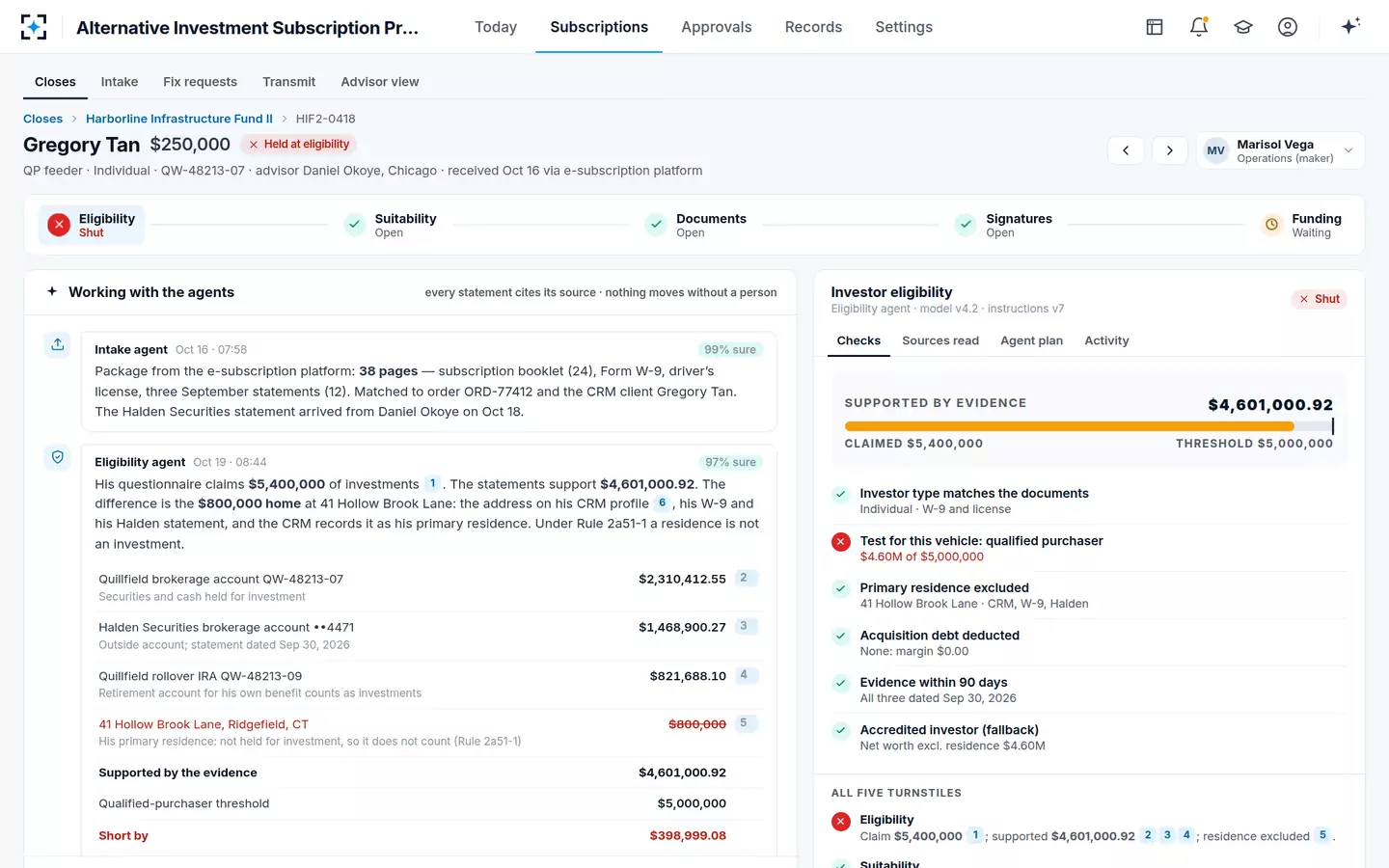
What evidence supports a reasonable belief in a client's net worth?
Rule 205-3 does not list documents for the net worth test, so the standard is the adviser's reasonable belief, and the safest evidence is the kind the SEC accepts elsewhere for the same arithmetic. Its accredited-investor verification rule, written for net worth tests that also exclude the home, names "bank statements, brokerage statements and other statements of securities holdings, certificates of deposit, tax assessments, and appraisal reports issued by independent third parties" for assets, and a consumer report for liabilities, each "dated within the prior three months" (17 CFR 230.506(c)(2)(ii)(B)). That rule governs issuers in general-solicitation offerings, not advisers' fees; it is a sensible benchmark, not a requirement here.
Two habits make a belief hard to defend. One is a questionnaire tick with nothing behind it, because the tick shows what the client said, not what the adviser believed or why. The other is old evidence: a statement from the spring does not show the value or the debt in October. Quillfield Private Wealth, a fictional firm whose sample close runs through Alternative Investment Subscription Processing, sets its own limit at 90 days for statements and letters, and its desk held one couple's subscription because their CPA letter was 143 days old. The limit is the firm's policy, not a rule, and it is written down where the reviewer can see it.
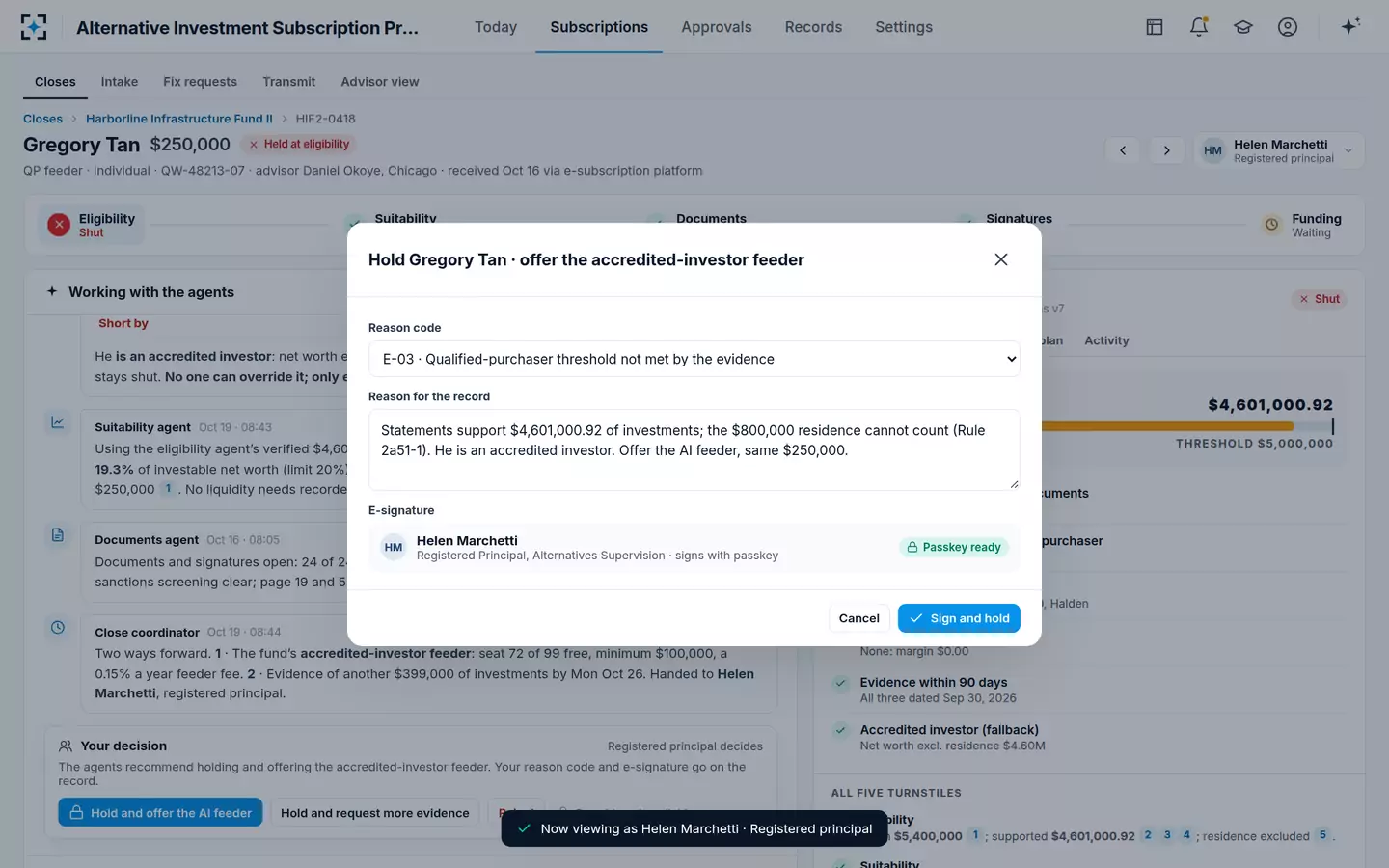
When the evidence falls short, the decision belongs to a person, and the useful question is what the client does qualify for. In the sample close, an investor whose statements supported $4.60 million against a $5 million qualified-purchaser claim was held by the registered principal, with a reason code and her signature, and offered the fund's accredited-investor feeder instead. The same move applies to the qualified-client test: a fund's class without the performance fee may be open to a client who misses $2.7 million.
The principal holds, with a reason code, and offers the vehicle that fits
What to change in the subscription check now
Three things change, and none needs new software: the thresholds, the date logic and the evidence. The thresholds are a two-number update. The date logic is the part that goes wrong, because the test depends on when a person becomes a party, not on when the fund launched or when the advisor first spoke to the client. And the evidence is what lets an adviser say it "reasonably believes" a client's net worth: statements and liabilities close to the contract date, not a questionnaire box.
Alternative Investment Subscription Processing treats each threshold as a setting with its source and version, and a change needs a reason and a principal's signature. Its Eligibility agent recomputes qualified-client status from the statements under the rule: home out, liabilities in, the 60-day rule applied, the test chosen by the vehicle. Where a client falls short, as in the sample case above for a different test, the agents propose the vehicle the client does qualify for and a registered principal decides. What it costs when that discovery comes after the documents cutoff is in what each missed close costs.
Updating a subscription desk for the 2026 qualified client threshold
- Change the two amounts, with a date
$1,400,000 and $2,700,000 for contracts entered into from June 29, 2026; keep the old amounts for earlier ones.
- Test new investors in old funds at the new amounts
A new equity owner of a 3(c)(1) fund becomes a party when admitted: Rule 205-3(c)(1).
- Write a policy for top-ups and straddles
Additional subscriptions, and documents signed before June 29 but accepted after: decide with counsel and apply it the same way every time.
- Note which route each investor used
Assets under management, net worth, qualified purchaser or insider, with the evidence for it.
- Compute net worth the rule’s way
Home out; home-secured debt out up to its value; any increase in the last 60 days counted.
- Know each fund’s answer for the gap
Accredited but not qualified: a share class without the performance fee, another feeder, or no admission.
- Watch the proposal, do not apply it
Comments close December 7, 2026. Nothing changes until a final rule takes effect.
Questions people ask
Is the qualified client threshold $2.2 million or $2.7 million?
$2.7 million of net worth, or $1.4 million under management, for contracts entered into from June 29, 2026. $2.2 million and $1.1 million applied to contracts from August 16, 2021 until then, and still govern those contracts.
What is the difference between a qualified client and a qualified purchaser?
A qualified client may be charged a performance fee; a qualified purchaser may invest in a 3(c)(7) fund. The qualified-purchaser test is higher, not less than $5 million in investments for an individual, and every qualified purchaser is also a qualified client under Rule 205-3(d)(1)(ii)(B).
Does a primary residence count toward qualified client net worth?
No. Rule 205-3 says the primary residence must not be included as an asset. Debt secured by it is ignored up to its fair market value, except that an increase in the 60 days before the calculation counts as a liability unless it came from buying the home.
Do qualified client rules apply to registered funds and BDCs?
Yes, in a limited way: under Rule 205-3(b) each equity owner charged a performance fee is treated as a client. The October 2026 proposal would widen when advisers can charge performance fees to registered funds and BDCs; it is a proposal, open for comment until December 7, 2026.
When will the qualified client threshold change again?
Rule 205-3(e) calls for an order approximately every five years after May 2026, so around 2031, computed from the PCE price index and rounded to the nearest $100,000. If the SEC adopts its October 2026 proposal, the dollar tests and the adjustment would be replaced by the accredited-investor definition.