Non-traded REITs are real estate investment trusts that register with the SEC and file regular reports, but whose shares are not listed on an exchange. Investors buy from the REIT in a continuous offering and can sell back only through a limited redemption program, until the REIT lists or liquidates, which the SEC warns "might not occur until more than 10 years after your investment". Upfront fees "can represent up to 15 percent of the offering price" (SEC investor bulletin, August 2015). Those two features, cost and a long, uncertain exit, are why wealth firms set concentration limits on how much of a client's net worth may sit in non-traded REITs and similar products. The limit only works if it is computed correctly, on verified figures and after the new subscription. Botminds' Alternative Investment Subscription Processing does that computation for every subscription, cites each figure, and puts any breach to a registered principal.
The figure below shows why the computation matters more than the limit. It follows a fictional client, Marguerite Ellsworth, whose questionnaire puts her net worth at $3.5 million. She already holds $180,000 in one non-traded REIT and $150,000 in an interval fund, and her advisor has recommended $200,000 in a second non-traded REIT. Her firm's policy caps alternatives at 20% of investable net worth after the subscription.
The same subscription passes on the questionnaire and fails on the statements
What is a non-traded REIT?
A non-traded REIT is a real estate company, usually externally managed, that raises money from individual investors through a registered offering but does not list its shares. The SEC's investor bulletin sets out the difference from a listed REIT: a publicly traded REIT can be bought and sold "with relative ease", and its value is visible in its share price; a non-traded REIT files the same kinds of reports but "an investment in a non-traded REIT poses risks different than an investment in a publicly traded REIT" (SEC, Investor Bulletin: Non-traded REITs).
A private REIT is different again: it is not registered at all and is sold in a private placement, usually to accredited investors. For a broker-dealer that recommends one, FINRA's private placement guidance applies, including the duty to investigate the offering and to comply with Reg BI when recommending it to retail customers (FINRA Regulatory Notice 23-08). On the subscription desk, the three need different checks: a listed REIT needs none of this, a non-traded REIT needs the prospectus's suitability standards and the firm's limits, and a private REIT needs investor eligibility as well.
Listed and non-traded REITs: same asset class, different investment
Publicly traded REIT: On an exchange, at the market price, at any time.
Non-traded REIT: Through a redemption program “typically subject to significant limitations”, until a listing or liquidation that may be over ten years away.
Publicly traded REIT: Visible every trading day.
Non-traded REIT: No market price; values come from periodic appraisals that “may not be accurate or timely”.
Publicly traded REIT: A brokerage commission.
Non-traded REIT: Fees that “can represent up to 15 percent of the offering price”, plus acquisition and asset management fees.
Publicly traded REIT: Judged against a share price the market sets every day.
Non-traded REIT: May be paid from offering proceeds and borrowings, a practice that “reduces the value of the shares”.
What fees do non-traded REITs charge?
Non-traded REITs charge upfront fees to pay the selling firm and cover offering and organisational costs, and these "can represent up to 15 percent of the offering price, which lowers the value and return of your investment and leaves less money for the REIT to invest". On top of the upfront fees, the SEC notes "significant transaction costs, such as property acquisition fees and asset management fees", often paid to an external manager whose interests may differ from shareholders'.
Where each $100 can go at the SEC's 15% upfront ceiling
At the 15% ceiling
- Upfront fees and offering costs · 15%
- Left for the REIT to invest · 85%
Fees matter to the concentration check in a way that is easy to miss. If a firm measures concentration at the amount subscribed, a $200,000 subscription counts as $200,000. If it measures at the REIT's own per-share estimated value, the position may count for less from the first statement onward. FINRA Rule 2310(b)(5) requires the issuer of a public DPP or REIT offering a member takes part in to disclose "a per share estimated value of the DPP or REIT security, developed in a manner reasonably designed" to be reliable (FINRA Rule 2310). A firm should say which value its limit uses and apply it the same way every time.
How illiquid are non-traded REITs?
Very, by design. The SEC's words: they "are illiquid investments, which mean that they cannot be sold readily in the market", and investors "generally must wait until the non-traded REIT lists its shares on an exchange or liquidates its assets". Redemption programs offer an earlier exit, but they "may be discontinued at the discretion of the REIT without notice" and "may require that shares be redeemed at a discount". The bulletin's conclusion is the one a suitability principal should test against: "investors with short time horizons or who may need to sell an asset to raise money quickly may not be able to do so".
Non-traded BDCs share the shape. The SEC's 2024 bulletin says investors in retail-offered BDCs "can generally only sell their shares when the BDC offers to repurchase them", typically quarterly or monthly, and that for privately offered BDCs without a repurchase program a liquidity event "may be several years (e.g., 5-7) after initial investment" (SEC Office of Investor Education and Assistance, December 2024). How the different repurchase structures compare is set out in interval fund vs evergreen fund.
Non-traded REIT suitability standards: what applies
A recommendation of a non-traded REIT to a retail customer is governed by Regulation Best Interest for broker-dealers, which requires the firm to understand the product's risks, rewards and costs and to have a reasonable basis to believe it is in the customer's best interest given the customer's investment profile, including liquidity needs and time horizon (17 CFR 240.15l-1). Advisers owe a comparable duty as fiduciaries. Neither sets a percentage, and the SEC's cases over L Bond sales to retirees show what a weak reasonable basis costs (see Reg BI enforcement actions).
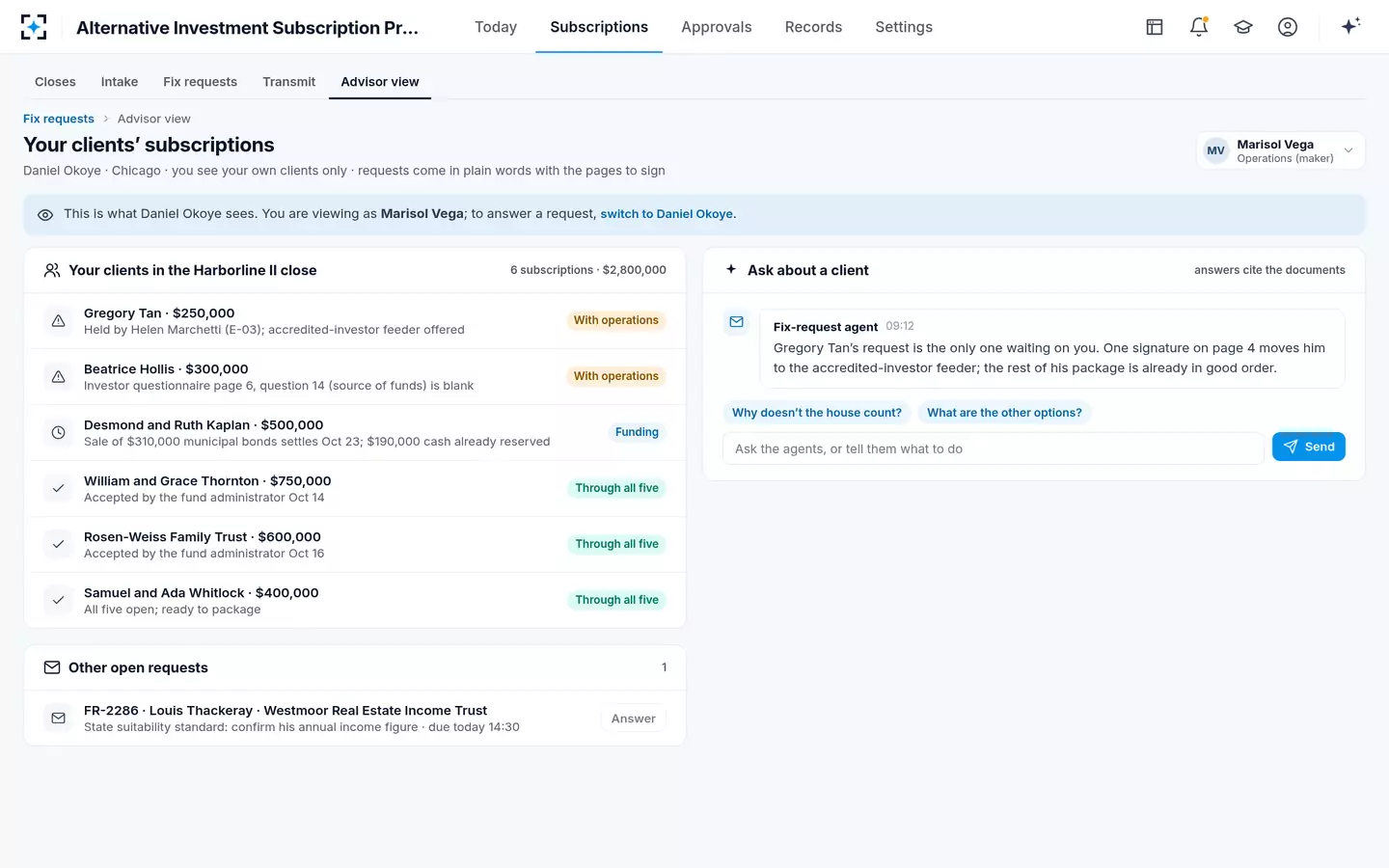
The percentages come from two other places. The offering documents set the sponsor's own suitability standards, often minimum income and net worth, sometimes stricter for residents of particular states; for BDCs the SEC describes retail-offered funds as open only to investors who meet state suitability standards, usually minimum income or net worth (who can buy each kind of BDC is set out in private credit for retail investors). And the firm sets its own concentration limits: FINRA has said firms with complex or risky offerings may write guidelines so that a product is not recommended to customers whose profiles do not fit, and a concentration limit is one form such a guideline can take (Regulatory Notice 23-08). In the sample advisor view shown below, a fix request asks an advisor to confirm a client's annual income figure because a REIT's state suitability standard depends on it: a number, checked against a statement, not a tick.
A REIT's state suitability standard turned into one plain question for the advisor
The concentration line: how firms set it, and what it should measure
No regulator publishes a concentration percentage for non-traded REITs or alternatives as a whole; each firm writes its own, and the useful work is in the definitions. Three choices decide whether a limit means anything. The base: investable net worth from statements, not the questionnaire's net worth with the home inside it. The timing: the position after the subscription, not before. And the scope: whether the limit counts all alternatives together, one sponsor, or one fund, and which value it uses for each holding.
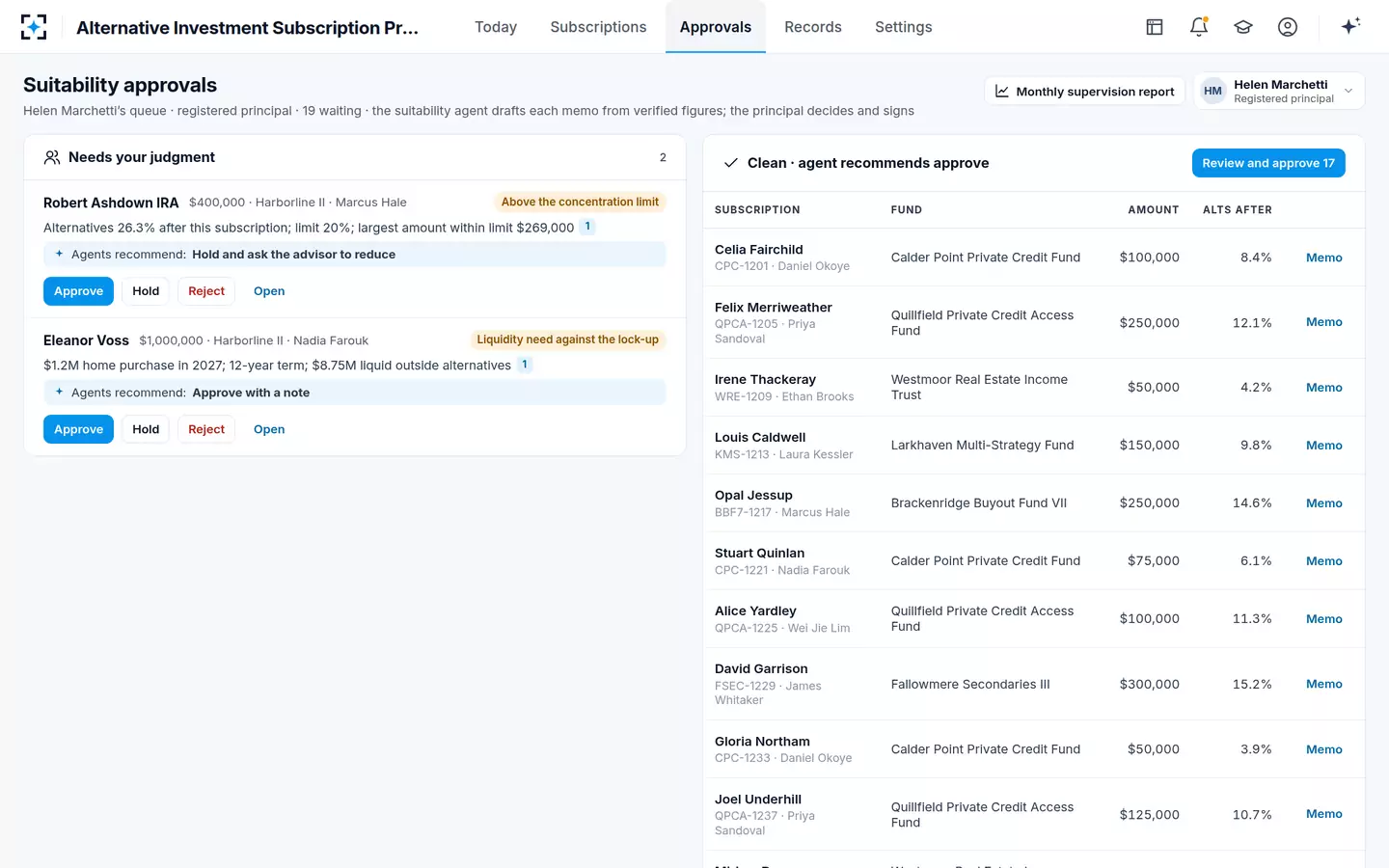
The sample firm whose close runs through the solution in this series uses two limits: 20% of investable net worth in alternatives after the subscription, and 10% in any one fund. Its principal's queue shows what the limits produce. One fictional client's subscription would take alternatives to 26.3% against the 20% limit; the largest amount inside it is $269,000 of the $400,000 proposed, and the agents recommend holding and asking the advisor to reduce. Another's lands at 19.3%: $890,000 of alternatives on $4,601,000.92 of verified investments, just inside. Both numbers are computed on statements, after the new money.
A concentration limit computed on the questionnaire measures what the client said. Computed on the statements, after the subscription, it measures what the firm is about to do.
Recompute after the new money, on verified figures
Recomputing means rebuilding both sides of the fraction from evidence every time. The numerator is every alternative holding the client has, at the firm and elsewhere, plus the new subscription. The denominator is investable net worth from statements: brokerage and bank balances, retirement accounts, less the home and less debt where the firm's definition says so. A held-away non-traded REIT bought through another firm counts as much as one bought here; the client's statements show it, and the questionnaire often does not.
That is what the solution's Suitability agent does, using only the figures the Eligibility agent has verified, and it drafts the principal's memo with each one cited to its page. It never approves suitability. When a subscription breaches a limit, the memo shows the largest amount that fits, so the principal's options are concrete: approve with a written exception, hold and ask for a smaller amount, or reject. For exceptions above $2,000,000, the sample firm requires a second principal. What the agents do when the evidence itself is in doubt is covered in alternative investment technology that asks the advisor once.
What a principal should see when a subscription crosses the line
A principal deciding a concentration breach needs four things on one screen: the position after the subscription, the limit it breaches, the largest amount that would fit, and the client's liquidity picture. Without them, the decision becomes a judgment about the advisor's confidence rather than about the client. With them, each of the three possible decisions is quick to make and easy to defend.
Take the fictional Ellsworth subscription from the top of this page. The memo would read: alternatives after the subscription 22.1% of $2.4 million verified investable net worth, against a 20% limit; the largest subscription inside the limit, $150,000; the existing positions, $180,000 in one non-traded REIT and $150,000 in an interval fund; the second REIT's upfront fees from its prospectus; and her dated cash needs. If the principal holds and the advisor comes back at $150,000, the position lands exactly at the limit, and the next distribution reinvestment or a fall in her other assets would push it over. A firm can decide whether "at the limit" passes, but it should decide in policy, once, not case by case.
The principal's queue in the solution puts cases like that apart from clean ones, so judgment time goes where judgment is needed. Clean cases still carry a memo, each with the alternatives share after the subscription, and the principal reviews and approves each one.
Breaches first, each with the largest amount that fits
Non-traded BDCs and other illiquid alternatives: the same questions
The same concentration logic applies to non-traded BDCs, interval funds, private credit funds and private equity feeders, and the firm has to decide whether one limit covers them all. The SEC's examiners have said they will prioritise advisers that recommend illiquid, hard-to-trade or unusual products, naming private-fund and BDC loans and stakes in private companies held through special purpose vehicles (SEC Division of Examinations, FY2027 priorities). A limit that counts only non-traded REITs will miss a client whose alternatives sit in three different wrappers.
Before a non-traded REIT subscription is approved
- Prospectus suitability standards, with figures
Minimum income and net worth, including any state-specific standard, checked against statements, not ticks.
- Verified investable net worth
From statements dated close to the subscription; the home out; the firm’s debt rule applied.
- Every alternative counted
Held-away positions and other wrappers included; the value basis (cost or estimated value) stated.
- The position after the new money
Against the overall limit and the single-fund limit; if over, the largest amount that fits.
- Liquidity needs against a long exit
Known cash needs with dates, against a redemption program that can be limited or stopped.
- Fees understood and disclosed
The upfront percentage from the prospectus, and ongoing acquisition and management fees.
- A principal’s decision on any breach
Approve with a reason, hold, or reject, signed; the reason kept with the evidence.
Questions people ask
Is there a list of non-traded REITs?
Non-traded REITs that register their offerings file with the SEC, and the SEC's bulletin points investors to its EDGAR database, where offering prospectuses are usually filed as "424B3" documents. No regulator publishes a ranked list; the filings are the source for each REIT's fees, suitability standards and redemption terms.
Can you sell a non-traded REIT before it lists?
Usually only through the REIT's share redemption program, which the SEC says is typically subject to significant limitations, may require a discount and may be discontinued without notice. Otherwise investors generally wait for a listing or liquidation, which may come more than ten years after investing.
Why do non-traded REITs pay high distributions?
Partly because early distributions may not come from earnings. The SEC warns that non-traded REITs "may use offering proceeds, which includes the money you invested, and borrowings to pay distributions", which reduces the value of the shares, so investors should look at total return, not the distribution rate.
What is a reasonable concentration limit for non-traded REITs?
No regulator sets one, so it is firm policy; what makes a limit defensible is how it is computed. Use verified investable net worth, count every alternative including held-away positions, measure after the subscription, and keep the principal's reason on file for any exception.
Is a non-traded BDC the same as a non-traded REIT?
No: a BDC invests mainly in small and mid-sized private companies, often through loans, while a REIT owns real estate or real estate debt. Their liquidity is similar, sold through continuous offerings with limited repurchases, so the same concentration and liquidity checks apply.