Reg BI enforcement actions began in June 2022, when the SEC charged Western International Securities and five of its brokers over sales of GWG Holdings' L Bonds to retirees, and the SEC and FINRA have settled a steady run of cases since, several of them in 2026. Read side by side, the Reg BI enforcement actions in this casebook ask four things of a broker-dealer: understand complex products before selling them, test each one against the customer's profile and concentration, write procedures that say how, and act when the red flags arrive. None of those failures was invisible; most were sitting in the firm's own forms, alerts and emails. Botminds' Reg BI Compliance Review exists for that gap: its agents test every retail recommendation overnight against the care obligation and put each flag in front of a supervising principal with the evidence, so the pattern is found while it can still be fixed cheaply.
The cases below are settled orders and published FINRA actions, quoted from the regulators' own documents; settlements are made without admitting or denying the findings. Where the page uses the solution's own screens, the people and firms in them are fictional.
The SEC's Reg BI cases, 2022 to 2025, and the control each one asks for
| Case | Product and finding | Sanction | The control that would have caught it |
|---|---|---|---|
| Western International Securities, June 2022 complaint; consent judgments proposed July 2024 | L Bonds, $13.3 million sold to retirees and other retail investors; care and compliance obligations alleged | Firm $160,000 penalty; five brokers $12,500 each; disgorgement | A product review that re-reads the issuer's risk disclosures, and a profile test for fixed-income, moderate-risk retirees |
| LifeMark Securities, 29 July 2024 | L Bonds; representative did not understand redemption terms; 63-year-old seeking preservation of capital | $85,000 penalty, censure, disgorgement | Product training before selling, and a flag on speculative products for preservation objectives |
| Western International Securities, 30 July 2024 | Options day-trading in 19 accounts; procedures not enforced | $140,000 penalty; $9 million remediation already paid | Turnover and cost-to-equity surveillance, with the written restriction actually applied |
| First Horizon Advisors, 18 September 2024 | Structured notes; 5,000+ migrated accounts without accurate customer data | $325,000 penalty | A data check after migration, and exception reports every representative can see |
| PHX Financial, 16 October 2024 | Short-term, high-volume strategy; eight customers lost money | $180,000 penalty; $142,995 disgorgement | Series testing on every retail account, not only flagged ones |
| Lion Street Financial, 15 November 2024 | L Bonds, about $4.77 million; concentration limits waived | $135,000 penalty; disgorgement | Concentration limits that block, with exceptions decided and recorded |
| Emerson Equity, 11 August 2025 | L Bonds to 10 customers, 16% to 72% of liquid net worth | $100,000 penalty; disgorgement | Questionnaire answers checked against the customer's actual history |
What was the first Reg BI enforcement action?
The SEC's first action enforcing Reg BI was its June 2022 case against Western International Securities and five of its registered representatives; the SEC's fiscal 2022 enforcement results called it "The SEC's first action enforcing Regulation Best Interest" (SEC, November 2022). From July 2020 through April 2021, Western "sold an aggregate of $13.3 million of L Bonds," which the issuer itself described as high risk, illiquid and only suitable for customers with substantial financial resources, to customers "many of whom were on fixed incomes and had moderate risk tolerances" (SEC press release 2022-110).
Unlike most later cases it was litigated, not settled at the outset. In July 2024 the SEC announced proposed consent judgments, subject to the court's approval: a $160,000 civil penalty for the firm, $12,500 for each of the five brokers, disgorgement of commissions and permanent injunctions against further Reg BI violations (SEC litigation release 26065). The same product, GWG's L Bonds, recurs through the casebook: LifeMark, Lion Street and Emerson Equity at the SEC, and two FINRA matters in 2026.
The SEC's cases, 2022 to 2025
The SEC's Reg BI cases are few and deliberately chosen, and each teaches one control. LifeMark is the product-understanding case: a representative who relied on the firm's approval and misunderstood the redemption terms. First Horizon is the data case: after a merger moved more than 5,000 brokerage accounts onto its system, the firm "did not have accurate customer information necessary to review structured note recommendations," and representatives from the merged firm could not reach its exception reporting site. PHX is the series case: a strategy that "made it virtually impossible for those customers to achieve positive returns due to the attendant commissions and fees."
Lion Street is the case of written limits nobody applied: its procedures capped any one alternative investment at 10% of a customer's liquid net worth, yet six customers at or near retirement age put in up to 44%, and the firm's Reg BI procedures were updated eight to nine months after the compliance date. Emerson Equity, settled in August 2025, repeats the pattern on L Bonds: 10 customers, most at or near retirement age, investing "between 16% and 72% of their liquid net worth," under procedures that "consisted of only general recitations of Regulation Best Interest's obligations." The July 2024 Western International order is the red-flag case: the chief compliance officer flagged possible overtrading in March 2021, customers did not return the activity letters the firm sent, and the accounts were not restricted as the firm's own procedures required.
"it is not enough to simply have written policies; firms must also enforce them."
Osman Nawaz, SEC Division of Enforcement, on First Horizon, 18 September 2024
FINRA's Reg BI cases in 2026
Three of FINRA's monthly disciplinary reports for 2026 alone carry seven firm cases citing Reg BI, and they show the same failures at smaller firms and for smaller sums. Most are about procedures: written, but not tailored, not specific, or not enforced.
Reg BI actions in FINRA's published reports, January to April 2026
| Firm and date | What FINRA found | Sanction |
|---|---|---|
| Stirlingshire Investments, 22 January 2026 | Procedures prohibited inverse and leveraged ETF purchases, but the prohibition was not enforced and no alert looked for them; 25+ retail customers bought them | $40,000 fine |
| Independence Capital and its supervisor, 27 January 2026 | Supervisor approved each sale of speculative bonds to nine customers, $443,000, without a reasonable assessment of concentration; no process to find recommendations inconsistent with profiles | $168,680 partial restitution, no fine given the firm's finances; supervisor $5,000 and a three-month principal suspension |
| The GMS Group, 27 January 2026 | Procedures did not describe how representatives meet the care obligation or how supervisors review it, including costs and alternatives | $35,000 fine |
| Arkadios Capital, 5 February 2026 | Cautioned representatives about holding periods for daily-reset ETFs but had no supervision of whether they considered them; 47 recommendations to 36 customers | $25,000 fine; $20,571.29 restitution |
| Taglich Brothers, 9 February 2026 | No Reg BI procedures until July 2022; then procedures that "merely recited language" from the rule | $60,000 fine |
| Andes Capital Group, 24 April 2026 | Procedures described Reg BI in general terms without saying how anyone would comply or supervise | $25,000 fine, lowered for the firm's revenues |
| Cambridge Investment Research, 30 April 2026 | Supervisors did not question vague rationales for early UIT sales despite one representative's outsized share of alerts; 184 customers paid $389,200.62 | $200,000 fine; restitution already paid by the firm |
Individual representatives are charged too. In April 2026 FINRA suspended one for three months and fined him $10,000 after he recommended speculative, unrated corporate bonds to five customers, four of them seniors, while "mistakenly" believing the bonds were still backed by life insurance policies (FINRA, June 2026). FINRA's January 2026 complaint against Sutter Securities and its chief executive, alleging 2,217 trades in a retired 89-year-old's accounts, is unadjudicated.
Which trend shows in Reg BI enforcement actions?
Four patterns run through the cases, and each is a control a firm can test. First, complex and illiquid products sold to people near or in retirement: L Bonds, structured notes, leveraged ETFs, early UIT rollovers. Second, procedures that restated the rule instead of saying how to comply, which is now the most common FINRA finding in the table above. Third, procedures that existed and were not enforced: Lion Street's concentration limits, Stirlingshire's product ban, Western's account restrictions. Fourth, supervisors and compliance staff who saw the warning signs and did not act on them in time.
The money has moved too. In several cases the sums returned to customers exceed the penalty: Western's $9 million of remediation against a $140,000 penalty, Cambridge's $389,200.62 of restitution against a $200,000 fine, Independence Capital's $168,680 with no fine at all. Both regulators say they weigh it: the Commission took Western's cooperation and remediation into account in accepting its offer, and FINRA cited Independence Capital's agreement to pay restitution when it imposed no fine. A firm that finds the pattern in a week has less to repay than one that finds it in a year.
SEC civil penalties in settled Reg BI cases, 2024–2025
How much are Reg BI penalties?
In the SEC's settled Reg BI cases from July 2024 to August 2025, firm civil penalties ran from $85,000 to $325,000. In FINRA's 2026 firm cases above, fines ran from $25,000 to $200,000, and FINRA lowered or waived fines after considering firms' revenues and financial resources. The penalty is rarely the largest number. Restitution, remediation and the cost of the investigation itself usually are, along with the undertakings to rewrite procedures under a regulator's eye.
Older cases set the scale for the same conflicts under earlier rules. In March 2019, before Reg BI took effect, the SEC settled with 79 investment advisers who returned more than $125 million to clients after placing them in mutual fund share classes that charged 12b-1 fees when a lower-cost share class was available (SEC press release 2019-28). Share-class selection is now a care-obligation question for broker-dealers too, which is why the sample firm's Care agent compares every class of the same contract.
What is a Reg BI violation? Four obligations, one general obligation
A Reg BI violation is a failure of any one of the four component obligations, which the SEC treats as a violation of the general obligation to act in the retail customer's best interest. The LifeMark order spells it out: "Because all of Regulation Best Interest's component obligations are mandatory, failure to comply with any of them constitutes a violation of Regulation Best Interest's General Obligation." A firm can therefore violate Reg BI without a single bad recommendation, by failing the compliance obligation alone, as First Horizon did.
Most settled orders also find the violation "willful," which surprises firms that meant no harm. The SEC's orders explain that for this purpose willfully "means no more than that the person charged with the duty knows what he is doing," and that there is no requirement that the actor knew it broke a rule. A representative who knowingly sold the product, and a firm that knowingly ran the process, act willfully in this sense.
The controls that would have caught each case
Every case above left evidence in the firm's own systems before a regulator found it: the prospectus that said "speculative," the account form that said "preservation of capital," the concentration figure above the firm's own limit, the alert that kept firing, the email from compliance. What was missing was someone joining those facts in time. That is the work Reg BI Compliance Review gives to its agents, each recommendation joined overnight to the profile, the product costs, the shelf and the payout grid, with every flag decided by a principal.
Seven controls drawn from the Reg BI cases
- Re-review complex products when the issuer changes
Lion Street's committee approved L Bonds in 2017 and did not reassess them after the issuer's business changed in 2018 and 2019.
- Test representatives' understanding, not just their attendance
LifeMark's representative misunderstood redemption; two Lion Street representatives never took the required training.
- Make concentration limits block, and record every exception
Lion Street's sales supervisors could grant exceptions to its limits with no guidance on when; the limits became a finding.
- Check data after every migration or system change
First Horizon reviewed structured notes against customer data it knew was inaccurate.
- Run series tests on every retail account
PHX and Western turned on turnover and cost-to-equity that ordinary trade review did not add up.
- Read rationales across the book, not one by one
Cambridge's supervisors saw vague rationales on early UIT sales and did not question them.
- Escalate on a clock, and enforce the restriction
Western's own procedures required restricting accounts when activity letters went unanswered for 30 days.
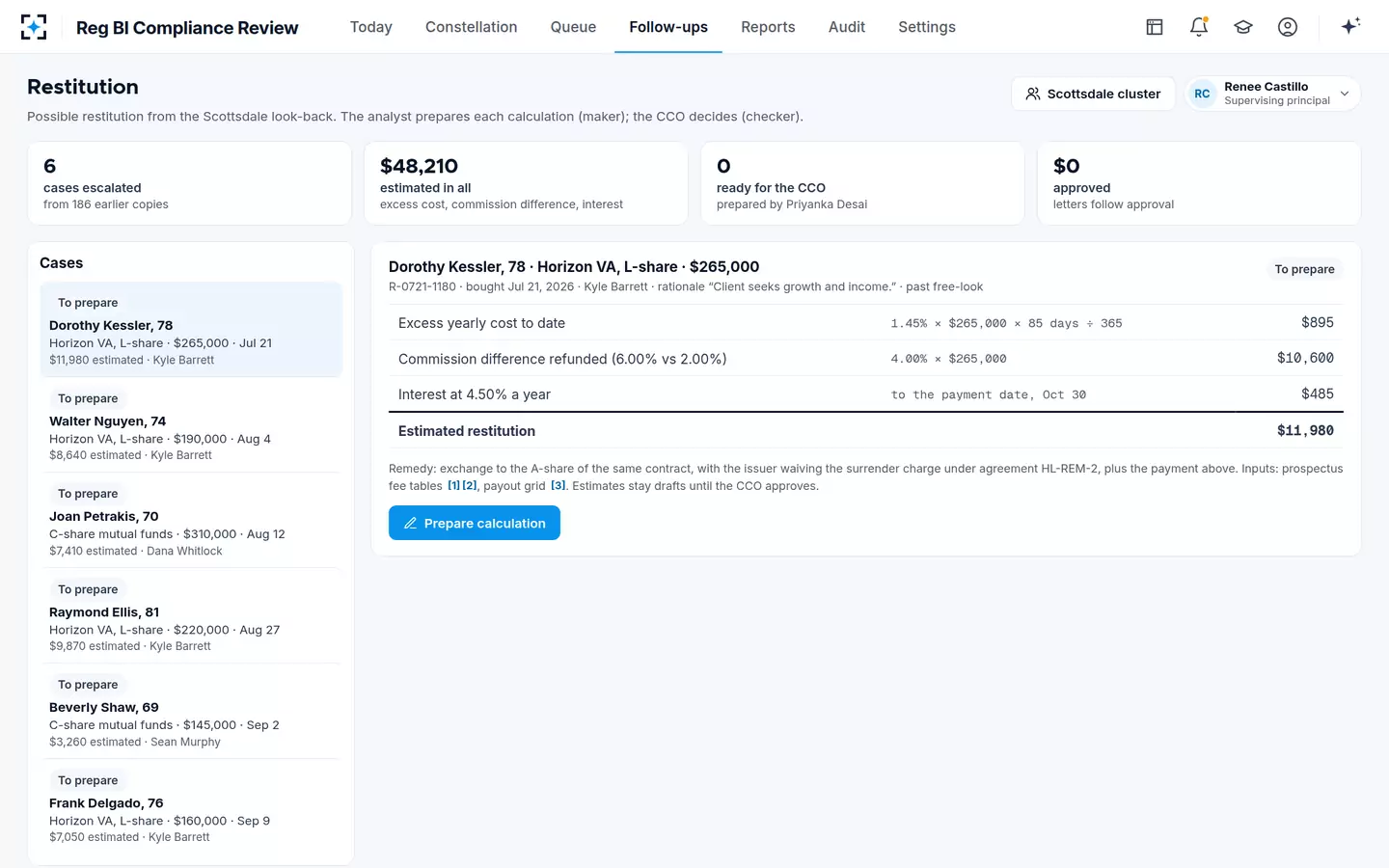
Finding a problem early also changes what it costs to fix. In the solution's sample data, the overnight review finds a variable annuity L-share sold to a 72-year-old with a ten-year horizon while the client can still exchange it for the cheaper A-share at no cost; the same pattern from the summer, found by a look-back, becomes six possible restitution cases for the chief compliance officer. The generic rationales behind that cluster and the procedures that would have stopped it are covered in their own guides.
Found late, a pattern becomes restitution math for the CCO
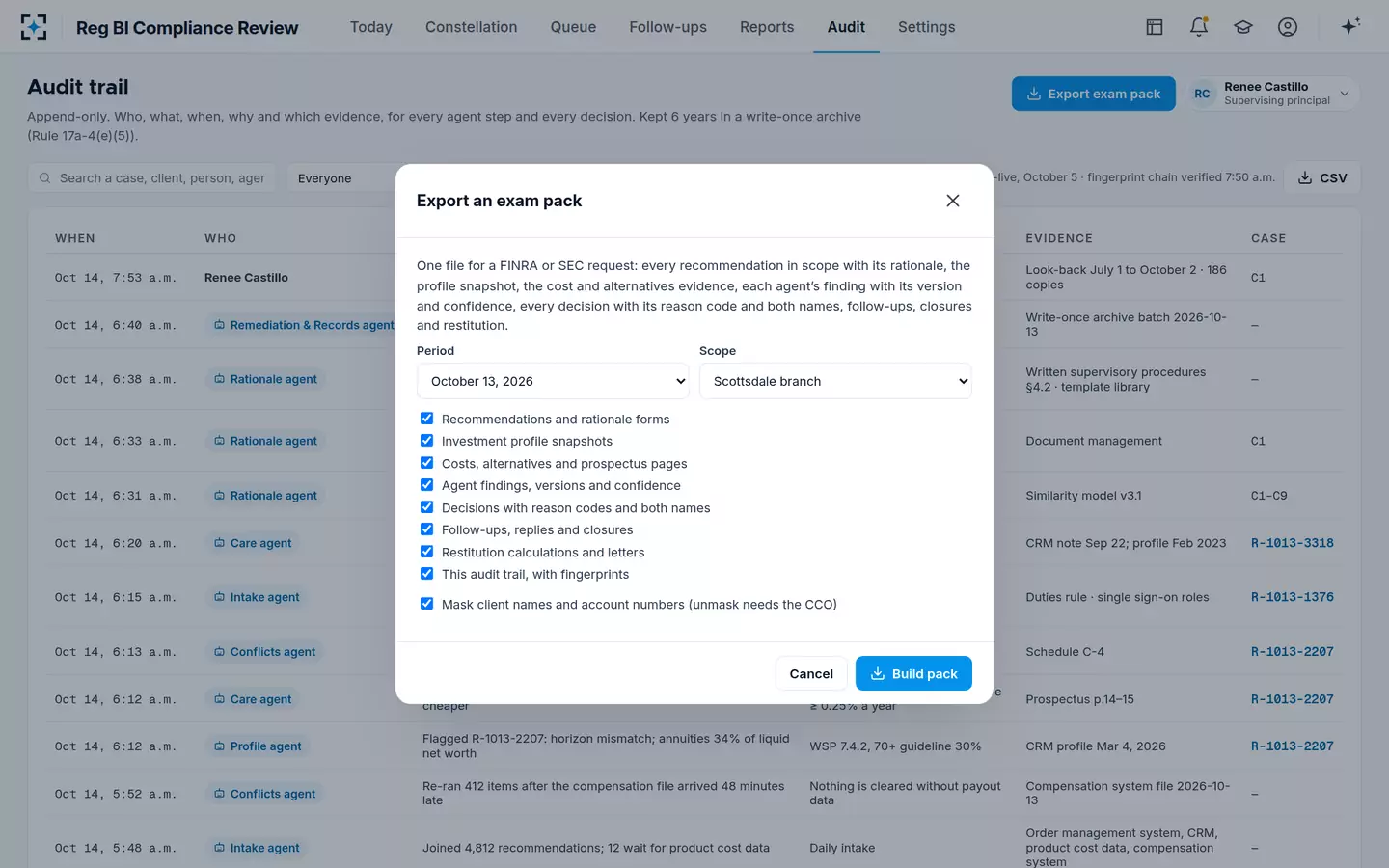
When a regulator does ask, the file has to be producible. The sample firm's audit trail records every agent step and decision with the agent's version, and exports an exam file of the recommendations in scope with their rationales, profiles, cost evidence, decisions and both names. To see the review that feeds it, start from Reg BI Compliance Review.
One export for a FINRA or SEC request
Questions people ask
What is the most common Reg BI violation?
In the FINRA firm cases from early 2026 listed here, the most frequent finding is the compliance obligation: written procedures that restated the rule or described it in general terms without saying how representatives would comply or how supervisors would check. At the SEC, the care obligation's customer-specific test, applied to complex products sold to retirees, appears in most cases.
Can individual brokers be charged under Reg BI?
Yes. The rule applies to natural persons associated with a broker-dealer. The SEC's first case charged five brokers alongside the firm, each agreeing to a $12,500 penalty in the 2024 settlement, and FINRA's 2026 reports include fines, suspensions and restitution for individual representatives.
Are supervisors personally liable for Reg BI failures?
They can be sanctioned for failing to supervise. In January 2026 FINRA fined a supervisor $5,000 and suspended him from acting as a principal for three months after he approved each sale of speculative bonds to nine customers without reasonably assessing whether they fitted the customers' profiles and concentrations.
Do Reg BI cases require restitution?
Often, in some form. FINRA orders restitution in many cases, and the SEC orders disgorgement of commissions for distribution to harmed investors where feasible. Firms that pay customers back before the regulator acts, as Western and Cambridge did, have that remediation taken into account.
Did Reg BI enforcement stop after 2024?
No. The SEC settled with Emerson Equity in August 2025, FINRA's published reports for early 2026 include at least seven firm cases citing Reg BI, and the SEC's fiscal 2027 examination priorities, published on 23 October 2026, again list Reg BI recommendations, alternatives and the care obligation.