Reg BI compliance means meeting Regulation Best Interest's four obligations, disclosure, care, conflict of interest and compliance, on every recommendation to a retail customer, and keeping the records that show it. For a broker-dealer of 12 representatives the rule is the same as for one of 2,000, and so is much of the fixed work: written procedures, a training programme, a supervisory system, a recordkeeping process. What differs is who does it. The SEC's own 2019 estimates assumed a large firm would update its procedures in-house while a small one would buy the help, and they priced records by the account, but they did not price the work that grows with every recommendation: a principal checking costs, alternatives and fit. That work falls on whoever reviews, and at a small firm that is usually one person. Botminds' Reg BI Compliance Review was built to take the per-recommendation assembly off that person, testing every retail recommendation overnight so the principal or compliance officer decides only the items that need judgment.
The SEC figures on this page are its 2019 estimates in the Reg BI adopting release, Release No. 34-86031, quoted as estimates and not updated for inflation or for later changes in the industry. Where we recompute or model, we say so; the review-time figures come from the solution's fictional sample firm and are an estimate and a design target, not measured results.
The same one-off Reg BI build, spread over 12 representatives or 2,000
What are the Reg BI compliance requirements?
Four obligations and two records rules. Each retail recommendation must come with written disclosure of the relationship, fees and conflicts; must meet the care obligation's three tests; and must be made under written policies that identify and mitigate conflicts and eliminate certain sales contests. The firm must keep written procedures "reasonably designed to achieve compliance" with the whole rule, and must keep a record of what it collected from and gave each retail customer, under Exchange Act Rules 17a-3(a)(35) and 17a-4(e)(5). Form CRS, the relationship summary, runs alongside.
The SEC's Small Entity Compliance Guide for Reg BI, dated September 9, 2019, sets the scaling principle. Procedures should be "proportionate to the scope, size, and risks associated with your operations," and depending on size and complexity a compliance programme generally would include "controls," "remediation of non-compliance," "training," and "periodic review and testing." The compliance obligation "applies solely to the broker- dealer entity, and not to its associated persons." Proportionate does not mean optional: none of the four obligations shrinks with the firm.
How many broker-dealers are subject to Reg BI?
The SEC counted about 2,766 broker-dealers serving retail investors at the end of 2018, with "almost 139 million (97%) customer accounts" and over $3.8 trillion in assets, and estimated that 102 million of those accounts belonged to retail customers. It also warned that 2,766 "likely overstates the number of broker-dealers that will be subject to Regulation Best Interest, because not all broker-dealers that serve retail investors provide recommendations to retail investors." FINRA's 2026 Industry Snapshot puts its total membership, retail and otherwise, at 3,184 firms in 2025, down roughly 6% in a year, with 639,723 registered representatives (FINRA, June 2026).
The SEC's 2019 picture of who Reg BI would reach
2,766
broker-dealers serving retail investors, December 2018
2,010
"large" in the SEC's burden estimates
756
"small": under $500,000 of total capital and not affiliated with a larger business
5,281
customer accounts at all 756 small firms combined, by the SEC's estimate
That last number reframes "small." By the SEC's definition, the smallest retail broker-dealers held, together, about 5,281 customer accounts: an average of about seven each. A firm of 12 registered representatives with a few thousand customer accounts is almost certainly "large" in the SEC's arithmetic, even though, to its owner, it is a small business with one compliance officer.
What did the SEC estimate for Reg BI burden?
The SEC estimated that Reg BI's record-making and recordkeeping would cost broker-dealers "an initial aggregate burden of 17,684,020 hours" and "an ongoing aggregate annualized burden of 5,520,800 hours," which it monetised at "an initial aggregate cost of at least $4,121.73 million and an ongoing aggregate annual cost of at least $1,736.52 million." The compliance obligation added 524,414 initial and 463,588 ongoing hours, mostly training: one hour a year for each of 428,404 registered representatives at retail broker-dealers.
The records estimate was built per account and per document. The ongoing figure assumed that each year 40% of fee schedules, 40% of conflict disclosures and 20% of account opening documents would be updated, across 102 million retail accounts, at two minutes per document: about 3.4 million hours. Recording oral disclosures added 1.06 million hours to make the records and 1.06 million to keep them.
Where the SEC's 5.5 million ongoing recordkeeping hours go
Ongoing record-making and recordkeeping, 2019 estimate
- Keeping updated account documents, 3.4m h · 62%
- Recording oral disclosures, 1.06m h · 19%
- Keeping those records, 1.06m h · 19%
Is Reg BI harder for small firms?
Per representative, yes. Much of the work is fixed per firm, and the SEC's own estimates show it. For the compliance obligation, the SEC assumed a large broker-dealer would spend "a onetime average internal burden of 30 hours" plus ten hours of general counsel and chief compliance officer review, and about $2,982 of outside counsel, to update its procedures. A small one would "primarily rely on outside counsel": 20 hours, "a one-time cost of $9,940 per small broker-dealer," plus six hours of in-house review. Every firm, of any size, was assumed to commission a training module at about $20,920.
The ongoing estimates follow the same pattern. A large firm would spend 12 hours a year reviewing its procedures; a small one about $2,485 of outside counsel and $1,365 of outside compliance help. Spread over 12 representatives, the one-off outside costs come to about $2,572 each; over 2,000, about $12. The rulebook is not more demanding for the small firm; it is the same rulebook paid for by fewer people.
Regulators recognise the difference when they set sanctions, not when they set obligations. In 2026 FINRA imposed a lower fine on one firm, and no fine on another, "after it considered, among other things, the firm's revenues and financial resources" (FINRA, June 2026; March 2026). Both still had to rewrite their procedures, and the second paid $168,680 of partial restitution.
The cost the SEC did not count: reading the recommendations
The SEC's estimates priced the rulebook, not the reading. For the compliance obligation it counted procedures and training, because it expected firms to comply "by adjusting their current systems of supervision and compliance, as opposed to creating new systems." It did not estimate the time a principal spends checking a recommendation's costs, alternatives and fit, because Reg BI does not require each one to be reviewed in detail; firms may design risk-based supervision.
That cost exists anyway, and it scales with recommendations, not with firms. FINRA's 2026 oversight report lists "sampling recommended transactions to evaluate how costs and reasonably available alternatives were considered" as an effective practice (FINRA, Reg BI and Form CRS): every sampled item needs someone to find the fee table, the alternatives, the profile and the payout. In the solution's sample firm, assembling that evidence by hand takes about 38 minutes per flagged recommendation, against a design target of about 6 minutes once the evidence arrives assembled. Run those figures at two sizes and the load looks like this.
Daily Reg BI review load at 12 representatives and at 2,000, on the sample firm's ratios
| Step | 12 representatives | 2,000 representatives |
|---|---|---|
| Retail recommendations a day (about 4.1 per representative) | about 49 | about 8,130 |
| Needing a principal (about 6.1%) | about 3 | about 495 |
| Review time by hand, about 38 minutes each | about 1.9 hours a day | about 313 hours a day |
| Review time with evidence assembled, about 6 minutes each | about 18 minutes a day | about 50 hours a day |
| People that is, in eight-hour days, by hand | a quarter of the one compliance officer | about 39 principals |
Per recommendation, the work is identical. The difference is that a firm of 2,000 has dozens of principals to share it and a firm of 12 has one person who is also the chief compliance officer, the anti-money-laundering officer and the person who answers FINRA's letters. Two hours a day of assembly is a quarter of that person's working time before any other duty, which is why small firms sample thinly and why the sample is where examiners look.
How much does Reg BI compliance cost a firm? Estimate it yourself
No regulator or independent study publishes what Reg BI compliance costs firms today; the SEC's 2019 figures are the only public estimate, and they leave out review. A firm can estimate its own review load from four numbers it already has.
Your daily Reg BI review load, from four numbers you already have
Daily review hours = representatives × retail recommendations per representative per day × share needing a person × minutes per review ÷ 60
At 12 representatives
12 × 4.1 × 6.1% × 38 ÷ 60 ≈ 1.9 hours by hand
12 × 4.1 × 6.1% × 6 ÷ 60 ≈ 0.3 hours with evidence assembled
At 2,000 representatives
2,000 × 4.1 × 6.1% × 38 ÷ 60 ≈ 317 hours by hand
2,000 × 4.1 × 6.1% × 6 ÷ 60 ≈ 50 hours with evidence assembled
Rounded ratios give slightly different totals from the table above, which uses the sample firm's unrounded figures.
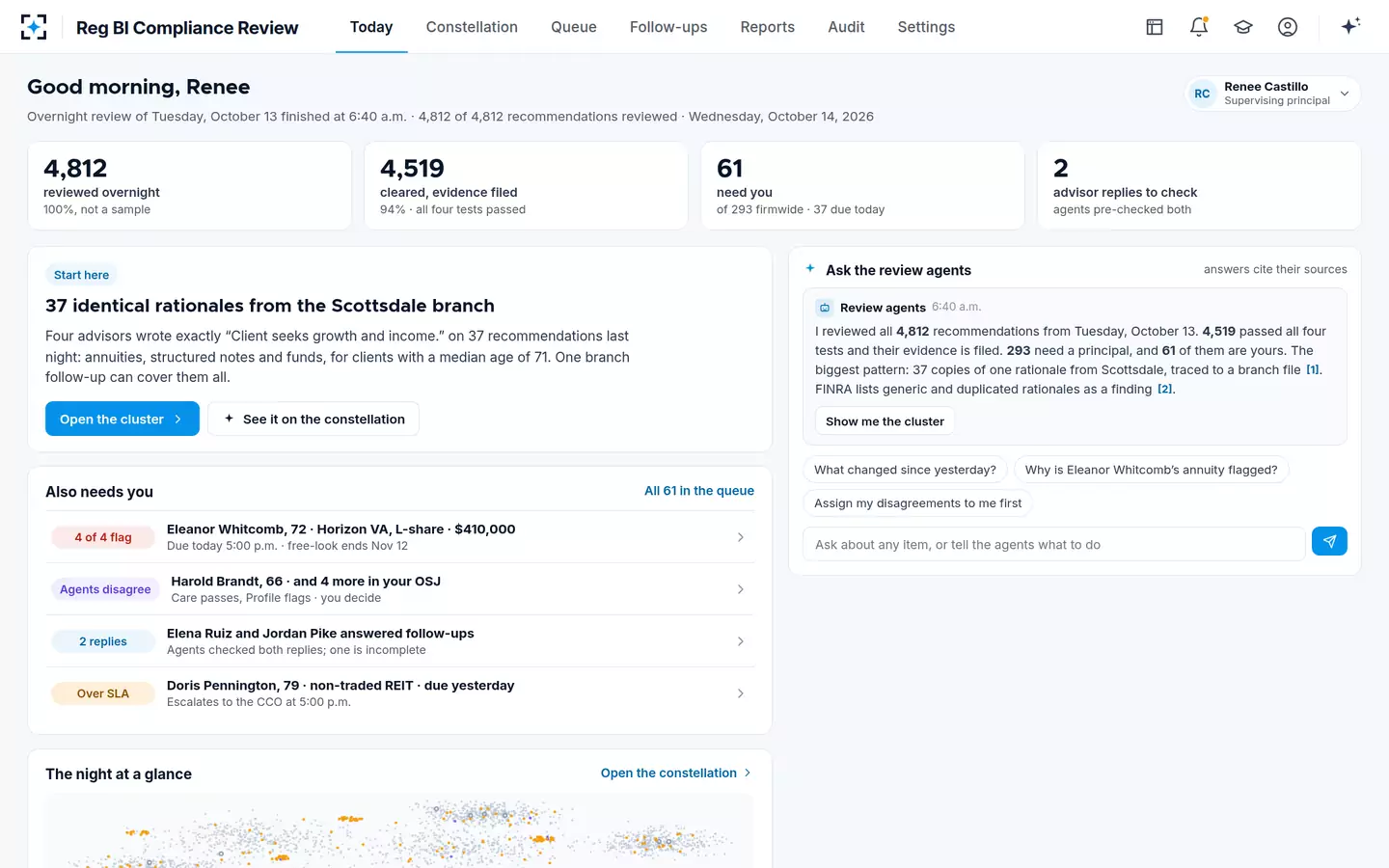
Two adjustments make the estimate honest. Add the share of recommendations your current surveillance never sees, such as holds, declined recommendations and account-type recommendations, which the SEC criticised firms for missing. And add the time spent after the decision: follow-ups with representatives, chasing replies, preparing restitution. In the sample firm, the follow-up arrives drafted from the findings and the advisor's reply is pre-checked, which is where much of the remaining time goes.
Where automation pays first, and where it does not
Automation pays first where the assembly is largest relative to the people available to do it. At a small firm, that is almost everywhere: one person, every recommendation, five systems. At a large one, it is in the products where a hand review takes longest, variable annuities, structured notes, alternatives and account-type recommendations, and in patterns no single reviewer can see, such as a rationale copied across a branch. In Reg BI Compliance Review the tests are settings the chief compliance officer approves, so the same system can run with a cost threshold, a concentration guideline and a profile-age limit that fit a 12-person firm or a 2,000-person one.
The tests are settings a CCO approves, whatever the firm's size
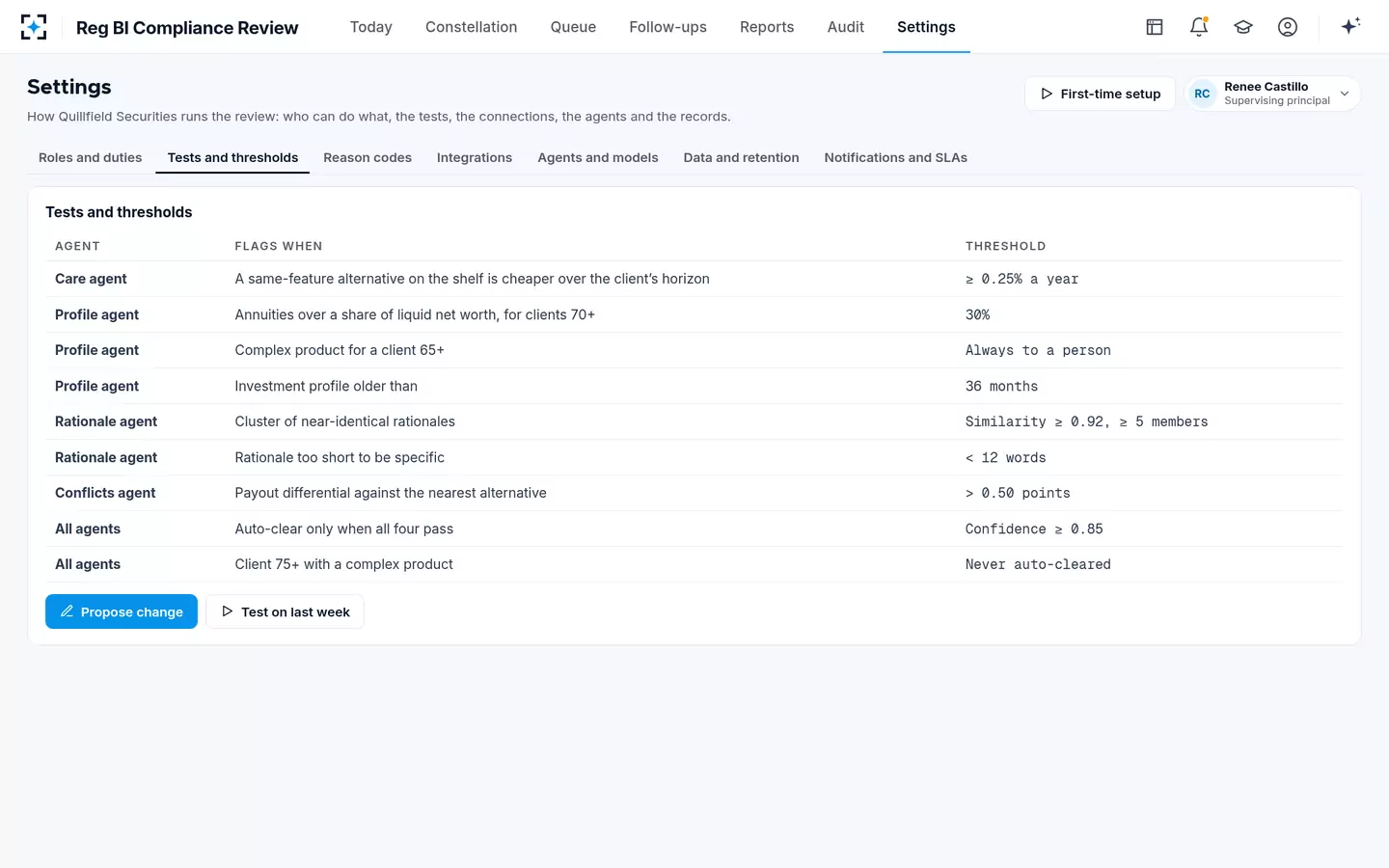
It does not pay everywhere. A firm that makes a handful of retail recommendations a week, mostly in plain mutual funds, can meet the care obligation with a good worksheet and a principal's eye, as FINRA's effective practices describe. A firm whose profiles, fee data and payout grids are not in any system the review can read has a data project first. And no system removes the decisions: a registered principal still decides each flag, and the procedures behind the settings still have to be the firm's own, which is where the written supervisory procedures manual comes in. What the test asks of each recommendation is in the Reg BI care obligation; to estimate the load on your own past recommendations, start from Reg BI Compliance Review.
What a principal's day starts from when the assembly is done overnight
Questions people ask
What is the Reg BI compliance obligation?
The fourth of Reg BI's component obligations: the broker-dealer must establish, maintain and enforce written policies and procedures reasonably designed to achieve compliance with Reg BI as a whole. It applies to the firm, not to individual representatives, and the SEC expects it to be proportionate to the firm's scope, size and risks, with controls, remediation, training and periodic testing.
Is there a Reg BI small entity compliance guide?
Yes. The SEC published a Small Entity Compliance Guide for Regulation Best Interest on September 9, 2019. It summarises the four obligations and the records rules and says it is not a substitute for the rule; it contains no separate requirements for small firms.
Does Reg BI apply to small broker-dealers?
Yes, in full. Reg BI applies to every broker-dealer that recommends securities, strategies or account types to retail customers, whatever its size. Size affects how procedures are designed and, in enforcement, how large a fine may be, not whether an obligation applies.
How much did the SEC estimate Reg BI would cost the industry?
For records alone, at least $4,121.73 million initially and $1,736.52 million a year ongoing, in 2019 dollars; the compliance obligation added an estimated $71.4 million initially, mostly training modules. These were estimates made before the rule took effect, and they did not include the cost of reviewing recommendations.
Can a one-person compliance department review every recommendation?
Not in detail by hand at any meaningful volume, and Reg BI does not require it; risk-based supervision is allowed. What a one-person department needs is a reliable way to see which recommendations deserve the detailed look, and the evidence assembled when it gets there.