A supervisory principal, in FINRA's terms, is a registered principal designated under FINRA Rule 3110 to supervise the business of the registered representatives assigned to them: reviewing their transactions and correspondence, evidencing that review in writing, following up exceptions and answering for it in an exam. In a branch network, each office of supervisory jurisdiction (OSJ) has one or more designated principals, and every registered representative is assigned to one. Since Reg BI, the principal's review has to cover costs, alternatives and conflicts as well as suitability, and the evidence for those sits in five different systems. That is why the morning goes to gathering, not deciding. Botminds' Reg BI Compliance Review was built to move the gathering overnight: agents test every retail recommendation and the supervising principal starts the day with the evidence assembled and only the items that need a person.
The morning described here belongs to a fictional principal, Renee Castillo, who supervises 212 financial professionals in the OSJ Southwest of the solution's sample broker-dealer, Quillfield Securities. Her firm has 1,184 financial professionals in 62 branches and 14 OSJs. Times and figures come from the solution's sample data; time savings are the solution's design target, not a measured result.
Where a principal's hours go on one night's 61 flagged items
- Pull forms4.0 h
- Prospectus costs10.4 h
- Alternatives8.0 h
- Profile and notes6.4 h
- Payout grid4.0 h
- Decide and file6.4 h
- Read3.6 h
- Act2.4 h
What does a supervisory principal do under FINRA rules?
A supervisory principal carries out the firm's supervisory system for the people assigned to them. FINRA Rule 3110 requires each member to "establish and maintain a system to supervise the activities of each associated person," including "The designation of one or more appropriately registered principals in each OSJ" and "The assignment of each registered person to an appropriately registered representative(s) or principal(s)." The principal is the name on the other end of that assignment.
The daily work is review. Rule 3110(b)(2) requires written procedures "for the review by a registered principal, evidenced in writing," of the firm's securities transactions, and Rule 3110(b)(4) adds review of correspondence. Under Reg BI, the review of a retail recommendation has to ask the care obligation's questions: did the representative understand the product, did it fit this customer, what did it cost against the alternatives, and was the representative's own pay a factor. The principal also approves exceptions, follows up with representatives, escalates possible harm to the chief compliance officer and takes part in branch inspections, which Rule 3110(c)(1) requires "at least annually (on a calendar-year basis)" for every OSJ.
The supervision system FINRA examines
3,184
brokerage firms FINRA oversees
146,826
branch offices
639,000+
registered representatives
What is FINRA Rule 3110?
Rule 3110 is FINRA's supervision rule: it requires every member firm to have a supervisory system, written procedures for it, designated principals, review of transactions and correspondence, and regular inspections of its offices. Its most recent amendment shown in FINRA's rulebook took effect on November 6, 2020, and FINRA added provisions for remote inspections and residential supervisory locations in 2024.
Two parts matter most for a principal reviewing Reg BI recommendations. The first is the evidence: the review must be "evidenced in writing," so a decision with no record is, for an examiner, a review that did not happen. The second is how much to review. Supplementary Material .05 lets a firm use a risk-based system: "A member is not required to conduct detailed reviews of each transaction if a member is using a reasonably designed risk-based review system that provides a member with sufficient information that permits the member to focus on the areas that pose the greatest numbers and risks of violation." That sentence is why most firms sample. It is also why the sample has to be designed: the firm must be able to show its system finds the risky recommendations, not just some recommendations.
7:45 a.m.: the exception report, by hand
Before the overnight review, the sample principal started at 7:45 a.m. with the previous day's exception reports: about 60 flagged items, read one ticket at a time. Exception rules of that kind are usually written for suitability: a concentration limit, an age band, a product risk score against the customer's risk tolerance. To decide any of them under Reg BI, she had to open the order ticket and rationale form, find the product's fee table and share classes in the prospectus, work out what else on the shelf would have served the same objective, check the profile and recent notes in the CRM, and look up what the representative was paid for each option.
The SEC's examiners have described what that kind of set-up misses. Their January 2023 risk alert named firms that "Relied on surveillance systems that captured only executed transactions to monitor for compliance with Regulation Best Interest," so recommendations to hold and recommendations the customer turned down were never reviewed at all. It named firms that "Relied on documentation maintained locally, rather than in a central location, so that the reviews designed to achieve compliance could only occur during branch examinations," leaving an extended period before recommendations were looked at against the care obligation. A principal can only review what reaches her.
How many trades does a principal review?
No rule sets a number; the firm's procedures do, and they must be reasonably designed to catch the risky recommendations. At the sample firm, one night produced 4,812 retail recommendations. Under sampling, the principal saw her share of the exception report and whatever sample her procedures required, and the rest went unread. With every recommendation tested overnight, 4,519 cleared with their evidence filed and 293 needed a principal; 61 of those were hers, 37 due that day.
The difference is not that she reads more. It is that what she reads was chosen by tests run on everything rather than by a rule run on executed trades, so a held position, a declined recommendation or a rationale copied across a branch can reach her desk. The tests themselves, and who sets them, are written into the firm's procedures; how to turn those procedures into settings is covered in the written supervisory procedures manual.
Where the hours go: assembling, not judging
Most of a hand review is assembly. In the solution's estimate for the sample principal's 61 items, pulling forms, looking up prospectus costs, finding the alternatives, checking the profile and the payout grid take about 33 of the 39 hours; deciding, writing the follow-up and filing the evidence take about 6. With the evidence assembled overnight, the deciding is the same work and becomes most of the time spent.
By hand, five-sixths of the review is assembling evidence
By hand · 39.2 hours
- Assembling evidence · 84%
- Deciding and filing · 16%
Evidence assembled · 6.0 hours
- Reading the evidence · 60%
- Deciding and filing · 40%
The shift matters for supervision, not just for the principal's calendar. When assembly takes five-sixths of the time, the pressure is to assemble less: open fewer documents, trust the rationale form, decide from the exception's one-line description. When assembly is done before the principal arrives, the time left is spent on the judgment the rule assigns to a registered principal.
A morning with the evidence assembled
At 6:40 a.m. the overnight review finishes. The principal's first screen is a summary in plain words: all 4,812 recommendations reviewed, 61 that need her, two advisor replies already pre-checked, and one suggested place to start, 37 identical rationales from the Scottsdale branch.
The principal's morning starts from a summary, not an alert list
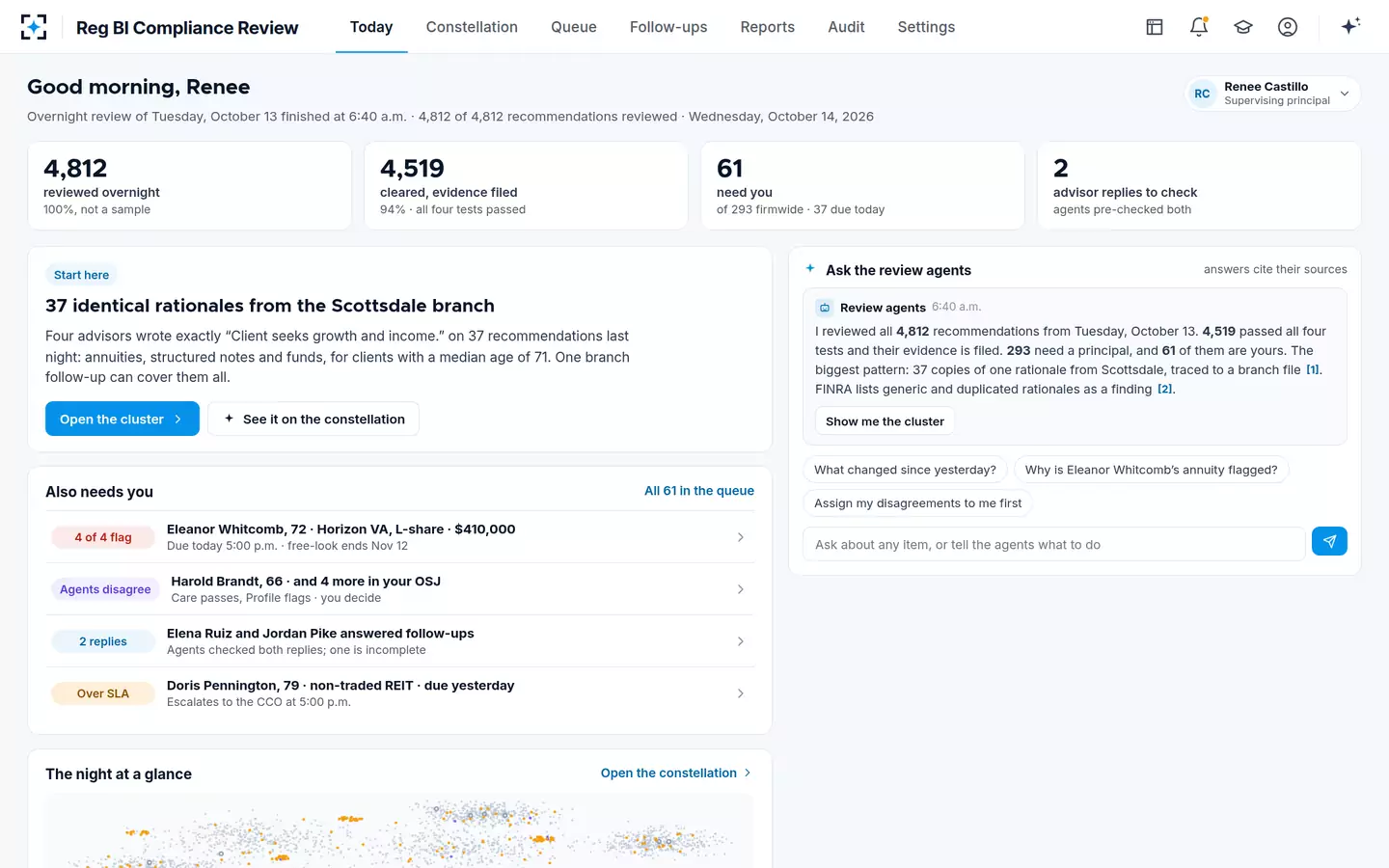
By 7:52 she has opened the cluster: four advisors, 37 recommendations, the same five words, traced to a phrase list on the branch's shared drive. She opens one of the 37, a $410,000 variable annuity L-share for a 72-year-old whose profile says income and preservation and a horizon of ten years or more. The agents have set out the same contract's A-share at 1.45% a year less, annuities at 34% of her liquid net worth against the firm's 30% guideline for clients 70 and older, and a 6.00% concession against 2.00%. She asks why not the guaranteed annuity, gets a cited answer, and at 7:53 sends a follow-up drafted from the four findings, which she edits, with a reason code, a two-business-day due date and an exchange request prepared for her approval.
Deciding a flag: the principal edits the follow-up and nothing goes until she confirms
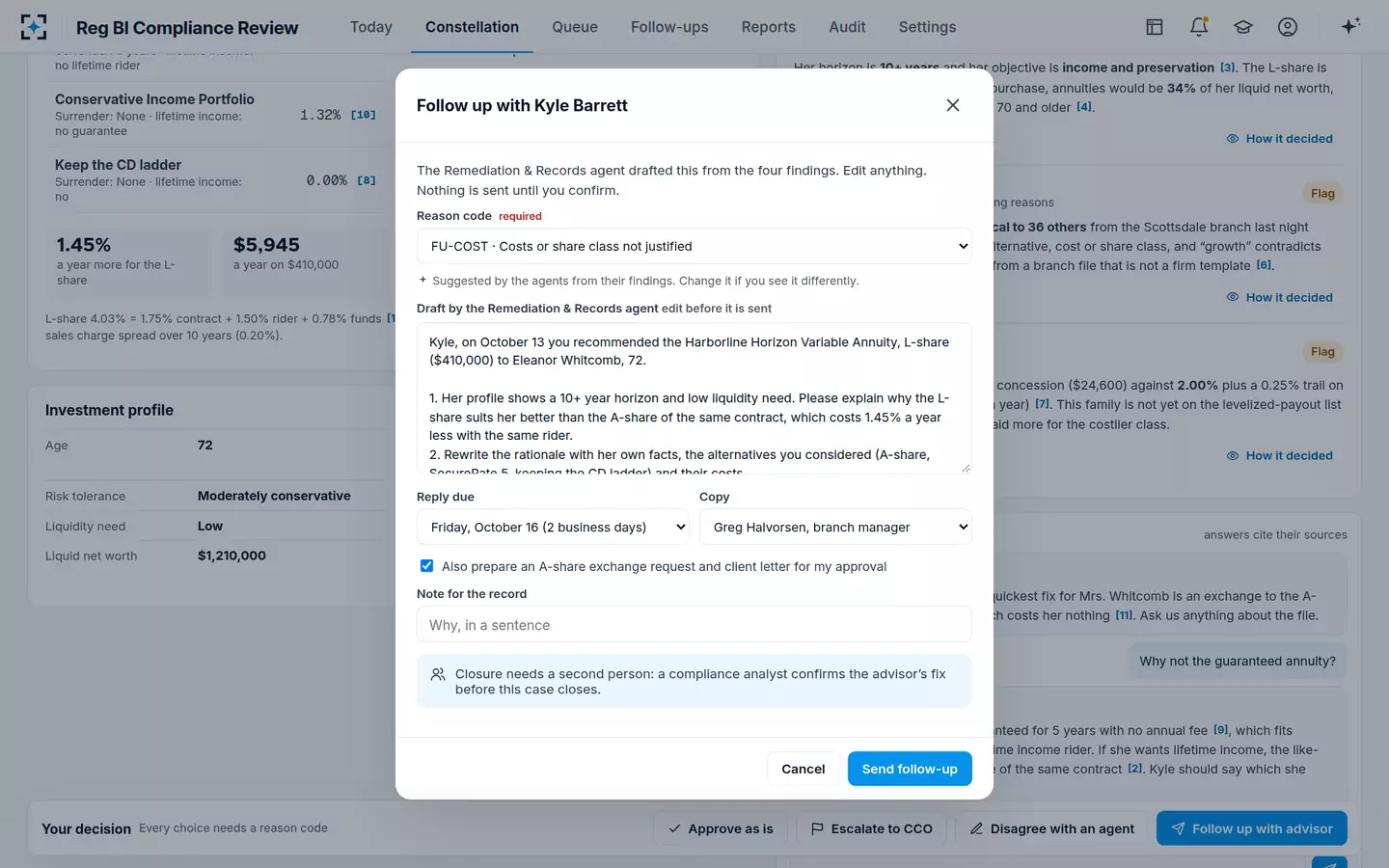
The rest of the morning follows the same shape. She opens one branch follow-up for the 37 instead of 37 tickets, sends six look-back cases to the chief compliance officer, and resolves a disagreement between agents on another client by siding with the cost test and asking the advisor to update a 44-month-old profile. At 11:20 the advisor's reply arrives, pre-checked by the agents against her four findings. Two days later a compliance analyst confirms the closure, so two names are on the record. None of the morning went to finding documents.
When the principal is the one held responsible
Supervisors are named in Reg BI cases, and the findings describe what they did with the evidence in front of them. In January 2026 FINRA suspended a supervisor from acting as a principal for three months and fined him $5,000. He "approved each sale of the bonds after reviewing the application documents" for nine customers, four of them seniors, who put $443,000 into speculative, illiquid bonds, without a reasonable assessment of whether the sales were consistent with their profiles, "particularly in light of the concentration levels" (FINRA, March 2026).
FINRA also faults firms that leave principals without the tools to judge. In April 2026 it fined a firm $450,000 and ordered $993,950.47 in restitution because its supervisory system did not give registered principals sufficient guidance for judging whether customers would gain enough from a rider's growth credit, before starting withdrawals, to justify its higher fees on variable annuity exchanges; 114 customers bought them, at an average incremental cost of $8,718.86 (FINRA, June 2026). In the SEC's July 2024 Western International order, the representative's direct supervisor and the firm did not apply a pre-approval policy for large options orders. And the SEC's fiscal 2027 examination priorities say examiners will check "whether appropriate and qualified individuals have been designated with the authority to carry out their supervisory responsibilities" (SEC, FY2027 priorities).
Five people who answer for the same night's recommendations
Today
Starts with yesterday's exception reports, about 60 items, reading one ticket at a time from a sample.
With agents
Starts with the agents' summary of every recommendation, opens the clusters and outliers, and decides each flag with a reason code.
Still theirs: The decision on every flag, and the follow-up.
Today
Sees a branch habit only when a review or an exam turns it up; his own business is supervised by the OSJ principal.
With agents
Sees the branch's copied-rationale rate by advisor and where the phrase came from; his own business still routes to the OSJ principal.
Still theirs: Coaching his advisors; never decides his own branch's items.
Today
Tunes exception reports that miss holds and declined recommendations, and chases closures by email.
With agents
Proposes changes to the tests, prepares restitution calculations, and confirms every closure a principal proposes.
Still theirs: The second signature on closures; never checks her own work.
Today
Hears late about money a client may be owed, and rebuilds files by hand for FINRA or the SEC.
With agents
Gets each possible restitution case with the calculation prepared, and approves every change to tests and agents.
Still theirs: Restitution decisions and the approval of every threshold.
Today
Hears days after the sale that a rationale needs more, without being told what.
With agents
Sees in plain words what is missing and answers between meetings; the agents check the reply before the principal sees it.
Still theirs: His own reasons, written by him.
The design choice behind the five columns is the one Rule 3110 already makes: the representative recommends, a different registered principal reviews and evidences the review, and the people who set the tests are not the people whose work they test. The agents add a fifth party that assembles and proposes but decides nothing; how far that line should run is the subject of Reg BI and AI. The full review starts at Reg BI Compliance Review.
Questions people ask
What is the difference between a supervisory principal and a branch manager?
A branch manager runs an office; a supervisory principal is the registered principal designated to review the business of particular representatives. The two can be the same person, but a producing branch manager cannot supervise his own business: Rule 3110(b)(6)(C) requires procedures prohibiting supervisory personnel from "supervising their own activities," so his recommendations go to another principal.
What is an exception report?
A report that lists transactions falling outside parameters the firm has set, such as a concentration above a limit or a product riskier than the customer's stated tolerance, for a principal to review. The SEC's 2019 Reg BI release mentions generating and reviewing exception reports as one way to review for compliance with the care obligation; the 2023 risk alert warned that reports built only on executed transactions miss holds and declined recommendations.
Does a principal have to review every transaction?
Not in detail. Rule 3110's Supplementary Material .05 allows a reasonably designed risk-based review system that lets the firm focus on the areas with the greatest numbers and risks of violation. The firm must still be able to show that the system is designed to find the recommendations that matter.
What must a principal's review show?
That it happened, who did it and what was decided: Rule 3110(b)(2) requires review by a registered principal "evidenced in writing." Under Reg BI the record should also show what the decision rested on, such as the costs and alternatives considered and any follow-up with the representative.
What is an OSJ?
An office of supervisory jurisdiction. Rule 3110(f)(1) defines it by what happens there, including "final acceptance (approval) of new accounts," "review and endorsement of customer orders," and "responsibility for supervising the activities of persons associated with the member at one or more other branch offices." Each OSJ needs one or more appropriately registered principals and an inspection at least annually.