Reg BI vs suitability is a comparison between two standards for the same act, a broker-dealer recommending a security to a customer. Since June 30, 2020, FINRA Rule 2111, the suitability rule, has not applied to recommendations covered by Regulation Best Interest, which governs recommendations to retail customers. Reg BI kept suitability's three obligations, reasonable basis, customer-specific and quantitative, as the tests inside its care obligation, then added what suitability never asked: weigh cost every time, compare reasonably available alternatives, cover account-type recommendations, and do not put the firm's interest first. For supervising principals trained on Rule 2111 the change is easy to underrate, because the tickets they review look the same. Botminds' Reg BI Compliance Review was built for that gap: agents ask the questions Reg BI added, on every retail recommendation, and the principal decides.
The rule texts are FINRA Rule 2111 and SEC Rule 15l-1; the reasons are in the SEC's 2019 adopting release. Sample figures come from the solution's fictional broker-dealer, Quillfield Securities.
Reg BI vs suitability vs the adviser's fiduciary duty, obligation by obligation
| Obligation | FINRA Rule 2111 (suitability) | Reg BI (retail recommendations) | Adviser fiduciary duty |
|---|---|---|---|
| Standard | Suitable for the customer | In the retail customer's best interest, without putting the firm's or representative's interest ahead | Best interest, under a duty of care and a duty of loyalty |
| Know the product | Reasonable-basis suitability: suitable for at least some investors | Understand risks, rewards and costs; could be in the best interest of at least some retail customers | Reasonable investigation so advice is not based on inaccurate or incomplete information |
| Fit to the customer | Customer-specific suitability, on the investment profile | Best interest of this customer, on the profile and the costs | Based on the client's objectives, updated over the relationship |
| Cost | Not named in the rule text | Always considered; never the only consideration | One of many important factors |
| Alternatives | No comparative assessment required | Reasonably available alternatives generally considered | Staff view: the same framework is useful |
| Series of trades | Quantitative suitability | Third care test, whether or not the firm controls the account | Judged under the duty of care as a whole |
| Account type | Not named in the rule | Covered, including rollovers and transfers | Covered, including advice about rollovers |
| Conflicts | Not part of the suitability test | Identify; disclose or eliminate; mitigate representative-level incentives; eliminate time-limited sales contests | Eliminate or fully disclose so the client can give informed consent |
| How long it applies | At each recommendation | At the time of each recommendation; monitoring only if agreed | The entire relationship |
What is the difference between Reg BI and suitability?
Suitability asks whether a recommendation fits the customer; Reg BI asks whether it is in the customer's best interest, judged on costs and alternatives as well as fit, and made without putting the broker's interest first. The SEC presented the comparison of alternatives as the centre of the change. Considering reasonably available alternatives, the adopting release says, is "a key enhancement over existing broker-dealer suitability" obligations, "which do not necessarily require a comparative assessment among such alternatives."
For a supervisor the practical difference is the number of questions per ticket. A Rule 2111 review could stop when the product fitted the profile. A Reg BI review has to ask what else the firm could have offered, what each would have cost the customer over the horizon, what the representative earned on each, and whether the account type itself was the right one. Those questions need data a suitability review never pulled: the product shelf, the fee tables of the alternatives, the payout grid.
Does FINRA Rule 2111 still apply?
Yes, but not to recommendations Reg BI covers. FINRA's rulebook records an amendment to Rule 2111 effective June 30, 2020, the day Reg BI's compliance date arrived, and the rule's Supplementary Material now draws the line in one sentence.
"This Rule shall not apply to recommendations subject to SEA Rule 15l-1 ("Regulation Best Interest")."
FINRA Rule 2111, Supplementary Material .08
Rule 2111 therefore still governs recommendations to customers who are not retail customers under Reg BI, such as businesses and institutional accounts, which is why "does Reg BI apply to institutional accounts" has a short answer: no. FINRA's know-your-customer rule, Rule 2090, and its product rules for variable annuities and direct participation programs continue alongside Reg BI. A firm with both retail and institutional business runs two standards, and its supervisory procedures have to say which one a given review applies.
Reasonable-basis suitability became the first care test
FINRA's reasonable-basis obligation required "a reasonable basis to believe, based on reasonable diligence, that the recommendation is suitable for at least some investors," and FINRA adds that "The lack of such an understanding when recommending a security or strategy violates the suitability rule." Reg BI's first care test keeps that shape and changes what has to be understood and believed: the potential risks, rewards and costs of the product, not just its features, and that it could be in the best interest, not merely suitable, for at least some retail customers.
Cost entering the first test means product due diligence now has to price the product, not just describe it. A product review committee that approves an annuity without recording its all-in cost by share class has done suitability work, not Reg BI work. The care test as a whole, with the factors the staff expect, is set out in the Reg BI care obligation.
Customer-specific: from suitable to best interest
FINRA's customer-specific obligation asked for a reasonable basis to believe the recommendation "is suitable for a particular customer based on that customer's investment profile." Reg BI's second care test asks for a reasonable basis to believe it is in the customer's best interest, judged on the profile and on the product's risks, rewards and costs, and that it "does not place the financial or other interest" of the firm or representative ahead of the customer's. Both rules list the same profile factors: age, other investments, financial situation and needs, tax status, objectives, experience, horizon, liquidity needs and risk tolerance.
Two FINRA settlements with individual representatives, published in June 2026, rest on this test. In April 2026 FINRA fined a representative $10,000, suspended him for six weeks and ordered $7,530 in restitution after he recommended structured notes with no principal protection and maturities of at least five years to two retirees with low risk tolerances and short-term liquidity needs, neither of whom had experience with complex products. FINRA found he "willfully violated the Care Obligation of Reg BI" (FINRA, June 2026). Under Rule 2111 the same facts would have been an unsuitable recommendation; under Reg BI the analysis also asks what simpler, cheaper product would have met their needs.
Quantitative suitability without the control element
FINRA's quantitative suitability obligation required a reasonable basis for believing a series of recommended transactions, "even if suitable when viewed in isolation, are not excessive and unsuitable for the customer when taken together," and pointed to "the turnover rate, the cost-equity ratio, and the use of in-and-out trading" as factors. Reg BI's third care test carries the idea over almost word for word.
The change is in who it reaches. The quantitative obligation used to turn on whether the broker controlled the account; the adopting release imposes Reg BI's version "without a “control” element," so it applies "irrespective of whether a broker-dealer exercises actual or de facto control over a customer's account." A customer who approves every trade is now protected from a pattern of recommendations that is excessive taken together. Surveillance designed around control, such as reviews triggered only for discretionary accounts or customers who follow every recommendation, now covers too little.
What Reg BI added that Rule 2111 never asked
Four questions are new, and each needs data a suitability review did not collect. Cost: the adopting release says "while cost must be considered, it should never be the only consideration," so the review has to price both the recommendation and its alternatives. Alternatives: what else on the firm's shelf met the same objective, the subject of reasonably available alternatives. Account type: a recommendation to open an account, or to move assets between account types, is itself covered. Conflicts: the firm must identify and mitigate incentives that could lead a representative to put their interest first, and must "Identify and eliminate any sales contests, sales quotas, bonuses, and non-cash compensation that are based on the sales of specific securities or specific types of securities within a limited period of time."
Disclosure changed too. Reg BI requires written disclosure of the capacity in which the firm acts, its material fees and costs, the scope of its services and its conflicts, "prior to or at the time of the recommendation." And the record changed: Exchange Act Rule 17a-3(a)(35) requires a record of all information collected from and provided to each retail customer under Reg BI.
What a suitability-era exception report checks, and what a Reg BI review has to add
Rule 2111 exception report: Executed trades that break a rule: concentration, age, risk score mismatch.
Reg BI review: Every recommendation, including holds, account types and recommendations the customer declined.
Rule 2111 exception report: Approved for sale and within the profile's risk band.
Reg BI review: Understood and priced: risks, rewards and all-in cost over the horizon.
Rule 2111 exception report: Not asked.
Reg BI review: Same-objective alternatives on the firm's shelf, with their costs.
Rule 2111 exception report: Not part of the suitability question.
Reg BI review: Payout differential against the alternatives; contests and proprietary products.
Rule 2111 exception report: Turnover and cost-equity, where the broker controlled the account.
Reg BI review: Turnover and cost-equity for every retail account.
Rule 2111 exception report: Present or missing.
Reg BI review: Specific to this customer, or generic and copied across the branch.
Reg BI vs fiduciary: is Reg BI a fiduciary standard?
No, by the SEC's own choice of words. The adopting release says that "although our standard draws from key fiduciary principles," the Commission is "not referring to Regulation Best Interest as a “fiduciary” standard," to emphasise that it is tailored to the broker-dealer relationship. An investment adviser's fiduciary duty, which the SEC set out the same day in Release IA-5248, "comprises a duty of care and a duty of loyalty" and "applies to the entire relationship between the adviser and its client."
The practical gap is narrower than the labels. SEC staff wrote in their 2022 bulletin on account recommendations that although the two standards "may differ in some respects and be triggered at different times," they "generally yield substantially similar results in terms of the ultimate responsibilities owed to retail investors." The differences that remain are structural. Reg BI applies at the moment of each recommendation and imposes no duty to monitor unless the firm agrees to monitor; the adviser's duty runs for the whole relationship. Reg BI requires firms to mitigate representative-level conflicts and to eliminate certain sales contests outright; the adviser's duty of loyalty works mainly through full disclosure and informed consent.
More than half of FINRA-registered representatives work under both standards
639,723
registered representatives in 2025, up for the fourth year running
331,802
held dual registration, as broker-dealer and investment adviser representatives
307,921
held broker-dealer only registrations
3,184
FINRA member firms in 2025, down roughly 6%
For dual registrants, the standard follows the capacity in which the professional acts, and the staff call that a facts-and-circumstances question. A principal reviewing a dually registered representative's book has to know, for each recommendation, which hat was on; a review system that cannot tell brokerage recommendations from advisory advice will apply the wrong test to some of them.
What a suitability-era review misses, and how to close the gap
The SEC's January 2023 risk alert named the habit directly: firms that "Relied heavily on surveillance systems that existed before the effective date of Regulation Best Interest without considering whether those systems needed modification." The examples it gave were the obligations suitability never had: rollovers, account recommendations, and implicit hold recommendations from agreed account monitoring.
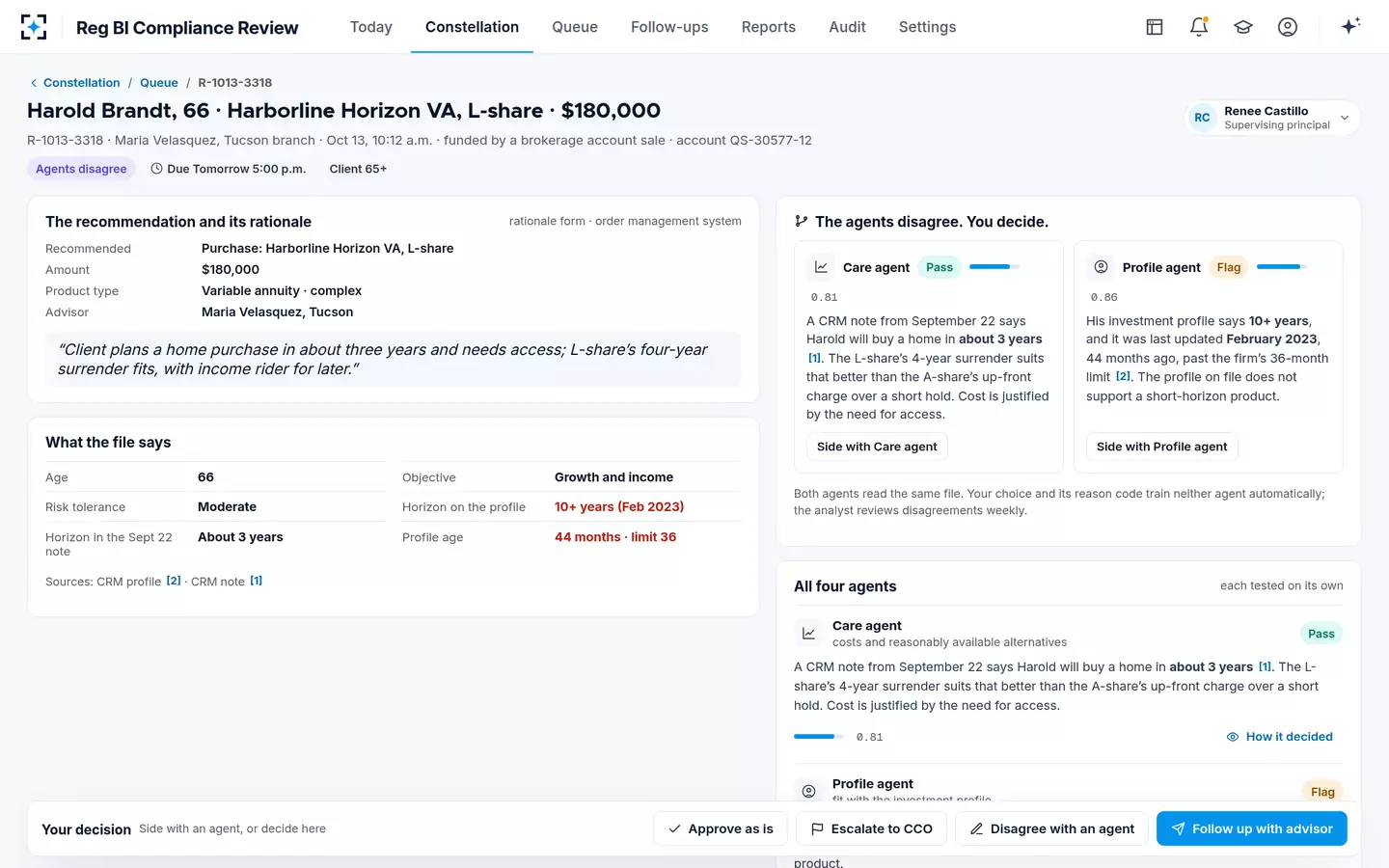
Closing the gap means running the new questions on the same tickets, which is a data problem before it is a judgement problem. In Reg BI Compliance Review, each recommendation is joined overnight to the profile, the fee tables, the shelf and the payout grid, and four agents each test one part. When they disagree, the principal sees both arguments rather than a single score. In the sample below the Care agent passes a short-surrender annuity because a recent CRM note says the client will buy a home in about three years, while the Profile agent flags it because the profile on file, 44 months old, still says ten years or more. The principal sides with the Care agent and asks the advisor to update the profile.
When the cost test and the profile test disagree, both arguments are on the screen
The firms that adjusted best did not throw away their suitability surveillance; they kept it for what it still does well and added the cost, alternatives and conflict questions on top. Where to begin is in Reg BI Compliance Review.
Questions people ask
Is Reg BI stricter than FINRA suitability?
Yes, for retail recommendations. It keeps suitability's three tests and adds a best-interest standard, mandatory consideration of cost, reasonably available alternatives, coverage of account-type recommendations and conflict mitigation, and it applies the excessive-trading test whether or not the broker controls the account.
What is reasonable basis suitability?
Under FINRA Rule 2111 it is the obligation to have a reasonable basis, from reasonable diligence, to believe a recommendation is suitable for at least some investors; without that understanding of the product the rule is violated. Reg BI's first care test is its successor and adds an understanding of costs.
What is quantitative suitability?
The FINRA obligation that a series of recommended transactions, each suitable alone, is not excessive taken together, judged by measures such as turnover rate, cost-equity ratio and in-and-out trading. Under Reg BI it is the third care test and no longer depends on the broker controlling the account.
Does Reg BI apply to institutional accounts?
No. Reg BI protects natural persons, and their non-professional legal representatives, who use a recommendation for personal, family or household purposes. Recommendations to businesses and institutions remain under FINRA Rule 2111 and the firm's institutional suitability procedures.
Does Reg BI require ongoing monitoring like the fiduciary standard?
No. Reg BI applies at the time of each recommendation and does not impose a duty to monitor. If a broker-dealer agrees to monitor an account, the buy, sell and hold recommendations that monitoring produces, including implicit holds, are covered.