The Reg BI care obligation is the part of Regulation Best Interest that requires a broker-dealer and its registered representatives to use "reasonable diligence, care, and skill" whenever they recommend a security, an investment strategy or an account type to a retail customer. It holds three tests: understand the product well enough to believe it could be in the best interest of at least some retail customers; believe it is in this customer's best interest, given their investment profile and the costs; and believe that a series of recommended trades is not excessive when taken together. It is hard to supervise because the evidence sits in five systems and the rule never says how much weighing is enough. Botminds' Reg BI Compliance Review was built for that gap: six agents test every retail recommendation overnight against each part of the care obligation and put the evidence in front of the supervising principal, who decides.
The rule text is short: it is 17 CFR 240.15l-1, adopted by the SEC in June 2019 with a compliance date of June 30, 2020. Most of what the tests mean in practice comes from the Commission's adopting release and the SEC staff's April 2023 bulletin on care obligations, which is a staff view rather than a rule. The worked examples come from the solution's fictional sample broker-dealer, Quillfield Securities.
The care obligation sits inside a four-part rule
4
component obligations: disclosure, care, conflict of interest, compliance
3
tests inside the care obligation, each with its own reasonable basis
10
investment profile factors the rule names, and "any other information" the customer discloses
2020
June 30: the date firms had to comply
What is the care obligation of Reg BI?
The care obligation is one of four component obligations, and a firm meets Reg BI's general best-interest obligation only if it meets all four. The general obligation says a broker-dealer must act in the retail customer's best interest "at the time the recommendation is made," without putting its own interest ahead of the customer's. Disclosure, conflict of interest and compliance are about what the firm tells customers and what its written procedures do. The care obligation is about the recommendation itself.
Its three tests are cumulative, and each is judged on the facts as they stood when the recommendation was made. SEC staff put the standard plainly: whether a recommendation meets the care obligation "is an objective evaluation, turning on the facts and circumstances of the particular recommendation or advice and the investment profile of the particular retail investor." A representative's good faith does not answer it; the file does. For a reviewer, that means each test can be written as questions with answers that can be checked against a source.
The Reg BI care obligation as questions a reviewer can answer
- Product: do we know its risks, rewards and costs?
Objectives, initial and ongoing costs, liquidity and exit costs, how it behaves in bad markets, special features. Would it suit at least some retail customers?
- Customer: is the profile on file current and complete?
Age, other investments, financial situation and needs, tax status, objectives, experience, time horizon, liquidity needs, risk tolerance, and anything else the customer disclosed.
- Fit: does the recommendation match that profile?
Horizon against surrender period, liquidity need against lock-ups, risk tolerance against loss potential, concentration against liquid net worth.
- Cost: what will this customer pay, all in, over their horizon?
Commissions or loads, ongoing fees, riders, exit charges and tax, against what the alternatives would cost.
- Alternatives: what else on the shelf would meet the same objective?
If a cheaper or less risky alternative fits, what justifies this one?
- Interest: does anything point to the firm or the representative coming first?
Payout differences, proprietary products, sales contests within a limited period.
- Series: taken together, are the recent trades excessive?
Turnover, cost-to-equity, in-and-out trading, for this customer, even if each trade looked fine alone.
Test one: understand the product before anyone recommends it
The first test, the "reasonable basis" prong, is about the product, not the customer. The rule asks the firm and the representative to "understand the potential risks, rewards, and costs associated with the recommendation" and to believe it "could be in the best interest of at least some retail customers." A product nobody at the firm understands cannot be recommended to anyone, however well it fits a profile on paper.
SEC staff list what that understanding should cover: the product's objectives; its initial and ongoing costs, "such as direct and indirect costs, as well as potential costs, such as redemption fees"; its key characteristics and risks; its likely performance in different market conditions; expected returns and potential losses; special features such as tax advantages or guaranteed payments; and its role in the customer's wider portfolio. The duty is personal as well as institutional. A firm's approved list does not discharge it: in the staff's words, financial professionals "cannot satisfy their own care obligations by solely relying on the efforts of others at their firm."
The SEC's July 2024 order against LifeMark Securities shows what a failure of this test looks like. Before recommending GWG's L Bonds, the representative "did little more than review the June 2020 Prospectus," took no training, and later believed investors could redeem the bonds without restriction for a 6% fee, when redemption before maturity was at the issuer's sole discretion. He "relied on Respondent's approval of L Bonds without question or inquiry." The firm, with about 200 registered representatives, paid a civil penalty of $85,000.
Test two: this customer, this profile, these costs
The second test, the "customer-specific" prong, asks for a reasonable basis to believe the recommendation is in the best interest "of a particular retail customer based on that retail customer's investment profile and the potential risks, rewards, and costs." This is where most reviews spend their time, because it needs three things side by side: the profile, the product and the price.
The same LifeMark order applied it. In December 2021 the representative recommended a $50,000, five-year L Bond to a 63-year-old semi-retiree with a moderate risk tolerance, whose only documented objective was preservation of capital, who had said he did not want to lose his principal, and who paid with retirement savings. The SEC found the recommendation "inconsistent with the customer's investment profile." Every fact needed to see that was already in the firm's own account form.
The profile has to be current, not just complete. SEC staff say a recommendation must not rest on "materially inaccurate, incomplete, or outdated information about the retail investor," and that gathering profile information is not "a once-and-done exercise." Where information is missing despite reasonable effort, the staff's view is that the representative "should generally decline to provide such recommendations or advice until you obtain the necessary investor information." Exchange Act Rule 17a-3(a)(17) sets the outer clock for refreshing the account record: a copy goes to the customer at least every thirty-six months (the account record, field by field).
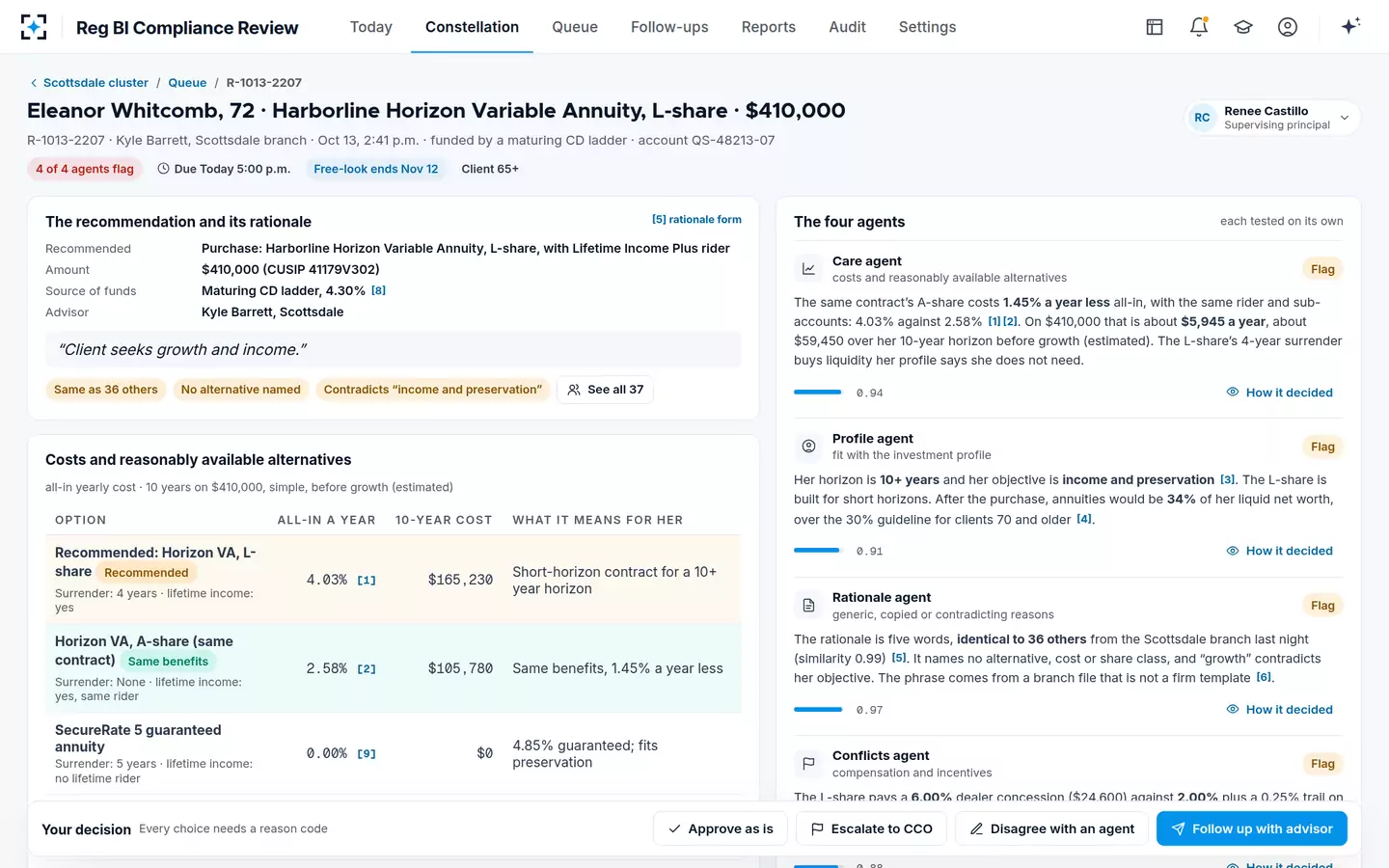
The care obligation on one recommendation: profile, costs and alternatives side by side
Which factors does the care obligation require? Cost, always
The rule names the profile factors, and SEC staff name the cost factors; cost is the one that must always be weighed. The staff bulletin says firms and representatives "must always consider cost as a factor," and that the analysis "should include costs beyond the explicit costs disclosed on a trade confirmation or account statement." Its list runs from commissions and markups through sales loads, advisory fees, 12b-1 and revenue-sharing, the trading costs of a strategy, the cost of getting out, tax, and "the likely impacts of those costs over the retail investor's expected time horizon."
Applied to a variable annuity, that list turns into arithmetic. Take one recommendation from the sample firm: $410,000 from a maturing CD ladder into the L-share of a variable annuity, for a 72-year-old whose profile says income and preservation, a horizon of ten years or more and low liquidity needs.
What 'cost' means under the care obligation, on one annuity recommendation
| Cost the staff name | L-share (recommended) | A-share, same contract |
|---|---|---|
| Ongoing contract charges | 1.75% a year | 0.60% a year |
| Rider (same lifetime income benefit) | 1.50% a year | 1.00% a year |
| Underlying funds | 0.78% a year | 0.78% a year |
| Sales charge | none up front; 4-year surrender schedule | 2.00%, spread over ten years: 0.20% a year |
| All-in, a year | 4.03% | 2.58% |
| Over a ten-year horizon on $410,000, simple | $165,230 | $105,780 |
| Dealer concession (the conflict) | 6.00%, $24,600 | 2.00%, $8,200, plus 0.25% trail |
Nothing in that table makes the L-share unlawful. A shorter surrender period has value for a client who may need the money within four years. The point of the care obligation is that the representative must be able to say why the higher cost is justified for this client, and the reviewer must be able to check the answer against the profile. Here the profile points the other way, which is why the sample file goes to the supervising principal; the shelf of alternatives behind the comparison is the subject of defining the shelf of reasonably available alternatives.
Test three: a series of trades, taken together
The third test catches what single-trade review cannot: trades that each pass but together drain an account. It carries over FINRA's old quantitative suitability concept into Reg BI, with one change that matters to a supervisor, covered in Reg BI vs suitability.
"a series of recommended transactions, even if in the retail customer's best interest when viewed in isolation, is not excessive and is in the retail customer's best interest when taken together in light of the retail customer's investment profile"
Rule 15l-1(a)(2)(ii)(C), the third care test
The SEC staff's Reg BI FAQ says a series is judged with the "existing guideposts, such as turnover rate, cost-to-equity ratio, and use of in-and-out trading," and that "Regulation Best Interest does not change this well-established approach." The cases show the scale such patterns reach. In October 2024 the SEC settled with PHX Financial over a short-term, high-volume strategy recommended to eight customers who all lost money while the firm and representative earned over $400,000 in commissions and fees; PHX paid a $180,000 penalty plus disgorgement. In January 2026 FINRA filed a complaint against Sutter Securities alleging 2,217 trades in the accounts of a retired 89-year-old customer, about $2.5 million in trading costs and red flags the supervisor did not follow up; the allegations are unadjudicated (FINRA, June 2026).
The SEC has also said where the guideposts usually sit. In its July 2024 order against Western International Securities, over one representative's options day-trading in 19 customer accounts, it wrote that "A cost-to-equity ratio of 20% or higher and an annual turnover ratio of six are thresholds that have been regarded as indicative of excessive trading." More than half of those accounts had a cost-to-equity ratio above 20%, so the accounts had to return more than a fifth of their average value just to pay the commissions and fees. Western paid a $140,000 civil penalty, and the Commission took into account the $9 million in remediation the firm had already paid affected customers.
A series test needs history, not a single ticket. That is why surveillance that looks only at the day's recommendation will miss it, and why the review has to join each recommendation to the account's recent activity before it decides anything.
How is the care obligation tested on one recommendation?
In practice the care obligation is tested by putting four kinds of evidence next to each other and asking the three tests of them in order. A supervising principal doing it by hand pulls the ticket and rationale form, the prospectus, the profile and notes, and the payout grid. In Reg BI Compliance Review the agents assemble the same evidence overnight and each applies one part of the test, so the principal starts from findings rather than from a blank ticket.
One recommendation through the care obligation, from intake to a principal's decision
Agent
Intake agentJoins the recommendation to the investment profile, product costs and share classes, the shelf of alternatives, holdings and the payout grid.
Never: Never clears anything it cannot join; it waits for the data.
Agent
Care agentPrices the recommendation and the same-feature alternatives over the client's horizon, citing the prospectus page for every figure.
Never: Never treats cheapest as best: it flags an alternative at least 0.25% a year cheaper with the same features.
Agent
Profile agentTests fit with age, objective, risk tolerance, horizon, liquidity and concentration, and flags profiles older than 36 months.
Never: Never edits a profile; a stale profile is a question for the advisor.
Agent
Rationale and Conflicts agentsRead the written reason against the file and check the payout differential, proprietary products and contests.
Never: Never rewrite a rationale or judge intent.
A person decides
Supervising principalDecides each flag: approve, follow up with the advisor, escalate, or side with one agent over another, always with a reason code.
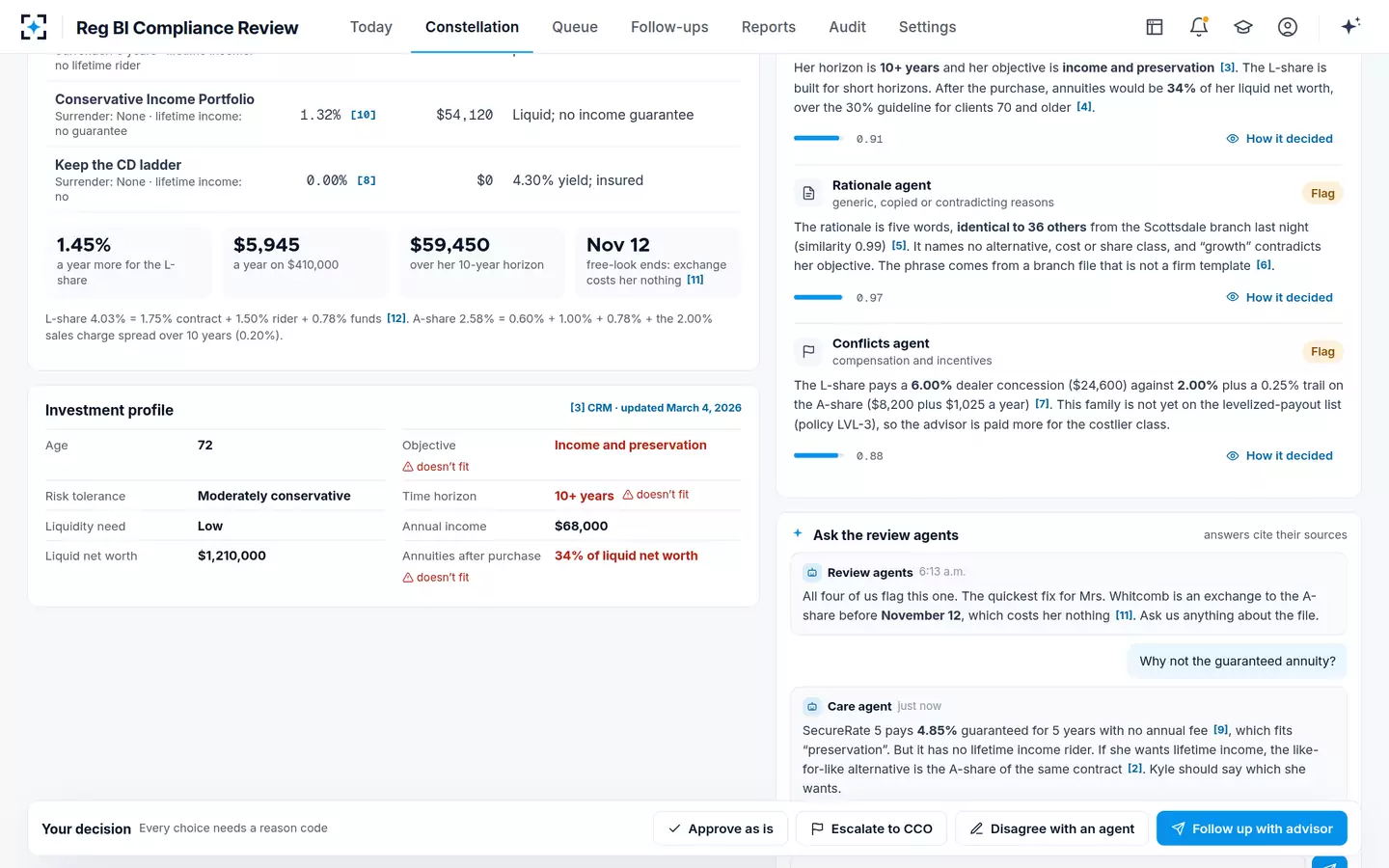
In the sample file above, all four agents flag. The Care agent finds the same-contract A-share 1.45% a year cheaper with the same rider and funds; the Profile agent finds annuities would reach 34% of the client's liquid net worth, above the firm's 30% guideline for clients aged 70 and older; the Rationale agent finds a five-word reason shared by 36 other tickets; the Conflicts agent finds a 6.00% concession against 2.00%. The principal asks the agents why not the guaranteed annuity, gets a cited answer, and sends a follow-up to the advisor. The agents decide nothing.
Asking about the alternatives before deciding
Who does Reg BI apply to, and when?
Reg BI applies to broker-dealers and their associated persons when they recommend a securities transaction, an investment strategy or an account type to a retail customer. A retail customer is a natural person, or a natural person's non-professional legal representative, who receives the recommendation and "uses the recommendation primarily for personal, family, or household purposes." Institutions and businesses are outside it; the wealth of the person is not a test.
The SEC staff's FAQ closes several gaps people ask about. The definition "does not exclude high-net worth natural persons and natural persons that are accredited investors." A retail customer "cannot waive or agree to waive the protections" of the rule. Account-type recommendations and rollovers are covered, and the release adds that implicit hold recommendations arising from agreed-upon account monitoring are covered too. Equally, the adopting release confirms Reg BI does not "apply to self-directed or otherwise unsolicited transactions," does not impose a general duty to monitor, and does not require a firm to refuse an order that goes against its advice.
Advisory accounts sit under a different standard: an investment adviser's fiduciary duty under the Advisers Act, which applies to the whole relationship. For dual registrants, which standard applies to a given recommendation depends on the capacity in which the professional acted. Rollover recommendations bring a third set of rules, the Labor Department's exemption for retirement advice; what that exemption asks of each rollover file, and who signs it, is in PTE 2020-02 requirements.
What the care obligation does not require
The care obligation does not require the cheapest product, the single best product, or a written note for every recommendation. The adopting release is explicit that a broker-dealer "will not be required to recommend the single “best” of all possible alternatives that might exist, in part because many different options may in fact be in the retail customer's best interest." Cost must be weighed; it need not win.
Nor does the rule itself require the basis of each recommendation to be written down, though the Commission expects firms to document where the stakes or the risks are higher. That gap between what the rule requires and what examiners read is large enough for its own guide: the SEC Reg BI documentation obligation. And the rule does not require every recommendation to be reviewed in detail by a principal; firms may design risk-based supervision. Reviewing all of them is a choice a firm can make once the cost of assembling the evidence falls, which is the case for doing it with agents.
To see the three tests run on a full night of sample recommendations, start from Reg BI Compliance Review.
Questions people ask
What are the four obligations of Reg BI?
Disclosure, care, conflict of interest and compliance. The disclosure obligation requires written disclosure of the relationship, fees and conflicts before or at the time of the recommendation; the conflict obligation requires procedures to identify, disclose, mitigate or eliminate conflicts, including eliminating sales contests tied to specific securities within a limited period; the compliance obligation requires written procedures reasonably designed to achieve compliance with the whole rule. Failing any one is a violation of the general best-interest obligation.
What are the Reg BI care obligation factors?
The rule names the customer's age, other investments, financial situation and needs, tax status, investment objectives, investment experience, time horizon, liquidity needs, risk tolerance and anything else the customer discloses, weighed against the product's risks, rewards and costs. SEC staff add marital status, assets and debts, and financial goals to the profile, and list the costs to weigh, from commissions to exit charges and tax.
Does Reg BI apply to advisory accounts?
No. Advice given in an advisory account falls under the investment adviser's fiduciary duty under the Advisers Act. Reg BI does apply to a broker-dealer's recommendation of an account type, including a recommendation to open an advisory account or to move assets from a brokerage account to an advisory one.
Is a recommendation to hold a security covered?
An explicit recommendation to hold is a recommendation of an investment strategy and is covered. Where a broker-dealer has agreed to monitor an account, the SEC treats the holds implied by that monitoring as recommendations too; without such an agreement, Reg BI imposes no duty to monitor.
What if the customer will not give profile information?
Rule 17a-3(a)(35) says a customer's "neglect, refusal, or inability" to provide or update information excuses the firm from obtaining it. It does not excuse the care obligation: SEC staff say that without sufficient information a representative should generally decline to make the recommendation.
Does the care obligation require the lowest-cost product?
No. Cost must always be considered, but a more expensive product can be in the customer's best interest if other factors justify it, such as a feature the customer needs that the cheaper alternatives lack. The representative must be able to say what that factor is.