The PTE 2020-02 requirements are the conditions a firm and its investment professionals must meet to receive pay that ERISA and the tax code would otherwise prohibit when they give fiduciary advice, including advice to roll a 401(k) into an IRA. In the exemption's text, as DOL republished it on March 20, 2026, they are: Impartial Conduct Standards, including a best interest standard; written disclosures before the transaction, including "A written acknowledgment that the Financial Institution and its Investment Professionals are fiduciaries"; written policies and procedures; documented "specific reasons" for each rollover, given to the investor before the rollover; an annual retrospective review certified by a Senior Executive Officer; and six years of records (PTE 2020-02, 91 FR 13503). Each condition belongs to someone. Botminds' IRA Rollover Analysis routes each to that person and records the signature, so a rollover file shows not only that a condition was met but who met it, and when.
The exemption is still in force as granted in 2020 (its 2026 status is set out here). The map below takes its conditions one at a time.
PTE 2020-02 requirements mapped to the person who signs, the moment, and the record
Impartial Conduct Standards II(a)
Who: The investment professional and the firm
When: When the advice is given
Keep: The analysis behind the advice: costs, alternatives, the client's profile
Fiduciary acknowledgment II(b)(1)
Who: The firm, in writing
When: Before the transaction
Keep: The acknowledgment and proof it was delivered
Services and conflicts II(b)(2)
Who: The firm, in writing
When: Before the transaction
Keep: The description given to this client
Specific reasons for the rollover II(c)(3), II(b)(3)
Who: The firm documents them; the professional drafts them
When: Documented, then provided before the rollover
Keep: The rationale, its version, and when the client received it
Policies and procedures II(c)(1)–(2)
Who: The firm
When: Established, maintained, enforced
Keep: Written procedures and evidence they were followed
Retrospective review II(d)
Who: The firm; a Senior Executive Officer certifies
When: At least annually, finished within six months
Keep: Report, certification and supporting data, six years
Records IV
Who: The firm
When: Six years
Keep: Everything that shows the conditions were met
What is PTE 2020-02?
PTE 2020-02, "Improving Investment Advice for Workers & Retirees", is a class exemption from the prohibited transaction rules of ERISA and the Internal Revenue Code, granted by the Department of Labor on December 18, 2020. Those rules bar a fiduciary who gives investment advice to a plan or IRA from receiving compensation that varies with the advice or comes from third parties. The exemption permits it, and it "expressly covers prohibited transactions resulting from both rollover advice and advice on how to invest assets within a plan or IRA", in DOL's words.
It is available to registered investment advisers, broker-dealers, banks and insurance companies that meet its conditions, and to their investment professionals. It is not available in two situations worth knowing for rollover programs: where the firm is the employer of the plan's employees, or is a named fiduciary or administrator of the plan chosen by a fiduciary that is not independent of it, and where the advice is "generated solely by an interactive website in which computer software-based models or applications provide investment advice ... without any personal interaction or advice with an Investment Professional (i.e., robo-advice)". A purely digital rollover offer needs another basis.
What are the PTE 2020-02 requirements? Six conditions and who owns each
Read as a list of owners, the exemption is short. The investment professional owns the advice itself: it must meet the Impartial Conduct Standards when it is given. The firm owns everything that makes the advice provable: the written acknowledgment and the services-and-conflicts description before the transaction, the policies and procedures, the documented specific reasons, the retrospective review and the records. A Senior Executive Officer owns the certification. The investor owns nothing, but must receive three things in writing before a rollover: the acknowledgment, the description and the reasons.
Two signatures that most firms require are not in the exemption at all. A supervising principal's approval of the recommendation comes from securities rules and the firm's own procedures, and a client's signature on the acknowledgment is the firm's proof of delivery, not a condition. Both are good practice, and both make the file stronger, but the exemption measures delivery and documentation, not who countersigned.
The five people who answer for one rollover file
Today
Writes a reason from the CRM template and re-keys fees from the plan PDF.
With agents
Tells the agents what to fix in plain words, reads a cited draft and submits it himself.
Still theirs: The advice and the submission
Today
Approves under volume pressure, checking completeness more than whether the reasons are the client's own.
With agents
Opens a file the critic has already argued with, and approves or sends back with a reason code and a signature.
Still theirs: Approval and the reason code
Today
Spends half the week getting fee disclosures out of recordkeepers.
With agents
Sees only missing documents and low-confidence values, and confirms any estimate before anyone relies on it.
Still theirs: Confirmation of estimates
Today
Runs the annual review on a sample and rebuilds a file's story by hand for each exam request.
With agents
Sees every closed file re-checked, tests a monthly sample of the agents' work and assigns remediation.
Still theirs: The review and its findings
Today
Certifies a review built on a sample of files.
With agents
Certifies a report that covers every closed file, with exceptions and fixes counted.
Still theirs: The certification, as Senior Executive Officer
What are the Impartial Conduct Standards?
Three promises about the advice. It must be, "at the time it is provided, in the Best Interest of the Retirement Investor", meaning it reflects the care, skill, prudence and diligence of a prudent person familiar with such matters, based on the investor's objectives, risk tolerance, financial circumstances and needs, and does not put anyone else's interests ahead of the investor's. The compensation must not exceed reasonable compensation, and the firm must seek best execution as the securities laws require. And statements to the investor about the recommended transaction must not be "materially misleading" when made.
For a rollover, the best-interest standard is where the analysis lives. The exemption does not list what to compare, and since DOL now treats the 2020 preamble as vacated, its old commentary on that point no longer helps. SEC staff fill much of the gap for broker-dealers and advisers: they expect a reasonable basis for the rollover and, separately, for the account recommended, and they say a firm "must always consider cost as a factor when making an account recommendation" (SEC staff bulletin, March 30, 2022; staff views, not a rule). For a rollover, that means pricing the plan the client is leaving.
The PTE 2020-02 fiduciary acknowledgment: what it must say, and when
It must say, in writing, that the firm and its investment professionals "are fiduciaries under Title I and the Code, as applicable, with respect to any fiduciary investment advice provided", and it must reach the investor "Prior to engaging in a transaction pursuant to this exemption". With it goes "A written description of the services to be provided and the Financial Institution's and Investment Professional's material Conflicts of Interest that is accurate and not misleading in all material respects".
The exemption defines a conflict of interest broadly, as an interest that might incline the firm or professional, "consciously or unconsciously", to make a recommendation not in the investor's best interest. A rollover from a plan that pays the firm nothing into an IRA that pays it an advisory fee is the plainest case, and the description should say so in plain terms, including how the firm is paid on the account recommended.
The client receives the reasons and the acknowledgment before money moves, in IRA Rollover Analysis
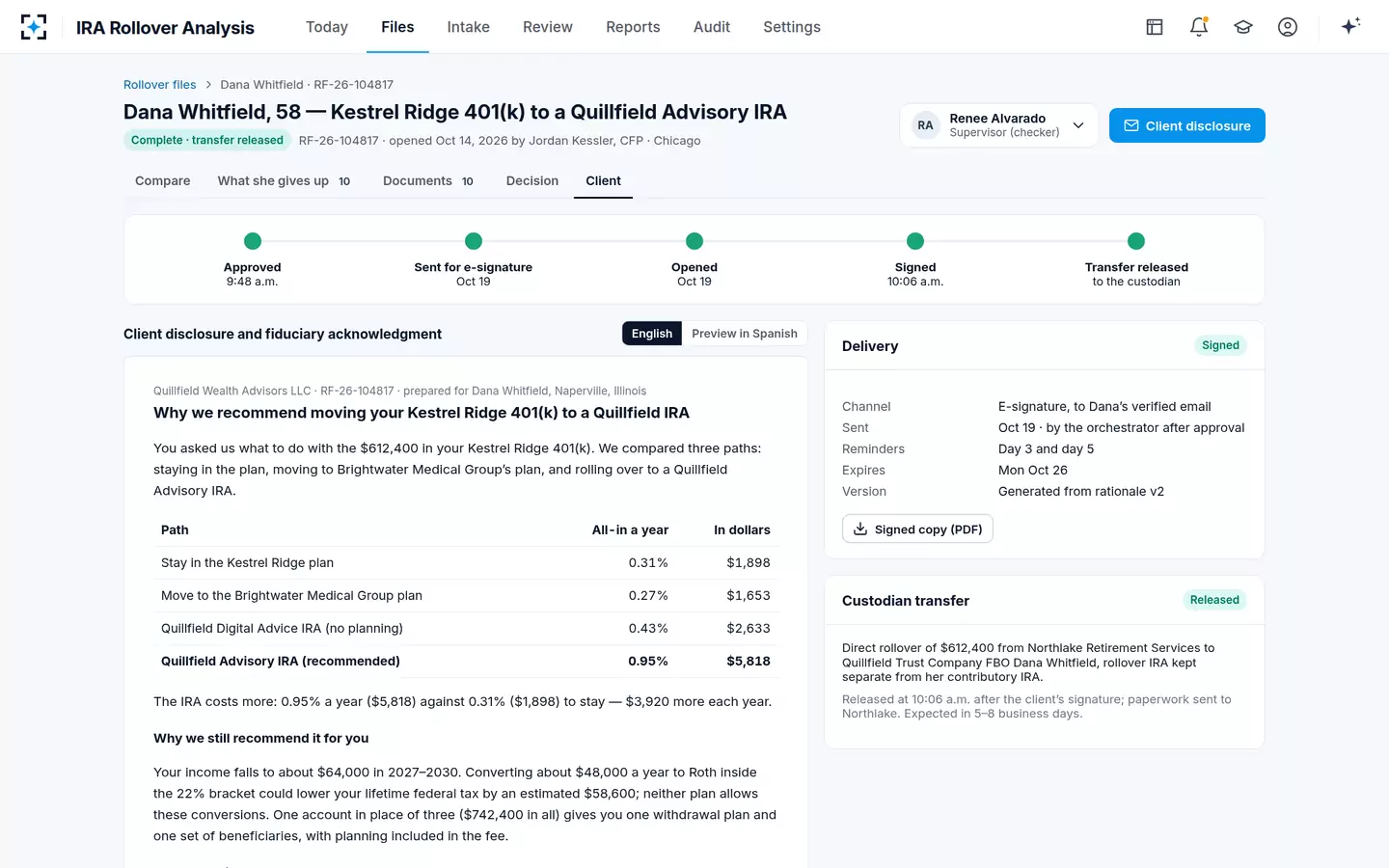
The exemption requires that the reasons and the acknowledgment be provided before the rollover. The signature here is how the firm proves it.
The rollover disclosure: specific reasons, delivered before the rollover
This is the condition people mean when they search for a "PTE 2020-02 rollover disclosure form". Section II(c)(3) requires the firm to document "the specific reasons that any recommendation to roll over assets" from a plan to another plan or an IRA, from an IRA to a plan or another IRA, "or from one type of account to another (e.g., from a commission-based account to a fee-based account)" is in the investor's best interest. Section II(b)(3) then requires the firm to provide that documentation to the investor before the rollover happens.
The exemption prescribes no form. "Specific" is the operative word: the reasons must belong to this investor, which is why a template sentence that would fit any client is the most common weakness examiners find. What a specific reason looks like, and how to test a draft for one, is the subject of the rollover rationale critic. Note the scope as well: account-type changes and IRA-to-IRA moves are covered, not only 401(k) rollovers.
Who is a Senior Executive Officer under PTE 2020-02?
"The chief compliance officer, the chief executive officer, president, chief financial officer, or one of the three most senior officers of the Financial Institution" (Section V(l)). The officer must certify, each year, having reviewed the retrospective review's report, that the firm has policies and procedures "prudently designed to achieve compliance", and that it has a prudent process to modify and test them. The review, report and certification are due within six months of the end of the period. How to build that review so the certification rests on every file is covered in the retrospective review guide.
Where the SEC's and FINRA's rules add signatures and deliveries
A broker-dealer must deliver its relationship summary, Form CRS, to an existing retail customer before or at the time it recommends that the investor "roll over assets from a retirement account into a new or existing account or investment" (17 CFR 240.17a-14(c)(2)(ii)), and must record the date it did so. Supervision of the recommendation by a registered principal comes from FINRA's rules and the firm's written procedures. These sit alongside the exemption, not inside it, and an examiner will look for both: the SEC's fiscal 2027 examination priorities name "account and rollover recommendations" for broker-dealers (SEC, October 23, 2026).
One rollover file, from draft to certification: who signs at each step
Agent
Draft the reasonsThe Rationale Drafter writes the specific reasons and the client disclosure from the cited costs and the services flagged.
Never: submit
A person decides
Advisor submitsThe advisor reads the cited draft, asks for changes in plain words and submits it under his name.
Agent
Critic checksThe Rationale Critic runs seven checks, including a test of whether the reasons would fit other clients.
Never: approve
A person decides
Principal decidesA different registered principal approves or sends back with a reason code and an electronic signature; a second principal above the thresholds.
A person decides
Client signsThe client receives the reasons, the acknowledgment and the conflicts description, and signs to confirm receipt.
Agent
Release and recordThe transfer is released only after approval and signature; every step is recorded with the evidence.
A person decides
Officer certifiesThe chief compliance officer certifies the retrospective review built from every closed file.
One file, five signers: the sample file in IRA Rollover Analysis
In the sample file, an advisor recommends rolling a 58-year-old client's $612,400 401(k) into the firm's advisory IRA at 0.95% a year, against 0.31% to stay. The first draft fails three of eight items checked against PTE 2020-02 and Reg BI, and the supervisor sends it back with reason code SB-02 and her note. The advisor asks for a revision; the second draft passes every check, and the supervisor approves it with reason code AP-01 and her electronic signature. Because the file sits under the firm's thresholds of $5,000 a year and 0.75 percentage points, one principal is enough.
The supervisor's signature, and what it does and does not release
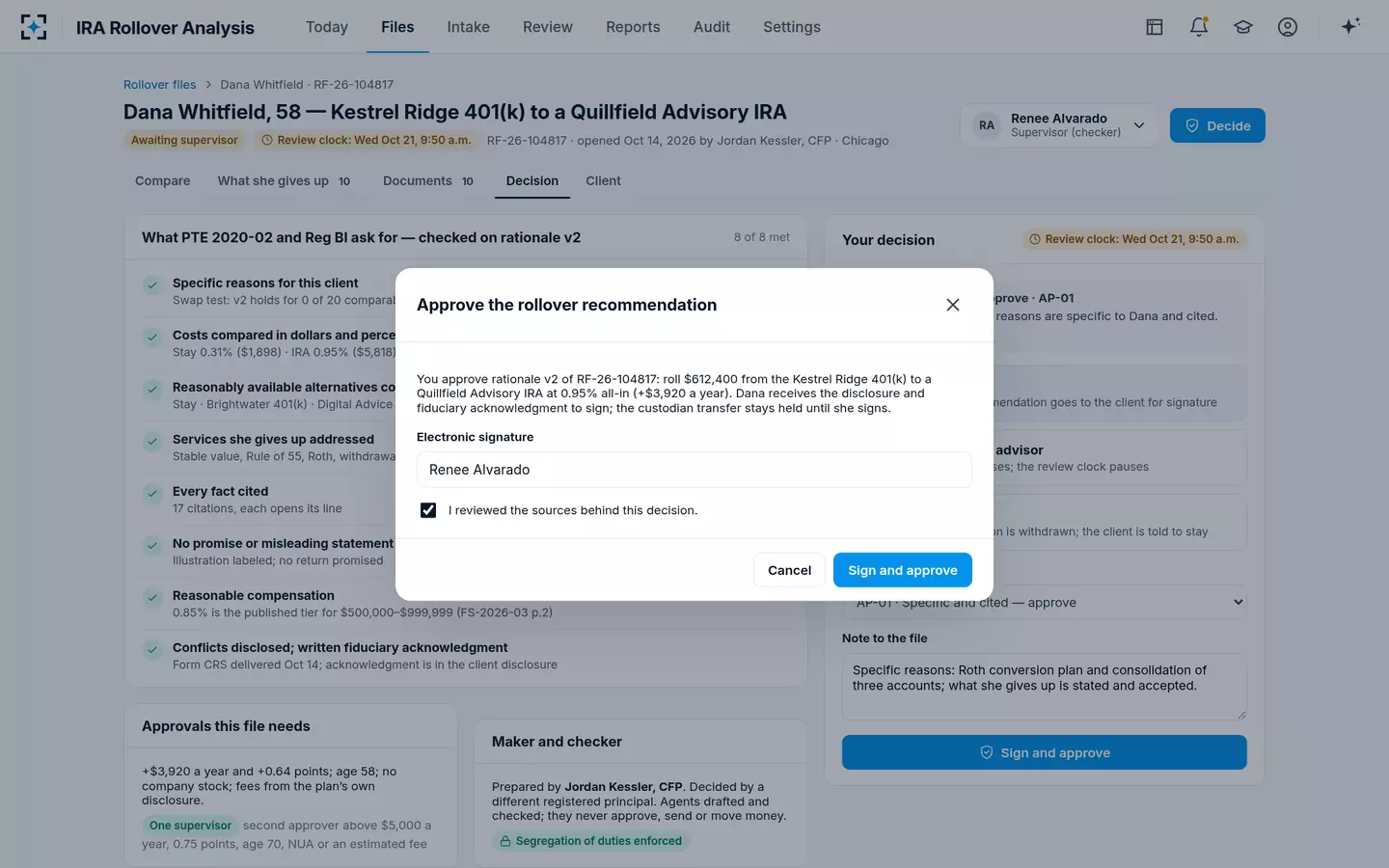
PTE 2020-02 requirements: what a rollover file should show, signer by signer
- The advisor's analysis
Costs of each path, alternatives considered, the client's profile, at the time of the advice.
- The specific reasons, documented
This client's facts, not a template; versioned.
- Delivery before the rollover
Reasons, acknowledgment and services-and-conflicts description, with the time each was provided.
- Reasonable compensation
The fee tier charged against the published schedule.
- A principal's approval and reason code
From the firm's procedures and securities rules; a second approver where the firm's thresholds require it.
- Form CRS delivery date
For a broker-dealer, at or before the rollover recommendation.
- Inclusion in the retrospective review
The file re-checked and counted in the report the Senior Executive Officer certifies.
- Six years of records
Everything above, retrievable for DOL on request.
Questions people ask
Does the client have to sign the PTE 2020-02 acknowledgment?
The exemption requires the firm to provide a written acknowledgment of fiduciary status before the transaction; it does not require the investor's signature. A firm may collect one anyway, because it proves the acknowledgment and the reasons were delivered before the rollover.
Is there a PTE 2020-02 disclosure template?
DOL's text sets the contents but no form: the fiduciary acknowledgment, an accurate description of services and material conflicts, and, for a rollover, the documented specific reasons. Firms write their own, and the reasons part must be specific to each investor.
Does PTE 2020-02 apply to IRA-to-IRA transfers?
The documentation condition covers recommendations to move assets from an IRA to another IRA, from an IRA to a plan, and from one type of account to another, such as from a commission-based to a fee-based account, as well as plan-to-IRA rollovers.
Can robo-advice rely on PTE 2020-02?
No. The exemption excludes transactions resulting from advice "generated solely by an interactive website" with no personal interaction with an investment professional. A digital offer with an investment professional involved is not excluded on that ground.
How long must PTE 2020-02 records be kept?
Six years. Section IV covers records showing compliance with the exemption, and Section II(d) covers the retrospective review's report, certification and supporting data, which must reach DOL within 10 business days of a request.
What happens if a firm breaks a condition?
It can self-correct if the investor had no loss or was made whole, the fix comes within 90 days of when the firm learned or should have learned of it, DOL is told within 30 days of the fix, and the review report records it. A systematic or intentional pattern can lead to ten years of ineligibility after DOL's warning and a six-month chance to cure.