An IRA rollover recommendation meets the best interest standard only when the firm has weighed what the client keeps or gives up by leaving the employer's plan, not just what each path costs. Under Reg BI's care obligation and PTE 2020-02, that means the fees on each path plus the plan-only features that do not follow the money: penalty-free withdrawals after separating at 55, plan loans, a stable value fund at book value, ERISA's creditor protection, delayed required distributions for someone still working, and employer stock. SEC staff list these factors by name, and PTE 2020-02 requires the specific reasons for each rollover to be documented and given to the investor before it happens. The work is hard because the features live in plan documents the advisor rarely has, and a rationale written from memory misses them. Botminds' IRA Rollover Analysis reads the plan's own rules and has a Services agent flag each difference on each path before a rationale can pass review.
The worked example on this page is sample data on a fictional client, plan and firm, used across the series.
One sample rollover file, before the plan features were weighed
10
differences between staying, the IRA and the new employer's plan, read from the plans' own rules
5
of them material for this client
0
addressed in the first draft of the rationale, which the supervisor sent back
7/7
critic checks passed by the second draft, which named all five
What must a rollover best interest analysis weigh besides cost?
It must weigh the services and features of each path, as they apply to this client. The SEC staff bulletin on account recommendations lists the factors firms "should generally consider when making a rollover recommendation to a retail investor": "costs; level of services available; features of the existing account, including costs; available investment options; ability to take penalty-free withdrawals; application of required minimum distributions; protection from creditors and legal judgments; and holdings of employer stock" (SEC staff bulletin, March 30, 2022; staff views, not a rule).
FINRA had set out the same list in 2013, with the observation that a departing participant typically has four options, to stay, move to a new employer's plan, roll to an IRA or cash out, "and may engage in a combination of these options" (FINRA Regulatory Notice 13-45). The combination matters: a partial rollover that leaves some money in the plan is often the answer that keeps the feature the client needs.
One factor works in the other direction. The SEC bulletin notes that the Commission "has cautioned broker-dealers not to rely on an IRA having 'more investment options' as the basis for recommending a rollover." A rationale whose main reason is choice, and which says nothing about what the plan offers, has the analysis backwards.
Six plan features a rollover can end, as the general rules stand
In the employer's plan: Withdrawals free of the 10% additional tax after separating in or after the year the employee turns 55 (50 for qualified public safety employees).
In a rollover IRA: The exception does not apply; before 59½ the additional tax is due unless another exception fits.
In the employer's plan: Available if the plan offers them, within the plan's and the tax code's limits.
In a rollover IRA: Not permitted from IRAs, in the IRS's words.
In the employer's plan: ERISA requires that benefits "may not be assigned or alienated".
In a rollover IRA: Protected in bankruptcy, with rolled-over plan money outside the indexed cap; outside bankruptcy, state law decides.
In the employer's plan: If offered, transacts at book value under a wrap contract.
In a rollover IRA: A plan-only fund cannot follow; substitutes are valued at market.
In the employer's plan: In the current employer's plan, may wait until retirement if the plan allows.
In a rollover IRA: Begin for the year the owner reaches 73, working or not.
In the employer's plan: Distributed in kind, the appreciation can be taxed later as capital gain.
In a rollover IRA: Rolled in kind, every dollar withdrawn is ordinary income.
What PTE 2020-02 asks the firm to write down
PTE 2020-02 asks for the reasons, specifically, before the money moves. Section II(c)(3) of the exemption requires that the financial institution "documents the specific reasons that any recommendation to roll over assets from a Plan to another Plan or an IRA … is in the Best Interest of the Retirement Investor", and Section II(b)(3) requires that documentation to be provided to the investor "prior to engaging in a rollover recommended pursuant to the exemption". The Department of Labor republished the exemption as originally granted on March 20, 2026, after the courts vacated the 2024 rule and its amendments (DOL, 91 FR 13503).
The exemption does not list the features to weigh; the regulators' factor lists do that. What the exemption adds is the test of specificity. A reason that would fit any client is not a specific reason, and a rationale that never mentions the stable value fund holding a quarter of the client's balance is not specific to that client. Who signs each condition, and when, is set out in PTE 2020-02 requirements, signature by signature.
FINRA's examiners look at the supervisory side. Its 2026 oversight report criticises procedures "requiring documentation of rationale, but not following up on generic or insufficient rationales", and procedures that fail to address "the factors to consider when recommending a particular account type, such as the costs associated with such accounts and the services provided (including whether the customer was already receiving such services)" (FINRA, 2026 Annual Regulatory Oversight Report).
Penalty-free withdrawals: the Rule of 55 stays with the plan
For a client between 55 and 59½ who will need money, the Rule of 55 is usually the most valuable plan feature, and a full rollover ends it. The IRS exception applies when "the employee separates from service during or after the year the employee reaches age 55 (age 50 for public safety employees of a state, or political subdivision of a state, in a governmental defined benefit or defined contribution plan)", and the IRS table marks it "yes" for qualified plans and "no" for IRAs (IRS, exceptions to tax on early distributions). The age-50 version also covers "specified federal law enforcement officers, corrections officers, customs and border protection officers, federal firefighters, private-sector firefighters, and air traffic controllers".
Three facts decide whether the feature matters on a given file: the calendar year of separation, whether the client will draw before 59½, and whether the plan allows partial withdrawals after separation, which the tax exception does not require it to do. The cost is easy to state in dollars, and it scales with the draws.
Three years of $40,000 draws before 59½: the additional tax by where the money sits
The third bar is the one rationales most often skip, and it is the one FINRA's "combination of these options" points to. Leaving the bridge money in the plan keeps the exception for exactly the dollars that need it and moves the rest. Whether that is better depends on the plan's withdrawal rules and costs, which only the plan's documents settle.
Loans, stable value and creditor protection: the features that do not travel
Three features are structurally plan-only, and the analysis should treat each as a fact to establish, not a talking point. Loans first: "Loans are not permitted from IRAs or from IRA-based plans such as SEPs, SARSEPs and SIMPLE IRA plans" (IRS, retirement plan loan FAQs). For a former employee the old plan's loan program may not apply anyway, but an outstanding loan at separation can be offset against the balance, and the file then needs the deadline for rolling the offset amount stated.
Stable value is the feature hardest to replace. The ERISA Advisory Council described such a fund as typically managed "with a wrap contract that guarantees book value to participants for participant-initiated events, such as transfers to other investment options and plan distributions", and warned that stable value funds "are commonly viewed as comparable to money market mutual funds, but differ significantly" (ERISA Advisory Council, 2009; an advisory body's report, not DOL policy). The plan's 404(a)(5) participant disclosure is where the current crediting rate and any guaranteed minimum appear (29 CFR 2550.404a-5), as the annotated 404a5 fee disclosure shows line by line.
Creditor protection changes less in bankruptcy than clients fear and more outside it. ERISA requires that "Each pension plan shall provide that benefits provided under the plan may not be assigned or alienated" (29 U.S.C. 1056(d)(1)). In bankruptcy, IRA assets are exempt up to a cap computed "without regard to amounts attributable to rollover contributions" from qualified plans "and earnings thereon"; the cap itself is $1,711,975 after the Judicial Conference's 2025 adjustment (11 U.S.C. 522(n)). Keeping rollover money in its own IRA preserves the evidence of which dollars came from the plan. Outside bankruptcy, FINRA's notice puts it simply: "State laws vary in the protection of IRA assets in lawsuits."
Required distributions and the still-working exception
For an older client who is still employed, the plan of the current employer can delay required distributions; an IRA cannot. The IRS sets the IRA's first required distribution by "April 1 of the year following the calendar year in which you reach age 73", while a 401(k) or 403(b) can wait until April 1 following "the later of the calendar year in which you: reach age 73, or retire (if your plan allows you to delay taking your RMD until retirement)" (IRS, required minimum distributions).
That turns the new employer's plan into a real alternative for some clients. A client who has moved to a new employer, plans to work past 73 and whose new plan accepts roll-ins can defer distributions on the rolled dollars too; the same move into an IRA would not. The analysis should price the new employer's plan as a path in its own right, which is why the solution's Cost agent prices staying, the IRA and the new employer's plan side by side.
Which plan features are material for this client?
A feature is material when the client is likely to use it or would bear a real cost from losing it, and the file should say which features meet that bar and why. A Rule of 55 exception means nothing to a client who will not draw before 59½; it can be worth more than several years of fee savings to one who will. Listing every feature as a disclaimer is as unhelpful to a supervisor as listing none.
Ten differences on one sample file, five marked material
| Plan feature | Staying in the plan | Firm advisory IRA | Material for this client? |
|---|---|---|---|
| Stable value fund | $148,200 at 3.10%, book value | No equivalent; a 1–5 year Treasury ladder at market | Yes: 24% of the balance |
| Rule of 55 | Separated at 58; plan withdrawals free of the 10% additional tax | Additional tax applies before 59½, until September 12, 2027 | Yes, only if she draws before then |
| Roth conversions | As the plan's rules allow | Partial conversions of about $48,000 a year planned | Yes |
| Partial withdrawals | Restricted by the plan | Any amount, subject to tax | Yes |
| Advice | As the plan's services provide | Ongoing planning and advice | Yes |
| Creditor protection | ERISA | Separate rollover IRA, protected in bankruptcy | Small |
| Loans, required distributions, company stock, share classes | Compared from the plan rules | Compared | Not material on this file |
IRA Rollover Analysis shows what the client gives up, path by path
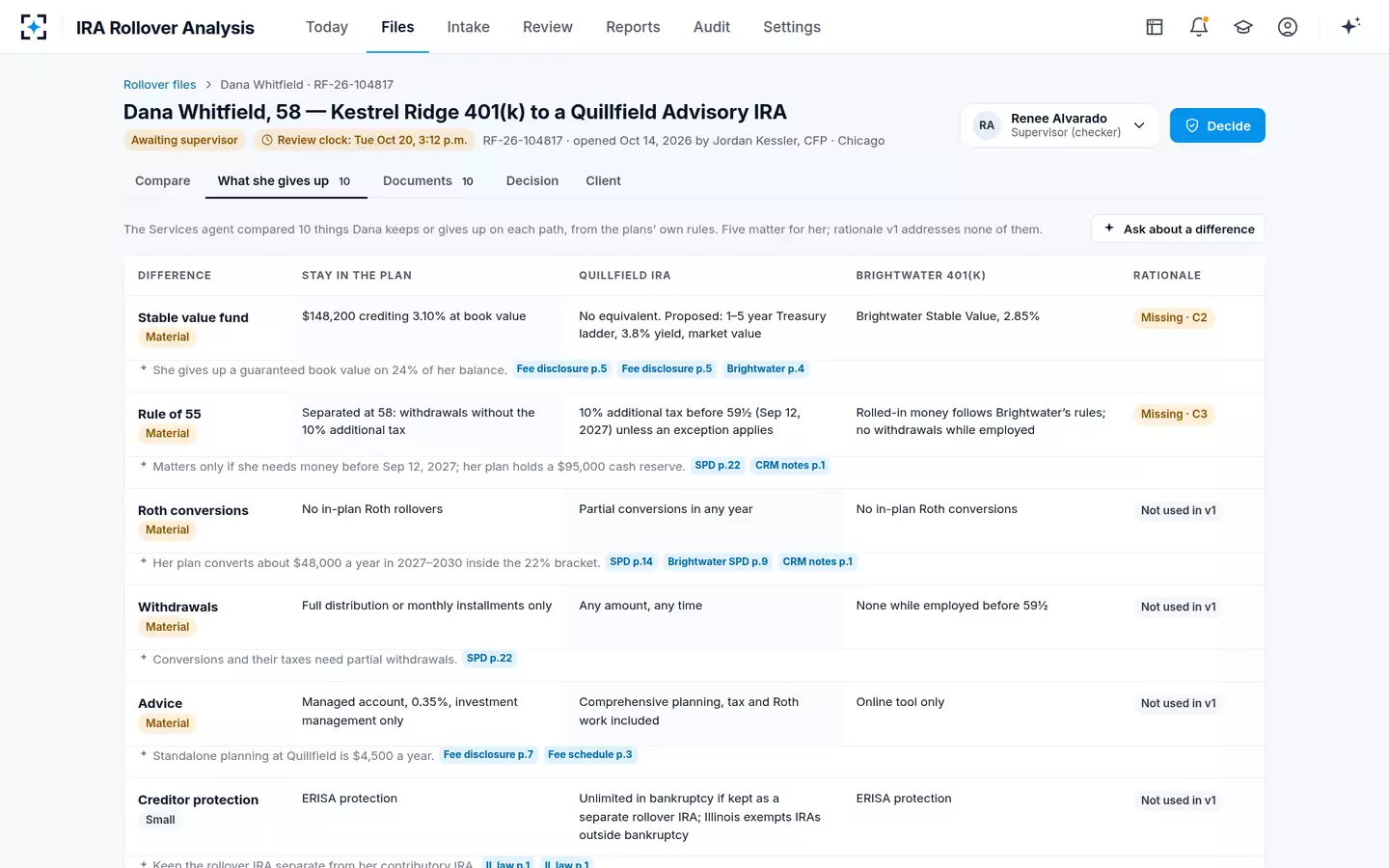
The new employer's plan has its own stable value fund at 2.85%, which makes it a third path worth pricing, not just a comparison column.
From flags to a rationale a supervisor can approve
The rationale has to name each material feature, say what the client gives up, and give the client's own reason for accepting it. In the sample, the first draft's third sentence read "An IRA will give you more investment choices and greater flexibility to meet your goals"; it held for most of the month's files and addressed none of the five material differences. The supervisor sent it back with a reason code: address the stable value fund, the Rule of 55 and the new employer's plan, and give the client's own reasons.
The second draft did. It cited the client's plan for partial Roth conversions of about $48,000 a year over four years inside the 22% bracket, consolidated three accounts totalling $742,400, and stated each feature given up and why she accepted it. It passed all seven of the Rationale Critic's checks and held for none of twenty comparable files in the swap test. At $3,920 a year more than staying and 0.64 points, it sat under the firm's second-approver thresholds, so one principal decided. How the critic argues with every draft is in the rollover rationale critic.
Where rollover best interest files fail
The common failures are omissions, and each one can be tested on a closed file. The checklist below is what a supervisor can run before approval and a retrospective reviewer after it.
Nine checks on the plan features in a rollover file
- Were the plan's own documents read?
Summary plan description, 404(a)(5) disclosure and the latest statement, not a general description of 401(k)s.
- Separation at 55 or later (50 for public safety)?
Will the client draw before 59½, and does the plan allow partial withdrawals?
- Outstanding loan?
Will it be offset, and is the deadline for rolling the offset amount stated?
- Stable value or another fixed-return option?
Book value, crediting rate, any guaranteed minimum, and whether it exists outside the plan.
- Employer stock?
Rolling it in kind ends net unrealized appreciation treatment; the file needs the basis and both paths.
- Still working past 73?
The current employer's plan may delay required distributions; price it as a path.
- Creditor exposure?
Rollover money kept in its own IRA; the state rule identified where it matters.
- Were the alternatives priced, including a partial rollover?
Stay, the new employer's plan, the IRA, and combinations of them.
- Does each material feature appear in the rationale with the client's reason?
And would the rationale fail if pasted into another client's file?
Employer stock gets a page of its own because its inputs come from the recordkeeper and its consequences cannot be reversed; the NUA analysis guide sets out what that part of the file must show.
How IRA Rollover Analysis puts plan features in front of the supervisor
The Services agent compares the plans' own rules, from the summary plan description, the fee disclosure and the client's statements, and flags each difference on each path: stable value, the Rule of 55, creditor protection, loans, Roth conversions, withdrawals, advice, required distributions, company stock and share classes. It flags; it does not give legal or tax advice, and a flag below 0.85 confidence goes to a retirement specialist. The Rationale Critic then checks that every material flag is addressed, and cannot be switched off for a file.
The supervisor sees which flags are missing from the draft before deciding, and the custodian transfer stays held until the file is approved and the client has signed the disclosure. A firm evaluating any rollover tool can test this directly: give it a plan with a stable value fund and a client who separated at 56, and see whether the draft it produces would survive a supervisor who reads the plan document.
Questions people ask
What factors must be considered in an IRA rollover recommendation?
SEC staff list costs, services, features of the existing account, investment options, penalty-free withdrawals, required minimum distributions, creditor protection and employer stock. FINRA's Regulatory Notice 13-45 sets out the same factors, and both apply them in light of the client's own profile.
Does the Rule of 55 apply after a 401(k) is rolled into an IRA?
No. The IRS marks the separation-from-service exception "yes" for qualified plans and "no" for IRAs, so withdrawals from the IRA before 59½ owe the 10% additional tax unless another exception applies. Leaving part of the balance in the plan keeps the exception for those dollars.
Is "more investment options" a valid reason for a rollover?
Not on its own. The SEC staff bulletin notes the Commission cautioned broker-dealers not to rely on an IRA having "more investment options" as the basis for a rollover recommendation, and a reason that fits every client is not the specific reason PTE 2020-02 requires.
Is a rollover IRA protected from creditors?
In bankruptcy, amounts rolled over from a qualified plan, and their earnings, are protected without regard to the IRA cap of $1,711,975 under 11 U.S.C. 522(n). Outside bankruptcy, protection depends on state law, while plan benefits are protected by ERISA's anti-alienation rule.
Can a client take a loan from a rollover IRA?
No. The IRS says loans are not permitted from IRAs or IRA-based plans; they are possible only from qualified, 403(b) and governmental plans that offer them. An outstanding plan loan at separation may be offset, which has its own rollover deadline.
When should the new employer's plan be priced as an alternative?
Whenever it accepts roll-ins. It can keep ERISA protection, may offer its own stable value fund and, for a client still working past 73, may delay required distributions. In the sample, the new employer's 401(k) cost 0.27% a year against 0.95% for the firm's advisory IRA.