An NUA analysis is the part of a rollover recommendation that deals with employer stock held in the client's 401(k) or other qualified plan. It establishes the plan's cost basis in the shares, the net unrealized appreciation above it, whether the client can take a lump-sum distribution this tax year, and what each path does to the tax character of that appreciation: distributed in kind, the appreciation can be taxed later as long-term capital gain; rolled to an IRA, every dollar withdrawn becomes ordinary income. For the firm, the analysis is evidence. SEC staff name "holdings of employer stock" among the factors in a rollover recommendation, and PTE 2020-02 requires the specific reasons for each rollover to be documented and given to the investor before it happens. The hard part is that the basis sits with the recordkeeper, not on the statement. Botminds' IRA Rollover Analysis flags company stock on every file, requests the basis, lays out both paths and holds the file for a second approver.
The worked figures on this page are sample data on fictional people and plans.
Why employer stock gets its own line in a rollover file
Box 6
of Form 1099-R carries the NUA on which tax is deferred, after the fact
1tax year
for the entire balance to leave all of the employer's plans of that kind
0
ways to restore NUA treatment once the shares are rolled into an IRA
2
approvals a company-stock file needs under the solution's default settings
Why is employer stock a named factor in rollover recommendations?
Because the tax cost of getting it wrong is permanent and falls on the client, and every regulator that has listed rollover factors has listed it. The SEC staff bulletin on account recommendations gives the list a firm should weigh when recommending a rollover: services available, "features of the existing account, including costs; available investment options; ability to take penalty-free withdrawals; application of required minimum distributions; protection from creditors and legal judgments; and holdings of employer stock" (SEC staff bulletin, March 30, 2022; staff views, not a rule).
FINRA said it a decade earlier and more bluntly. "An investor who holds significantly appreciated employer stock in a plan should consider the negative tax consequences of rolling the stock to an IRA. If employer stock is transferred in-kind to an IRA, stock appreciation will be taxed as ordinary income upon distribution" (FINRA Regulatory Notice 13-45).
For a fiduciary relying on PTE 2020-02, the exemption turns those factors into a documentation duty. Section II(c)(3) requires that the financial institution "documents the specific reasons that any recommendation to roll over assets from a Plan to another Plan or an IRA … is in the Best Interest of the Retirement Investor", and Section II(b)(3) requires that documentation to reach the investor before the rollover. The Department of Labor's notice of March 20, 2026 republished the exemption as granted in 2020, after the courts vacated the 2024 rule and its amendments (DOL, 91 FR 13503). A rationale that is silent on company stock, for a client who holds it, is missing a reason the reviewer cannot supply.
The tax rules an NUA analysis turns on
Four rules from the tax code and IRS guidance decide what the analysis has to establish. The statute excludes from gross income "the net unrealized appreciation attributable to that part of the distribution which consists of securities of the employer corporation" in a lump-sum distribution (26 U.S.C. 402(e)(4)(B)). IRS Publication 575 translates that into working rules.
Four rules that decide what the client's employer stock costs in tax
| Rule | What IRS Publication 575 says | What the analysis must establish |
|---|---|---|
| What NUA is | NUA is "the net increase in the securities' value while they were in the trust"; it covers the employer's "stocks, bonds, registered debentures, and debentures with interest coupons attached" | Every employer security in the plan, in any fund or account, and the plan's cost of each |
| The lump-sum test | The participant's "entire balance (within a single tax year) from all of the employer's qualified plans of one kind", paid after death, age 59½, separation from service or disability | A triggering event, and every plan of that kind with the employer, emptied in one tax year |
| Partial deferral | Outside a lump sum, "tax is deferred only on the NUA resulting from employee contributions" | Whether the stock was bought with employee or employer money, if a lump sum is not possible |
| Sale and reporting | Gain is "long-term capital gain up to the amount of the NUA"; the deferred NUA "should be shown in box 6 of the Form 1099-R" | That the client and their tax adviser know how the gain will be reported, and when |
Two further rules shape the transaction itself. Publication 575 says an eligible rollover distribution "isn't subject to withholding to the extent it consists of NUA from employer securities that can be excluded from your gross income", so the in-kind shares do not trigger the 20% withholding that the cash part might. And IRS Topic 412 closes the door behind a rollover: "If you do a rollover, the regular IRA distribution rules will apply to any later distributions, and you can't use the special tax treatment rules for lump-sums" (IRS Topic 412).
The inputs, where each comes from, and who confirms it
An NUA analysis needs six inputs, and only one of them is on the statement a client brings to the first meeting. The rest come from the plan, its recordkeeper or the client's own history, so the request has to go out when the file opens, not when the rationale is written.
Six inputs to an NUA analysis, and the document each comes from
| Input | Where it comes from | Who confirms it | If it is missing |
|---|---|---|---|
| Market value of the employer stock | Latest plan statement | Fee and statement reading, checked to the statement total | The file cannot be priced |
| Plan's cost basis in the shares | Recordkeeper, on request | Retirement specialist | Marked estimated; the file waits for a person |
| Triggering event | Employment status, age, plan terms | Retirement specialist | Lump-sum treatment cannot be assumed |
| Other plans of the same kind with the employer | Plan document library, client interview | Advisor | A second plan left behind breaks the lump sum |
| Client's age and early-distribution exceptions | Client profile, plan terms | Advisor | The 10% additional tax on the basis is unknown |
| Client's intentions for the shares | Planning notes | Advisor, with the client | The rationale cannot say why one path fits |
The basis deserves the emphasis. Without it there is no NUA figure, only a guess at one, and a guess presented as a number is the kind of fact an examiner will ask the firm to source. In IRA Rollover Analysis the Intake agent requests it from the recordkeeper with the other plan documents, and any figure that does not come from the plan is labelled estimated and routed to a specialist before an agent uses it.
One block of employer stock, two tax paths, worked through
The comparison a supervisor needs to see is short: what is taxed now, what is taxed later and at what character, on each path. Take a fictional client, 61, separating from a fictional manufacturer with $800,000 in its 401(k), of which $300,000 is the company's stock. The recordkeeper reports the plan's cost of those shares as $60,000, so the NUA is $240,000.
The same $300,000 of employer stock, sorted by how it would be taxed
On the NUA path the client takes the whole balance in one tax year: the shares go in kind to a taxable brokerage account and the other $500,000 goes by direct rollover to an IRA. Ordinary income tax is due on $60,000 for that year; the $240,000 is long-term capital gain whenever the shares are sold. On the rollover path all $800,000 goes to the IRA, nothing is taxed now, and the full $300,000 of stock value becomes ordinary income as it is withdrawn. At 61 the client is past 59½, so the 10% additional tax does not reach the $60,000; for a younger client it would, unless an exception applies.
When does rolling the employer stock still make sense?
Rolling the stock can be the right recommendation, and the file should say so when it is. FINRA's own notice makes the counter-case: "The tax advantages of retaining employer stock in a non-qualified account should be balanced with the possibility that the investor may be excessively concentrated in employer stock," and "for some investors, it may be advisable to liquidate the holdings and roll over the value to an IRA, even if it means losing long-term capital gains treatment on the stock" (FINRA Regulatory Notice 13-45).
The cases where the NUA path is weakest are recognisable from the inputs: a cost basis close to market value, so there is little appreciation to protect; a client who needs to diversify at once and would sell the shares within days of distribution; a stock that is a small share of the balance; or a client whose income in retirement will be low enough that the rate gap barely exists. A concentrated position also carries risk that the tax treatment does not offset. None of this makes the analysis optional. It changes what the rationale says, and the rationale has to say it with the client's numbers.
What the rationale must say on a file with company stock
The rationale must name the employer stock, state which path was chosen, and give the reason in terms that fit this client and no other. FINRA's 2026 oversight report criticises supervisory systems that require "documentation of rationale, but not following up on generic or insufficient rationales" (FINRA, 2026 Annual Regulatory Oversight Report). On a company-stock file, generic usually means silent.
Two rationale sentences on the same company-stock file
Generic: fits any client: Not mentioned.
Specific: fits this client: $300,000 of the employer's stock, plan basis $60,000 per the recordkeeper's letter, NUA $240,000.
Generic: fits any client: "Consolidating into an IRA simplifies your finances."
Specific: fits this client: Shares distributed in kind to a brokerage account; the remaining $500,000 rolled directly to the IRA in the same tax year.
Generic: fits any client: "More investment choices and greater flexibility."
Specific: fits this client: The client intends to sell a third of the shares a year over three years; the gain on the NUA is long-term capital gain on each sale.
Generic: fits any client: Not stated.
Specific: fits this client: Ordinary income tax on $60,000 this year; concentration risk while the shares are held, which the client accepted.
Generic: fits any client: Not stated.
Specific: fits this client: The client's tax preparer reviewed both paths; the firm does not give tax advice.
The specific version also protects the firm if the client later regrets the outcome. It shows the question was asked, the basis came from the plan, the client chose with numbers, and a tax professional saw the paths. That is what the rationale critic's seven checks test for on every draft.
Supervising company-stock rollovers: a second approver and a held transfer
The supervisory control that matters is timing: the review has to happen before the transfer instruction is released, because a direct rollover of the shares cannot be reversed. In IRA Rollover Analysis the custodian transfer is held until the file is approved and the client has signed, and under the default settings a file with company stock always needs two approvals, whatever its cost difference.
How IRA Rollover Analysis runs the employer-stock check on a rollover file
Agent
Services agentReads the plan statement and fund menu for employer securities and flags company stock alongside the other plan-only features.
Never: Never gives tax advice
Agent
Intake agentRequests the cost basis from the recordkeeper with the fee disclosure and plan rules.
Never: Never uses an unlabelled estimate
A person decides
Retirement specialistConfirms the basis, the triggering event and whether every plan of that kind can be emptied this tax year.
Agent
Rationale Drafter and CriticState the path chosen and why; the Critic checks the company-stock flag is addressed with cited facts.
A person decides
Advisor and clientChoose the path with the client's tax adviser; the advisor submits the rationale.
A person decides
Two principalsA supervisor and a second approver sign before the transfer is released.
IRA Rollover Analysis flags company stock in the supervisor's queue
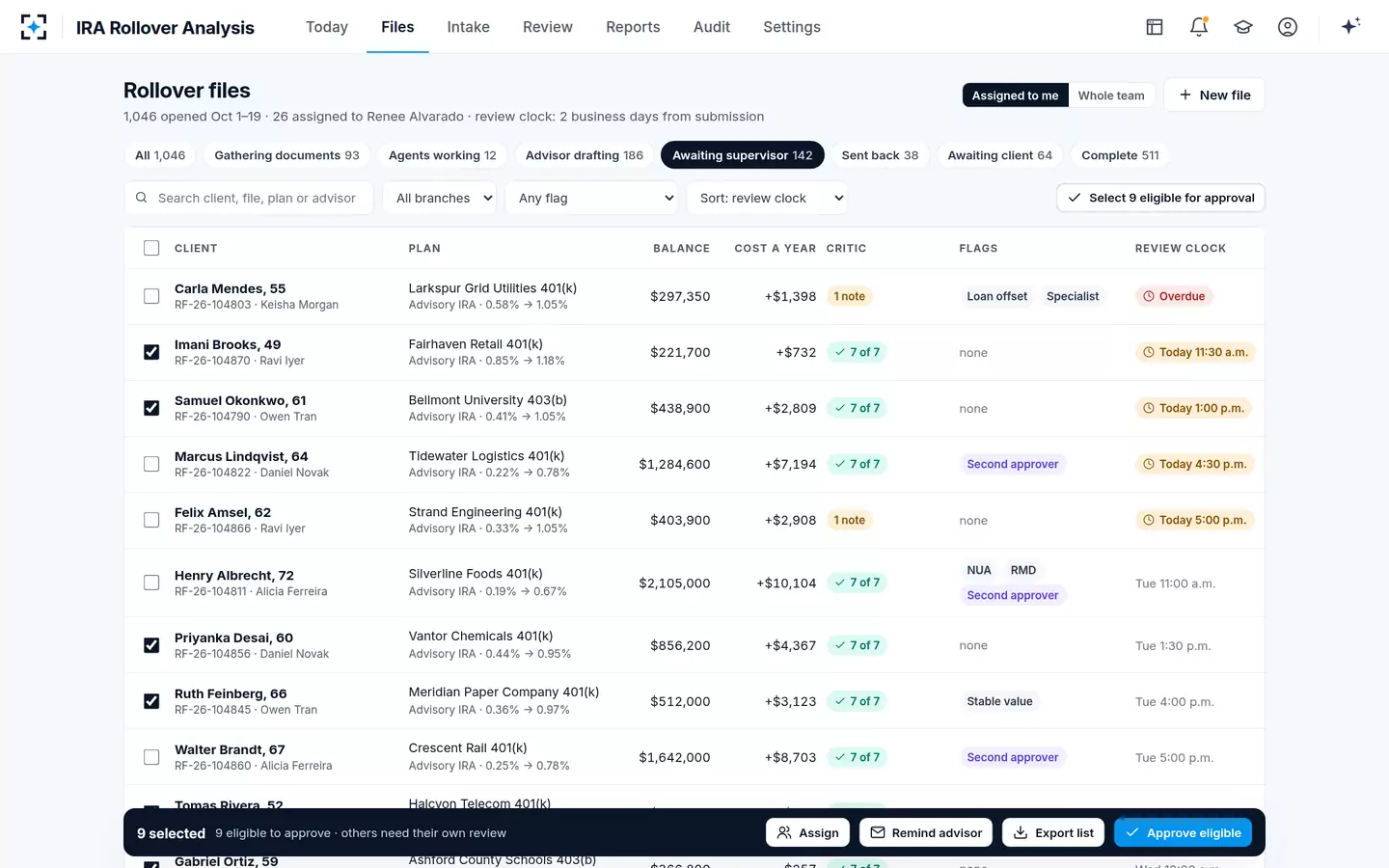
Company stock takes the file out of batch approval: it needs its own review and a second approver.
Batch approval is where the risk concentrates. A supervisor clearing a queue under volume pressure approves files that look alike, and a company-stock file looks like any other file with a cost increase. Taking it out of the batch by rule, not by the supervisor's memory, is the control. The full set of signatures on a rollover file is set out in who signs what in a rollover file.
Where NUA analyses fail, and the check for each
Most failures on company-stock files are failures of sequence or of sourcing, not of tax knowledge. The checklist below is the one a supervisor or a retrospective reviewer can run against any closed file.
Eight checks on a rollover file from a plan that holds employer stock
- Was employer stock identified?
Stock, bonds or debentures of the employer, in any fund or account in the plan.
- Did the basis come from the plan?
A recordkeeper figure, with its date; anything else labelled as an estimate.
- Was the lump-sum test checked?
A triggering event, and every plan of that kind with the employer emptied in one tax year.
- Was the client's age checked against the 10% additional tax?
Under 59½, the taxable basis may owe it unless an exception applies.
- Are both paths shown in numbers?
Ordinary income now and capital gain later, against ordinary income on every IRA withdrawal.
- Does the rationale name the path and the reason?
In the client's facts, so it would not fit another file.
- Did a tax professional see it?
The firm shows the numbers; the client and their adviser make the tax decision.
- Was the transfer held until approval and signature?
With a second approver on every company-stock file.
The retrospective review is where these checks pay twice. PTE 2020-02 requires an annual review of compliance, and a review that samples a few dozen files can easily miss the handful with company stock. In the solution, the Review & Evidence agent re-checks every closed file the day it closes, so each company-stock file is tested against the same list, as the retrospective review guide describes.
What IRA Rollover Analysis does with employer stock, and what it leaves to people
The solution's job is to make sure the question is asked, sourced and answered in writing on every file. The Services agent compares ten things the client keeps or gives up on each path, company stock among them, from the plans' own rules. The Fee Reader cites every figure to its page and line, and below 0.90 confidence a person verifies the value first. The Cost agent prices each path with deterministic arithmetic and never forecasts returns.
What it does not do is as deliberate. It does not give tax advice or choose a tax outcome; it does not decide whether a client should diversify; and it does not approve. A firm evaluating any tool for this work should ask the same three questions: where the basis comes from, what happens when it is missing, and whether a company-stock file can reach the custodian on one signature.
Questions people ask
What is an NUA analysis?
It is the comparison, in a rollover recommendation, of distributing employer stock in kind against rolling it into an IRA. It needs the plan's cost basis, the market value, the lump-sum facts and the client's plans for the shares; IRS Publication 575 sets the rules for the tax character of each path.
Do Reg BI and PTE 2020-02 require an NUA analysis?
Neither uses the term. SEC staff list "holdings of employer stock" among the factors for a rollover recommendation, and PTE 2020-02 Section II(c)(3) requires the specific reasons for each rollover to be documented. For a client who holds employer stock, those reasons cannot be specific without addressing it.
Where does the cost basis for NUA come from?
From the plan, through its recordkeeper. After a distribution, the NUA on which tax is deferred appears in box 6 of Form 1099-R, which is too late for the recommendation; before it, the firm has to request the figure.
Can a client roll part of a 401(k) and still use NUA treatment?
Yes, if the distribution as a whole qualifies as a lump sum: the employer stock is distributed in kind and the rest can be rolled to an IRA, with the entire balance leaving all of the employer's plans of that kind in one tax year. IRS Topic 412 lists rolling over "all or part" of a lump-sum distribution among the options.
Is tax withheld on employer stock distributed in kind?
Not on the NUA. IRS Publication 575 says an eligible rollover distribution is not subject to withholding to the extent it consists of excludable NUA from employer securities; the taxable basis and any cash paid out can still be subject to it.
Should a company-stock rollover always need a second approver?
No rule requires one, but the loss of NUA treatment cannot be reversed once the shares reach an IRA, which is why IRA Rollover Analysis makes a second approval the default for every file with company stock. The firm's administrator can change the setting, with compliance approving the change.