Yes, PTE 2020-02 is still in effect. The Department of Labor's notice of March 20, 2026 republished the exemption's operative text exactly as granted on December 18, 2020, and said its action "leaves in full effect each term and condition of PTE 2020-02 as originally granted" (91 FR 13503, effective April 20, 2026). What the courts removed is the 2024 Retirement Security Rule, which never took effect, the 2024 amendments to the exemption, and, in DOL's own reading, every word of the exemption's 2020 preamble. For a firm that recommends rollovers, the conditions stand: impartial conduct, a written fiduciary acknowledgment, documented specific reasons for each rollover given to the investor before it happens, and an annual retrospective review. Botminds' IRA Rollover Analysis exists for that file: its agents read the plan's fee disclosure, price staying against rolling, and draft a cited rationale that a supervisor then approves or sends back.
The status question is common because the history is tangled: two rules, two exemptions' worth of amendments, three district courts, an appeal and a set of FAQs. The timeline below sorts it into three strands, because they ended differently. One strand, the exemption itself, never changed.
Three strands, three different endings: only the exemption was never touched
- In force as granted2020–2026
- Before the 2024 ruleto Apr 2024
- Adopted, then stayedApr 2024 – Mar 2026
- VacatedMar 2026 on
- Guidance in useDec 2020 – Feb 2023
- FAQ 7 policy vacatedFeb 2023 – Jul 2025
- Partly vacated2025–26
- Treated as vacatedMar 2026 on
Is PTE 2020-02 still in effect after the 2024 rule was vacated?
It is, and in its original form. The exemption lets an investment advice fiduciary, and the firm it works for, receive compensation that ERISA and the Internal Revenue Code would otherwise prohibit, including on a rollover from a plan to an IRA. DOL's 2026 notice says that neither court that heard the challenges "questioned the procedural aspects of the Department's grant of PTE 2020-02", including the findings that the exemption is administratively feasible and protective of participants and IRA owners. Those findings, it says, "continue to be expressed through the exemption's conditions".
So a firm relying on the exemption today works to the text published on December 18, 2020, which DOL reprinted in full as Part II of the notice "as a matter of convenience". The exemption is not codified in the Code of Federal Regulations, so the reprint is the most convenient official copy to cite. The 2024 amendments, which would have rewritten the disclosure and policy conditions, are gone: the Northern District of Texas stayed them in July 2024, the appeal was dismissed in November 2025, and the final judgment followed in March 2026.
The money moving through these conditions is large. Taxpayers reported $682.4 billion of rollover contributions into IRAs for tax year 2023, from 5.86 million taxpayers, about $116,500 each on average (IRS Statistics of Income, IRA study, June 2026; the average is our arithmetic). Not every one of those rollovers followed a fiduciary recommendation, but every one that did is a file the conditions below apply to.
Four dates a compliance manual about PTE 2020-02 should carry
Dec 182020
PTE 2020-02 granted; this is the text in force
Mar 172026
the later of two final judgments (E.D. Texas ruled March 12)
Mar 202026
DOL notice republishes the exemption, 91 FR 13503
Apr 202026
the notice takes effect
What happened to the 2024 Retirement Security Rule?
It never took effect, and it is now vacated. DOL published the Retirement Security Rule on April 25, 2024 to replace the 1975 definition of an investment advice fiduciary, together with amendments to PTE 2020-02. Suits followed in May 2024 in the Eastern and Northern Districts of Texas, and on July 25 and 26, 2024 those courts stayed the rule's effective date; the Northern District also stayed the exemption amendments. The Fifth Circuit dismissed the consolidated appeal on November 28, 2025, on the appellant's motion, and the district courts entered final judgment on March 12, 2026 (Eastern District) and March 17, 2026 (Northern District).
DOL's notice puts the consequence plainly: "Because the 2024 Fiduciary Rule never became effective, and the Five-part Test Regulation was never replaced", the notice conforms the Code of Federal Regulations to the 1975 text. Nothing a firm built for the 2024 rule ever became a legal requirement. Insurance-only annuity sales are a different story, because the stayed amendments also touched PTE 84-24; our guide to the DOL fiduciary rule in 2026 covers what governs annuity recommendations now.
Is the PTE 2020-02 preamble still valid? DOL says rely on none of it
No. The 2026 notice "clarifies its view that the entire preamble of PTE 2020-02 is effectively vacated". A court had vacated only parts of it, on July 9, 2025, in the Federation of Americans for Consumer Choice case: the parts in which DOL interpreted the five-part test, including when rollover advice counts as fiduciary advice. DOL went further than the court. It wrote that the courts' rulings "leave in their wake too much ambiguity regarding what portions of the preamble guidance remain valid and reliable", and it withdrew its confidence in all of it.
The preamble is where DOL described the exemption's terms and, in its own words, gave "guidance on when advice to roll over plan assets to an IRA would be considered fiduciary investment advice". That commentary has not been replaced. The operative text is short and general, so a procedure that cites the preamble for a requirement now cites nothing. The better anchor for the content of a rollover analysis is the SEC staff's account of what a reasonable basis takes, set out below, and the exemption's own words: specific reasons, documented, in the investor's best interest.
After the March 2026 notice: the commentary fell, the conditions stand
What fell: The April 25, 2024 amendments, stayed in July 2024 and never effective.
What still stands: PTE 2020-02 as granted on December 18, 2020: Sections I to V, reprinted in full by DOL on March 20, 2026.
What fell: The 2024 Retirement Security Rule definition, vacated.
What still stands: The 1975 five-part test at 29 CFR 2510.3-21(c), restored to the Code of Federal Regulations.
What fell: The 2020 preamble's commentary, including on when rollover advice is fiduciary advice; DOL now treats all of it as vacated.
What still stands: Section II(c)(3): document the specific reasons a rollover is in the investor's best interest; II(b)(3): give them to the investor first.
What fell: The policy referenced in 2021 FAQ 7 on rollover advice, vacated February 13, 2023; the appeal was withdrawn May 16, 2023.
What still stands: The exemption's definitions in Section V, including Best Interest and Senior Executive Officer.
What fell: Nothing: the review condition was never amended.
What still stands: Section II(d): retrospective review at least annually, written report, Senior Executive Officer certification within six months, six-year retention.
Does the FAQ 7 guidance still apply?
No. FAQ 7 was one of the "Frequently Asked Questions" DOL issued in April 2021, and it built on the preamble's view on when rollover advice is fiduciary advice under the five-part test. The American Securities Association challenged it in the Middle District of Florida, and on February 13, 2023 the court vacated the "policy referenced in FAQ 7". The Department of Justice withdrew its appeal on May 16, 2023, so that ruling is final.
In practice, this matters most for a rollover recommendation to someone who is not yet a client. The suits that ended this guidance challenged DOL's reading of rollover advice and of the "regular basis" part of the test. Without that reading, each recommendation is measured against the 1975 regulation on its own facts. Firms that have treated every rollover as fiduciary advice can keep doing so as policy, and many will, because the SEC's standards apply either way. What they should stop doing is citing FAQ 7 or the preamble as the reason.
The exemption's conditions survived intact. What did not survive is the commentary that told firms how to meet them, so a rollover file now has to show its reasoning on its own.
What is the five-part test, and does it decide whether the exemption is needed?
It does. PTE 2020-02 gives relief only to a fiduciary, and whether a rollover recommendation is fiduciary advice under ERISA and the Code is decided by the 1975 test at 29 CFR 2510.3-21(c). A person with no discretion over the assets gives "investment advice" only if all five parts are met: advice on the value of, or a recommendation to buy or sell, securities or other property; given on a regular basis; under a mutual agreement or understanding; that the advice will be a primary basis for investment decisions; and individualized to the plan's or investor's particular needs.
The test is cumulative, so a single conversation may fail the regular-basis part where an ongoing advisory relationship meets it. That is a legal judgment for each firm and its counsel, and it is exactly the judgment that the vacated preamble and FAQ 7 used to shape. Two things do not depend on the answer. A firm that does rely on the exemption must meet every condition on every rollover it covers. And a broker-dealer or investment adviser recommending a rollover to a retail investor is held to a best-interest standard by the SEC regardless of ERISA status.
What the SEC and FINRA expect of a rollover, whatever DOL does
They expect the same analysis the exemption's specific reasons require. SEC staff wrote in a March 30, 2022 bulletin that a firm recommending a rollover "must have a reasonable basis to believe both that the rollover itself and that the account being recommended are in the retail investor's best interest", and that evaluating a move out of an employer's plan means obtaining "information about the existing plan, including the costs associated with the options available in the investor's current plan" (SEC staff bulletin on account recommendations; staff views, not a rule). A broker-dealer must also give an existing customer Form CRS no later than the moment it recommends a rollover out of a retirement account (17 CFR 240.17a-14(c)(2)(ii)); every delivery trigger, and the dated record that proves it, is in when Form CRS must be delivered.
Examiners are looking. The SEC Division of Examinations' fiscal 2027 priorities, published October 23, 2026, list "recommendations of products and investment strategies, including account and rollover recommendations" first among its Reg BI focus areas (SEC, FY2027 examination priorities). FINRA's 2026 oversight report lists, among Reg BI findings, procedures not reasonably designed to address rollover recommendations and firms that asked for a written rationale but never followed up when the rationale was generic (FINRA, 2026 Annual Regulatory Oversight Report). The Reg BI side is set out in the Reg BI care obligation; the rollover-specific file is what this page is about.
The exemption's conditions and Reg BI's, checked on one draft in IRA Rollover Analysis
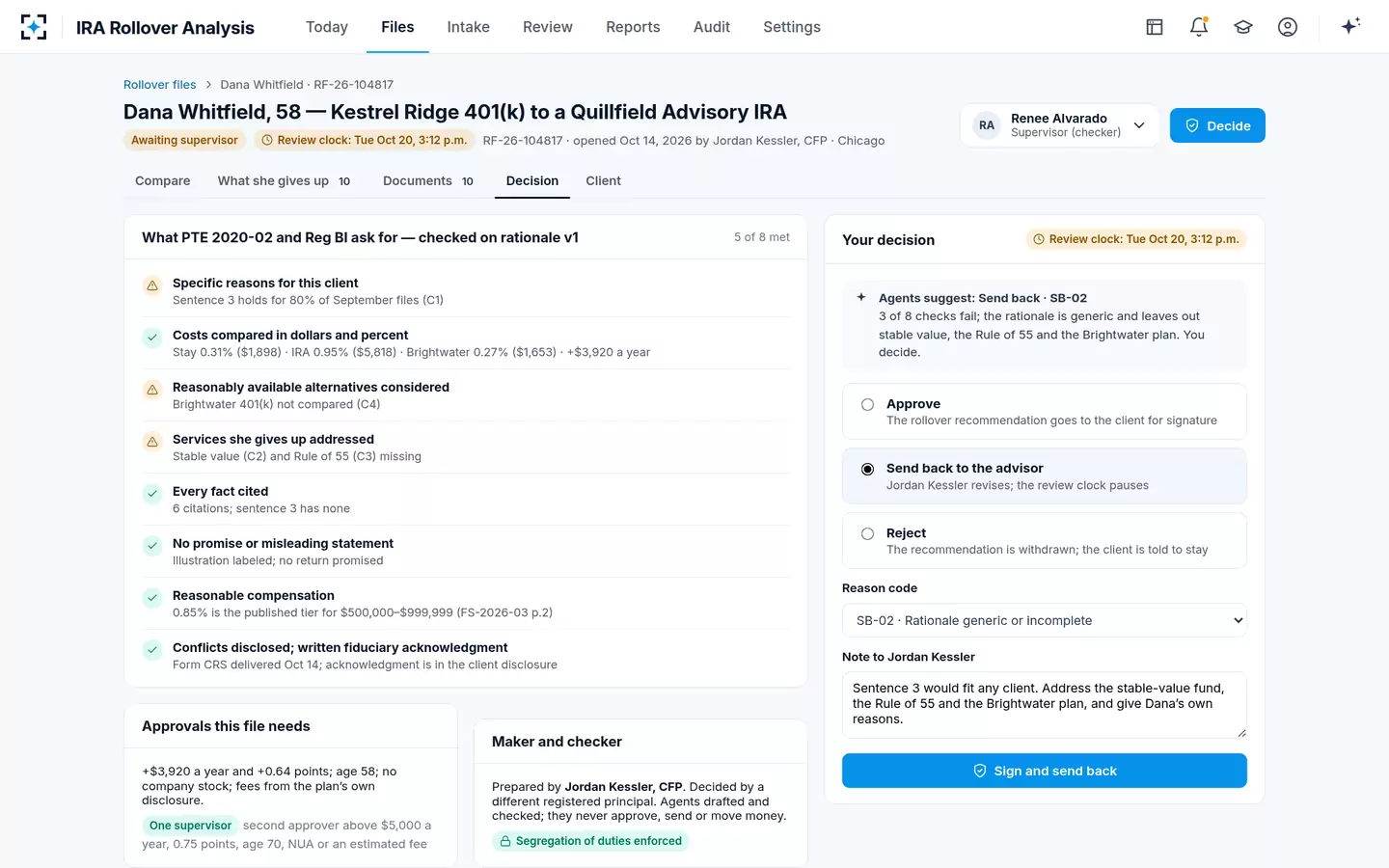
The panel leaves the decision to the registered principal: the agents suggest a send-back code, and she chooses, writes her note and signs.
What should a compliance team change now, and what can stay?
Most of the work is removing citations, not changing controls. A manual written in 2021 to 2023 typically quotes the preamble or FAQ 7 for the factors to weigh and the documents to collect. Those references should go, and the obligations they described should be re-anchored to the exemption's text, the SEC staff bulletin and the firm's own policy. Anything built in 2024 for the amended exemption, such as revised disclosure templates, should be checked against the 2020 text, which is the one in force.
Seven checks for a rollover procedure after the 2026 notice
- Cite the 2020 text as reprinted on March 20, 2026
Sections I to V of PTE 2020-02, 91 FR 13503. Remove citations to the 2024 amendments.
- Remove preamble and FAQ 7 citations
DOL treats the whole preamble as vacated; the FAQ 7 policy was vacated in 2023. Keep the controls, change the authority.
- Write down how fiduciary status is decided
The five-part test at 29 CFR 2510.3-21(c), applied by the firm and its counsel, or a policy of treating every rollover as covered.
- Keep the specific-reasons file on every covered rollover
Section II(c)(3), delivered to the investor before the rollover under II(b)(3).
- Keep the written fiduciary acknowledgment and the services-and-conflicts description
Section II(b)(1) and (2), before the transaction.
- Price the leave-it-in-the-plan option
SEC staff: hard to form a reasonable basis without considering it, where it is an option.
- Keep the retrospective review on the calendar
At least annually; report, certification and completion within six months of the period end; six years' retention.
How IRA Rollover Analysis keeps the exemption's conditions on every file
The conditions that survived are documentary, which is the kind of work agents can carry and people can check. In IRA Rollover Analysis, an Intake agent gathers the plan's participant fee disclosure, statement and plan rules; a Fee Reader cites each fee to its page and line; a Cost agent prices staying, the firm's IRA options and any new employer's plan that accepts roll-ins; and a Rationale Drafter writes the specific reasons. A separate Rationale Critic argues against every draft before a supervisor sees it, including a test of whether the reasons would fit other clients. The advisor submits; a different registered principal approves or sends back with a reason code and an electronic signature; and the client's disclosure and fiduciary acknowledgment go out only after approval.
The annual review condition is handled the same way: an agent re-checks each file on the day it closes, so the report a Senior Executive Officer certifies rests on every file rather than a sample. How that replay works, and what it finds, is the subject of the PTE 2020-02 retrospective review; who signs each part of the file is mapped in PTE 2020-02 requirements, signer by signer.
The solution does not decide whether a recommendation is fiduciary advice; that stays with the firm's policy and counsel. It also does not track Federal Register changes for you. If DOL starts new rulemaking, the settings that drive the checks, from the second-approver thresholds to the client-signature clock, are firm settings that compliance approves, and they can change without rebuilding the files already closed.
Questions people ask
What is the status of PTE 2020-02 in 2026?
It is in force as granted on December 18, 2020. DOL's notice of March 20, 2026, effective April 20, 2026, reprinted the operative text and left "each term and condition" in full effect, while treating the exemption's 2020 preamble as effectively vacated.
Was the DOL fiduciary rule vacated?
The 2024 Retirement Security Rule was vacated by final judgments of March 12, 2026 (E.D. Tex.) and March 17, 2026 (N.D. Tex.), after courts had stayed it in July 2024 and the Fifth Circuit appeal was dismissed in November 2025. It never took effect, and the 1975 five-part test is again the definition in the Code of Federal Regulations.
Do the 2024 amendments to PTE 2020-02 apply?
No. The Northern District of Texas stayed them in July 2024 and they never became effective. DOL's 2026 notice republished the exemption "without the amendments adopted on April 25, 2024".
Is a rollover recommendation still fiduciary advice?
Under ERISA and the Code, only if it meets all five parts of the 1975 test, including advice given on a regular basis, and the 2020 preamble's reading of that test for rollovers no longer stands. Under SEC rules, a broker-dealer's or adviser's rollover recommendation to a retail investor must be in the investor's best interest either way.
Does PTE 2020-02 still require a retrospective review?
Yes. Section II(d) requires a review at least annually, a written report to a Senior Executive Officer, a certification, completion within six months of the end of the period reviewed, and retention for six years with access for DOL within 10 business days of a request.
Is there a new DOL fiduciary rule coming?
DOL's March 2026 notice is a technical amendment that conforms the regulations to the courts' judgments; it proposes no new rule. Any new rulemaking would start with a proposal in the Federal Register, so a firm should check there on the day it updates its procedures.