The DOL fiduciary rule in 2026 is gone: on 18 March 2026 the Department of Labor's Employee Benefits Security Administration "removed from the Code of Federal Regulations the Biden-era 2024 final rule, “Retirement Security Rule: Definition of an Investment Advice Fiduciary,” responding to final judgments entered in the Northern and Eastern Districts of Texas vacating the rule." The removal restores ERISA's five-part test, written in 1975, for deciding who is an investment advice fiduciary, and the department says it has no current plans for new rulemaking. For annuities that means no new federal layer, but no relaxation either: every recommendation still answers to the state best-interest rule, NAIC Model #275 in 49 jurisdictions and Regulation 187 in New York, and variable and registered index-linked annuities to the SEC's Regulation Best Interest and FINRA. Botminds' Annuity Suitability Review applies those rules to each sale before issue, which is where a carrier's exposure now sits.
The sample screens on this page come from the solution's fictional carrier. The rule history is quoted from the Department of Labor, the Federal Register and the eCFR, linked where it appears.
The 2024 rule's two years: it never took effect, and the 1975 test never left
- To stays3 months
- Stayed while on appeal; appeal dismissed 28 Nov 202516 months
- Judgments; removedMar–Apr 2026
- The definition that applied all along, restored to the CFR text on 20 April 202624 months
What is the status of the DOL fiduciary rule?
There is no new DOL fiduciary rule in force. The 2024 Retirement Security Rule was vacated by two federal district courts in Texas and removed from the Code of Federal Regulations in March 2026, and the definition that applies is the 1975 regulation, the five-part test. The Federal Register notice is precise about what never happened: "Because the 2024 Fiduciary Rule never became effective, and the Five-part Test Regulation was never replaced, this document takes the administrative steps necessary to conform the regulatory text in the CFR." The notice was published on 20 March 2026 and took effect on 20 April 2026.
The exemptions moved with the rule. The notice reflects the vacatur of the 2024 amendments to Prohibited Transaction Exemption 2020-02 and republishes that exemption as originally granted in December 2020. It also records that the Texas courts had stayed the 2024 amendments to other exemptions, including PTE 84-24, and that the pre-amendment versions of those exemptions apply. And it declares the whole preamble to PTE 2020-02, where the department had explained when rollover advice is fiduciary advice, effectively vacated.
Was the DOL fiduciary rule vacated?
Yes. The department's own page names the cases: the rule and the amendments to the associated exemptions were "vacated by court order" in Federation of Americans for Consumer Choice v. U.S. Department of Labor, in the Eastern District of Texas, and American Council of Life Insurers v. U.S. Department of Labor, in the Northern District of Texas. Both courts stayed the rule's effective date in July 2024, the consolidated appeal was dismissed in the Fifth Circuit on 28 November 2025 on the appellant's motion, and final judgments followed on 12 and 17 March 2026.
It is the second time. The department's 2016 fiduciary rule was vacated by the Fifth Circuit in 2018; the 2020 notice implementing that vacatur records that on 21 June 2018 the court "issued a judgment and mandate vacating the Fiduciary Rule, the new PTEs, and the amendments to the previously granted PTEs in toto." Both times, the 1975 regulation came back.
What is the five-part test?
The five-part test is the 1975 ERISA regulation that decides whether a person giving advice for a fee is an investment advice fiduciary to a plan. A person who does not have discretionary authority over plan assets is a fiduciary only if all five parts are met; miss one and the advice is not fiduciary advice under ERISA.
ERISA's five-part test, as restored to 29 CFR 2510.3-21(c)
| Part | What the regulation requires | What it means for an annuity recommendation |
|---|---|---|
| 1. Advice | Advice as to the value of securities or other property, or recommendations on investing in, buying or selling them. | A recommendation to buy an annuity, or to move plan or IRA money into one, can be advice. |
| 2. Regular basis | Rendered "on a regular basis" to the plan. | A single sale is hard to fit; an ongoing advisory relationship fits. |
| 3. Mutual agreement | Under a mutual agreement, arrangement or understanding, written or otherwise, with the plan or a plan fiduciary. | Both sides must understand that advice is being given. |
| 4. Primary basis | That the advice "will serve as a primary basis for investment decisions with respect to plan assets". | One input among several may not be enough. |
| 5. Individualized | "Individualized investment advice to the plan based on the particular needs of the plan". | Advice tailored to the client, not general sales material. |
The "regular basis" part is where the fight has been. In 2022 litigation, the Federation of Americans for Consumer Choice challenged the department's preamble guidance to PTE 2020-02 on rollover advice and on the regular-basis requirement; in July 2025 a Texas court vacated portions of that preamble, and the 2026 notice now treats the whole preamble as unreliable. The test itself is the regulation's text, nothing more.
Does the DOL fiduciary rule apply to annuities?
The vacated 2024 rule would have made many more brokers and insurance agents ERISA fiduciaries when they recommended annuities to retirement plans and IRAs; that was the objection the department's own Assistant Secretary voiced when removing it. What applies now is narrower: an agent selling an annuity to an IRA or plan is an ERISA fiduciary only if the five-part test is met, and, if so, needs an exemption such as PTE 84-24 or PTE 2020-02 to be paid in the usual ways.
"The challenged regulation wrongly sought to impose ERISA fiduciary status on securities brokers and insurance agents when there was not a relationship of trust and confidence"
Daniel Aronowitz, Assistant Secretary of Labor for Employee Benefits Security, 18 March 2026
He went on: "The Securities and Exchange Commission and state regulators regulate the activities of securities brokers and insurance agents and will continue to do so." That is the practical answer. Outside ERISA, annuity sales were never governed by the DOL rule, and the rules that do govern them were not touched by the vacatur.
What governs an annuity recommendation after the vacatur
Sold by an insurance producer: The state best-interest rule: Model #275 in 49 jurisdictions, Regulation 187 in New York.
Sold by a broker-dealer representative: The same state rule; these are insurance products, not securities.
Sold by an insurance producer: Not sold without a securities registration.
Sold by a broker-dealer representative: Reg BI, FINRA Rule 2330 for deferred variable annuities, and the state rule, with the model’s safe harbor for comparable standards.
Sold by an insurance producer: Not sold without a securities registration.
Sold by a broker-dealer representative: Reg BI and the state rule; FINRA calls 2330-style controls an effective practice.
Sold by an insurance producer: Add ERISA and the Code only if the five-part test is met; then an exemption such as PTE 84-24.
Sold by a broker-dealer representative: Add ERISA and the Code only if the five-part test is met; then an exemption such as PTE 2020-02.
Sold by an insurance producer: Supervision and pre-issue review under the state rule.
Sold by a broker-dealer representative: Supervision and pre-issue review under the state rule; it may rely on information from the broker-dealer.
Rollover advice after the vacatur: the guidance that went with the rule
Advice to move a 401(k) balance into an IRA annuity is now judged by the five-part test's text alone, because the department's interpretations of it have fallen too. The 2026 notice traces the sequence: in February 2023 a federal court in Florida vacated the "policy referenced in" the department's 2021 FAQ 7 on rollover advice, and the government withdrew its appeal that May; in July 2025 the Northern District of Texas vacated the parts of the PTE 2020-02 preamble that interpreted the five-part test.
The department then went further than the courts. It said the vacated passages "interrelate with matters and guidance in other portions of the preamble to such an extent that the Department is no longer confident in the soundness of the remaining portions of the preamble", and treated the whole preamble as effectively vacated, while leaving every condition of the exemption itself in force. For a carrier the consequence is practical: whether a producer was a fiduciary on a rollover is a question of fact under five short paragraphs, so the file needs to say how the producer and the client described their relationship.
Do insurance agents have a fiduciary duty?
Not by default. Under the state best-interest rule, an insurance producer owes care, disclosure, conflict-of-interest and documentation obligations that Model #275 says create a regulatory obligation, not a fiduciary one; the four are set out in annuity best interest obligations. Under ERISA, an agent becomes a fiduciary only by meeting the five-part test, or by holding discretion over plan assets. New York's Regulation 187 asks for a prudent-person standard of care with only the consumer's interests considered, which is the strictest state standard; how states differ is mapped in NAIC best interest states.
Agents who are also registered investment advisers carry the adviser's fiduciary duty for that business, and the model's safe harbor treats compliance with those duties, or with ERISA's fiduciary duties where they apply, as satisfying the state rule. The safe harbor is a route to compliance, not an exemption from supervision: the insurer must still have its own reasonable basis before it issues.
Is there a new DOL fiduciary rule in 2026?
No new rule has been proposed. The department said in its March 2026 release that it "has no current plans to engage in notice and comment rulemaking in this regard" and that it will consider whether additional guidance, including transitional or non-enforcement relief, is appropriate. Anyone tracking the question should watch the Federal Register for a proposal under EBSA's name; until one appears, the five-part test is the rule.
Why the rule mattered: what the evidence on commissions shows
The best evidence on why regulators keep returning to annuity conflicts comes from variable annuity sales data, and it does not depend on any rule surviving. A study by Mark Egan, Shan Ge and Johnny Tang, published by the National Bureau of Economic Research and later in the Review of Financial Studies, measured how sales respond to what brokers are paid.
What the 2016 proposal did to variable annuity sales, in one study
10%+
top of the commission range, from 0%, that insurers pay brokers on variable annuities, as a share of premium
4×
how much more sensitive sales were to brokers’ financial interests than to investors’
52%
fall in sales of high-expense variable annuities after the 2016 fiduciary rule was proposed
In the authors' words, "Brokers earn higher commissions for selling inferior annuities, in terms of higher expenses and more ex-post complaints." After the 2016 proposal, sales shifted toward lower-expense products and insurers offered more of them; the authors estimate investor welfare improved. The shift followed a proposal, a reminder that scrutiny of conflicts, not the label on the duty, is what changes behaviour.
What readiness means for a carrier now
Readiness after the vacatur means keeping the state review strong rather than building a federal layer. Three things deserve attention. Compensation and conflicts: the model requires disclosure of how the producer is paid and the removal of product-specific sales contests, and a review should see both on the file. Rollovers into annuities: where a recommendation moves plan or IRA money, the file should show whether the producer was acting as a fiduciary and under which exemption, because the five-part test turns on facts a carrier can only learn from the file. And variable and index-linked sales: FINRA's 36-month exchange check and principal review run beside the carrier's own.
One sale's record: the checks, the file and the documents read
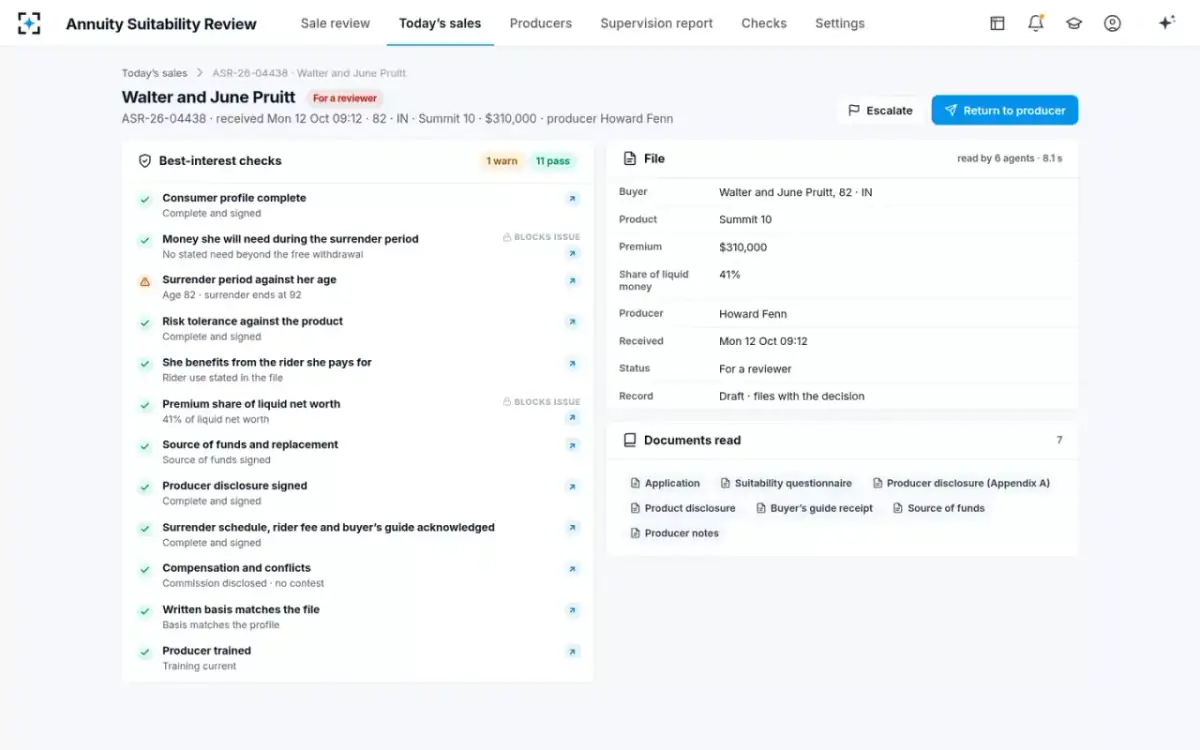
The carrier's checks are where those three things become routine. In the sample carrier's set, compensation and conflicts are checked against the conflict-of-interest obligation, the producer disclosure against the disclosure obligation, and the written basis against the documentation obligation, each on every sale.
The carrier's checks, mapped to the obligations that survived the vacatur
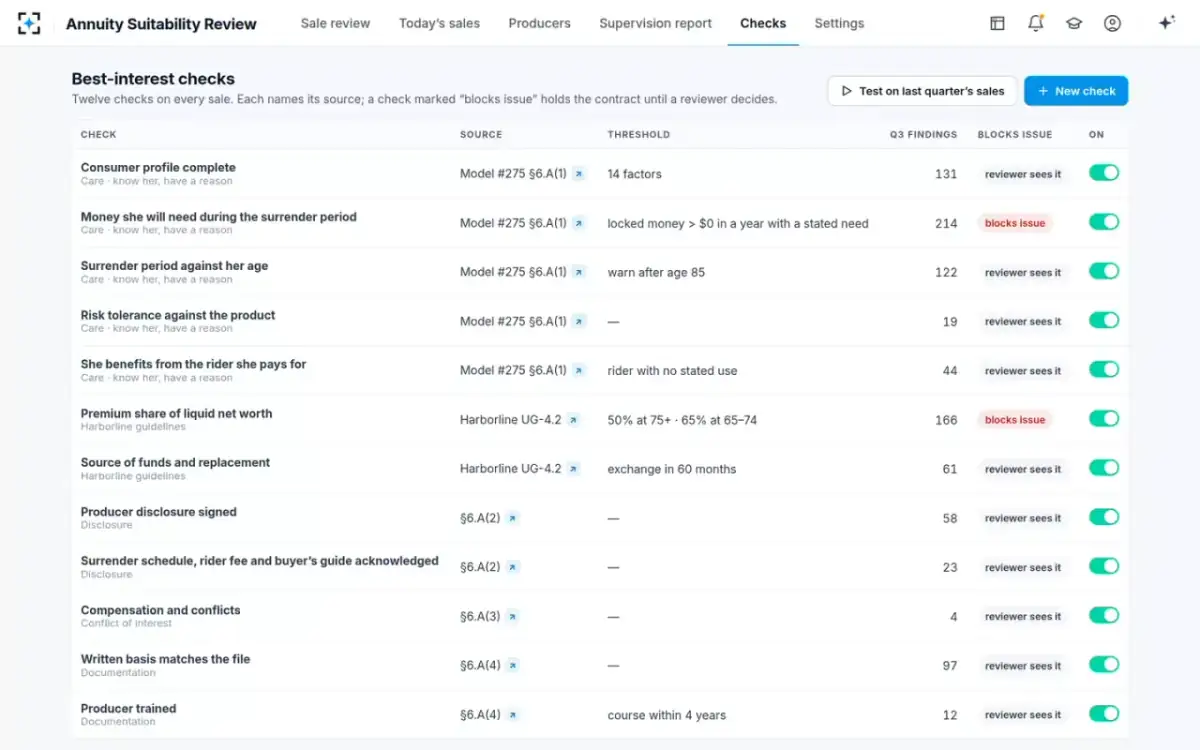
For variable and index-linked products, the securities rules add their own checks; how a reviewer reads a registered index-linked annuity is covered in registered index linked annuity pros and cons. The solution is at Annuity Suitability Review.
Questions people ask
What replaced the Retirement Security Rule?
Nothing new: the 1975 five-part test, which the 2024 rule was meant to replace, stayed in force throughout because the 2024 rule never took effect. The March 2026 notice simply restored its text to 29 CFR 2510.3-21 and republished PTE 2020-02 as originally granted.
What happened to PTE 84-24?
It stays in its pre-amendment form. The 2026 notice records that the Texas courts stayed the 2024 amendments to PTE 84-24 and other exemptions, and says EBSA's website would be updated to reflect the pre-amendment versions. It matters only where the agent is a fiduciary under the five-part test.
Does Regulation Best Interest apply to fixed annuities?
No. Reg BI covers broker-dealers recommending securities, which include variable annuities and registered index-linked annuities. Fixed and fixed indexed annuities sold as insurance products are governed by the state best-interest rule.
When did the removal take effect?
The Federal Register notice was published on 20 March 2026, two days after DOL's release, and took effect on 20 April 2026. The department relied on good cause to skip notice and comment because it was giving effect to court orders.
Did the vacatur change any state annuity rule?
No. The state rules come from state law: Model #275 as each state adopted it, and New York's Regulation 187, which its Court of Appeals upheld in 2022. They applied before the 2024 rule, during its stay and after its removal.