An annuity suitability report, in the sense regulators use, is the written report an insurer must give senior management every year on how well its annuity supervision system works. NAIC Model #275 requires the insurer to "annually provide a written report to senior management, including to the senior manager responsible for audit functions, which details a review, with appropriate testing, reasonably designed to determine the effectiveness of the supervision system, the exceptions found, and corrective action taken or recommended, if any." The report is hard to write well because a year of pre-issue decisions sits in hundreds of review notes, and because a system that drifted in March is reported in the following January. Botminds' Annuity Suitability Review files a written review for every sale it reads, and builds the supervision report, and a draft of the annual one, from those reviews.
The carrier, producers and figures from the solution on this page are fictional sample data. The requirements are quoted from the NAIC model and from FINRA's rule and 2026 oversight report, linked where they appear.
A once-a-year test finds a drift months late; monthly monitoring finds it the month it starts
- No signal while the problem grows10 months
- Test and report2 months
- Monthly sample and drift review, corrections as found10 months
- Test and report2 months
What must the annual supervision report include?
The annual supervision report must include three things: a review of the supervision system "with appropriate testing, reasonably designed to determine the effectiveness" of it, the exceptions found, and the corrective action taken or recommended. It goes to senior management, explicitly including the head of audit. That is the whole text; the model leaves the method to the insurer, and the method is where reports differ.
Read closely, each phrase sets a design requirement. "With appropriate testing" means the report cannot rest on attestations alone; someone has to re-perform reviews on a sample and compare the results. "Reasonably designed to determine the effectiveness" means the sample has to be able to find a failure if one exists, which a sample drawn only from passed sales, or only from one product, cannot. "The exceptions found" means a list, not a rate. And "corrective action taken or recommended" means each exception needs an owner and an outcome.
What an annual annuity supervision report should contain
- Scope: what the supervision system covers
Products, channels and states; which sales were screened, which were reviewed by a person, and any function performed by a contractor.
- The test: method, sample and who performed it
How sales were selected, how many, and who re-performed the reviews; someone other than the reviewers being tested.
- Results by procedure
Pre-issue review, detection of non-compliant recommendations, disclosure checks, suspicious refusals, sales-contest controls, producer training verification.
- Every exception, with its cause
A sale issued without a reasonable basis on file, a missed disclosure, an override without a reason; grouped by rule, product and producer.
- Corrective action, taken or recommended
For consumers, for producers and for procedures, each with an owner and a date.
- Contracted functions
How the insurer monitored them, and the annual certification from the senior manager responsible for each.
Who receives the annuity suitability report?
Senior management receives the annuity suitability report, and the model names one recipient specifically: "the senior manager responsible for audit functions". Putting the head of audit on the distribution list makes the report a document the third line will read, and makes it awkward for the first line, the reviewers whose work is being tested, to write it alone.
The report also has a second audience that never appears on its cover. NAIC examination standards for life and annuity insurers test whether an insurer's suitability rules for annuity transactions comply with the applicable statutes, rules and regulations, and an examiner testing that standard will ask for the supervision procedures and the evidence that they were tested. The report is that evidence. How an exam team readies itself is the subject of how to prepare for a market conduct examination.
How often must insurers test suitability supervision?
The model requires the report annually and asks for "appropriate testing" within it; it does not fix how often the underlying monitoring runs. It does describe the tools an insurer may use to detect recommendations that do not comply, and they work at any frequency: "confirmation of the consumer’s consumer profile information, systematic customer surveys, producer and consumer interviews, confirmation letters, producer statements or attestations and programs of internal monitoring." It also says sampling is acceptable, and that profile information may be confirmed after the annuity is issued or delivered.
The case for monitoring monthly is arithmetic, not regulation. A check that stopped firing after a form change in March affects every sale issued from March onward. Found in the annual test, those sales have been issued for nine months; found in April's monthly sample, they number a few weeks' worth. Whichever cadence is chosen, the annual report should say what it was.
A supervision system for annuities, as the report must describe it
A supervision system for annuities is the set of procedures section 6.C(2) of the model lists, and the report tests each of them: informing producers of the rules and putting them in training manuals; producer product-training standards; product-specific training on every material feature; pre-issue review of each recommendation; detection of non-compliant recommendations; checking that the producer gave the consumer the required information; handling suspicious refusals to give profile information; and eliminating sales contests and quotas based on specific annuities. The pre-issue review is the largest of them, and how to run it with software that reviewers trust is the subject of an annuity supervision system reviewers trust.
Contracted functions carry their own test. If a third party performs any part of the system, the insurer must monitor it and, where appropriate, audit it, and obtain each year "a certification from a senior manager who has responsibility for the contracted function that the manager has a reasonable basis to represent, and does represent, that the function is properly performed." The report should list those certifications, because the insurer remains responsible for corrective action regardless.
From a yearly report to monthly monitoring: the six drift signals
Six signals, read every month, show most of the ways a pre-issue review drifts: the flag rate, the override rate, returns by producer, exchange rates, refusals of profile information and the time to a decision. None is a regulatory metric. Each is a number the reviews already produce, and each moves before the exceptions do.
FINRA's examiners describe the securities-side version of this design in their 2026 report on annuities. Its effective practices include "Using automated tools, exception reports, and surveillance to review exchanges of variable annuities or RILAs", some of which consider the "cumulative surrender charges" incurred by a representative's customers and "excessive rates of exchanges within the last one to two years of the surrender schedule"; standardizing review thresholds for rates of exchanges and "monitoring for emerging trends across registered representatives, customers, products and branches"; and second-level supervision of reviews of exception reports. FINRA Rule 2330 already requires broker-dealers selling deferred variable annuities to "implement surveillance procedures" to find representatives whose exchange rates raise questions.
Six drift signals for an annuity review, and what a change in each usually means
| Signal | What to count each month | A rise may mean | A fall may mean |
|---|---|---|---|
| Flag rate | Share of sales sent to a reviewer, by check | A new product, a form change or a producer group with a pattern | A check that stopped reading a field after a form or system change |
| Override rate | Sales issued despite a failed check, by reviewer and by check | A check set too tight, or review pressure at quarter end | Healthy, if flags held steady |
| Returns by producer | Returns per producer per sale, and repeats of the same finding | A producer whose questionnaires disagree with his own notes | Coaching working, or a producer who stopped writing notes |
| Exchange rate | Sales funded by another annuity within 60 months, by producer | Replacement activity worth a supervisor’s look | Little, unless sales also fell |
| Refusals | Sales with a signed refusal of profile information, by producer | Producers steering buyers around the questions | Little, on its own |
| Time to a decision | Median and longest time from flag to decision | A queue reviewers cannot keep up with, so checks get skipped | More capacity, or flags no longer reaching people |
The most useful readings combine signals. A falling flag rate with a steady sales mix is a warning about the screen, not good news. A rising override rate on one check, concentrated in one reviewer, is a training question; spread across reviewers, it is a question about the check. Returns that repeat the same finding from one producer are the pattern the producer's supervisor needs, and the subject of the next section.
What exceptions go in the report?
The exceptions are the sales and procedures where the supervision system did not work as designed: a sale issued without a reasonable basis on file, an override without a written reason, a disclosure that was missing at issue, a refusal that should have been treated as suspicious, a producer who sold before completing required training, or a sales incentive tied to a specific annuity. The report should show each one, its cause and its fix, and group them so senior management can see whether they are isolated or a pattern.
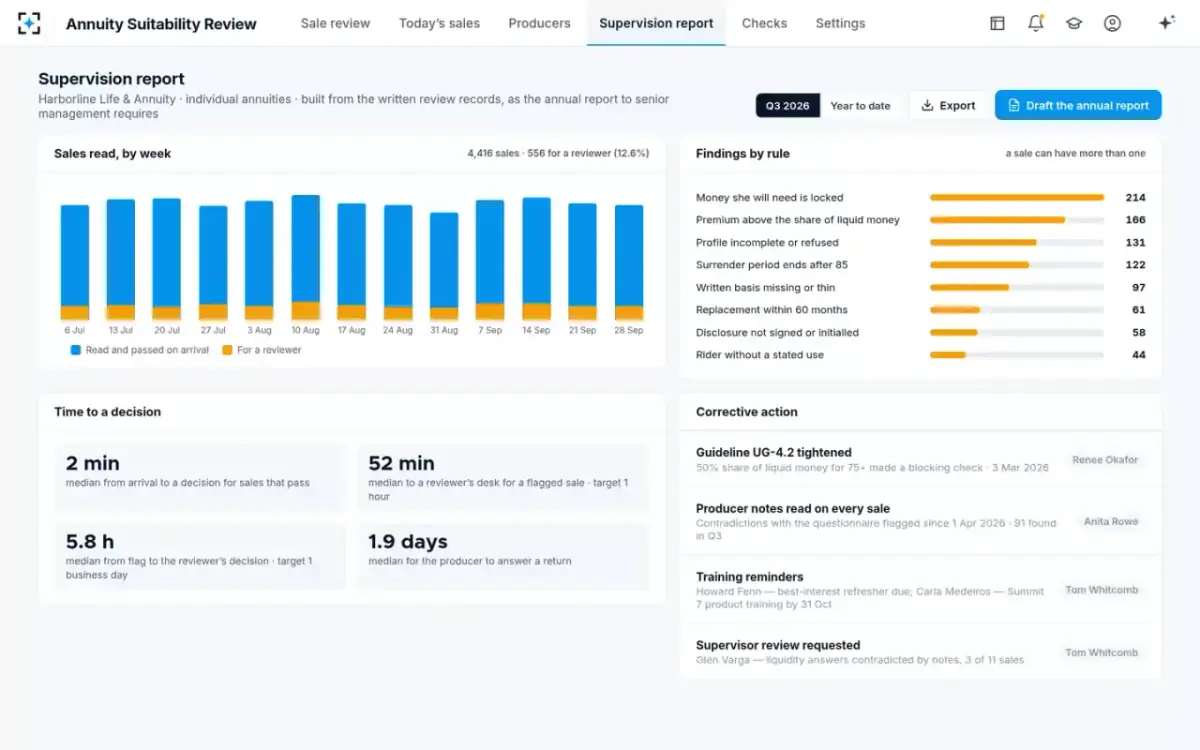
Take a sample quarter from the solution. Of 4,416 annuity sales the fictional carrier read in the third quarter of 2026, 556 went to a reviewer. A sale can raise more than one finding, and the counts below are findings by rule, not sales.
Findings by rule in one sample quarter: locked money leads
Findings and exceptions are different lists, and the report needs both. The 214 liquidity findings are the system working: each was caught before issue and passed, returned or escalated with a reason. The exceptions are the ones that got through, or got through without the required trace. A report that shows only findings tells management how busy the reviewers were; one that shows only exceptions hides the work that prevented them.
The supervision report: sales read, findings by rule, time to a decision, corrective action
What is corrective action in suitability?
Corrective action in suitability is what the insurer does about an exception: for the consumer harmed, for the producer involved, and for the procedure that failed. Model #275 gives the commissioner power to order "An insurer to take reasonably appropriate corrective action for any consumer harmed by a failure to comply with this regulation", whether the failure was the insurer's, a contractor's or the producer's, and to order a general agency, independent agency or producer to do the same.
The same section rewards finding problems early. Any penalty may be reduced or eliminated if corrective action for the consumer was taken promptly after a violation was discovered, or if the violation was not part of a pattern or practice. That is the regulatory case for monthly monitoring in one sentence: an exception found and remedied in its month is a different event from one found by an examiner.
The sample report lists four corrective actions from a single quarter, and they show the three kinds. A guideline was tightened: premium share of liquid money for buyers 75 and over became a blocking check. A procedure was added: producer call notes are read against the questionnaire on every sale, which found 91 contradictions in the quarter. And two people-level actions went to the producer supervisor: training reminders, and a review of one producer whose liquidity answers his own notes contradicted on three of eleven sales.
Patterns by producer: the drift the report cannot see in totals
A producer-level view finds what carrier totals average away. The model ties the insurer's supervision to its producers' compliance, and its detection procedures name producer interviews and attestations among the tools; a monthly view by producer is how those tools get aimed.
Producers over 90 days: the same finding three times from one producer
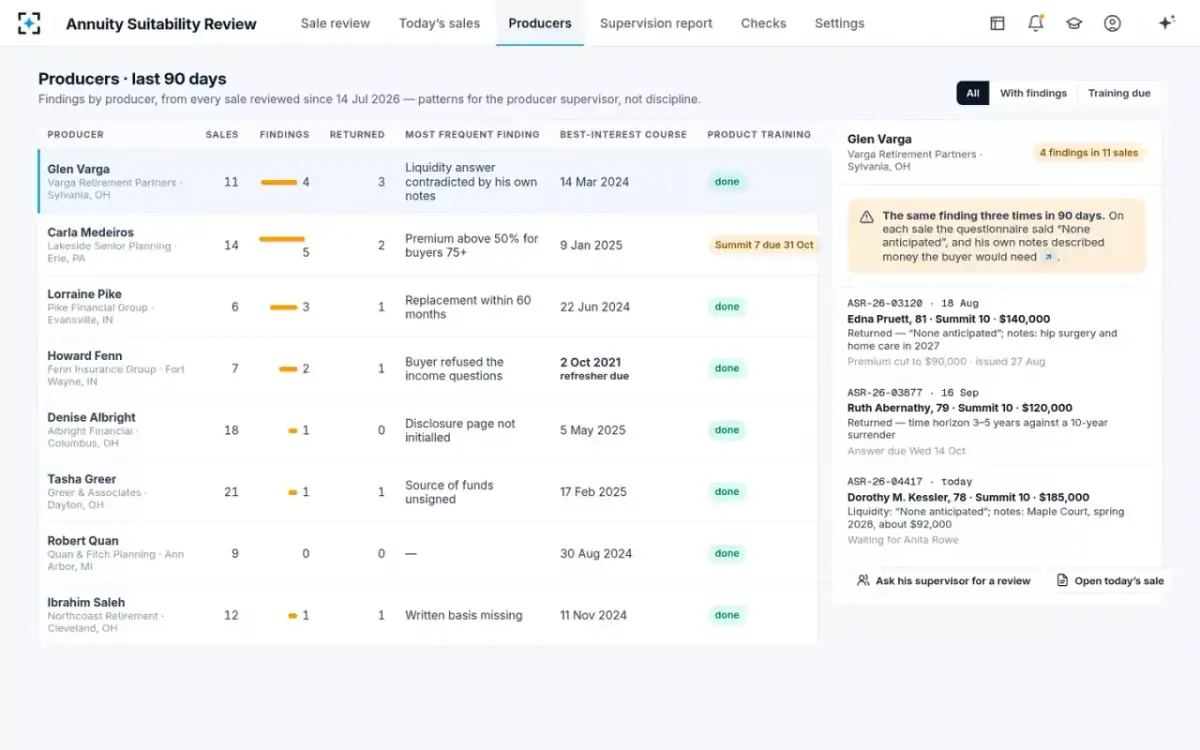
In the sample, one producer's three findings are the same finding: the questionnaire said the buyer anticipated no need for the money during the surrender period, while his own notes described one. His training was current, so the cause is not knowledge. The corrective action is a conversation his supervisor owns, and the report records that it happened. The questionnaire field at the centre of it, and how each profile answer is proved, is covered in the annuity suitability questionnaire.
Writing the annual report from the year's reviews
When every sale has a written review, the annual report becomes a matter of selection and testing rather than reconstruction. The counts, the findings by rule, the time to a decision and the corrective actions already exist; what the year-end work adds is the independent test: re-performing a sample of passed, returned and overridden sales and comparing the results.
That division is how the solution is built. The supervision reporter groups findings by producer, rule and week and drafts the annual report; sales-practice compliance completes and signs it. Two parts stay with people by design: the test sample, which has to be drawn and re-reviewed by someone other than the reviewers being tested, and the judgment of whether an exception was isolated or a pattern. The questions an examiner is likely to ask of the result are gathered in the market conduct exam self-audit questions, and the solution is at Annuity Suitability Review.
Questions people ask
Is the annual suitability report filed with the state?
Not under the model's text: it is a report to the insurer's own senior management, including the senior manager responsible for audit. Examiners can ask to see it, and the supervision procedures it tests, during a market conduct examination.
Can the annual review be performed by an outside firm?
The model lets an insurer contract for any supervision function, including maintaining procedures, but keeps the insurer responsible for corrective action and penalties. The insurer must monitor the contractor, audit where appropriate, and obtain an annual certification from the senior manager responsible for the function.
How large should the testing sample be?
The model does not set a size; it asks for testing reasonably designed to determine effectiveness and allows sampling procedures. A sample should be able to find a failure if one exists, which means drawing from passed, returned and overridden sales and from each product and channel.
Does a broker-dealer's review count toward the insurer's report?
It can inform it. Under the model's safe harbor an insurer may rely on comparable standards such as Reg BI, but it must monitor the conduct of the financial professional or the supervising firm and provide that firm with information and reports that help it maintain its own supervision system.
How long should suitability records be kept?
The model leaves the number of years to each state, with a drafting note that some states may choose five; Florida's statute requires five years after the transaction is completed. Records may be kept in paper or electronic form, as long as the process reproduces the document accurately.