An annuity suitability review analyst is the person at a life and annuity carrier who reads a recommended annuity sale before the contract is issued and decides whether there is a reasonable basis to believe it fits the buyer: pass it to issue, return it to the producer, or escalate it to sales-practice compliance. The seat exists because the NAIC's best-interest model regulation, Model #275, says an insurer "may not issue an annuity recommended to a consumer unless there is a reasonable basis to believe the annuity would effectively address the particular consumer’s financial situation, insurance needs and financial objectives". The rule puts that duty on the insurer but never names the person who carries it, and the work is hard because the evidence is spread across a questionnaire, disclosures, a source-of-funds form and the producer's own notes. Botminds' Annuity Suitability Review reads every sale on arrival and lays that evidence out for the analyst, who still makes every decision.
The sales, producers and carrier on this page, Harborline Life & Annuity among them, are fictional sample data from the solution. The rules are quoted from the NAIC model, FINRA's rulebook and its 2026 oversight report, linked where they appear.
One annuity sale, from the producer to issue, and where the analyst sits
A person decides
ProducerCollects the consumer profile, makes the recommendation, gives the disclosure on a form like Appendix A and writes the basis for the recommendation.
Agent
Read the fileReads the application, questionnaire, disclosures, source of funds and the producer’s notes; fills each profile factor from its page.
Never: fills a blank by guessing
Agent
Check it against the rulesCompares answers across documents, projects stated cash needs against the surrender schedule and runs the carrier’s best-interest checks, each citing its rule.
Never: approves a sale or removes a hold
A person decides
Suitability review analystPasses the sale to issue, returns it to the producer with the evidence, or escalates it. A sale with a failed blocking check stays held until the analyst decides.
A person decides
Sales-practice complianceGives the second signature when the analyst wants to issue despite a failed check, and owns the annual report to senior management.
What does an annuity suitability analyst do?
An annuity suitability analyst tests each recommended sale against the reasonable-basis standard before issue, using the file the producer submitted. In Model #275 terms, the analyst is how the insurer meets its duty to keep "procedures for the review of each recommendation prior to issuance of an annuity", procedures designed to ensure the recommended annuity would effectively address the consumer's situation, needs and objectives.
The model's own list of insurer procedures reads like the seat's job description. Beyond the review itself, section 6.C(2) asks the insurer to keep procedures to detect recommendations that do not comply, to assess before or on issue whether the producer gave the consumer the required information, and to identify and deal with suspicious refusals by consumers to give profile information. The analyst is where those procedures touch a single file.
What gets read is set by the producer's obligations. The care obligation asks the producer to know the consumer's financial situation, understand the options available, have a reasonable basis that the recommendation addresses the consumer's needs for as long as the contract runs, and communicate the basis. The analyst checks that each of those left a trace: a complete profile of fourteen factors, a product whose surrender period and features match the stated time horizon and liquidity needs, a benefit the buyer will actually use from any rider she pays for, a signed disclosure, and a written basis that agrees with the rest of the file. How each of the fourteen factors is proved is worked through in the annuity suitability questionnaire, field by field.
Exchanges add three questions the model writes out: whether the consumer will incur a surrender charge or start a new surrender period, whether the new product would substantially benefit the consumer compared with the old one over its life, and whether the consumer has had another exchange or replacement, "in particular, an exchange or replacement within the preceding 60 months". Those questions sit with the analyst too, though the replacement paperwork itself has its own process.
Who reviews annuity applications before issue?
The insurer does, and it cannot hand the duty away. Model #275 lets an insurer contract out any supervision function, but the insurer "is responsible for taking appropriate corrective action and may be subject to sanctions and penalties" whether or not it does, and it must monitor the contractor and obtain each year a certification from the senior manager responsible for the contracted function. Where the analyst sits on the organisation chart, in new business, in a suitability unit or inside compliance, is the carrier's choice; the accountability is not.
Who else has already reviewed the sale depends on the channel. When a broker-dealer's registered representative sells a variable annuity, FINRA Rule 2330 puts a registered principal in front of the insurer: before the application goes to the insurance company, and "no later than seven business days after an office of supervisory jurisdiction of the member receives a complete and correct application package", the principal must review and approve or reject it. Model #275 then offers a safe harbor for sales made under comparable standards, such as the SEC's Regulation Best Interest, but it keeps the insurer's own duty in place: the safe harbor does not limit the insurer's obligation under section 6C(1), "although the insurer may base its analysis on information received from either the financial professional or the entity supervising the financial professional."
Who reads an annuity sale before issue, by channel
| Channel | First review | What the carrier’s analyst still does |
|---|---|---|
| Independent or captive insurance producer, fixed or fixed indexed annuity | None before the carrier: the producer’s written basis arrives with the application. | The full review: profile, product, disclosures, documentation; pass, return or escalate. |
| Broker-dealer representative, deferred variable annuity | A registered principal under FINRA Rule 2330, within seven business days of a complete package, documented and signed. | Must still have a reasonable basis to issue (Model #275 section 6C(1)), and may rely on information from the representative or the broker-dealer. |
| Broker-dealer representative, registered index-linked annuity | Regulation Best Interest; FINRA’s 2026 report calls principal review of RILAs an effective practice, not a rule. | As for variable annuities, plus the contract adjustments a RILA carries. |
| Direct-response sale with no recommendation | None: the model does not apply where no recommendation is based on information collected from the consumer. | Nothing under Model #275. |
Pass, return or escalate: the evidence each decision needs
Each of the analyst's three decisions needs evidence of a different kind, and the written review should say which evidence carried it. A pass needs a complete profile, a product that fits it and a basis in writing; a return needs a specific fact the producer can fix; an escalation needs a reason the analyst should not decide alone.
A pass is the commonest outcome and the easiest to do badly. Model #275 says the profile factors, the insurer's characteristics and the product's costs, rates, benefits and features are generally relevant, that their weight may vary from case to case, and that no factor may be weighed on its own. A pass that rests on boxes ticked one by one, without asking whether the liquidity answer squares with the surrender schedule, is the kind of review that rule warns against.
A return is a request, not a judgment of the buyer. It works when it names the conflicting answers, the page each came from and what would resolve it, because the producer, not the analyst, is the one who can go back to the consumer. An escalation is for the cases the analyst should not settle: a pattern from one producer, a suspected refusal to give information, a buyer whose answers suggest someone else is steering the sale, or a wish to issue despite a failed check.
What the written review should show for each decision
- Pass: every profile factor present, each from a named page
Fourteen factors in the model, including liquidity needs, liquid net worth and the financial resources used to fund the annuity.
- Pass: the product checked against the time horizon and liquidity
Surrender period and charges against the needs the buyer stated anywhere in the file, not only on the questionnaire.
- Pass: a benefit for each feature she pays for
The care obligation includes a reasonable basis that the consumer would benefit from features such as annuitization, death or living benefits.
- Return: the conflicting evidence, quoted, with its rule
What is wrong, where it is written, which requirement it touches, and what would fix it.
- Escalate: the reason the analyst should not decide alone
A producer pattern, a suspicious refusal, a failed blocking check the analyst would override, or signs of undue influence.
- Every decision: who decided, when, and on what file
The model leaves retention to each state; its drafting note suggests five years for some, and Florida’s statute says five.
What happens when an annuity sale is returned?
When an annuity sale is returned, issue waits while the producer answers the analyst's questions, corrects the file with the consumer, or withdraws the recommendation. The return does not reach the buyer directly; it goes to the producer, who made the recommendation and holds the relationship.
Take a sample sale as it runs through the solution. Dorothy M. Kessler, 78, of Toledo, Ohio, is recommended a $185,000 fixed indexed annuity with a ten-year surrender schedule. Her questionnaire says she anticipates no need for the money during the surrender period. The producer's call notes of 22 September say she has paid a deposit on a senior community she expects to move into in spring 2028, with an entrance fee of about $92,000, and that her roof needs replacing next spring for about $18,000. The analyst opens a sale already held, with both documents side by side.
The analyst's page: the buyer, the product and the checks, with issue held
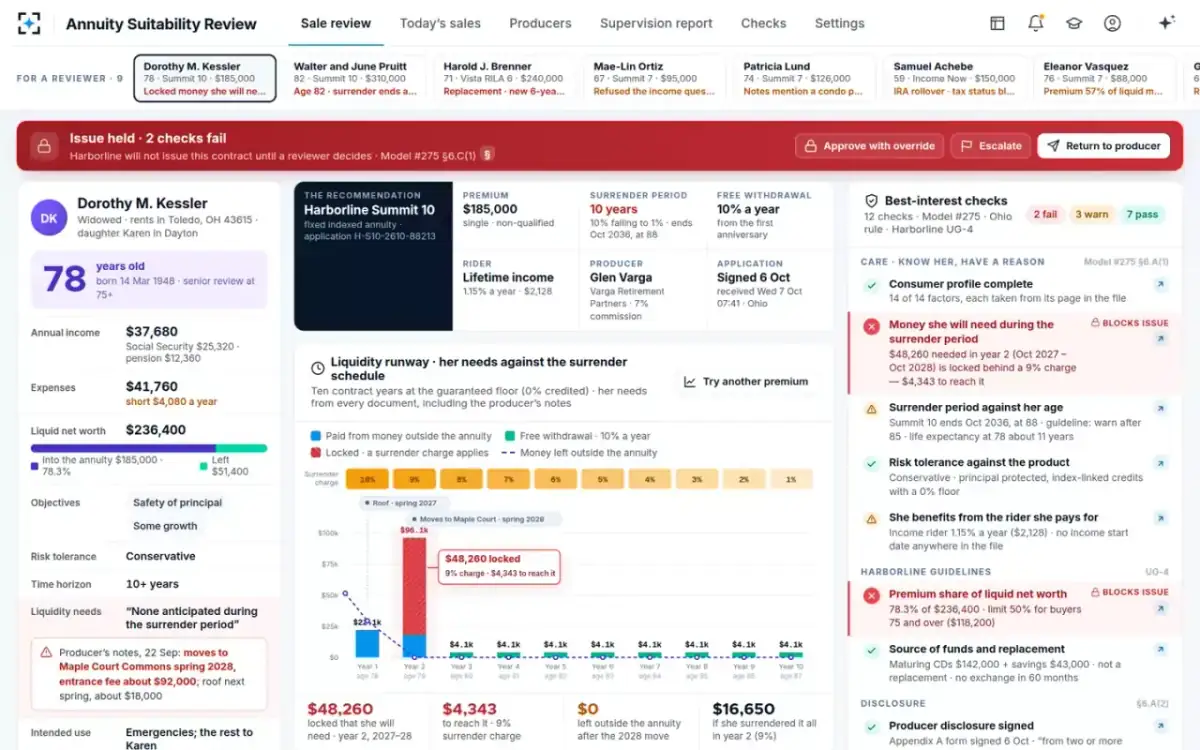
The solution drafts the return as two items, each with its evidence and its rule: the liquidity answer contradicts the producer's own notes, and at the applied premium $48,260 of what she needs in the second contract year sits behind a 9% surrender charge. It also carries an alternative the analyst worked out: at $118,200, half her liquid net worth, every stated need is paid from money outside the annuity. The analyst sends it; the answer is due in two business days, and issue stays held until then. How the locked dollars are tested against the schedule is laid out in annuity surrender charge schedule.
Two model provisions shape what happens next. If a recommendation turns out to rest on "materially inaccurate information provided by the consumer", the producer's care obligation does not attach to it. The insurer gets no such shelter: its issuance "shall be reasonable under all the circumstances actually known to the insurer at the time the annuity is issued", so a contradiction sitting in the file has to be resolved, not noted. And the model forbids producers and insurers to discourage a consumer from answering truthfully when the insurer asks to confirm the profile, so a carrier that confirms answers with the buyer is using a tool the model expects.
What qualifications do suitability reviewers need?
No licence is required of the insurer's analyst by Model #275; the qualifications it writes down belong to producers, and those set the floor for what an analyst must be able to judge. A producer who sells annuities must complete a one-time training course worth at least four continuing-education credits, and the insurer must verify it "before allowing the producer to sell an annuity product for that insurer". The course covers the types of annuities, the parties, how contract features affect consumers, the taxation of qualified and non-qualified annuities, primary uses, and the standard of conduct, sales practices, replacement and disclosure requirements. State-by-state training rules for producers are covered in the insurance CE requirements by state guide.
Securities channels set a sharper bar. FINRA defines the registered principal who reviews a deferred variable annuity as a person registered as a General Securities Sales Supervisor (Series 9/10), a General Securities Principal (Series 24) or an Investment Company Products/Variable Contracts Principal (Series 26). A carrier's analyst is not required to hold any of these, but one who reviews variable or index-linked products is reading files that a principal with one of them has already signed.
What the job needs in practice is product fluency. The model's disclosure obligation lists what the consumer should know before buying, and it doubles as the analyst's reading list: "the potential surrender period and surrender charge, potential tax penalty if the consumer sells, exchanges, surrenders or annuitizes the annuity, mortality and expense fees, investment advisory fees, any annual fees, potential charges for and features of riders or other options of the annuity, limitations on interest returns, potential changes in non-guaranteed elements of the annuity, insurance and investment components and market risk."
Four people stand behind one annuity sale, and what changes for each
Today
Gives most sales a quick look at the questionnaire’s boxes; the call notes sit in a file there is rarely time to open.
With agents
Opens the flagged sales with the buyer, the product, the cash runway and the checks on one page, and the contradiction already marked.
Still theirs: pass, return or escalate
Today
Owns the rules and builds the annual report to senior management from scattered review notes.
With agents
Gives the second signature on overrides and starts the annual report from a draft built from the written reviews.
Still theirs: overrides, rules, the report
Today
Gets a sale back days later with a vague question and guesses what the carrier wants.
With agents
Gets a return naming the exact answer, the rule and a premium that would pass, with a date to answer by.
Still theirs: the recommendation and the client
Today
Hears about a producer’s pattern when a complaint arrives.
With agents
Sees findings by producer over 90 days with training status, and is asked for a review when a pattern repeats.
Still theirs: coaching and any discipline
How many annuity sales does a reviewer review?
There is no regulatory quota and no published benchmark from a regulator or independent study; the number a reviewer reads depends on how the carrier screens. Model #275 lets the review procedures use a screening system to pick out transactions for additional review, electronic or otherwise, and lets that system require additional review only of the transactions it selects. So the honest staffing question is not how many sales one person can read, but how many sales need a person at all, and whether the screen is choosing the right ones.
One morning and one quarter at a sample carrier, in Annuity Suitability Review
68
applications read on arrival since 07:00
9
waiting for the analyst; 5 back with producers, 3 escalated, 51 passed
12.6%
of 4,416 third-quarter sales sent to a reviewer
52min
median from arrival to a reviewer’s desk for a flagged sale
In the sample carrier's morning, 68 applications arrived and were read in seven to nine seconds each; 51 passed with their written reviews, and the analyst's queue held nine. Across the quarter, 556 of 4,416 sales needed a person. The design goal is that every sale is read in full before issue and only the ones with a reason reach the queue: a target, not a measured result.
Today's sales, in lanes: for a reviewer, returned, escalated, passed
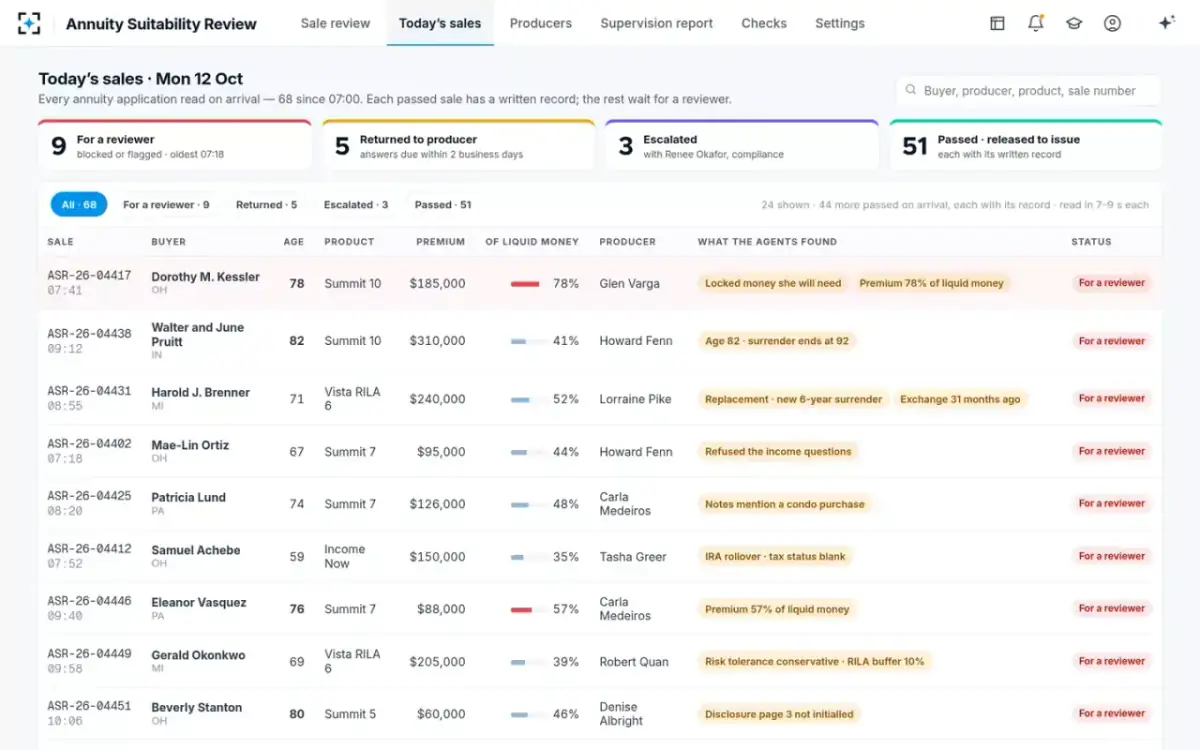
Reading every sale changes what the analyst spends time on. In the sample queue the flags are specific: a buyer of 82 whose surrender period would end at 92; a replacement that starts a new six-year schedule 31 months after the last exchange; a buyer who refused the income questions; producer notes that mention a condominium purchase the questionnaire does not. Each is a question a person should answer, and none needed a person to find it.
Is suitability review a compliance job?
Suitability review is a first-line control that compliance designs and tests: the analyst decides individual sales, while sales-practice compliance owns the rules, the overrides and the annual report. The model's reporting line shows the split. The insurer must give senior management, the head of audit included, a yearly written report on a tested review of the supervision system, the exceptions found and the corrective action. That report is about the analyst's work, which is why the analyst should not also be the one who tests it.
Market conduct examiners look at the same seat from outside. The NAIC's examination standards for life and annuity insurers include, among the marketing and sales standards, that "Insurer rules pertaining to suitability in annuity transactions are in compliance with applicable statutes, rules and regulations", alongside standards on producer requirements, training and fixed-indexed disclosures. An examiner testing those standards will ask for review files, and a file where the decision cannot be traced to evidence is a finding. The questions an exam team asks itself first are collected in the market conduct exam self-audit questions.
FINRA's 2026 report shows how securities examiners describe the same failure from their side. Among its annuity findings is "Not collecting and retaining records on annuity transactions, particularly in connection with replacement/exchange transactions", and relying on data collection processes "in situations where the volume of annuity transactions renders these processes ineffective". The second phrase is the analyst's daily problem stated as a regulatory finding.
Overrides: why the analyst should not issue a failed sale alone
An override, issuing a sale despite a failed check, should take a written reason and a second signature, because it is the decision most likely to appear later as an exception in the annual report. The model does not prescribe a two-person rule; it requires procedures reasonably designed to achieve compliance and a report of exceptions and corrective action. A second signature is one way to make each override an exception someone in compliance has already seen.
Approving a sale with a failed check takes a reason and a second signature
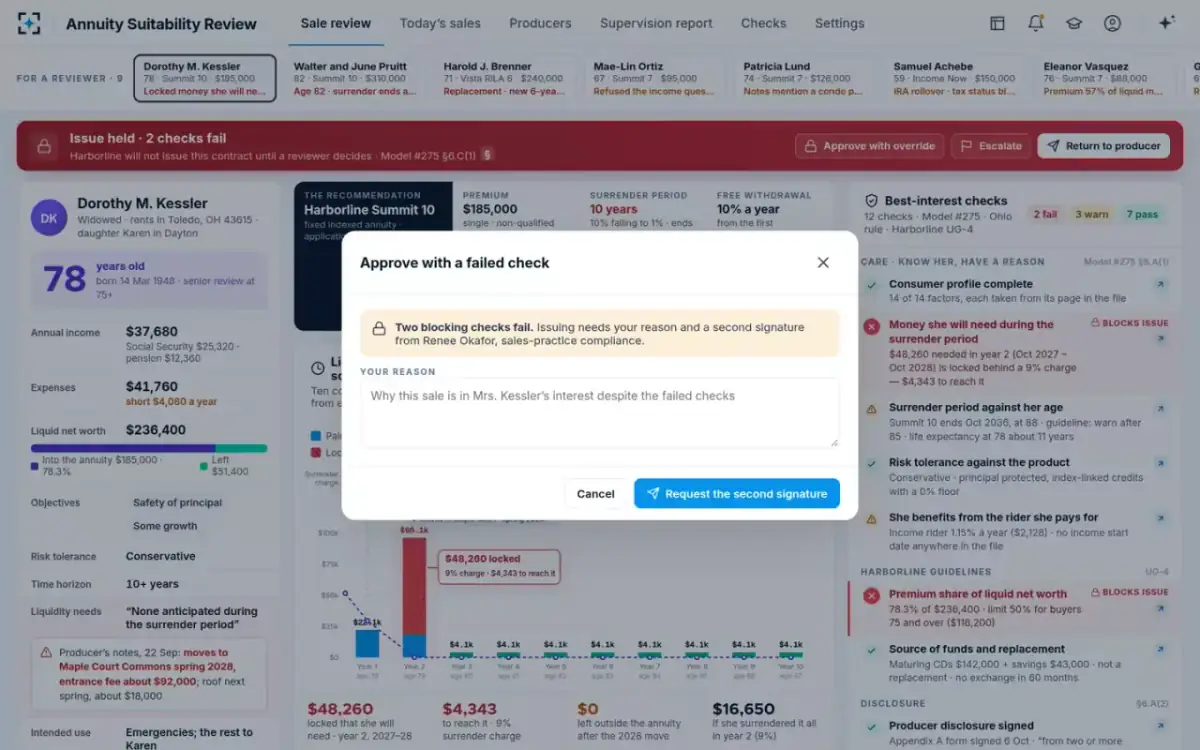
The same logic runs through the rest of the seat. The agents in the solution read, compare, project and draft; they never approve a sale, contact the buyer or change the application. The analyst keeps the judgment the model calls a reasonable basis, and compliance keeps the exceptions. How the screening system earns the analyst's trust in its first three months is the subject of an annuity supervision system reviewers trust, and what the analyst is checking each producer against is set out in the four annuity best interest obligations. The whole solution is at Annuity Suitability Review.
Questions people ask
What is a suitability review for annuities?
It is the insurer's check, before issue, that a recommended annuity has a reasonable basis to address the buyer's financial situation, insurance needs and financial objectives. Model #275 requires procedures for the review of each recommendation prior to issuance and allows a screening system to pick the sales that get additional review.
Is an annuity suitability analyst the same as a FINRA principal?
No. A FINRA registered principal works for a broker-dealer and, under Rule 2330, must approve or reject a deferred variable annuity sale within seven business days of a complete package. The carrier's analyst works for the insurer, which keeps its own duty not to issue without a reasonable basis even after a principal has approved.
Can a suitability reviewer contact the buyer?
The insurer can: the model lists confirmation of the consumer profile, customer surveys, consumer interviews and confirmation letters among the procedures an insurer may use to detect non-compliant recommendations. In Annuity Suitability Review returns go to the producer, who holds the relationship, and the agents never contact the buyer.
Does every annuity sale need a human reviewer?
Not under the model. It allows review procedures that apply a screening system and require additional review only of the transactions the selection criteria identify. Every sale still needs a review; what the screening decides is how much human attention each one gets.
What is the difference between a return and a decline?
A return sends the sale back to the producer with questions and holds issue until they are answered; a decline means the carrier will not issue the recommended contract. A return that resolves the contradiction, for example by lowering the premium so stated needs are met outside the annuity, can end in a pass.
Who is accountable if an outside firm does the review?
The insurer. Model #275 allows contracting out supervision functions but makes the insurer responsible for corrective action and subject to penalties regardless, and requires it to monitor the contractor and obtain an annual certification from the senior manager responsible for the contracted function.