The annuity best interest obligations are the four duties NAIC Model #275 places on a producer who recommends an annuity: care, disclosure, conflict of interest and documentation. The standard they serve is short: a producer "shall act in the best interest of the consumer under the circumstances known at the time the recommendation is made, without placing the producer’s or the insurer’s financial interest ahead of the consumer’s interest", and has done so if the four obligations are met. Behind the producer stands the insurer, which must supervise every recommendation and may not issue one without a reasonable basis. The hard part is that each obligation leaves its evidence in a different document. Botminds' Annuity Suitability Review reads those documents for every sale and runs its checks grouped under the four obligations and the carrier's own guidelines, each citing its rule; whether the basis is reasonable stays a person's call.
The sale and the carrier used as an example below are fictional sample data from the solution. Every rule is quoted from the model as the NAIC published it in 2020; states adopt it in their own words.
The four annuity best interest obligations, and what each leaves on file
CareSection 6.A(1)
The rule
Know the consumer, understand the options, have a reasonable basis that the recommendation addresses her situation, needs and objectives over the life of the product, and communicate the basis.
What the reviewer looks for
A complete profile; the product against her time horizon and liquidity; a benefit for each feature she pays for; for an exchange, the whole transaction.
Stays with a person: whether the basis is reasonable.
DisclosureSection 6.A(2)
The rule
Before the recommendation, a form like Appendix A: the producer’s role, what the producer is licensed to sell, whose annuities, how the producer is paid, and the right to ask for more.
What the reviewer looks for
A signed Appendix A; on request, an estimate of cash compensation; a reasonable basis that she was told of surrender charges, fees, riders and market risk.
Stays with a person: whether what she was told was enough.
Conflict of interestSection 6.A(3)
The rule
Identify and avoid, or reasonably manage and disclose, material conflicts of interest, including those related to an ownership interest.
What the reviewer looks for
Ownership or other financial interests that could sway the recommendation; the insurer separately removes product-specific sales contests and quotas.
Stays with a person: whether a conflict was managed.
DocumentationSection 6.A(4)
The rule
At the time of the recommendation, a written record of it and its basis; signed statements when the consumer refuses information or buys without a recommendation.
What the reviewer looks for
A written basis that matches the rest of the file; Appendix B or C where they apply.
Stays with a person: whether the written basis explains the sale.
What are the four best interest obligations?
The four best interest obligations are care, disclosure, conflict of interest and documentation; a producer who satisfies all four has, in the model's words, "acted in the best interest of the consumer". They arrived in the NAIC's 2020 revision of the Suitability in Annuity Transactions Model Regulation, which the NAIC first adopted in 2003. The NAIC's own summary says the revisions "incorporate a “best interest” standard of care, which requires producers to put the consumer’s interest ahead of their own".
Three things about the structure matter before the detail. The obligations attach to a recommendation, defined as advice intended to result, or that does result, in a purchase, exchange or replacement; general education, prospectuses and sales material are not recommendations. They are the producer's, not the insurer's: the insurer's duties sit in a separate supervision section. And they are tested at a moment, "the circumstances known at the time the recommendation is made", which is why what the producer knew, and wrote down, is the evidence that counts. Which states have put the model into force, and where New York differs, is mapped in NAIC best interest states.
What is the care obligation for annuities?
The care obligation requires the producer to "exercise reasonable diligence, care and skill" to know the consumer's financial situation, insurance needs and financial objectives; understand the options available after a reasonable inquiry; have a reasonable basis to believe the recommended option addresses those needs "over the life of the product, as evaluated in light of the consumer profile information"; and communicate the basis of the recommendation.
The paragraphs that follow the four verbs shape the review more than the verbs themselves. The producer must make reasonable efforts to obtain the consumer profile before recommending. The options to consider are the ones the producer is "authorized and licensed to recommend or sell", not every product in the market. The factors may weigh differently case by case, "However, each factor may not be considered in isolation." The basis must cover features the consumer pays for: the producer needs a reasonable basis that the consumer "would benefit from certain features of the annuity, such as annuitization, death or living benefit or other insurance-related features", and the obligation applies to the annuity as a whole, its subaccounts and its riders.
Three limits are written in too. The care obligation does not mean the annuity with the lowest compensation must be recommended. It creates no ongoing monitoring duty, unless a separate advisory or planning agreement does. And for an exchange or replacement the producer must weigh the whole transaction: surrender charges, a new surrender period, lost benefits and higher fees, whether the new product "would substantially benefit the consumer in comparison to the replaced product over the life of the product", and any exchange in the preceding 60 months. How a replacement team prices that whole transaction, contract against contract, is shown in annuity exchange technology.
The care obligation is where the hardest judgments sit, because "over the life of the product" turns a snapshot into a forecast. A fixed indexed annuity with a ten-year schedule sold to a 78-year-old is a ten-year promise about her liquidity. The guide on the annuity suitability questionnaire shows how each profile factor is evidenced; the care question is whether they agree with each other.
What is the disclosure obligation in annuity sales?
The disclosure obligation requires the producer, before recommending or selling an annuity, to "prominently disclose to the consumer on a form substantially similar to Appendix A" five things: the scope and terms of the relationship and the producer's role; whether the producer is licensed to sell fixed annuities, fixed indexed annuities, variable annuities, life insurance, mutual funds, stocks and bonds, and certificates of deposit; whose annuities the producer can sell, from one insurer, two or more, or two or more while primarily contracted with one; the sources and types of cash and non-cash compensation; and the consumer's right to ask for more about cash compensation.
If the consumer asks, the producer must give a reasonable estimate of the cash compensation, which may be a range of amounts or percentages, and say whether it is paid once or repeatedly. Separately, the producer must have a reasonable basis to believe the consumer was informed of the annuity's features: the surrender period and charge, potential tax penalties, mortality and expense fees, advisory fees, annual fees, rider charges, limits on interest, possible changes in non-guaranteed elements, and market risk.
Appendix A itself is plain. It opens "Do Not Sign Unless You Have Read and Understand the Information in this Form", and its section on pay begins: "It’s important for You to understand how I’m paid for my work." For a reviewer the test is binary first, a signed form or not, and qualitative second: whether the product disclosure's surrender schedule and rider fee were acknowledged, and whether anything in the file suggests the consumer was told something different.
What is the conflict of interest obligation?
The conflict of interest obligation requires a producer to "identify and avoid or reasonably manage and disclose material conflicts of interest, including material conflicts of interest related to an ownership interest." The definition carries the surprise. A material conflict of interest is a financial interest of the producer in the sale that a reasonable person would expect to influence the impartiality of a recommendation, and it "does not include cash compensation or non-cash compensation."
So commissions are not handled under this obligation at all. They are disclosed under the disclosure obligation, and the most distorting kind is removed at the insurer: section 6.C(2)(h) requires the insurer to keep procedures to "identify and eliminate any sales contests, sales quotas, bonuses, and non-cash compensation that are based on the sales of specific annuities within a limited period of time". What remains for the producer's conflict obligation is mainly ownership: an interest in an agency, a marketing organisation or a product that a reasonable person would expect to sway the recommendation.
The SEC draws the line differently for broker-dealers. Under Regulation Best Interest, a conflict of interest is "an interest that might incline a broker, dealer, or a natural person who is an associated person of a broker or dealer —consciously or unconsciously—to make a recommendation that is not disinterested." Compensation is squarely inside that definition, which is one reason the same annuity can face a stricter conflict review when a broker-dealer sells it.
What documentation does best interest require?
The documentation obligation requires the producer, at the time of the recommendation or sale, to make "a written record of any recommendation and the basis for the recommendation", and to obtain two signed statements where they apply: Appendix B, when the consumer refuses to give profile information or gives only some of it, and Appendix C, when the consumer buys an annuity that was not recommended. The NAIC describes the point of it: the regulation "codifies, as a requirement, the good business practice of carefully and clearly explaining to the consumer the basis for a recommendation."
Records then have to last. Insurers, general agents, independent agencies and producers must keep the information collected from the consumer, the disclosures made, "including summaries of oral disclosures", and the other information used in the recommendation, for a number of years each state sets; the model's drafting note says that for some states it may be five. An insurer may keep the documentation for its producers but is not required to.
The written basis is the document a reviewer reads hardest, because it is the only place the producer explains the sale in his own words. In the sample sale it says the client "has adequate liquid funds for emergencies", while the producer's call notes describe a $92,000 entrance fee in the second contract year. A basis that does not mention the largest cash need in the file is the clearest documentation finding there is.
Who is responsible for best interest: producers, insurers or both?
Both, for different things: the producer owes the four obligations on each recommendation, and the insurer owes a supervision system and may not issue without a reasonable basis. Model #275 extends the producer's duties to "every producer who has exercised material control or influence in the making of a recommendation and has received direct compensation as a result of the recommendation or sale, regardless of whether the producer has had any direct contact with the consumer." Providing marketing or educational material, wholesaling, back-office support and general supervision of a producer do not, by themselves, count as material control or influence.
Who owes what on one annuity sale under Model #275
A person decides
Recommending producerOwes care, disclosure, conflict of interest and documentation on the recommendation; so does any producer with material control or influence who is paid directly for it.
A person decides
Insurer’s training and contractingVerifies the producer finished the one-time annuity training before selling, and provides product-specific training on every material feature.
Agent
Pre-issue readingReads the file and runs checks under each obligation, each with its rule and the page its evidence came from.
Never: decides that a basis is reasonable
A person decides
Suitability review analystDecides whether there is a reasonable basis to issue, returns the file, or escalates it.
A person decides
Sales-practice complianceApproves overrides, removes product-specific sales contests and quotas, and reports to senior management each year.
Training is the joint piece. The producer must complete a one-time course of at least four continuing-education credits before selling annuities, and the insurer must verify it and provide product-specific training. The producer side of that rule, state by state, is covered in insurance CE requirements by state; the insurer side is part of the supervision system the analyst operates.
Does best interest make agents fiduciaries?
No. Model #275 says so in terms, and adds in its purpose section that nothing in it creates a private cause of action or subjects a producer to civil liability under the best-interest standard or the standards governing a fiduciary.
"The requirements under this subsection do not create a fiduciary obligation or relationship and only create a regulatory obligation as established in this regulation."
NAIC Model #275, section 6.A(1)(d)
The distinction has consequences for a reviewer. A regulatory obligation is enforced by the insurance commissioner, who may order the insurer, the agency or the producer to take corrective action for a harmed consumer and impose penalties; any penalty may be reduced if corrective action was taken promptly or the violation was not part of a pattern. So the review's job is to catch the sale before it needs corrective action. Fiduciary duties come from elsewhere: a producer who is also an investment adviser, or a plan fiduciary under ERISA, carries those duties under that law. Where the federal fiduciary rule now stands is covered in the DOL fiduciary rule in 2026.
Model #275 beside Regulation Best Interest
The two standards were designed to line up, and the NAIC says so: the 2020 revisions "align with the SEC’s Regulation Best Interest." They are not the same rule. Reg BI governs broker-dealers recommending securities, including variable annuities and registered index-linked annuities; Model #275 governs insurance producers and insurers, and a sale made under comparable SEC and FINRA standards falls within the model's safe harbor.
Model #275 and Reg BI: four obligations each, not the same four
NAIC Model #275 (producers): Care, disclosure, conflict of interest, documentation.
SEC Regulation Best Interest (broker-dealers): Disclosure, care, conflict of interest, compliance.
NAIC Model #275 (producers): A reasonable basis "over the life of the product"; benefit from riders and features; the whole transaction on an exchange.
SEC Regulation Best Interest (broker-dealers): A reasonable basis that a series of recommended transactions is not excessive when taken together.
NAIC Model #275 (producers): A material conflict excludes cash and non-cash compensation, which are disclosed instead.
SEC Regulation Best Interest (broker-dealers): Any interest that might incline the person, "consciously or unconsciously", to a recommendation that is not disinterested.
NAIC Model #275 (producers): The insurer must identify and eliminate contests and quotas based on specific annuities within a limited period.
SEC Regulation Best Interest (broker-dealers): The broker-dealer must identify and eliminate contests and quotas based on specific securities within a limited period.
NAIC Model #275 (producers): A written record of the recommendation and its basis; signed refusal and no-recommendation forms.
SEC Regulation Best Interest (broker-dealers): Written policies and procedures reasonably designed to achieve compliance.
FINRA's examiners read the securities side strictly. Their 2026 report on annuities notes that under Reg BI a broker-dealer must not put its interests ahead of the customer's and that the standard "cannot be satisfied through disclosure alone." The model reaches a similar place through structure: disclosure is one obligation of four, and a disclosed conflict still has to be avoided or managed.
What is a reasonable basis, and who decides it?
A reasonable basis is a belief, grounded in the consumer profile and the product's terms, that the recommendation effectively addresses the consumer's financial situation, insurance needs and financial objectives; the model asks for it but does not define it further. It is a judgment about evidence, and the producer forms it first; the insurer must then have its own reasonable basis before it issues. That second judgment is the analyst's.
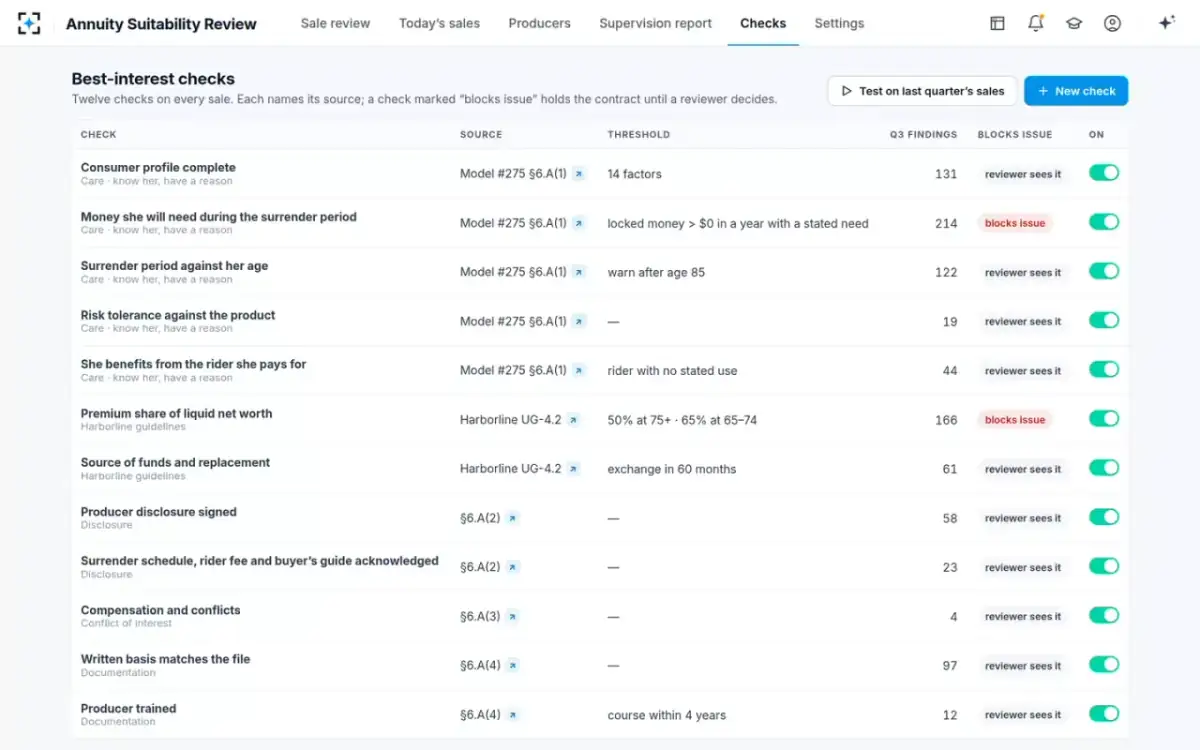
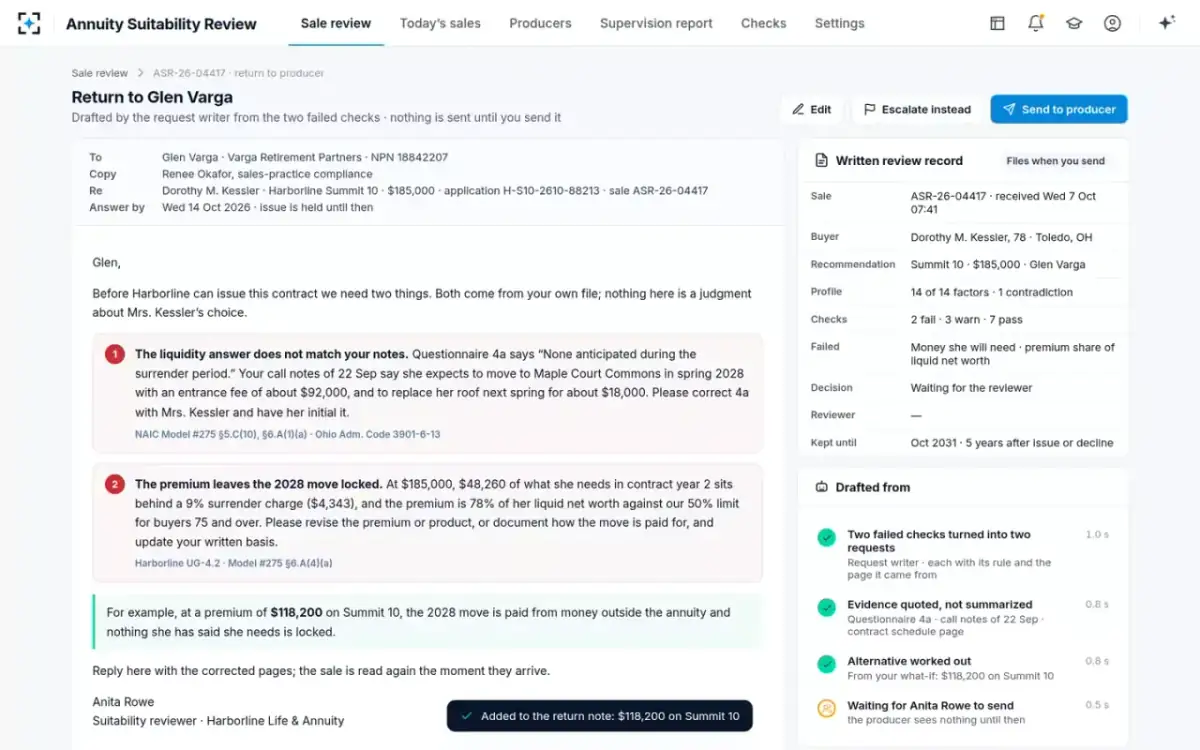
What software can do is make the evidence complete and the conflicts visible. In the sample sale, the checks show two failures. The liquidity check fails because $48,260 the buyer needs in her second contract year would sit behind a 9% surrender charge, and the carrier's guideline on premium share fails because $185,000 is 78.3% of her $236,400 of liquid net worth, against a limit of 50% for buyers 75 and over. Each failure cites its source, the model's care obligation or the carrier's own guideline, so the analyst can see whether a check rests on the rule or on house policy.
Best-interest checks in Annuity Suitability Review, each naming its source
The agents also draft the conversation that follows. A return to the producer turns each failed check into one request, with the quoted evidence and its rule, and an alternative the analyst worked out. Nothing is sent until the analyst sends it, and the agents never approve a sale, contact the buyer or change the application.
A return that names the evidence and the rule for each item
That division is the useful reading of the four obligations for anyone designing a review. The producer owes them; the insurer must see their evidence before issue; a machine can gather, compare and cite; and the judgment that a basis is reasonable, or that a sale should issue despite a failed check, belongs to a named person. The seat that makes those judgments is described in the annuity suitability review analyst, and the solution itself at Annuity Suitability Review.
Questions people ask
Do the best interest obligations apply to fixed annuities?
Yes. Model #275 applies to any sale or recommendation of an annuity that is an insurance product under state law and individually solicited, which includes fixed and fixed indexed annuities. It exempts contracts funding employer plans such as ERISA plans and employer 401(k) or 403(b) plans, settlements of personal injury claims and formal prepaid funeral contracts.
Does a producer have to recommend the cheapest annuity?
No. The model says the care obligation does not mean the annuity with the lowest one-time or multiple-occurrence compensation structure must be recommended. It must still be the option the producer has a reasonable basis to believe addresses the consumer's needs over the life of the product.
Does a producer have to compare products from other companies?
Only those the producer is authorized and licensed to sell. The model says the care obligation does not require analysis of products outside the producer's authority and licence, and producers are held to the standard of producers with similar authority and licensure.
What happens if a consumer will not give profile information?
The producer obtains a signed statement on a form like Appendix B recording the refusal and the consumer's understanding of its consequences. If the transaction is then not recommended, the producer's care obligation does not apply, and the insurer must have procedures to identify suspicious refusals.
Is commission a conflict of interest under Model #275?
Not under the conflict obligation: the model's definition of a material conflict excludes cash and non-cash compensation. Compensation is covered by the disclosure obligation, including an estimate on request, and the insurer must eliminate sales contests and quotas based on specific annuities.