An annuity surrender charge schedule is the table in the contract that sets the percentage charged on money taken out above the free withdrawal in each contract year, usually starting high and falling to zero over seven to ten years or more. For a carrier reviewing a recommended sale before issue, the schedule is not a disclosure item to tick but a test of the buyer's file: the NAIC best-interest model asks for a reasonable basis that the annuity addresses the consumer's needs "over the life of the product", and the schedule is what decides whether money she has said she will need is reachable in the year she needs it. That is hard because the dates sit in different documents, the questionnaire, the source of funds, the producer's call notes, and the schedule sits in the product disclosure. Botminds' Annuity Suitability Review reads them together and projects each stated need against the schedule before the contract is issued, so the reviewer sees locked dollars and the age the last charge ends, not only a percentage.
The sale used as the example is fictional sample data in the solution: a buyer of 78 at a sample carrier, sold a $185,000 fixed indexed annuity with a ten-year schedule. Rules are quoted from NAIC models, state statutes and FINRA, linked where they appear.
The schedule is where the money leaves, and where the rules bite
$487.6B
surrender benefits and withdrawals paid by US life insurers in 2025
61.1%
average surrenders-to-premiums ratio in 2025, up from 58.4%
10%
Florida’s cap on the charge for buyers 65 and over, with none after year 10
30days
California’s minimum free look for buyers 60 and over
What is an annuity surrender charge schedule, and what does a reviewer read from it?
It is the contract's charge for early withdrawal, year by year, and a reviewer reads six terms from it, not one. The length, which sets the age at which the money comes free. The starting percentage and the slope. Whether the charge is figured on premium or on account value. Whether the schedule runs from the contract date or from each premium payment, so an added premium starts a clock of its own. The free withdrawal, its size, when it starts and whether unused amounts carry forward. And any market value adjustment applied on top.
The NAIC's own sample illustration in its disclosure model shows what a moderate schedule looks like: seven years, falling from 8% to 2%, with nothing charged from year eight, and partial withdrawals of up to 10% of account value a year free of charge (NAIC Model #245). It is an example, not a standard, and no regulator or independent study publishes what is typical across the market; the sample sale on this page uses ten years from 10% to 1%.
The schedule in the NAIC's sample annuity illustration
| Contract year | Surrender charge | Charge on $100,000 above the free amount |
|---|---|---|
| Year 1 | 8% | $8,000 |
| Year 2 | 7% | $7,000 |
| Year 3 | 6% | $6,000 |
| Year 4 | 5% | $5,000 |
| Year 5 | 4% | $4,000 |
| Year 6 | 3% | $3,000 |
| Year 7 | 2% | $2,000 |
| Year 8 and later | 0% | $0 |
Two features deserve a reviewer's attention because they move the date. The disclosure model makes illustrations run for ten contract years, or for the surrender charge period "if longer than ten (10) years, including any renewal surrender charge period(s)", and requires annuities with recurring schedules to explain "what circumstances will cause the surrender charge to recur." A schedule that restarts on an added premium, or renews at the end of a guarantee period, can leave money locked long after the date on the first page.
Which rules make the schedule the reviewer's business?
Three parts of the best-interest model put the schedule in front of the carrier's reviewer: the profile, the disclosure, and the insurer's own duty before issue. The consumer profile the producer must gather lists age, financial time horizon, liquidity needs and liquid net worth among its fourteen factors (NAIC Model #275 §2.C). The disclosure obligation requires a reasonable basis to believe the consumer was informed of "the potential surrender period and surrender charge" and the potential tax penalty before or at the sale. Each factor's field is traced in the annuity suitability questionnaire.
The insurer's duty is the one that makes the schedule a review test rather than a form. Under §6.C(1) "an insurer may not issue an annuity recommended to a consumer unless there is a reasonable basis to believe the annuity would effectively address the particular consumer’s financial situation, insurance needs and financial objectives based on the consumer’s consumer profile information." Its supervision system must include review of each recommendation before issue, and the model allows that review to "apply a screening system for the purpose of identifying selected transactions for additional review" and to run electronically. A screening rule that compares the schedule with the buyer's stated needs is exactly such a system.
The rule is the same in substance where a deferred variable annuity is sold through a broker-dealer. FINRA Rule 2330 requires a reasonable basis to believe the customer has been informed of "the potential surrender period and surrender charge", and on an exchange, whether the customer "would incur a surrender charge, be subject to the commencement of a new surrender period" (FINRA Rule 2330(b)).
Which states limit annuity surrender charges?
Most states regulate the charge indirectly, through disclosure, free-look and nonforfeiture rules, and a few set direct limits for older buyers. Florida is the clearest. An annuity issued to a senior consumer 65 or older "may not contain a surrender or deferred sales charge for a withdrawal of money from an annuity exceeding 10 percent of the amount withdrawn", and the charge must fall so that none exists after the tenth policy year, or ten years after each premium payment where there are several, whichever is later. Accredited investors and contracts exempted by the statute are outside it. A ten-year schedule starting at 10%, like the sample's, sits at the edge of what Florida allows for a senior.
California works through the free look. Every individual annuity delivered to a buyer 60 or older on the date of purchase must allow at least 30 days to return it, and a non-variable contract carries a cover notice that ends: "After 30 days, cancellation may result in a substantial penalty, known as a surrender charge." The statute adds that whether a charge is a surrender charge "will be determined by the nature of the charge and not the name given to the charge by the insurer."
Every state that follows the NAIC's nonforfeiture model also puts a floor under any surrender. The minimum value is built from 87.5% of premiums paid, accumulated at a rate tied to the five-year Treasury rate and capped at 3%, less withdrawals and certain charges, and "In no event shall any cash surrender benefit be less than the minimum nonforfeiture amount at that time." A reviewer does not need to recompute the floor, but a schedule whose early charges would breach it is a product filing question, not a suitability one.
How a reviewer tests the schedule against the buyer's dates
Test the schedule from the buyer's needs, not from the percentages. Take every need the buyer stated, anywhere in the file, with the year it falls; pay it first from money she keeps outside the annuity, then from the free withdrawal; whatever is left is locked behind that year's charge. A schedule is unsuitable for this buyer when a stated need lands in a locked year, whatever the percentage.
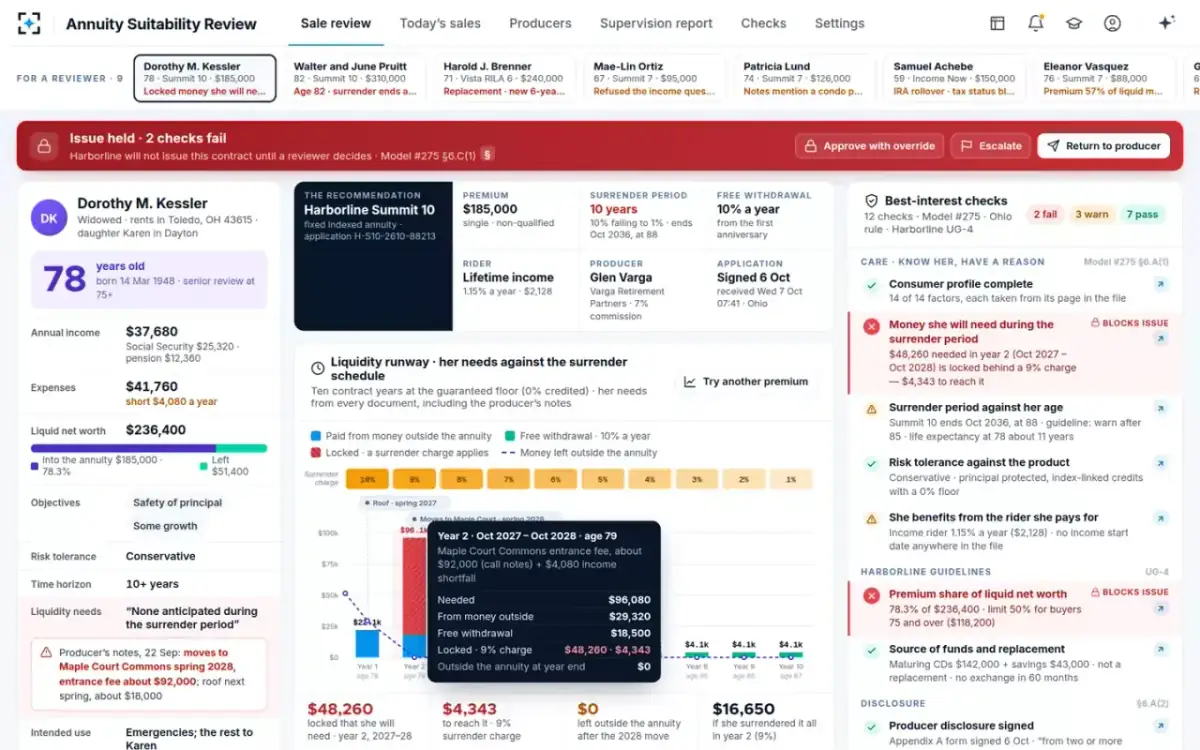
The sample sale shows why the file has to be read whole. The questionnaire says no money will be needed during the surrender period. The producer's call notes say the buyer has paid a deposit at a retirement community, expects to move in contract year two with an entrance fee of about $92,000, and needs a roof next spring, about $18,000. Her income is $4,080 a year short of her expenses. At the applied $185,000 premium, her year-two need of $96,080 is met by $29,320 she has outside the annuity and $18,500 of free withdrawal; the remaining $48,260 sits behind a 9% charge, and reaching it costs $4,343.
The buyer's year-two need against the schedule, at two premiums
Premium $185,000: need $96,080
- Outside the annuity, $29,320 · 30.5%
- Free withdrawal, $18,500 · 19.3%
- Locked behind a 9% charge, $48,260 · 50.2%
Premium $118,200: need $96,080
- Outside the annuity, $96,080 · 100%
Three conventions keep the test honest. Project at the guaranteed floor, with no index credits, because the charge is certain and the credits are not. Apply the free withdrawal exactly as the contract states it: on the sample contract it starts only from the first anniversary, so a need in year one is charged in full. And never project a need the buyer did not state; the reviewer's question is about the file, not a forecast of her life.
The liquidity runway: her stated needs against the schedule, year by year
When does the schedule outlast the buyer?
When the last charge ends later than the buyer's plans can reasonably be known, which in practice means a review rule tied to age. No model rule sets a maximum; carriers set their own. The sample carrier warns when a surrender period would end after age 85, and on the sample sale the ten-year schedule ends at 88. The warning does not block issue; it asks the reviewer to read the file for whatever makes a decade-long lock reasonable, such as money set aside elsewhere for care or a stated plan to leave the contract to heirs.
Age-based checks are an examination point, not only a carrier preference. FINRA's 2026 oversight report lists, among supervisory gaps it found, procedures that did not cover "consideration of the customer’s age in assessing whether the recommendation to purchase an annuity complies with FINRA Rule 2330 or Reg BI" (FINRA, 2026 Annual Regulatory Oversight Report: Annuities). The wider set of checks a carrier runs on sales to older buyers, from premium share to the free look, is in selling annuities to seniors.
Surrender charge waivers: verify them, never assume them
A waiver is a contract term or rider with its own conditions, so a reviewer should confirm that the sale's rationale does not lean on one the contract lacks or the buyer cannot meet. Nursing-home confinement and terminal-illness waivers, where a contract has them, carry conditions of their own, such as a waiting period or a condition that must begin after issue. Whether a death benefit is paid free of the charge is also a contract term; in the NAIC's sample illustration, "The death benefit is not affected by surrender charges or the MVA."
Two items are often mistaken for waivers. Required minimum distributions: Model #245 requires the disclosure for annuities subject to them to explain their effect on contract values, so whether an RMD is charged is answered there, not assumed. And the federal additional tax: section 72(q) adds 10% of the taxable part of an early distribution before age 59½, with exceptions such as death and disability (26 U.S.C. §72). An exception from that tax does not waive the contract's charge.
Before the schedule passes review: what to confirm in the file
- The schedule’s length, slope and basis are on the disclosure the buyer signed
Premium or account value; contract date or each premium; any renewal or recurring period.
- Every stated need is placed in a contract year
Questionnaire, source of funds and call notes read together; a need in one and not the other is a finding.
- No stated need falls in a locked year
Paid first from outside money, then the free withdrawal, at the guaranteed floor.
- The free withdrawal works as the rationale assumes
When it starts, what it is a percentage of, whether it carries forward.
- Any waiver relied on exists in this contract and fits this buyer
Waiting periods, conditions arising after issue, rider fees.
- The age at which the last charge ends is within your guideline
Or the file explains why a longer lock suits this buyer.
- On an exchange, the old charge and the new schedule are both shown
Model #275 and Rule 2330 list both among the costs to weigh.
- State limits are met
Florida’s cap for buyers 65 and over; California’s 30-day free look and cover notice for buyers 60 and over.
What the schedule costs on an exchange
On an exchange the buyer can pay twice: the old contract's charge to leave, and a new schedule that starts at issue. Both rule sets name them. Model #275 tells the producer to consider whether "The consumer will incur a surrender charge, be subject to the commencement of a new surrender period, lose existing benefits" and whether there was another exchange within 60 months; FINRA Rule 2330 asks the same for variable annuities with a 36-month look-back.
Examiners keep finding the cost understated. FINRA's 2026 report lists paperwork "understating surrender charges" among its findings, and among effective practices, surveillance that takes into account the "cumulative surrender charges" incurred by a representative's customers and "excessive rates of exchanges within the last one to two years of the surrender schedule." A late-schedule exchange looks cheap because the old charge is nearly gone; the new ten-year schedule is the cost. Where the new product is a registered index-linked annuity, an interim value adjustment can sit on top of the charge, covered in registered index linked annuity pros and cons.
Measuring the schedule across a book of sales
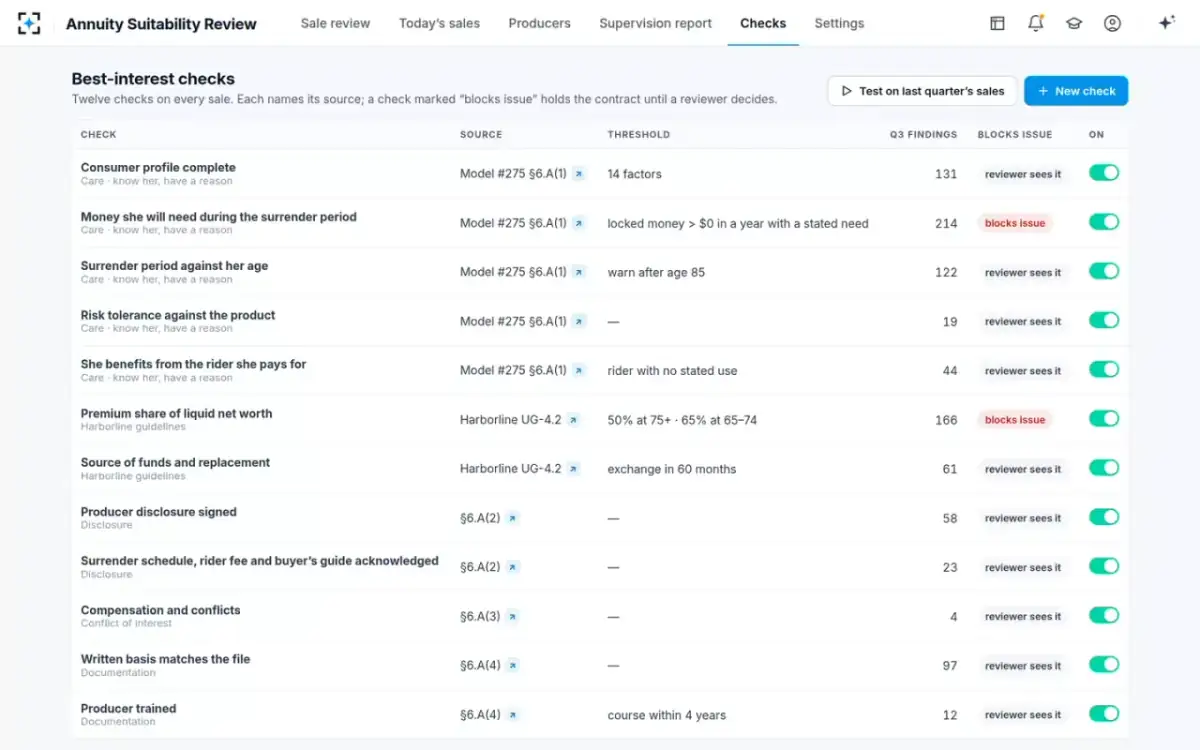
Count, each quarter, how often each schedule-related check fires, how often it blocks issue, and how the findings resolve, because that is the evidence a supervision system works. The model requires the insurer to report annually to senior management on "a review, with appropriate testing, reasonably designed to determine the effectiveness of the supervision system, the exceptions found, and corrective action taken or recommended."
On the sample carrier, the schedule checks are among the busiest of the quarter
Read the shape, not only the totals. A liquidity check that fires often but is usually resolved by a lower premium says producers are over-allocating; one resolved by an override says the guideline may be wrong, or the overrides need a closer look. The acknowledgment check firing rarely means the forms are signed, which is a different thing from the schedule being suitable. How a reviewer team earns trust in screening rules like these over its first quarter is in annuity supervision system.
Each schedule check names its source, its threshold and whether it blocks issue
What Annuity Suitability Review does with the schedule, and what it leaves alone
The solution reads the application, questionnaire, disclosures, source of funds and producer notes as each sale arrives, places every stated need in a contract year, and pays it against the schedule at the guaranteed floor. A need left locked fails a check that holds issue until a reviewer decides; a schedule ending past the carrier's age guideline warns. The reviewer can move the premium or switch the product and see the runway worked out again, then send the producer a return naming the evidence, the rule and a premium that would pass. An override needs a written reason and a second signature from sales-practice compliance.
It does not price the contract, replace the insurer's illustration system or judge an index strategy, and it never adds a need the buyer did not state. Its figures on this page are sample data on fictional people; the review clock in its settings, one hour to a reviewer's desk and one business day to a decision, is a carrier setting, not a measured result. The solution is at Annuity Suitability Review.
Questions people ask
What is a typical annuity surrender charge schedule?
No regulator publishes a market-wide typical schedule. The NAIC's sample illustration in Model #245 uses seven years falling from 8% to 2%, and Florida caps the charge for buyers 65 and over at 10% with none after the tenth policy year. The sample sale on this page uses ten years, from 10% to 1%.
Are annuity surrender charge waivers standard?
No. Nursing-home, terminal-illness and similar waivers are contract terms or riders with their own conditions, and a reviewer should confirm the contract has one before a rationale relies on it. The NAIC sample illustration states that its death benefit is not affected by surrender charges, but that too is a contract term.
Is the surrender charge figured on premium or account value?
Either, depending on the contract. On a contract that has grown, a charge on account value costs more; on one that has fallen, less. A pre-issue review usually projects at the guaranteed floor with no growth, the conservative view.
Does an added premium restart the surrender charge schedule?
On some contracts, yes. Model #245 requires annuities with recurring schedules to explain what will cause the charge to recur, and Florida's limit for seniors runs ten years from each premium payment where there are several.
How long must suitability records be kept?
As long as each state's version of Model #275 sets; the model's drafting note suggests five years in some states, and Florida's statute requires five years after the transaction is completed. Annuity Suitability Review keeps the written review with the application for five years by default, a setting the carrier can lengthen.
Does the free look avoid the surrender charge?
Yes, a return inside the free look is without the charge. Model #245 sets at least 15 days where the buyer's guide and disclosure came late, and California gives buyers 60 and over at least 30 days.