The NAIC best interest states are the 49 jurisdictions that, by the NAIC's count, have put the 2020 best-interest revisions of the Suitability in Annuity Transactions Model Regulation, Model #275, into force: every state except New York. The NAIC's map, "[Status as of February 1, 2026]", shows "Adopted (49-Jurisdictions)", one jurisdiction pending, the District of Columbia, and New York alone under "Other Provisions Regulating Annuity Transactions". Adoption by nearly everyone does not mean uniformity: states adopt the model in their own words, fill in its blanks differently and add rules of their own, and a carrier selling in many states has to review each sale against the right one. Botminds' Annuity Suitability Review runs its checks against the rule of the state where the sale was made and cites it, a Model #275 section or the state's own regulation, on every finding.
Sample screens on this page come from the solution's fictional carrier. The map, statutes and court decision are quoted from the NAIC, state legislatures, New York's Department of Financial Services and its Court of Appeals, linked where they appear.
NAIC best interest states: where the 2020 revisions to Model #275 stand
Adopted, 49 Pending, District of Columbia Own rule, New York Regulation 187
Which states have adopted the NAIC best interest rule?
Forty-nine have: Alabama through Wyoming, every state but New York. The NAIC's August 2025 brief names them: "As of this update, 49 jurisdictions have implemented the Suitability in Annuity Transactions Model Regulation (#275) revisions", followed by the list, and its February 2026 map shows the same 49. The brief adds that nearly every state had adopted some version of the earlier suitability model before the 2020 revision.
"Adopted" means the state has a rule in force that the NAIC counts as implementing the revisions. It does not mean the same text. The map carries its own warning: it "does not reflect a determination as to whether the pending or enacted legislation contains all elements of NAIC amendments to the model(s)". Some states adopted by regulation and some by statute; some kept drafting-note options the model leaves open. How model laws travel from the NAIC into state codes is explained in how states adopt NAIC model laws.
Where the annuity best-interest rule stood on 1 February 2026
49
jurisdictions with the 2020 revisions in force
1
pending: the District of Columbia
1
with its own rule: New York, Regulation 187
2019
year New York’s best-interest rule took effect for annuities
Is DC a best interest state?
Not yet, on the NAIC's February 2026 map: the District of Columbia is the one jurisdiction shown as "Pending". Pending means action is under way, not that a rule is in force. A carrier selling in the District should confirm with the District's insurance regulator which annuity sales rule applies today, rather than rely on a map dated months earlier.
Does New York follow NAIC Model #275?
No. New York regulates annuity and life insurance recommendations under its own Insurance Regulation 187, 11 NYCRR 224, Suitability and Best Interest in Life Insurance and Annuity Transactions, which took effect "August 1, 2019 for annuity transactions and February 1, 2020, for life insurance transactions." The NAIC map files New York under "Other Provisions Regulating Annuity Transactions". New York's rule came first, and in several places it asks more: it also reaches recommendations to change an existing policy, the kind of request that arrives at a life service desk (the in-force requests that need the issued contract).
The rule survived a constitutional challenge. In 2021 the Appellate Division declared the amendment unconstitutionally vague; in October 2022 the Court of Appeals disagreed and ruled: "Order reversed, with costs, and judgment of Supreme Court, Albany County, reinstated." The court described what the amended rule asks: a recommendation based on an evaluation of the relevant suitability information that "reflects the care, skill, prudence, and diligence that a prudent person acting in a like capacity and familiar with such matters would use under the circumstances then prevailing", made with only the consumer's interests considered and without influence from compensation.
Model #275 and New York Regulation 187: where the two rules part
NAIC Model #275 (49 jurisdictions): Annuities.
New York Regulation 187: Annuities and life insurance.
NAIC Model #275 (49 jurisdictions): Purchases, exchanges and replacements of annuities.
New York Regulation 187: Sales transactions and in-force transactions, such as changes to an existing policy.
NAIC Model #275 (49 jurisdictions): Products the producer is authorized and licensed to sell; no analysis of products outside that authority.
New York Regulation 187: “Suitable” is judged against “all products, services, and transactions available to the producer”.
NAIC Model #275 (49 jurisdictions): Advice intended to result, or that results, in a purchase, exchange or replacement.
New York Regulation 187: Advice that results in a consumer entering into, or refraining from, a transaction; judged objectively and by intent.
NAIC Model #275 (49 jurisdictions): Reasonable diligence, care and skill; expressly not a fiduciary obligation.
New York Regulation 187: A prudent-person standard of care, skill, prudence and diligence, with only the consumer’s interests considered.
NAIC Model #275 (49 jurisdictions): Model text adopted by each state, with forms substantially similar to Appendices A to C.
New York Regulation 187: Principles-based; no particular systems, forms or procedures imposed.
The Department of Financial Services describes its approach in one line: Regulation 187 "does not impose any particular systems, forms, or procedures for meeting the requirements of the regulation." For a reviewer that cuts both ways. There is no Appendix A to check for, and there is also no template to hide behind: the file has to show the reasoning.
What is the difference between suitability and best interest?
Suitability asks whether a recommendation fits the consumer; best interest adds that the producer must not put his or the insurer's financial interest ahead of the consumer's, and spells out how to show it, through care, disclosure, conflict-of-interest and documentation obligations. The NAIC's 2020 text describes itself as "a successor regulation that exceeds the requirements of the 2010 model regulation", the earlier suitability version.
In practice the change shows up in three places a reviewer can see. A disclosure form, like Appendix A, now tells the consumer the producer's role, licences, insurers and pay before the sale. The care obligation reaches over the life of the product and to every rider the consumer pays for. And the documentation obligation requires the basis of the recommendation in writing, not only the profile. What each obligation asks is set out in the annuity best interest obligations.
Is California a best interest state?
Yes: California is among the 49 jurisdictions the NAIC lists as having implemented the 2020 revisions. Like Florida, it also has rules for older buyers that sit beside the model. Its Insurance Code gives anyone 60 or older on the date of purchase a right to return an individual annuity for at least 30 days, and requires a printed notice on the front of non-variable annuities sold to those buyers promising a full refund within that period.
What still differs from state to state
Five things still differ between best-interest states often enough to matter to a reviewer: how long records are kept, the rules for older buyers, free-look periods, what New York covers, and which forms the state approves. The model itself leaves some of these open with brackets and drafting notes, so differences are designed in.
Annuity best interest by state: the differences a reviewer meets
| Topic | What Model #275 says | Examples of state differences |
|---|---|---|
| Record retention | Records kept for "[insert number] years"; a drafting note says some states may choose five. | Florida: 5 years after the transaction is completed. New York: its record retention regulation, 11 NYCRR 243. |
| Older buyers | No age-specific rule; age is the first profile factor. | Florida: for buyers 65 and over, no surrender charge above 10% and none after year 10. California: 30-day free look from age 60. |
| Free look | Not addressed; the disclosure model sets 15 days where the buyer’s guide came late. | California: at least 30 days for buyers 60 and over, with a printed cover notice. |
| Scope | Annuities only. | New York: annuities and life insurance, sales and in-force transactions. |
| Forms | Disclosure, refusal and no-recommendation forms "substantially similar" to Appendices A to C; states that approve forms may say so. | New York imposes no particular forms; states that approve forms may require their own versions. |
Florida's version shows how a state can build on the model while keeping its skeleton. Its statute repeats the model's purpose, its fourteen-factor consumer profile and its exchange questions, then adds a section titled "PROHIBITED CHARGES" for seniors: an annuity issued to a consumer 65 or older may not carry a surrender charge above 10% of the amount withdrawn, and no charge may remain "after the end of the 10th policy year or 10 years after the date of each premium payment if multiple premiums are paid, whichever is later." How a carrier builds those limits into its checks on older buyers is worked through in selling annuities to seniors.
When did my state adopt annuity best interest?
Dates differ, and the NAIC map shows status, not dates; the state's insurance department or its code is the source for an effective date. One public record captures a cluster of them: the New York Court of Appeals, in October 2022, listed states with similar NAIC-derived requirements, and gave effective dates for those that had just acted.
Effective dates the New York Court of Appeals listed for six states, October 2022
| State | Rule | Effective |
|---|---|---|
| Colorado | 3 Colo. Code Regs. 702-4-1-11-1, as amended | 1 November 2022 |
| South Carolina | S.C. Code Ann. Regs. 69-29 | 27 November 2022 |
| Hawaii | Haw. Rev. Stat. 431:10D-621, amended by 2022 Act 58 | 1 January 2023 |
| Minnesota | Minn. Stat. §72A.203, amended by 2022 Laws ch. 84 | 1 January 2023 |
| North Carolina | 11 N.C. Admin. Code 12.0462 | 1 January 2023 |
| South Dakota | S.D. Codified Laws §58-33A-13, amended by 2022 Sess. Laws ch. 186 | 1 January 2023 |
Producers meet adoption dates through training as well as rules. The 2020 model gave producers who had completed an annuity course under the old rule six months after the effective date to take either a new four-credit course or a one-time one-credit course on the revised sales practices, replacement and disclosure requirements. Those training transitions, state by state, belong to producer licensing; the reviewer's question is only whether the producer on the sale had completed what his state required.
Reviewing a multistate book against the right rule
A carrier selling in many states needs every check to know which state's rule it is applying, and every finding to cite it. The model makes that harder than it sounds, because forms, retention and senior rules vary while most of the text does not. In the solution, the states the carrier sells in are a setting, and each finding names its source.
Settings carry the states, and every threshold is a draft until compliance approves it
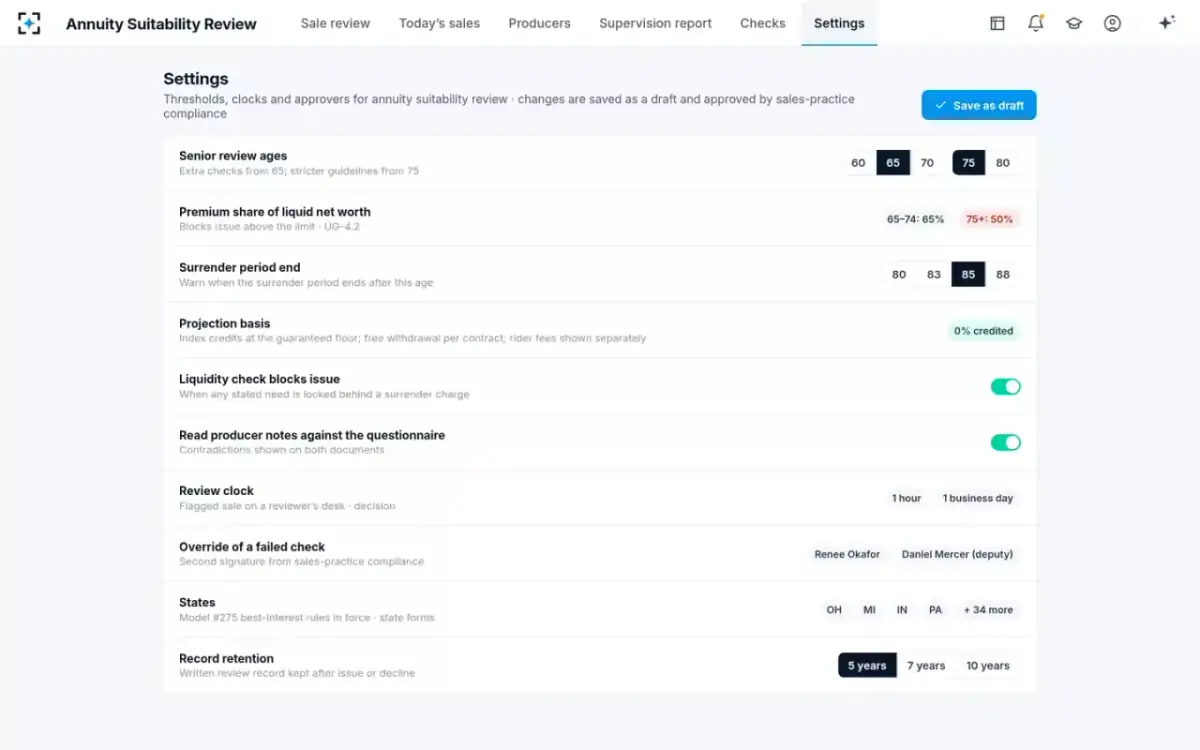
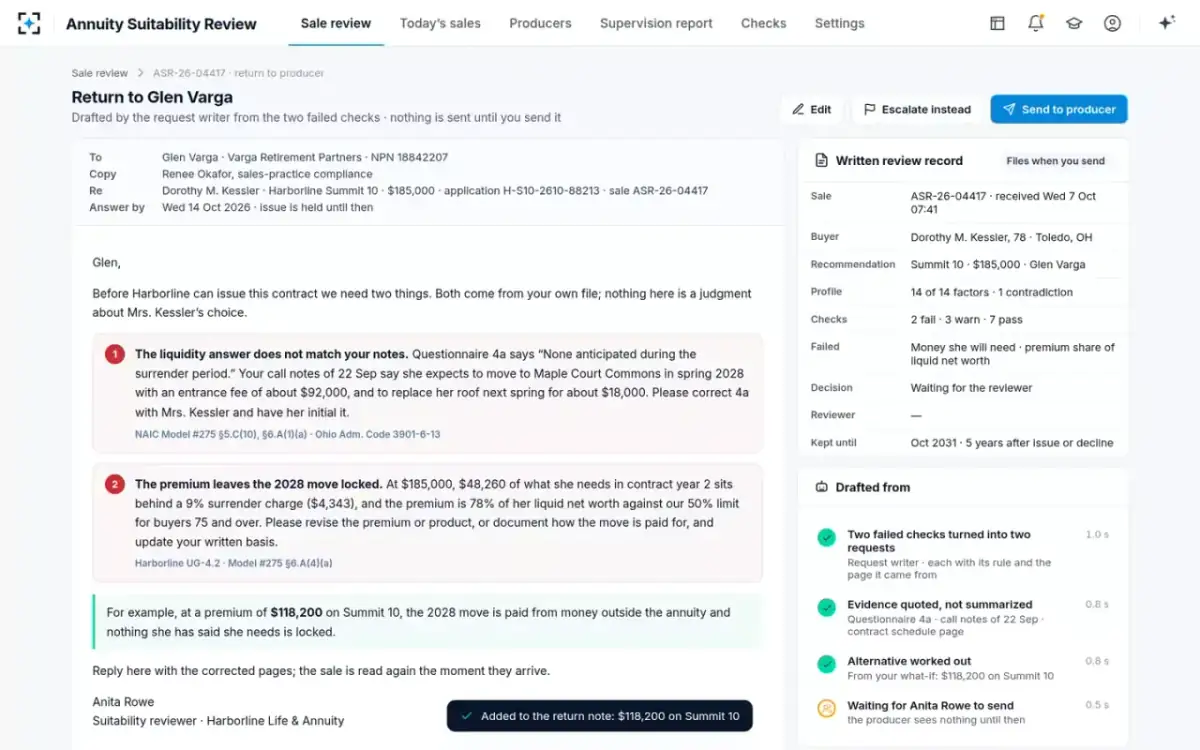
The citation is the test of whether the state rule was applied. In the sample sale, made in Ohio, the drafted return to the producer cites the model's tenth profile factor, liquidity needs, the care obligation, and the Ohio Administrative Code rule that adopts the model, 3901-6-13, beside the carrier's own guideline. An examiner from that state, or the producer, can read each item against the text it names.
A return that cites the model section and the state rule for the same finding
New York needs the same treatment with a different rulebook: a sale there is reviewed against Regulation 187's suitability information and best-interest standard, and an in-force recommendation, such as a change to an existing contract, can be in scope where the model would not reach it. The federal layer, after the Department of Labor's 2024 rule was vacated, is covered in the DOL fiduciary rule in 2026; the solution is at Annuity Suitability Review.
Questions people ask
Is there a list of NAIC best interest states?
Yes. The NAIC's August 2025 brief lists the 49: AL, AK, AZ, AR, CA, CO, CT, DE, FL, GA, HI, ID, IL, IN, IA, KS, KY, LA, ME, MD, MA, MI, MN, MS, MO, MT, NE, NV, NH, NJ, NM, NC, ND, OH, OK, OR, PA, RI, SC, SD, TN, TX, UT, VT, VA, WA, WV, WI and WY. Its February 2026 map shows the same picture, with DC pending.
Does the best interest rule apply to life insurance?
Not under Model #275, which covers annuities. New York's Regulation 187 is the exception: it has applied to life insurance transactions since 1 February 2020, as well as to annuities since 1 August 2019.
Do territories such as Puerto Rico follow the model?
The NAIC's February 2026 map shows Guam, the Northern Mariana Islands, Puerto Rico, American Samoa and the US Virgin Islands without a status. Check with the territory's insurance regulator for its current annuity sales rule.
Does a state's adoption change the producer's training?
It can. The 2020 model gave producers trained under the earlier rule six months from the state's effective date to complete either a new four-credit course or a one-time one-credit course on the revised requirements. States set and approve the courses.
Can a state be stricter than the model?
Yes. A model is only binding as each state adopts it, and states add their own provisions: Florida caps surrender charges for buyers 65 and over, California sets a 30-day free look for buyers 60 and over, and New York's rule reaches life insurance and in-force transactions.