Policy servicing in life insurance is everything a carrier does on a policy between issue and claim: financial transactions such as loans, withdrawals, surrenders, premium and dividend changes, reinstatements and term conversions, non-financial ones such as beneficiary, ownership, assignment and address changes, and the explanations behind them (values, lapse notices, annual reports, in-force illustrations). It is hard because the service screen shows today's values from the admin system, while the answer to most of those requests sits in the contract that was issued, on a form version and state variant that may be decades old and held only as a scan. Botminds' In-Force Policy Servicing exists for that gap: its agents find the form the policy was issued on, read that contract, read today's values and run the carrier's projection engine, so a representative can answer on the first contact with every sentence cited to its page.
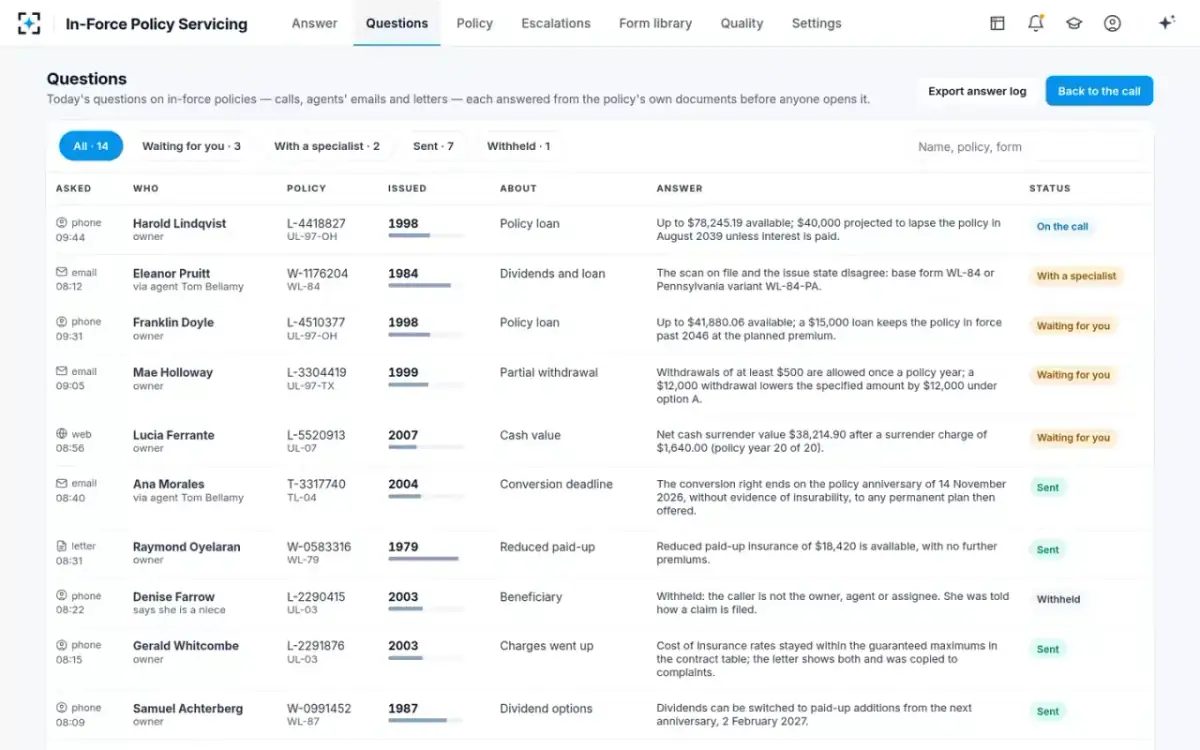
One Monday's in-force requests, sorted by what each needed
08:09
Who and howOwner · Phone
The requestSwitch dividends to buy paid-up additions
What the answer neededContract The 1987 whole life contract’s dividend options, and the next anniversary
StatusSent
08:12
Who and howAgent of record · Email
The requestCan dividends pay down a $6,200 loan?
What the answer neededPapers disagree Which contract was issued: the scan is the base form, the issue state had a variant
StatusWith a specialist
08:15
Who and howOwner · Phone
The requestWhy did the monthly charges rise?
What the answer neededContract The guaranteed maximum rates in the contract’s table, beside the current ones
StatusSent
08:22
Who and howCaller, not on the policy · Phone
The requestWho is the beneficiary on a relative’s policy?
What the answer neededPrivacy rule Nothing about the policy: the caller is not the owner, agent or an assignee
StatusWithheld
08:31
Who and howOwner · Letter
The requestWhat happens if premiums stop on a 1979 policy?
What the answer neededContract The contract’s nonforfeiture table and today’s values
StatusSent
08:40
Who and howAgent of record · Email
The requestWhen does the term conversion right end?
What the answer neededContract The conversion clause of a 2004 term contract
StatusSent
08:56
Who and howOwner · Web
The requestWhat is the surrender value today?
What the answer neededValues Today’s values from the admin system
StatusWith the representative
09:05
Who and howOwner · Email
The requestWithdraw $12,000
What the answer neededContract The withdrawal clause of a Texas variant, and its effect on the face amount
StatusWith the representative
09:44
Who and howOwner · Phone
The requestBorrow $40,000: what does it do to the policy?
What the answer neededContract + projection The loan clauses of a 1998 contract, today’s values and a 20-year projection
StatusOn the call
What does policy servicing in life insurance cover?
It covers every request on an issued policy that is not a new sale or a death claim, and it is defined by the in-force book, not by a department's name. Carriers call the function policy service, policyowner service, in-force operations or the service centre; third-party administrators run it under contract for closed blocks. The work divides into transactions that change the policy and explanations that do not, and the second kind is where most calls go wrong.
Policy servicing requests, and what each answer has to rest on
| Request | Answer rests on | Who may ask | Examiners test |
|---|---|---|---|
| Policy loan or withdrawal | The contract's loan or withdrawal clauses, today's values, often a projection | Owner, assignee | Transactions processed accurately and completely |
| Stopped premium, lapse, reinstatement | Grace, nonforfeiture and reinstatement clauses; the values | Owner | Reinstatement and nonforfeiture applied per the contract |
| Beneficiary or ownership change | The contract's change provisions; the owner's signed request | Owner | Transactions processed accurately and completely |
| Dividend option change | The dividend options section of that form version | Owner, agent of record for information | Transactions processed accurately and completely |
| Term conversion | The conversion clause: deadline, products, evidence | Owner, agent of record for information | Correspondence answered timely and responsively |
| Values, annual report, in-force illustration | The admin system's valuation; the illustration engine | Owner, agent of record | Annual report provided; illustration on request |
The size of the book explains the pressure. In the Federal Reserve's 2022 Survey of Consumer Finances, 16.1% of American families held cash value life insurance, down from 19.0% in 2019, with a median value of $9,700 among those who held it (Federal Reserve, Changes in U.S. Family Finances from 2019 to 2022, Table 3). Each of those policies carries a contract that can outlive several admin systems and every representative who first answered for it.
Which in-force requests need the contract, not the screen?
Most of them. Money the owner can reach (a surrender value, the loan available) is partly on the screen; money the owner might lose and the people who will be paid turn on the contract. On the sample Monday above, only the surrender value request could be answered from today's values alone.
Everything else needed a page of paper. A switch to paid-up additions depends on the dividend options of a 1987 whole life form and on when the next anniversary falls. A conversion deadline is a clause in a 2004 term contract, not a field in most admin systems. A $12,000 withdrawal is governed by the withdrawal section of the Texas variant the owner holds, which says what it does to the specified amount. A question about rising monthly charges needs the table of guaranteed maximum rates printed in the contract, set beside the current rates the carrier has declared.
A quarter of the sample week's requests were about policy loans
Sample week, 1,846 requests, all channels
- Policy loans · 24%
- Beneficiaries and ownership · 18%
- Values and surrender · 17%
- Premiums and lapse · 14%
- Conversions and riders · 9%
- Dividends · 8%
- Other · 10%
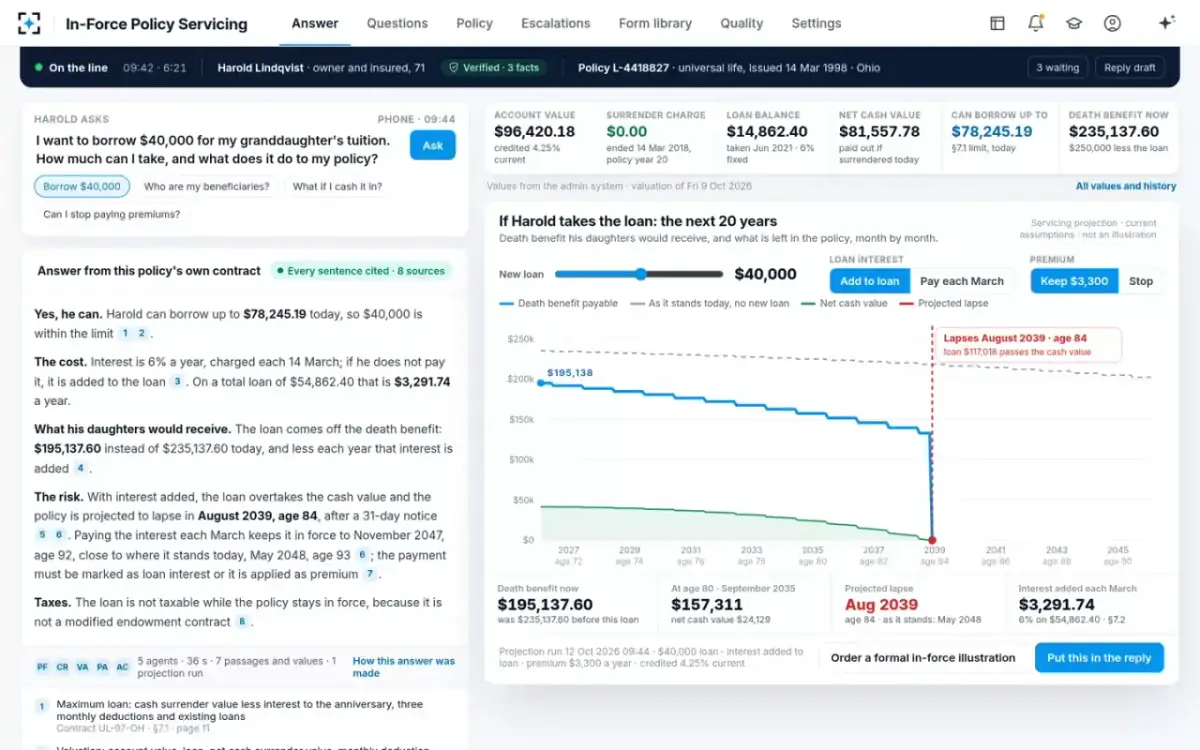
The loan request is the one that carries the most risk. The owner of a 1998 universal life policy asked to borrow $40,000. The answer needed the contract's loan clauses, today's values and a projection of the loan with interest added over twenty years, which showed the policy lapsing at 84. That lapse year is the part of a loan answer an owner rarely hears from a screen of values; how loan interest works until the policy lapses works the arithmetic through.
Why do form versions and state variants drive escalations?
Because the same product name can cover several contracts, and the admin system rarely knows which one a policy holds. Products are revised and refiled, so one product can have been sold on several printed forms over a decade with different loan, dividend or withdrawal terms. And forms are approved state by state: in New York, "No policy form shall be delivered or issued for delivery in this state unless it has been filed with and approved" by the superintendent, and the statute counts riders and endorsements as policy forms. A carrier selling in many states ends up with one product and a dozen contracts.
One sample carrier's form library: many contracts behind few products
212
product and rider forms the sample carrier has issued
61
state variants among them
1.38million
policies in force on those forms, issued 1971 to 2019
38
variant rules decided by in-force specialists
System conversions add the third problem. A policy issued in 1998 may be on its third admin system, which carried the values and transaction history across but often only a pointer to the contract image; what administration systems hold and lack sets that out. One agent's request on the sample Monday shows the result. A client's 1984 whole life was issued in Pennsylvania, but the scan on file is the base form, whose dividend section has no option to reduce a loan; the filed Pennsylvania variant adds one. A representative reading the scan would have said no, and one reading the product summary would have guessed. Two documents disagreed, so it went to a specialist.
The solution's own estimate is that about one in five calls on older policies is escalated to a specialist, with a callback two to three business days later. That is Botminds' estimate from typical service-centre practice, not a measured industry rate. What a carrier can measure is its own: escalations by topic, form and issue year show where the contract, not the representative, is the bottleneck.
Who may be told what about a life policy?
The owner, after identity checks; people the owner has authorized or who act for the owner; and holders of an interest in the policy, such as an assignee. Everyone else is told how a claim is filed or how the owner can authorize them. The federal floor is the Gramm-Leach-Bliley Act: a financial institution "may not, directly or through any affiliate, disclose to a nonaffiliated third party any nonpublic personal information" without the required notice, and its exceptions name disclosure "with the consent or at the direction of the consumer", "to persons holding a legal or beneficial interest relating to the consumer" and "to persons acting in a fiduciary or representative capacity on behalf of the consumer". States add insurance privacy laws of their own.
Who may be told what on a life service desk
| Caller | Values | Beneficiaries | Transactions |
|---|---|---|---|
| Owner, verified by three facts | Yes | Yes | Yes, on the owner's signed request where the contract requires one |
| Agent of record | Yes | No | No; information for the client only |
| Assignee | Yes | Per the carrier's procedure | Within the assignment |
| Person acting for the owner (accepted power of attorney) | Yes | Yes | Within the authority accepted |
| Anyone else, family included | No | No | How to file a claim; how the owner can authorize them |
The privacy row is where a desk most often errs under pressure, because the caller is sympathetic. At 08:22 on the sample Monday a caller who said she was the owner's niece asked who the beneficiary was. She was not the owner, the agent of record, an assignee or a person acting for the owner, so the answer was withheld and she was told how a claim is filed. The withheld answer is logged like any other, so a quality lead can confirm the line was held.
What market conduct examiners test on in-force service
State examiners test policyholder service against written standards, and several of them land directly on the service desk. The NAIC's 2025 Market Regulation Handbook Examination Standards Summary lists general standards for every line in Chapter 20 and life and annuity standards in Chapter 23. States use the handbook as guidance; their own laws decide.
Seven examination standards a life service operation answers to
- "All correspondence directed to the regulated entity is answered in a timely and responsive manner by the appropriate department."
A promised callback is correspondence. A queue that tracks the promise date is the evidence.
- "Policy transactions are processed accurately and completely."
A loan quoted on the wrong form version is an inaccurate transaction even if the system processed it cleanly.
- "Reasonable attempts to locate missing policyholders or beneficiaries are made."
Returned mail and a stopped premium on an older policy are a reason to look, not only to lapse.
- "All complaints are recorded in the required format on the regulated entity’s complaint register."
An owner who says the desk got it wrong has often made a complaint, whatever the call was logged as.
- "Reinstatement is applied consistently and in accordance with policy provisions."
The policy’s own reinstatement clause, not a product summary.
- "Nonforfeiture options are communicated to the policyholder and contractholder and correctly applied in accordance with the policy contract."
The option the contract names, at the values its table gives.
- "The regulated entity provides each policyowner with an annual report of policy values … and, upon request, an in force illustration or contract policy summary."
The request often arrives as a phone call, and the clock starts there.
Read together, the standards say what a good service contact leaves behind: a timely answer, a correct one, and evidence of both. The in-force illustration standard has a written clock in states that adopted the NAIC illustrations model: an annual report without an illustration must tell the owner, "If you do not receive a current illustration of your policy within 30 days from your request, you should contact your state insurance department." How a servicing projection differs from that illustration is covered in the in force illustration and a projection.
Accelerated benefit requests: the disclosure examiners look for
An owner who asks to draw part of the death benefit early, under an accelerated benefit rider, is making one of the largest decisions on the policy, and the examination standard spells out what the desk must say first. On receiving the request, the carrier "must disclose to the policyholder the effect of the request on the policy's cash value, accumulation account, death benefit, premium, policy loans and liens", and must also advise that the request may affect eligibility for Medicaid or other government benefits.
Every item on that list is policy-specific. The effect on the death benefit and on an outstanding loan depends on the rider's own terms and the form it was attached to; the effect on premium depends on whether the base policy continues on a reduced face. A desk that answers from a rider summary gives the owner a disclosure that may not match the contract, which is the failure the standard is written to catch. The safe pattern is the same as for a loan: the rider's clauses, today's values and, where the policy continues, a projection of what is left.
Running the service desk: escalation rules, review thresholds and quality sampling
Three settings decide most of the risk on a life service desk: when a request must stop and go to a specialist, which replies a specialist must review before they go, and how much of the week's work a quality lead reads. All three should be written down, versioned and visible to the people who answer.
In the sample carrier's settings, a request stops and escalates whenever the issue state, the scan and the form variant differ, or two passages give different answers. A specialist reviews any reply whose projection lapses within 15 years or whose loan exceeds $50,000 before it is sent. Tax wording is limited to the policy's tax status and Form 1099-R, with no advice. The complaints and quality lead reads a weekly sample of 120 answers drawn by topic, each sentence with its source, and agrees or disagrees with each.
Those settings make the desk measurable. In the sample carrier's week to 5 October 2026, 1,846 requests were answered across all channels, 98% with a cited answer, at a median of 52 seconds to that answer; of the 120 answers the quality lead read, 117 were agreed and one disagreed. These are figures from a fictional carrier's sample data, shown to illustrate what a desk can count, not results from any customer. The first numbers a head of service needs from a real desk are simpler: escalations by topic and form, callbacks promised and kept, and complaints in the register that trace back to a service answer.
One in-force request through In-Force Policy Servicing, and who decides
Agent
Policy finderFinds the policy, the form version and state variant it was issued on, its riders and endorsements, and checks the caller may be told.
Never: Never guesses a form version: two candidates means escalate
Agent
Contract reader and values agentReturns the contract passages that answer the request, with section and page, and reads today's values from the admin system as of the last valuation.
Never: Never writes to the admin system or calculates a value it holds
Agent
Projection agent and answer checkerRuns loans and stopped premiums through the carrier's projection engine, then reads every sentence back against its page, valuation or run.
Never: An uncited sentence never reaches the screen
A person decides
RepresentativeDecides what the caller needs and sends the answer; escalates when the papers disagree.
A person decides
In-force specialistDecides every unclear reading and reviews flagged replies, and can add a variant rule for the next policy on that form.
On the sample loan call the representative had a cited answer 36 seconds after pressing Ask: the owner could borrow up to $78,245.19; interest at 6% would be charged each 14 March; the death benefit would fall from $235,137.60 to $195,137.60; and with interest added the policy was projected to lapse in August 2039, at 84. Because the lapse fell within 15 years, the written reply went to a specialist first. These are sample figures on a fictional policy; the same loan question traced second by second shows each step and its limits.
The answer on the call: cited sentences, today's values and the year to watch
Where In-Force Policy Servicing fits in life policy servicing
In-Force Policy Servicing sits beside the admin system, the imaging archive, the form library and the projection engine, reading from each and writing to none. Each request in the queue arrives with a cited draft, and the representative decides and sends. The specialist decides every unclear reading. The agents never write to the admin system, never calculate a value the system holds, never send a reply and never give tax advice beyond the policy's status.
The service queue: each request answered from the policy's own documents
What it changes is where the time goes on an escalated request. By Botminds' estimate for one loan question on an older policy, finding the form version, retrieving and reading the scanned contract, pulling values, getting a projection, writing the reply and a specialist's review take about seven staff hours by hand, plus two to three business days of the owner's wait; the agents do the finding, reading and projecting in under a minute, and the reply and review remain people's work. Those are estimates, not measured results, and the first measure a carrier takes is its own escalation rate before and after.
Questions people ask
What is policy servicing in insurance?
Policy servicing is the work an insurer does on a policy after issue: processing changes such as loans, withdrawals, beneficiary and ownership changes, and explaining values, notices and statements. In life insurance it runs for decades, so the issued contract, its form version and state variant govern most answers.
What is the difference between policy servicing and policy administration?
Policy administration is the system and record-keeping that hold a policy's values, transactions and billing; policy servicing is the work of answering and acting on requests about the policy. The admin system holds today's values but often only an image pointer to the contract, which is why servicing needs both.
What is in-force policy service?
The same work, named for the book it serves: everything between issue and a claim on policies currently in force. Market conduct examiners test it under the NAIC handbook's policyholder service standards, including whether nonforfeiture options are "correctly applied in accordance with the policy contract".
Why do life insurance service calls get escalated?
Mostly because the answer depends on a contract the representative cannot see or cannot be sure of: an older form version, a state variant or a scan that does not match the issue state. Botminds estimates about one in five calls on older policies is escalated, with a callback two to three business days later.
Who can a life insurer tell about a policy's values or beneficiaries?
The owner after identity checks, someone the owner authorizes or who acts for the owner, and holders of an interest such as an assignee. The Gramm-Leach-Bliley Act bars disclosure of nonpublic personal information to other third parties without notice and an exception, and state insurance privacy laws add their own rules.
How long does a carrier have to send an in-force illustration?
No federal rule sets a deadline. In states that adopted the NAIC illustrations model, the annual report tells the owner to contact the state insurance department if a requested illustration has not arrived within 30 days, and the insurer must furnish one on request.