The modified endowment contract 7 pay test asks one question of a life insurance policy: at any time in its first seven contract years, has the total paid into it exceeded what would have been paid by then if the policy were bought with seven level annual premiums that left it paid up? If it has, the policy becomes a modified endowment contract, or MEC, under section 7702A of the Internal Revenue Code, and loans and withdrawals from it are taxed income first, with a 10% additional tax before age 59½. The test also re-runs when the death benefit is cut in the first seven years and restarts after a material change, which is why a service representative asked "can I add money?" or "can I lower my face amount?" needs more than today's values. Botminds' In-Force Policy Servicing reads each policy's tax status and its admin history, including past 7702A retests, and limits its answers to that status and Form 1099-R reporting; a change that could alter the status goes to a specialist. Below, the test is worked on illustrative numbers, then the benefit-cut and material-change rules, then the tax.
The statute is quoted from the Legal Information Institute's copy of the US Code. The worked numbers are illustrative arithmetic, not a real policy's 7-pay premium, which depends on the insured's age and sex, the mortality basis and the interest rate the law prescribes.
“A contract fails to meet the 7-pay test of this subsection if the accumulated amount paid under the contract at any time during the 1st 7 contract years exceeds the sum of the net level premiums which would have been paid on or before such time if the contract provided for paid-up future benefits after the payment of 7 level annual premiums.”
26 U.S.C. §7702A(b), the 7-pay test
What is a modified endowment contract?
A modified endowment contract is a life insurance policy that qualifies as life insurance under section 7702 but was funded faster than the 7-pay test allows. The statute defines it as any contract meeting section 7702 that "is entered into on or after June 21, 1988" and "fails to meet the 7-pay test", or that "is received in exchange for" such a contract (26 U.S.C. §7702A(a)).
It is still life insurance. The death benefit keeps its income tax treatment, and the policy's values still grow without current tax. What changes is how money taken out during life is taxed: a MEC is treated more like an annuity, so gains come out first and early withdrawals carry a penalty.
How does the 7 pay test work? One limit that rises each year
The 7-pay test compares two running totals during the first seven contract years: what has actually been paid, and the sum of seven hypothetical "net level premiums" that would pay the policy up. If the first total exceeds the second at any time, the policy fails.
Four rules shape the second total. It is computed "as of the time the contract is issued" (§7702A(c)(1)). The death benefit for the first contract year is "deemed to be provided until the maturity date without regard to any scheduled reduction after the 1st 7 contract years". The net premiums use the interest and mortality rules of section 7702's cash value accumulation test, which set interest at the greater of the guaranteed rate or an "applicable accumulation test minimum rate", the lesser of 4% or the "insurance interest rate" (26 U.S.C. §7702(b)(2)–(3)); for contracts issued in 2021 the insurance interest rate was fixed at 2%. And "amount paid" means premiums paid, reduced by amounts received that were not taxed (§7702A(e)(1)(A)).
The interest rule matters more than it looks. A lower assumed interest rate means a larger net premium is needed to pay the policy up in seven years, so a contract tested at 2% has a higher 7-pay limit than one tested at 4% for the same death benefit. Two policies with the same face amount and premium can therefore sit on opposite sides of the line because of the year they were issued and the rate they guarantee.
A worked 7 pay test: one premium too many in year three
A worked example makes the test concrete. Take an illustrative policy with a $250,000 death benefit whose 7-pay premium, computed by the insurer under the statute, is $8,000 a year. The limit is cumulative: $8,000 by the end of year one, $16,000 by year two, $24,000 by year three, and so on to $56,000 in year seven. The owner pays $6,000 a year for two years, then adds $20,000 in year three.
Year three: $32,000 paid against a $24,000 limit
At the end of year two the owner had paid $12,000 against a $16,000 limit, $4,000 of room. The year-three payment of $20,000 brought the total to $32,000 against a $24,000 limit, so the policy failed the test in year three and became a MEC. Paying $12,000 in year three instead would have used the room exactly and passed.
The same policy, year by year: the cumulative limit and what was paid
| Contract year | Paid that year | Cumulative paid | 7-pay limit | Room left |
|---|---|---|---|---|
| 1 | $6,000 | $6,000 | $8,000 | $2,000 |
| 2 | $6,000 | $12,000 | $16,000 | $4,000 |
| 3 | $20,000 | $32,000 | $24,000 | −$8,000: fails, a MEC |
| 3, alternative | $12,000 | $24,000 | $24,000 | $0: passes |
| 4 to 7 | $8,000 each year | $56,000 by year 7 | $56,000 by year 7 | Passes if the year-3 payment was $12,000 |
The example also shows the escape hatch. If the insurer had returned the excess $8,000 with interest "within 60 days after the end of such contract year", the returned premium would be deemed to reduce the premiums paid that year (§7702A(e)(1)(B)). A representative promising that "we'll sort it out later" without knowing the 60-day window has promised something the law may not allow.
The benefit cut that makes a policy a MEC after the fact
A reduction in the death benefit during the first seven contract years re-runs the test from the start at the lower benefit. "If there is a reduction in benefits under the contract within the 1st 7 contract years, this section shall be applied as if the contract had originally been issued at the reduced benefit level" (§7702A(c)(2)(A)). A policy funded comfortably inside its limit can fail retroactively.
Take the same illustrative policy, funded at $7,500 a year for four years, $30,000 in all, well inside the $32,000 limit. In year five the owner cuts the death benefit from $250,000 to $150,000 to lower the charges. Net premiums for the same insured on the same basis scale roughly with the death benefit, so in this illustration the 7-pay premium at $150,000 is about $4,800. The limit at the end of year four becomes $19,200, and $30,000 has already been paid. Re-run from issue, the policy fails, and it is a MEC.
Two details soften the rule. A reduction caused by nonpayment of premiums is ignored "if the benefits are reinstated within 90 days after the reduction" (§7702A(c)(2)(B)). And for second-to-die policies the reduction rule reaches beyond the seventh year: any cut below the lowest death benefit in the first seven years re-runs the test (§7702A(c)(6)). An owner asking to lower the face amount of a survivorship policy in year twelve still needs the test run.
Material changes: when the seven years start again
A material change restarts the test: the contract is "treated as a new contract entered into on the day on which such material change takes effect", with "appropriate adjustments" for the cash surrender value already in it (§7702A(c)(3)(A)). The term "includes any increase in the death benefit under the contract or any increase in, or addition of, a qualified additional benefit".
Not every increase counts. The statute excludes increases attributable to premiums "necessary to fund the lowest level of the death benefit and qualified additional benefits payable in the 1st 7 contract years", and interest or dividends credited on them, and, as regulations provide, certain cost-of-living increases funded ratably (§7702A(c)(3)(B)). In practice an owner who adds a rider or raises the face amount opens a new seven-year window, with a new limit that has to take account of value already in the policy, and whether the policy then passes is a calculation for the insurer's tax systems, not for a call.
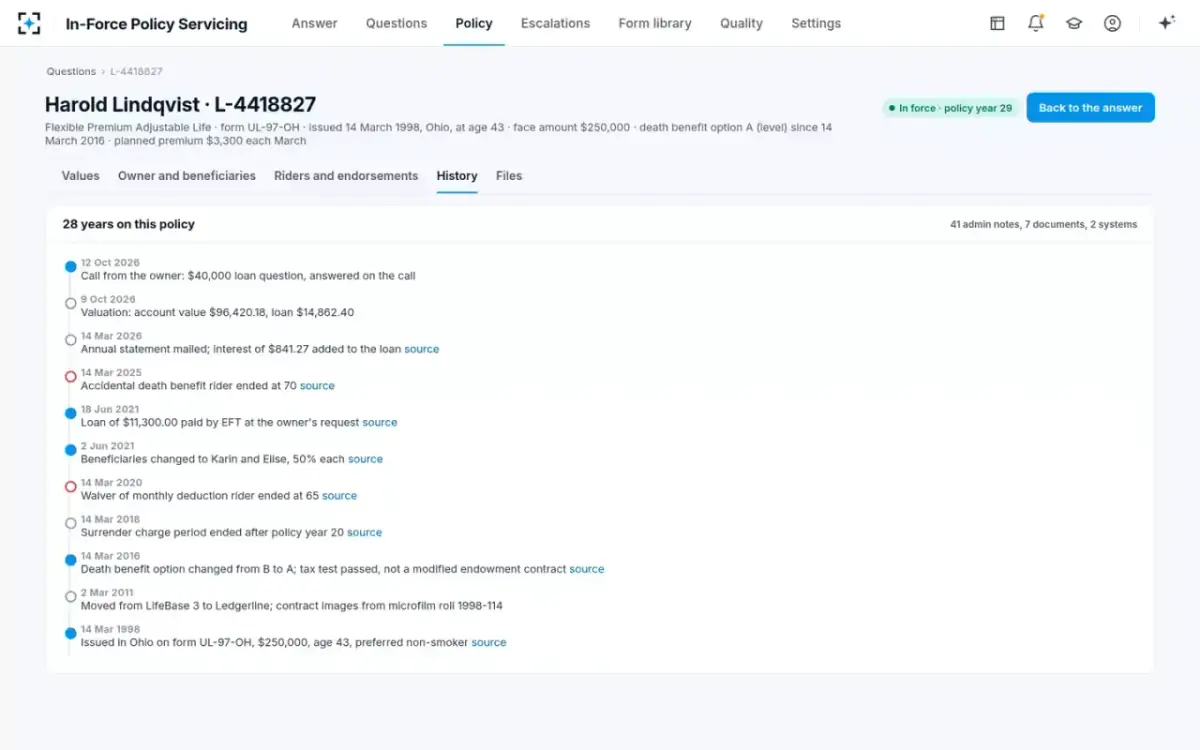
The sample policy in the solution shows what this looks like in an admin history. Harold Lindqvist's 1998 universal life policy changed from death benefit option B to option A in 2016, and the admin system's note for that date reads: tax test passed, not a modified endowment contract. That note is one of the eight sources the answer to his loan question cites.
A 7702A retest in the policy's history, cited in the loan answer
What happens if my policy becomes a MEC? Loans and withdrawals taxed income first
If a policy becomes a MEC, money taken out during the insured's life is taxed gain first, policy loans count as distributions, and the taxable part carries a 10% additional tax unless an exception applies. The death benefit is not affected.
The same withdrawal from a policy that passed the test, and from a MEC
Life insurance that passed the 7-pay test: Taxed only to the extent they exceed the investment in the contract: basis comes out first (§72(e)(5)(A), (C)).
A modified endowment contract: Taxed income first: gain in the policy comes out before basis (§72(e)(10) applying §72(e)(2)(B)).
Life insurance that passed the 7-pay test: Not a distribution while the policy stays in force.
A modified endowment contract: Treated as amounts received under the contract, so taxable to the extent of gain (§72(e)(4)(A) via (e)(10)).
Life insurance that passed the 7-pay test: Not a distribution.
A modified endowment contract: Treated like a loan, with a narrow exception for small burial contracts (§72(e)(10)(B)).
Life insurance that passed the 7-pay test: None.
A modified endowment contract: 10% of the taxable part, unless the taxpayer is 59½ or older, disabled, or taking substantially equal periodic payments (§72(v)).
Life insurance that passed the 7-pay test: Generally excluded from income.
A modified endowment contract: Unchanged by MEC status.
Two rules catch owners out. Distributions in anticipation of failure count too: "any distribution which is made within 2 years before the failure to meet the 7-pay test shall be treated as made in anticipation of such failure" (§7702A(d)). And MECs are aggregated: for figuring the taxable amount, "all modified endowment contracts issued by the same company to the same policyholder during any calendar year shall be treated as 1 modified endowment contract" (§72(e)(12)(A)(i)). A loan on a policy that has just failed is a taxable event the caller will not have expected; how life insurance loan interest works covers the loan rules on a policy that has not failed.
Can a MEC be reversed? Sixty days, then a closing agreement
Not by the owner. Once a policy fails the 7-pay test it remains a MEC, and a contract "received in exchange for" a MEC is itself a MEC (§7702A(a)(2)). Two routes exist, and both run through the insurer.
The first is time-limited: excess premium returned with interest within 60 days after the end of the contract year in which it was paid is deemed to reduce that year's premiums, and the interest returned is taxable to the owner (§7702A(e)(1)(B)–(C)). The second is for the insurer's errors. Revenue Procedure 2008-39 "provides a procedure by which an issuer of a life insurance contract may remedy an inadvertent non-egregious failure to comply with the modified endowment contract rules under section 7702A of the Code", through a closing agreement with the IRS (Internal Revenue Bulletin 2008-29). Neither is something a representative can offer on a call; both start with a specialist who knows the policy's test history.
Why "can I add money?" is a question for a specialist
Because the answer depends on the policy's issue date, its 7-pay premium, every premium paid in the current seven-year window, any reduction or material change since issue, and the interest basis in force when the window started. None of those is on a typical service screen, and a wrong "yes" can make the policy a MEC permanently.
In-Force Policy Servicing is set up for that boundary. The values agent reads the policy's tax status from the admin system, including retest notes such as Harold's 2016 entry, and the cost basis the system holds. The answers are locked to status and Form 1099-R wording: they can say a policy is not a MEC according to the insurer's own test, and that a surrender would be reported on Form 1099-R, but they give no tax advice. A request that could change the status, such as an extra premium, a face reduction or a rider added inside a seven-year window, is routed to a specialist with the history attached.
What a representative should have before answering 'can I add money?'
- The policy’s current MEC status, from the insurer’s own test
Including any retest after a benefit change or exchange.
- When the current seven-year window started
At issue, or at the last material change.
- Premiums paid in the window, less untaxed amounts received
The “amount paid” the statute tests.
- The 7-pay limit to date
Computed by the insurer’s tax system; never estimated on a call.
- Any planned reduction in benefits
A face cut inside seven years re-runs the test at the lower amount; for second-to-die policies, at any time below the lowest early level.
- Who answers if the room is close to zero
A specialist, before the money is applied, not after the contract year ends.
The same caution applies to premiums a universal life owner adds after a cost-of-insurance increase, covered in what a cost of insurance increase notice must say. To see how the tax status is cited in an answer, start from In-Force Policy Servicing.
Questions people ask
Are loans from a MEC taxable?
Yes, to the extent of gain in the policy. For a modified endowment contract, section 72(e)(10) applies the rule that treats a loan as an amount received under the contract, and amounts received are taxed income first; a 10% additional tax applies to the taxable part before age 59½, absent another exception.
Does a 1035 exchange affect MEC status?
A MEC stays a MEC through an exchange: section 7702A(a)(2) makes a contract "received in exchange for" a MEC a MEC itself (the exchange paperwork is annotated in the 1035 exchange form). An exchange of a policy that is not a MEC does not inherit the label, but the new contract has its own tests, so ask the receiving insurer how it will be tested.
How do I know if my policy is a MEC?
Ask the insurer: it runs the test and records the result, including any retest after a benefit change or exchange. The insurer's own admin note is the authority; a representative should read it, not recompute it.
Does the 7-pay test apply to old policies?
Only to contracts "entered into on or after June 21, 1988", but an older policy can be brought into the rules by a material change, which treats the contract as newly entered into on the day the change takes effect.
What interest rate is used in the 7-pay test?
The greater of the rate guaranteed in the contract or the applicable accumulation test minimum rate, which is the lesser of 4% or the insurance interest rate in effect at issue. For contracts issued in 2021 the law fixed the insurance interest rate at 2%; later years follow the statute's adjustment rule.
Is a MEC always bad?
Not necessarily. A policy bought for its death benefit, with no plan to borrow or withdraw, loses little by being a MEC; one bought to fund loans or withdrawals during life loses a great deal. Whether it matters is a question for the owner's tax adviser, which is why a service desk should state the status and leave the advice to them.