A policy servicing co-pilot is software that sits beside a life insurance service representative and drafts the answer to an in-force question while the caller is still on the line: how much can I borrow, what happens if I stop paying, can my dividends reduce my loan. The useful test of one is not how fluent its answer sounds but whether every sentence traces to the policy's own contract, the latest valuation or a projection run, and whether it stops when the papers disagree. Botminds' In-Force Policy Servicing is built that way, with five agents that find, read, look up, project and check, and a sixth that drafts the letter. Below, one loan question on a 1998 universal life policy is traced through it, step by step, followed by the checklist a head of in-force service can take into any demonstration.
The question, the policy and the people are fictional sample data in the solution: Harold Lindqvist, 71, calling Larchmere Mutual Life about policy L-4418827. The regulatory text quoted along the way is real and linked.
Five agents answered the loan question; the representative decided what to send
Agent
Policy finder · 1.1 sFound L-4418827 on form UL-97-OH, Ohio variant, Rev. 11/96, with two riders (both ended) and two endorsements, and confirmed the caller was verified as the owner by three identity checks.
Never: guesses a form version: two candidates means escalate.
Agent
Contract reader · 1.4 sRead the 1998 contract from its microfilm scan: §7.1–7.5 on pages 11 and 12 and the grace period, §5.3, on page 8.
Never: paraphrases a number or rate: it quotes them.
Agent
Values agent · 1.0 sRead the 9 October valuation: account value $96,420.18, loan $14,862.40, monthly deduction $328.30.
Never: writes to the admin system or recalculates a value it holds.
Agent
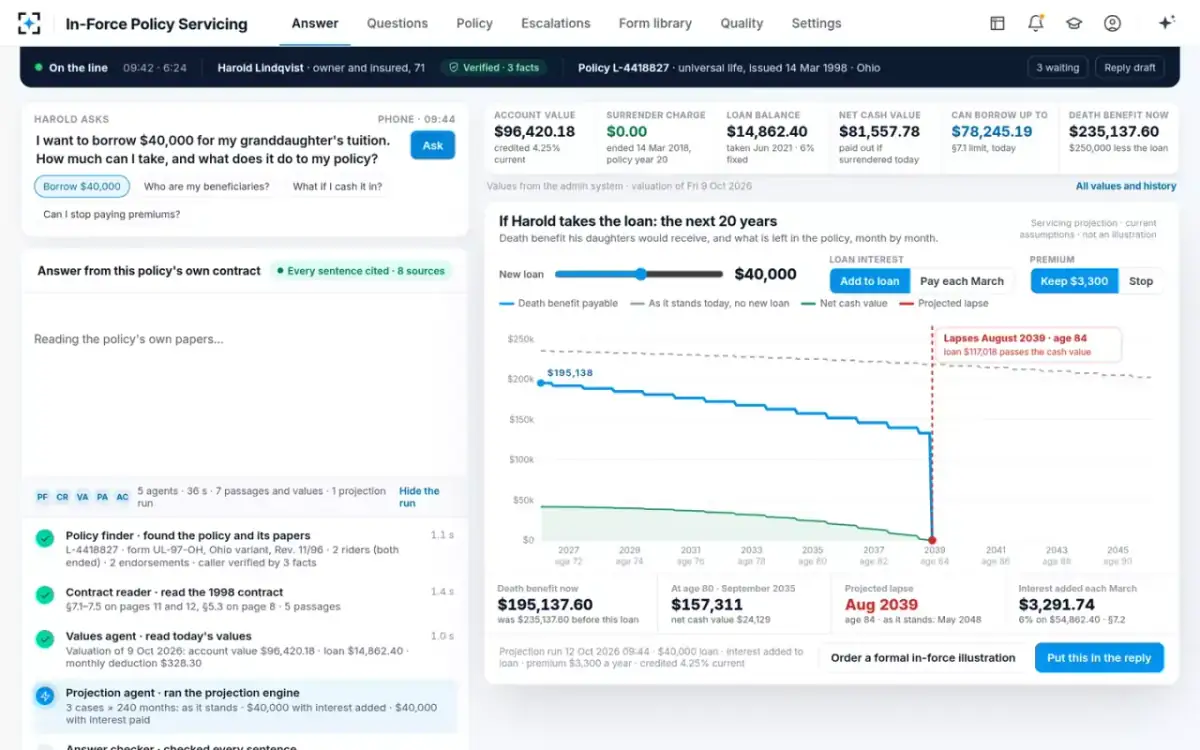
Projection agent · 1.5 sRan three 240-month cases through the company’s in-force projection engine: as it stands, $40,000 with interest added, $40,000 with interest paid.
Never: computes a projection itself, or calls it an illustration.
Agent
Answer checker · 1.0 sRead every sentence back against its passage and every figure against the valuation or the run: 7 of 7 sentences cited, 12 figures matched.
Never: lets an uncited sentence reach the screen.
A person decides
Renee Castillo, representativeRead the answer to Harold, opened the contract at the clause, switched the projection to interest paid, and asked for the letter.
What is a policy servicing co-pilot, and what should it never do?
A policy servicing co-pilot is an agent-assist tool for in-force service: it finds the policy, reads what governs the answer, and drafts a reply the representative can check and send. What separates a co-pilot a carrier can defend from a chatbot is the list of things it must never do, because each of them is a way a wrong answer reaches a policyowner.
In this solution those limits are written into each agent. The policy finder never guesses a form version: two candidates means the question goes to a specialist. The contract reader quotes numbers and rates, never paraphrases them, and reports a page it could not read rather than skipping it. The values agent reads the admin system and never calculates a value the system holds. The projection agent never writes a projection itself; the company's engine computes it. The answer checker removes any sentence it cannot match to a source. The reply writer never sends. The flow above is the order they ran in on Harold's call.
One loan question on a 1998 policy, from Ask to a checked answer
36s
from the representative pressing Ask to a checked, cited answer
7of 7
sentences cited to a page, the valuation or the projection run
12
figures matched to their source before the answer appeared
3runs
projection cases of 240 months each: as it stands, interest added, interest paid
Finding the policy, the form version and the caller in 1.1 seconds
The first step decides whether everything after it is right. A loan answer read from the wrong form version is wrong in a way no later check will catch, because every citation will point at a real page of the wrong contract. So the policy finder starts from the policy number and works out which printed form was issued, in which state variant, at which revision, and which riders and endorsements changed it afterwards.
On Harold's policy that meant form UL-97-OH, revision 11/96, issued in Ohio on 14 March 1998; a waiver of monthly deduction rider that ended at 65 and an accidental death rider that ended at 70; a 2016 endorsement changing the death benefit option and a 2021 beneficiary change. The same step confirms who is calling. Harold had been verified as owner and insured by three identity checks, so values, beneficiaries and actions could all be discussed. A caller who could not be verified would have been told nothing about the policy.
When the step cannot settle the form, it does not choose. On the sample queue the same morning, a 1984 whole life policy issued in Pennsylvania had only the base form on file, while the filed Pennsylvania variant added a dividend option the base form lacks. The agents wrote no answer; a specialist saw both pages side by side.
Reading the 1998 contract at the loan clauses
The contract reader returns passages, not summaries. For a loan question on this form it pulled the maximum-loan rule (§7.1), the loan interest clause (§7.2), how loaned value is credited (§7.3), the effect of indebtedness (§7.4), how payments are applied while a loan is outstanding (§7.5) and the grace period (§5.3). Each came back with its section, page and a margin note on what it means for this policy today.
Two of those passages change the answer a representative would give from memory. §7.3 credits the loaned part of the account value at "not less than 4%", so the $54,862.40 held against Harold's loan would earn 4% while the rest earned the current 4.25%. And §7.5 says a payment received while a loan is outstanding "will be applied as a premium unless you tell us in writing that it is a loan repayment". A caller told only "you can pay the interest each year" might send a cheque that never touches the loan.
Each step in view while the answer is drafted
Can a co-pilot quote a loan value without calculating it?
Yes, and it should. The loan value is the contract's rule applied to the values the admin system already holds, so the co-pilot's job is to read both and show the working, not to compute a cash value of its own. Harold's contract defines the maximum loan as the cash surrender value less interest to the next anniversary, three monthly deductions and existing loans. Applied to the 9 October valuation, that is $78,245.19.
The interest rate is a contract term with a regulatory frame around it. The NAIC's Model Policy Loan Interest Rate Bill (Model #590, §3) lets a policy carry either a fixed maximum of 8% a year or an adjustable rate the insurer sets within a formula cap, and requires the insurer to tell the owner the starting rate when the loan is made; how both kinds run until a lapse is worked through in how life insurance loan interest works. Harold's policy carries a fixed 6%, charged in arrears each 14 March. On a total loan of $54,862.40, that is $3,291.74 a year, and the answer says so in the contract's own numbers.
This is also where a co-pilot proves it is not inventing anything. Every figure in the answer either appears in the valuation, appears on a contract page, or comes out of the projection run, and the answer checker matches each one before the representative sees it. A tool that shows a loan value without showing where it came from is asking the representative to trust arithmetic she cannot see.
What the projection run adds: the lapse year nobody quoted
A loan answer without a projection tells the caller what he can borrow and what it costs this year. It does not tell him what the loan does over time, which is the question he will care about in 2039. The projection agent turns the request into cases for the company's own in-force projection engine and runs them month by month.
The same policy, three ways: when the sample projection runs out
The answer the representative read included the third line: with interest added, the loan passes the cash value in August 2039 and the policy is projected to end 31 days after a notice, at 84. Switching the projection to interest paid each March kept it in force to November 2047. That one comparison is most of the value of the call, and how loan interest works until the policy lapses explains the mechanics behind it.
The projection is labelled "servicing projection · current assumptions · not an illustration", and a formal in-force illustration can be ordered from the same screen. Whether a projection shown to a policyowner must meet the illustration rules is a question for the carrier's compliance team and illustration actuary, not for a label; the in force illustration and how it differs from a projection sets out what the regulation says.
How accurate are AI servicing answers? Every sentence read back against its page
Accuracy in in-force service is measured the way a quality team already measures people: by reading answers against their sources. The answer checker does it for every answer before anyone sees it, and the complaints and quality lead does it again on a weekly sample.
The checker reads each sentence against the passage it cites and each figure against the valuation, the page or the run. A sentence that cannot be matched is removed and written to the answer log; it never reaches the screen. On Harold's answer, all seven sentences were cited and twelve figures matched. The checker also stops the answer outright when two sources disagree, which is the case a fluent model is most likely to get confidently wrong.
Seven sentences, twelve figures, eight sources
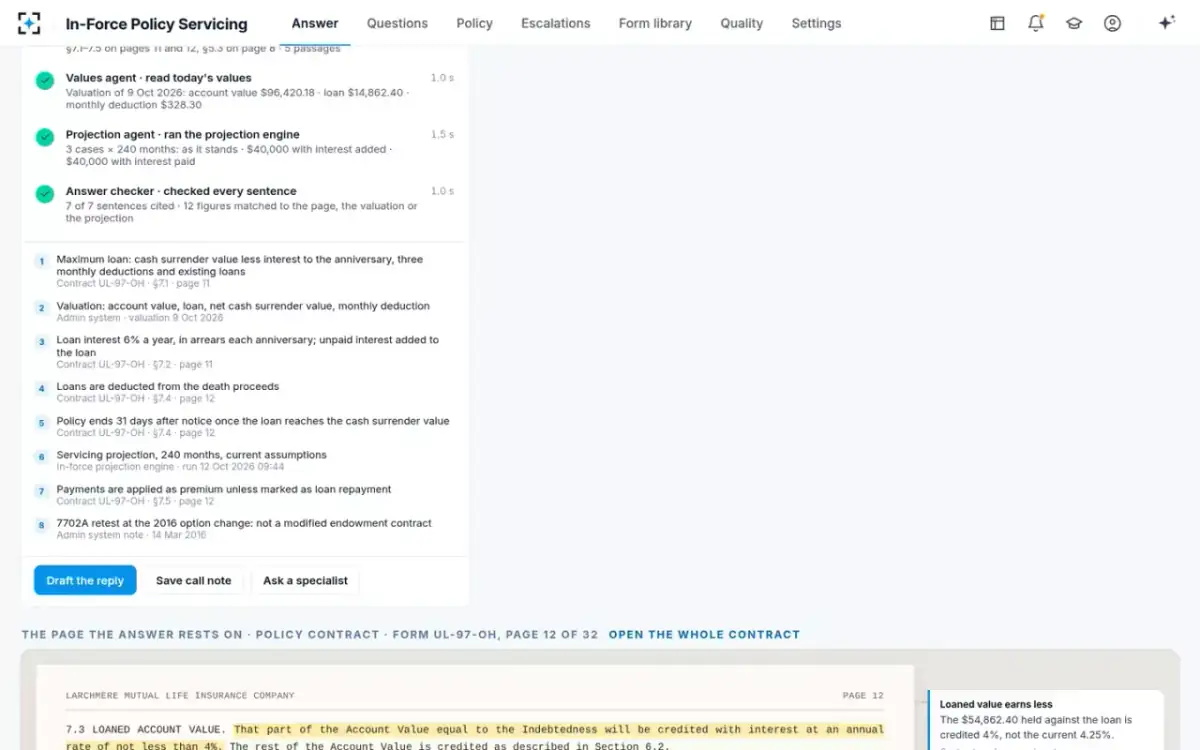
The second check is human and weekly. In the sample week the quality lead read 120 answers drawn by topic: 117 agreed, one disagreed on wording, with the number of sentences cited shown on each. A carrier evaluating any co-pilot should insist on the same measurement on its own policies, because a vendor's accuracy figure on someone else's block says little about scans of yours. How regulators expect insurers to govern AI systems generally is set out in the NAIC's model bulletin, covered in what the NAIC AI bulletin requires of insurers.
Where a policy servicing co-pilot fits, and where it does not
A co-pilot fits between the representative and the documents: it reads, drafts and checks. It does not replace the admin system, process transactions, issue formal illustrations or decide what an unclear contract means. The comparison below is the line a buyer should draw between this kind of tool and a general chat assistant trained on product brochures.
A chat assistant on product documents, and a co-pilot on the policy's own papers
Chat assistant on product summaries: The current product summary or a knowledge base, often written for today’s products.
Co-pilot on the policy's own papers: The contract, riders and endorsements issued on this policy, at section and page.
Chat assistant on product summaries: Assumes the current form; variants are rarely in the knowledge base.
Co-pilot on the policy's own papers: Identified first; two candidates stop the answer.
Chat assistant on product summaries: Generated in prose, sometimes rounded or restated.
Co-pilot on the policy's own papers: Quoted from the page or read from the valuation, and matched before display.
Chat assistant on product summaries: Not available, or a general warning.
Co-pilot on the policy's own papers: Run through the company’s projection engine, month by month, labelled not an illustration.
Chat assistant on product summaries: Picks one, usually without saying so.
Co-pilot on the policy's own papers: Stops and sends both pages to a specialist.
Chat assistant on product summaries: Depends on the channel’s login, if any.
Co-pilot on the policy's own papers: Checked on every question: owner after three identity checks, agent of record without beneficiaries, anyone else how to file a claim.
Chat assistant on product summaries: A chat transcript.
Co-pilot on the policy's own papers: The question, passages, values, run and reply on an answer log the quality team samples.
Three limits are worth stating plainly. The solution needs the contracts as images or files; a block whose contracts were never scanned must be scanned first, and pages that cannot be read are reported, not guessed. It reads admin systems but does not write to them, so the representative still processes the loan. And it does not give tax or legal advice beyond a policy's tax status and Form 1099-R reporting.
The regulators' own survey explains why the integration point matters. Of the 42% of life insurers in the NAIC's 2023 survey that did not use, plan or explore AI, the reasons given included dependence on legacy systems (why old admin systems hold the values but not the contracts), and the models life insurers did run were mainly in marketing (36%) and underwriting (34%) (NAIC Big Data and AI Working Group, life insurer AI/ML survey, December 2023). Servicing was not among the top uses. A co-pilot that needs the admin systems replaced first will not reach the service desk; one that reads them as they are can. What a policy administration system holds, and what you bring to go live, lists the inputs.
Ten questions to put to any policy servicing tool in a demonstration
A demonstration on the vendor's sample policy proves the interface. The questions below prove the method, and most of them can only be answered on your own policies.
Ten questions for a policy servicing co-pilot demonstration
- Which form version and state variant did it read, and how did it decide?
Ask for a policy whose scan and issue state disagree. The right answer is a stop, not a guess.
- Can I open the page behind every sentence?
Not a document link: the page, with the clause highlighted.
- Are numbers quoted or restated?
Rates and dollar amounts should match the contract and the valuation character for character.
- Does it ever calculate a value the admin system holds?
Cash and loan values should be read, with the contract’s rule shown.
- Who computes the projection, and is it labelled?
Your engine, your assumptions, and a label that says what it is.
- What happens to a sentence it cannot cite?
It should be removed before display and kept on a log someone reads.
- What does it do with a caller who is not on the policy?
Try a niece, an ex-spouse and an agent who is not of record.
- Does it write to the admin system?
Read-only is the safe default for a tool that drafts answers.
- Who sends, and who reviews the risky ones?
A person sends every answer; thresholds for specialist review should be settings.
- Will you run it on last quarter’s escalations?
Your scans, your forms, your specialists’ decisions as the answer key.
The last question is the one that settles a purchase. Take fifty questions your specialists answered last quarter, give the tool the same scans and values, and count how many answers match the specialist's, how many it correctly refused, and how many it got wrong. How to build the business case on your own call data turns those counts into callbacks and hours. To see the full call, from the queue to the letter, start from In-Force Policy Servicing.
Questions people ask
What is agent assist for life insurance?
Agent assist is software that supports a service representative during a call or while answering a letter, by finding information and drafting responses the representative reviews. For in-force life policies the hard part is finding the contract that governs the answer, which is why a co-pilot that reads the issued form is different from one that searches a knowledge base.
Does a policy servicing co-pilot calculate cash values?
It should not. Cash values, loan balances and monthly deductions are held by the admin system as of the last valuation, and a co-pilot that recalculates them creates a second, unaudited number. In this solution the values agent reads them read-only and the loan limit is the contract's own rule applied to them.
Can AI answer policyholder questions directly, without a representative?
Simple ones, such as a duplicate statement, are already handled by portals. Questions that turn on the contract, a projection or who may be told are better drafted for a representative who sends, because a wrong loan or lapse answer becomes a complaint years later. In this solution the representative sends every answer and the reply writer never does.
What happens if the co-pilot cannot find the right form version?
It stops. When the issue state, the scan and the form variant differ, or two passages give different answers, the question goes to an in-force specialist with both pages side by side, and the specialist's decision can become a rule for the next policy on that form.
How does a co-pilot handle grace periods that differ by state?
By reading the policy's own grace clause and the state's rule rather than a default. New York, for example, gives flexible-premium policies "a sixty-one day grace period" that begins when the net cash surrender value cannot cover a month's charges, and fixed-premium policies 31 days (N.Y. Ins. Law §3203(a)(1)).
How long does it take to put a policy servicing co-pilot live?
It depends mostly on the contracts: how many forms and variants the block holds, and how much of it is scanned and legible. This solution is built from the carrier's form library, scanned contracts, letter templates and a sample of past questions, and goes live once its quality checks pass on those policies; a pilot on your own older policies comes first.