Contact centre insurance automation AI earns its keep on an in-force life block by removing callbacks: the question a representative cannot answer on the first call because the answer sits in a decades-old contract, a form variant or a projection nobody on the phone can run. Faster talk time matters less than the callback, the specialist hours behind it and the wrong answer that returns years later as a complaint. No regulator or independent study publishes in-force call volumes, callback rates or escalation rates, and insurers don't publish theirs, so the business case has to be built from the carrier's own data. Botminds' In-Force Policy Servicing is built for this part of the contact centre: its agents read each policy's own contract, today's values and the company's projection engine, so the representative can answer the first time with every sentence cited. This guide sets out the KPIs to track, a cost model to fill with your own numbers, what the research says about AI assistance, and what automation cannot fix.
The before-and-after figures come from the solution's demonstration on a fictional carrier, Larchmere Mutual Life, and the hours from Botminds' own estimate; neither is a customer's result. Research and regulatory figures are linked where they appear.
In the sample, weekly callbacks fell from 296 to 41
Why in-force calls cost twice: the first call and the callback
An in-force question that cannot be answered on the call is paid for twice: once for the call that ends in a promise, and again for the research, the review and the second contact. On an older policy most of that second cost is finding and reading paper. Botminds' estimate for one escalated loan question on an older policy is about seven staff hours by hand, while the customer waits two to three business days on top.
Most of an escalated loan question's hours go on finding paper and getting a projection
By hand · about 7.0 staff hours
- Find the policy and form version · 1 h · 14%
- Retrieve and read the scan · 2 h · 29%
- Pull values · 0.5 h · 7%
- Get the loan projected · 2 h · 29%
- Write the letter · 1 h · 14%
- Specialist review · 0.5 h · 7%
With the solution · about 0.65 staff hours
- Find, read, values, projection · 0.2 h · 31%
- Letter · 0.2 h · 31%
- Specialist review · 0.25 h · 38%
The money moving through in-force requests is large enough to make accuracy the bigger prize. Across life and annuity business, US insurers paid $487.6 billion of surrender benefits in 2025, and the average surrenders-to-premiums ratio rose to 61.1% (NAIC, U.S. Life and A&H Insurance Industry Analysis Report, 2025). Each surrender, loan, withdrawal and lapse starts as a service question, and a wrong answer on any of them is a cost no talk-time metric shows.
Which KPIs measure contact centre automation on in-force policies?
Six measures carry an in-force business case: callbacks, escalations, time to a cited answer, first contact resolution, answer accuracy on a sample, and complaints. Each can be measured before go-live from the carrier's own telephony, queue and complaint data, which is what makes the case honest.
Six KPIs for in-force service automation, and where each one's data comes from
| KPI | How to define it | Where the data comes from | What moves it |
|---|---|---|---|
| Callbacks per 1,000 in-force questions | Questions closed with a promise to call or write back, divided by questions received | Queue and telephony logs, labelled at the end of each call | Answers that needed the contract or a projection |
| Escalation rate, by topic and issue decade | Questions sent to a specialist, divided by questions received | Queue routing, joined to the policy’s issue year and form | Form versions, state variants and conversions between systems |
| Median time to a cited answer | From the question to an answer whose every sentence cites a page, value or run | The answer log | How quickly the contract and values can be found and checked |
| First contact resolution | Questions answered on the first contact with no follow-up within a set window | Telephony and queue data, matched by policy and caller | Callbacks, and repeat calls after a wrong answer |
| Answer accuracy on a sample | Answers a reviewer agrees with, divided by answers sampled, drawn by topic | A weekly reading of answers against their sources | Form-version errors, paraphrased rates, missed riders |
| In-force service complaints | Complaints on in-force service per quarter, by topic | The complaint register examiners already test | Wrong loan, lapse and value answers, and slow ones |
Two practical points decide whether the KPIs are usable. Label every callback with its reason at the end of the call (contract needed, projection needed, values not current, caller not authorised, transaction needs a signature), because only some reasons are fixable by automation. And join every question to the policy's issue year and form, because in-force service problems concentrate in older forms. Broader operations measures for a servicing centre are in policy servicing KPIs and metrics.
How much does an insurance callback cost? A model with your own numbers
A callback costs the staff hours spent producing the second answer plus the cost of the second contact, and in-force callbacks are expensive because the hours are a specialist's. The return on automation is the hours released and the complaints avoided, less what the programme costs, and each term has a different owner.
The return on in-force service automation, as a sum
Escalation hours released
escalations avoided per year × (hours by hand − hours with the solution) × loaded hourly cost
Hours from your own time study. Botminds’ estimate for an escalated loan question is 7.0 hours by hand and 0.65 with the solution.
Priced by the head of in-force service
Second contacts avoided
callbacks avoided per year × cost of one outbound call or letter
Telephony, postage and the representative’s time on the second contact.
Priced by contact centre finance
Complaints avoided
in-force complaints avoided × handling cost per complaint
Count only complaints whose cause the KPIs tie to a wrong or late answer.
Priced by complaints and quality
Cost of the programme
subscription + scanning and setup + specialist review time
Review time stays in the cost: a specialist still reads the risky replies.
Priced by finance
A worked example shows the scale, with hypothetical inputs a reader should replace. Suppose a carrier escalates 100 in-force questions a week that the KPIs tie to finding a contract or getting a projection. At Botminds' estimated 7.0 hours by hand and 0.65 with the solution, that is 635 staff hours a week released. Priced at the BLS median wage for customer service representatives in insurance carriers and related activities, $22.47 an hour in May 2025 (BLS), it is about $14,270 a week, or about $742,000 a year, before benefits and overhead. Specialists earn more than the median representative, so wage alone understates the hours; the example is arithmetic on assumptions, not a benchmark.
The second and third terms are usually smaller in money and larger in risk. One complaint about a loan that lapsed a policy can cost more to resolve than the hours saved on fifty loan questions, and it is the item examiners look at. The sample carrier's quality screen shows in-force service complaints at 14 this quarter against 31 a year earlier; that is sample data, offered as the shape of the measure.
What the research says AI assistance does to service work
The best peer-reviewed evidence on AI assistance in customer service found real productivity gains, concentrated in less experienced staff. A study of the staggered rollout of a generative AI conversational assistant to 5,179 customer support agents, by Erik Brynjolfsson, Danielle Li and Lindsey Raymond, found that access "increases productivity, as measured by issues resolved per hour, by 14% on average, including a 34% improvement for novice and low-skilled workers but with minimal impact on experienced and highly skilled workers" (NBER Working Paper 31161, published in the Quarterly Journal of Economics, 2025).
AI assistance in customer support: the gains went to newer agents
5,179
customer support agents in the study
14%
more issues resolved per hour, on average
34%
improvement for novice and low-skilled workers
Minimal
impact on experienced and highly skilled workers
The study is the right evidence for one claim and the wrong evidence for another. It supports the idea that assistance helps newer representatives handle what experienced colleagues already can, which matters on a service desk where, by the BLS's account, staff in finance and insurance can need months of training on financial rules (which in-force requests need the contract). It does not measure contract reading, form versions or projections, which is where in-force callbacks come from. A carrier should not borrow its 14% as a forecast; it should measure its own callbacks.
What is first contact resolution in insurance, and why the contract decides it?
First contact resolution in insurance is the share of questions answered completely on the first contact, with no follow-up needed. On an in-force life block, whether a question is resolved on first contact usually depends on whether the representative can see the governing contract and trust it is the right version.
That makes FCR a function of the block more than the representative. A 2015 term policy on a current form, with a clean digital contract, resolves on the first call. A 1984 whole life policy issued in Pennsylvania, whose scan on file is the base form while the filed state variant adds a dividend option, should not be resolved on the first call by anyone, human or software: the right outcome is a specialist decision. The KPI that matters is not FCR overall but FCR on questions that could be resolved, which is why labelling each escalation with its reason comes first.
Can AI reduce callbacks? Only the ones that were waiting on a document
Yes, for callbacks caused by a missing contract, a missing projection or uncertainty about the form version, which on an older block are the expensive ones. No, for callbacks that wait on a signature, a medical review for reinstatement, a legal reading of an unclear clause or a caller who is not authorised to be told.
In-Force Policy Servicing is designed around that split. The agents answer from the policy's own papers when the papers agree; when the issue state, the scan and the form variant disagree, they stop and send both pages to a specialist, whose decision can become a rule for every other policy on that form. In the sample week, 98% of 1,846 questions had a cited answer; the ones where the papers disagreed went to a specialist. A vendor promising to eliminate escalations is promising to answer the questions that should not be answered by a machine. Generic contact-centre tools, built for routing, transcription and coaching across lines, are compared in contact center AI software; this guide covers only the in-force life question.
The accuracy KPI: a weekly sample, read answer by answer
Speed KPIs reward wrong answers given quickly, so every in-force automation case needs an accuracy KPI read by people. The method is the one quality teams already use: draw a sample by topic each week, read each answer against its sources, and record agree or disagree.
The quality screen: answers, speed, callbacks, complaints and the weekly sample
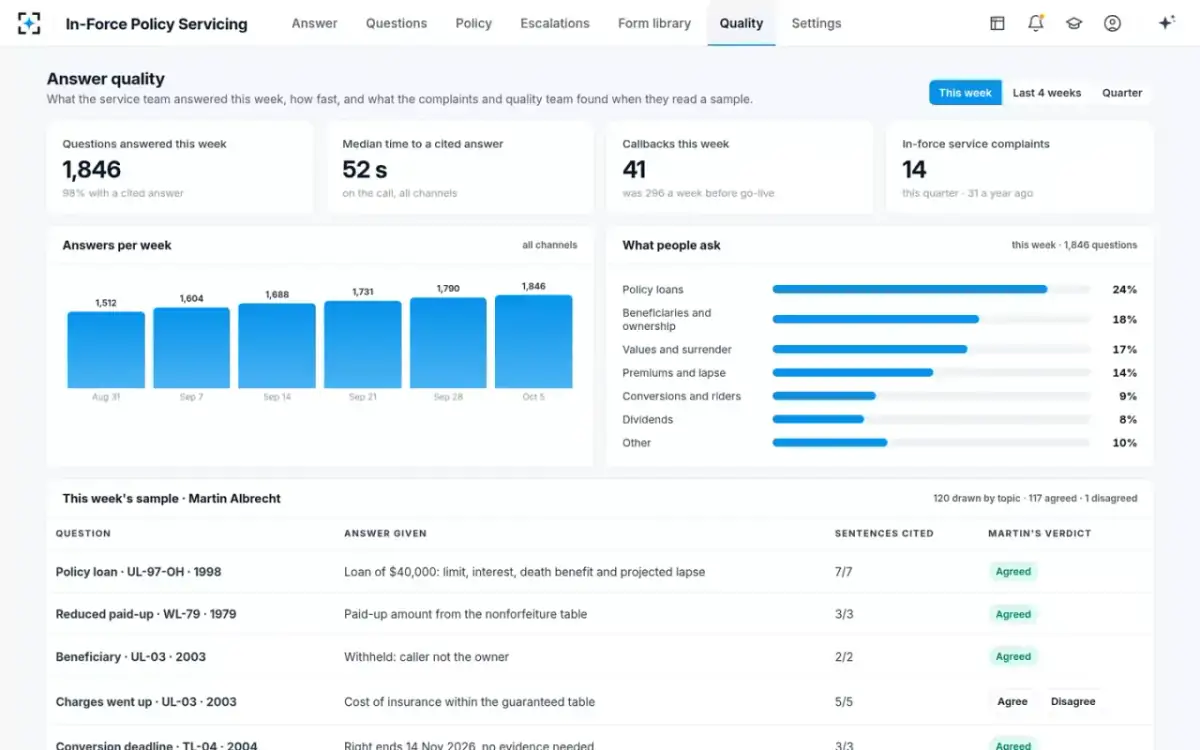
The examiners' standards give the complaint side its definition. Among the NAIC handbook's general standards, every complaint goes on the insurer's complaint register in the required format, and complaints are answered within the time the state's rules allow (NAIC Market Regulation Handbook, 2024 summary). A carrier that can show, for each complaint about an in-force answer, the passages, values and projection the answer rested on has a better exam than one that can show a call recording.
How to build the business case for AI in policy service on your own call data
Build it in the order a sceptical finance partner would check it: baseline first, then a back-test on questions already answered, then a live measure against the baseline. The steps below take eight to twelve weeks of the carrier's own data before any purchase decision rests on them.
Seven steps to an in-force automation business case you can defend
- Label eight weeks of callbacks and escalations by reason
Contract needed, projection needed, values, authority, signature, medical or legal. Only the first three are the automation case.
- Join each question to its policy’s issue year and form
The case is usually strongest on forms issued before the current admin system.
- Run a time study on twenty escalations
Replace Botminds’ estimate with your own hours, by step and by role.
- Back-test on last quarter’s escalations
Give the tool the same scans and values; count answers that match the specialist, correct refusals and errors.
- Set the review thresholds before go-live
Projected lapse within a set number of years, loans above a set amount: the risky replies a specialist reads.
- Measure the six KPIs weekly against the baseline
Callbacks, escalations, time to a cited answer, FCR, sampled accuracy, complaints.
- Count only hours that are redeployed
Hours released into backlog, growth or attrition are savings; idle hours are not.
The back-test step is also the best product evaluation, and the questions to ask during it are listed in the policy servicing co-pilot guide. What the carrier must supply to run it, from scanned contracts to the form library, is in life insurance policy administration systems and the missing contracts.
What contact centre automation cannot fix in life insurance
Automation cannot read a contract nobody scanned, settle a contract the papers disagree about, or process a transaction that needs a signature. Those limits belong in the business case, because they decide how much of the callback count is reachable.
Four limits recur. Unscanned or illegible contracts must be retrieved and scanned first; the sample carrier's form library shows scan quality by form, from 84% on a whole life form issued from 1979 to 100% on its recent term forms. Unclear wording and conflicting papers go to a specialist by design. Transactions still run in the admin system, which the solution reads but never writes. And tax or legal advice stays out: the answers state a policy's tax status and Form 1099-R reporting, nothing more. The BLS expects customer service employment overall to fall 5% from 2025 to 2035 as simple tasks move to self-service; the questions left on an in-force desk are the ones these limits describe, which is why the case rests on answering them correctly rather than on removing the desk. To see the quality screen and the queue together, start from In-Force Policy Servicing.
Questions people ask
What is the ROI of contact centre automation in life insurance?
There is no published benchmark for in-force life service. The return is the specialist hours released on escalations, the second contacts avoided and the complaints avoided, less the cost of the programme and the review time that remains. Measure each against an eight-to-twelve-week baseline of your own calls before relying on a figure.
How do you measure AI in a contact centre?
Against a baseline, with at least one measure of correctness. Callbacks, escalation rate and time to answer show speed; a weekly sample of answers read against their sources shows whether the speed is safe. In life insurance, add complaints by topic, because wrong loan or lapse answers surface years later.
Can AI reduce callbacks in insurance?
It can reduce the callbacks that wait on a document, such as a contract clause, a value or a projection, which on older in-force blocks are a large and expensive share. It should not remove callbacks that wait on a signature, a medical review, a legal reading or the caller's authority to be told.
What KPIs matter most in an insurance contact centre?
For in-force life service: callbacks per thousand questions, escalation rate by topic and issue decade, median time to a cited answer, first contact resolution, sampled answer accuracy and in-force complaints. Talk time and calls per hour matter less, because the costly failures are wrong answers and second contacts.
Does contact centre AI replace service representatives?
The evidence points the other way for complex work. In the NBER study of 5,179 support agents, AI assistance raised productivity 14% on average and 34% for novices, with minimal effect on the most experienced. In this solution the representative still decides and sends every answer.
How quickly does an in-force automation programme show results?
Callbacks and time to answer move as soon as answers are drafted from the contract; accuracy needs several weeks of samples to be meaningful; complaints lag by quarters, because a wrong answer often surfaces only when a policy lapses. Plan to report each KPI on its own clock.